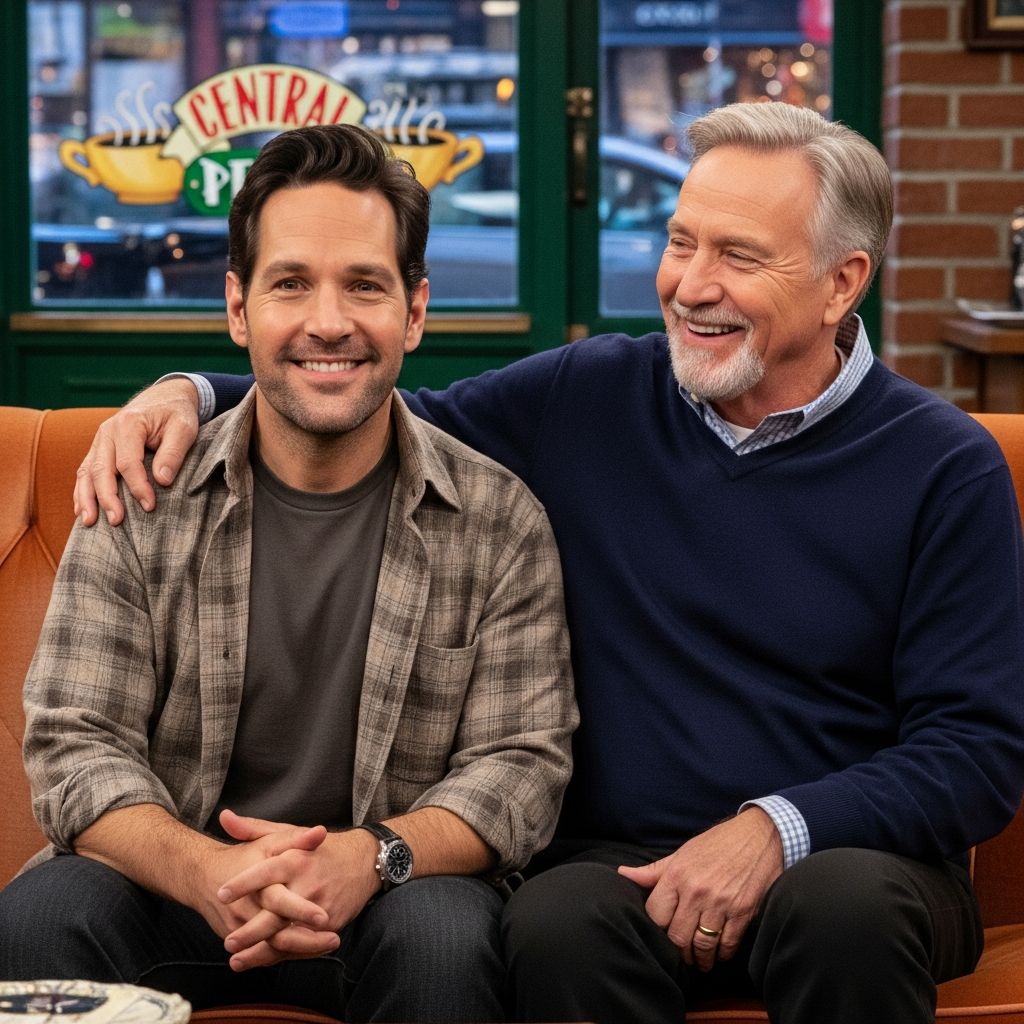
Imagine binging your favorite comfort show, falling in love with every character, quoting the lines with your friends — and then suddenly realizing one of the characters is your actual parent. Not just a background extra, but someone who dated one of the leads and appears in some of the show’s biggest moments. That is the surreal situation Paul Rudd’s teenage daughter found herself in when she discovered her dad on Friends.
Her reaction — delightfully unimpressed and laser-focused on his hair and wardrobe choices — has become a viral anecdote. It is funny on the surface, but it also reveals something deeper about how kids view their parents, how teens stake out their own identities, and how modern families now share pop culture in a way that earlier generations never did.
From Phoebe’s Boyfriend to Dad on the Couch
Paul Rudd’s character on Friends, Mike Hannigan, arrived during the final stretch of the series, long after the show had become a global phenomenon. He was the slightly awkward, sweet, piano-playing love interest who ended up marrying Phoebe in a snowy, whimsical wedding that fans still rewatch today. For millions of viewers, Mike is part of the nostalgia package: a late-series addition who somehow feels like he had always been there.
For Rudd’s daughter, though, Mike wasn’t a beloved sitcom memory. He was just “Dad, but with questionable hair and very ‘early-2000s’ sweaters.” The fact that she devoured the show first as a fan, not as a celebrity’s kid, matters. To her, Friends was hers — her comfort watch, her thing — and suddenly her father turned up in the middle of it like a pop-up ad she hadn’t requested.
- To viewers: Mike Hannigan is a charming, low-key part of Friends history.
- To his daughter: Mike is visual proof that parents once dressed like that — which is apparently unforgivable.
Why Teens Roast Their Parents (Even Famous Ones)
At first glance, mocking a parent’s hairstyle or sweater might seem trivial, but it is classic teenager behavior. Adolescence is defined by the tension between attachment and independence. Kids still need their parents deeply, but they also desperately want to feel separate from them. That tension often expresses itself through humor, teasing, and a calculated level of indifference.
When your dad is well known, roasting him becomes even more tempting. It is a way of saying, “You might be a big deal to everyone else, but in this house, you are just the person who forgets where the car keys are.” Rudd’s daughter did what many teens would do in her place: she poked fun at his appearance on the show instead of gushing over how cool it was. Her focus on hair and clothing was a subtle power move — an insistence on seeing him not as a celebrity guest star but as a normal, slightly cringey parent.
The Awkward Collision of Fandom and Family
There is something uniquely awkward about realizing your safe, fictional world is suddenly shared with your real-life parent. For a fan, a show like Friends can feel like a private emotional space. It is where you go after a hard day, where you memorize storylines and characters, where you build inside jokes with your friends. When a parent barges into that universe — even in a way that predates you — it can feel intrusive.
That helps explain why Rudd’s daughter reportedly experienced a kind of gentle disconnection. She enjoyed the series deeply but was not particularly interested in her father’s involvement. She liked Friends, not Dad on Friends. The show wasn’t suddenly cooler because he was in it; if anything, his presence was an irritant, a reminder that the adults in her life had a history before she existed and a footprint in culture that doesn’t revolve around her.
The Strange Time Travel of Watching Your Parent’s Past
For children of actors, athletes, or musicians, old work functions like a time machine. It shows them a version of their parents they never knew — younger, less experienced, maybe clumsier or more flamboyantly dressed. Watching that version can be disorienting. The parent who nags about homework is suddenly the carefree twenty- or thirty-something flirting on screen, making jokes, or wearing clothes straight out of a different decade.
In Rudd’s case, his daughter encountered an alternate timeline version of her dad: pre-kids, pre-Marvel, pre-modern haircut. That disconnect can make kids almost defensive. Laughing at the old style becomes a way of gaining control over how weird it feels. It is easier to say “What was going on with that sweater?” than to say “It’s strange seeing you in a life before me.”
Generational Fashion, Frozen on Screen
Another layer of humor is baked into the fashion of any long-running show. When kids and teens watch older series, they often react to clothes and hair first. Oversized suits, tiny sunglasses, low-rise jeans, and chunky highlights — all of these become unintentionally comedic with enough distance. Friends is a time capsule for style as much as for storytelling.
That time capsule effect is amplified when it involves a parent. Rudd’s daughter is not just laughing at an era; she is laughing at a personal relic, a family artifact broadcast worldwide. In a sense, his wardrobe choices on Friends have become part of her inherited history, like old photo albums you did not consent to but now have to live with.
How Celeb Parents Stay Grounded at Home
Stories like this one are oddly reassuring. It turns out that even people who star in Marvel blockbusters and beloved sitcoms still come home to kids who are unimpressed. The family dynamic does not suddenly transform because one parent is famous. Teens still roll their eyes. They still critique outfits. They still care more about their own playlists and group chats than their parent’s resume.
In public, Paul Rudd is often discussed as one of Hollywood’s most likable figures — charming, self-effacing, and approachable. At home, though, that likability meets the same filter every parent passes through: “Does this embarrass me?” For his daughter, the answer was apparently yes, or at least “I need to make fun of this so it does not embarrass me as much.” That is a strangely healthy sign. It suggests that the family’s emotional gravity sits in their everyday lives, not in his IMDB page.
Parenting Lessons Hidden in a Sitcom Cameo
Beyond the jokes, there are a few useful takeaways for any parent — famous or not — watching their kids discover something from their past. When children stumble across old yearbook photos, bizarre hairstyles, or, in rarer cases, entire television arcs, their reactions can be intense. They might cringe, laugh, ignore, or interrogate. How parents respond shapes whether that moment becomes a source of connection or a recurring embarrassment.
Practical Tips for Parents
- Lean into the cringe. If your child teases your old look, laugh with them. Owning the awkwardness signals that you are comfortable with your younger self and with them seeing it.
- Invite curiosity, do not demand it. Not every kid wants a behind-the-scenes lecture. Offer to answer questions, but do not insist they pay attention to your “cool” past.
- Let their fandom stay theirs. If they discover you show up in their favorite series or game, resist the urge to hijack the experience. Allow them to keep loving the thing on their own terms.
- Use it as a bridge, not a trophy. The goal is not to prove that you were once awesome. The goal is to find a shared reference point for conversation, jokes, or even comfort.
Pop Culture as a Family Conversation Starter
One of the best parts of streaming-era television is the way it can link generations. Parents can revisit shows they loved as young adults while kids encounter them for the first time. A series like Friends is now older than many of its viewers, yet it still circulates as a cultural shorthand in memes, reaction GIFs, and endless reruns. When a parent has a personal connection to that world, the potential for rich, funny conversation multiplies.
For families without famous parents, the same effect appears when kids discover old family favorites. Maybe a teen starts watching the sitcom you loved in college. Maybe they find the band you played on repeat in your twenties. Their reactions — sometimes dismissive, sometimes surprisingly appreciative — can open doors. “Wait, you liked this?” becomes a way of glimpsing who you were before they arrived.
How Shared Shows Build Connection
- They create a neutral space for conversations that might otherwise feel forced or awkward.
- They give parents and kids a shared language of references, quotes, and characters.
- They allow kids to see that their parents once had obsessions, crushes, and in-jokes too.
Table: Parent vs. Teen View of a Beloved Show
| Aspect | How Parents See It | How Teens See It |
|---|---|---|
| Main Characters | Reminders of their own youth, friendships, and dating years. | Relatable memes, outfit inspo, and drama to comment on. |
| Fashion | “That used to be stylish, seriously!” | Vintage, ironic, or totally roastable. |
| Parent Cameo | Proud or nostalgic career moment. | Prime material for teasing and eye-rolls. |
| Rewatching Together | Opportunity to share stories and memories. | Fun when it does not feel like a lecture or a brag. |
When Kids Are Unimpressed — and That’s Healthy
Parents often secretly (or not so secretly) want their kids to be impressed by their achievements. That desire gets amplified when the achievement is visible — an album, a sports highlight, a movie, a TV appearance. But there is something healthy about a child who treats those accomplishments as just one piece of who their parent is, not the core of their identity.
Rudd has spoken in other contexts about feeling like a “prop” on Friends, conscious that the series belonged to its central six characters. That humility fits neatly with his daughter’s reaction; in her eyes, he was a minor character in her show, too. Parents do not need to be central characters in their children’s favorite fictional worlds. It is enough to be the person in the next room, ready to laugh when they inevitably roast your screen past.
What This Says About Modern Fame
The internet has flattened celebrity in strange ways. Kids today can see their parents’ most public moments alongside strangers’ videos, viral clips, and trending memes. There is no clear hierarchy on a phone screen. A major movie star and a random TikTok account share the same digital real estate. To a teenager, both are content — and both are fair game for commentary.
That makes it easier for kids of well-known parents to treat fame with nonchalance. They are not necessarily dazzled by red carpets or talk show clips. Instead, they might fixate on the one thing that cuts through all the noise: whether Dad’s haircut on a 20-year-old sitcom makes them cringe. In a world saturated with image and performance, the most grounding response might be a teenager’s ruthless honesty.
FAQs: Parents, Teens, and Old Roles
Do kids of famous parents always watch their parents’ old work?
Not necessarily. Some are curious and want to see everything; others avoid it because it feels strange or embarrassing. Many treat it the same way they treat anyone else’s content — they dip in when it overlaps with their own interests, like a favorite show or movie.
Why do teens react with sarcasm instead of sincere admiration?
Sarcasm is a protective shield. It allows teens to manage big feelings — pride, confusion, secondhand embarrassment — without feeling too vulnerable. Teasing a parent’s style or performance can be easier than admitting, “Seeing you like this makes me feel weird and emotional.”
How should parents respond if their child mocks an old photo or role?
The best approach is usually to laugh along, acknowledge that trends change, and maybe share a quick story about that time in your life. Getting defensive or demanding respect tends to shut down conversation instead of deepening it.
Can sharing old work or photos actually bring families closer?
Yes — when handled with lightness and openness. When kids see that their parents once made questionable choices, took creative risks, or had their own obsessions, it humanizes the adults in their lives. That can open doors to more honest, relaxed conversations.
What if a child flat-out ignores a parent’s proudest moment?
It can sting, but it is usually not personal. Kids are deeply focused on their own worlds. Over time, as they grow and gain perspective, they may come back with new appreciation. In the meantime, parents can quietly hold onto their pride without needing their children to validate it.
Embracing the Cringe, Enjoying the Ride
The image of Paul Rudd’s daughter rolling her eyes at his hair on Friends is both comic and oddly universal. It is a reminder that every parent, no matter how beloved by the public, eventually becomes mildly mortifying in the eyes of their teenager. And that is not a failure; it is part of the developmental script.
For parents, the real victory is not raising kids who are endlessly impressed by them. It is raising kids who feel safe enough to joke, to tease, and to see their parents as whole, flawed, once-young people with a backlog of cringey wardrobe decisions. Whether those decisions live in a yearbook or in syndicated reruns, they all tell the same story: parents had a life before their children, and letting kids discover that life — with laughter — can be one of the quiet joys of growing up together.