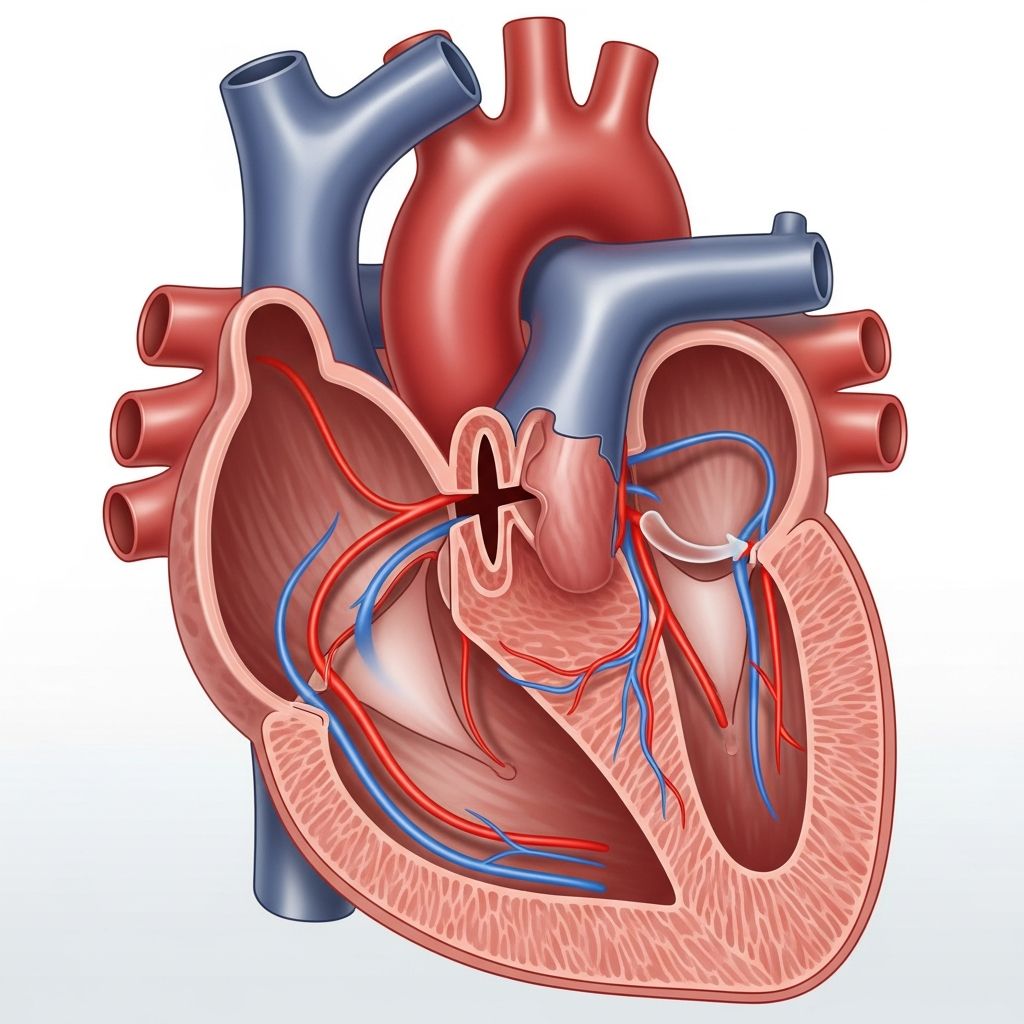
A patent foramen ovale (PFO) is a very common finding on children’s heart tests and often sounds more alarming than it truly is. Most of the time, it is a harmless remnant of normal fetal circulation and never causes health problems.
This guide explains what a PFO is, why doctors sometimes talk about it, how it is found, and when families actually need to worry about it.
How the Fetal Heart Works Before Birth
To understand a PFO, it helps to know how a baby’s heart works during pregnancy. Before birth, a baby’s lungs are not yet in use. Instead, oxygen comes from the placenta, through the umbilical cord, and into the baby’s bloodstream.
- Fetal lungs are bypassed: Blood does not need to pass through the lungs for oxygen; those organs are filled with fluid and not yet working.
- Special shortcuts exist: The fetal heart has several temporary pathways that direct blood away from the lungs and toward the body and brain. One of these is the foramen ovale between the upper heart chambers (atria).
- Foramen ovale’s job: It allows oxygen-rich blood coming from the placenta to flow directly from the right atrium into the left atrium and then out to the body, skipping the lungs.
These special pathways are normal and essential for life before birth. They are designed to close once a baby starts breathing air.
What Is a Patent Foramen Ovale?
After birth, when a newborn takes the first breaths, blood begins to flow through the lungs to pick up oxygen, and the pressure inside the heart changes. These pressure changes usually push the flap of tissue at the foramen ovale closed.
- Foramen ovale: A flap-like opening in the wall (septum) between the right atrium and left atrium present in every fetus.
- “Patent” means open: A patent foramen ovale is when this flap does not seal completely and can still allow a small amount of blood to pass between the atria.
- How common is PFO? About 25% of people have a PFO that persists into adulthood, often without knowing it.
In most children, a PFO is small, does not change how the heart pumps, and does not cause symptoms or limit activity.
PFO vs. Atrial Septal Defect: What’s the Difference?
Parents often hear the words “hole in the heart” and immediately think of serious problems. It is important to distinguish a PFO from an atrial septal defect (ASD), which is a true structural defect in the heart wall.
| Feature | Patent Foramen Ovale (PFO) | Atrial Septal Defect (ASD) |
|---|---|---|
| Basic nature | Flap-like opening that was normal in fetal life | Actual hole in the atrial wall (septum) |
| How it forms | Failure of normal flap to completely seal after birth | True congenital defect in the septal tissue |
| Typical impact | Usually no effect on heart size or function | Can cause extra blood flow to lungs and enlarge right heart over time |
| Symptoms in childhood | Generally none | May cause fatigue, frequent respiratory infections, or murmur |
| Treatment need | Rarely needs closure in children | Moderate or large ASDs are often closed |
While both conditions involve the wall between the atria, a PFO is usually considered a minor variant of normal anatomy, whereas an ASD is a heart defect that more often requires repair.
How Common Is PFO in Children?
Studies of heart anatomy show that over half of infants still have a PFO at around six months of age, and roughly one in four people still have it in adulthood.
- Very frequent finding: PFO is one of the most common observations on echocardiograms (heart ultrasounds) in otherwise healthy children.
- Usually discovered by accident: Most PFOs are found only because a test is done for another reason, such as a heart murmur or chest pain evaluation.
- Not considered a major defect: Pediatric and adult cardiology guidelines typically treat an isolated PFO as a minor, often incidental, finding.
Does a PFO Cause Symptoms in Kids?
For the vast majority of children, a PFO does not cause any signs or symptoms. The heart pumps normally, and the child can play sports and be active without limitations.
In rare situations, especially later in life, PFO has been associated with certain problems, although these are uncommon in children:
- Stroke from a paradoxical embolus: A clot from the veins can, in rare cases, pass through a PFO to the left side of the heart and then travel to the brain, causing a stroke.
- Low oxygen levels in unusual conditions: Specific body positions or lung diseases can rarely cause more blood to flow through a PFO from right to left, lowering oxygen levels.
- Migraine and other associations: Some studies suggest links between PFO and migraine headache or decompression illness in divers, though these connections are still being studied and are more relevant in adults.
In children without other serious medical conditions, an isolated PFO most often behaves like a silent anatomic variant rather than a disease.
How Is a PFO Diagnosed?
A PFO is usually identified by a pediatric cardiologist using heart imaging and, at times, specialized tests that look at how blood flows between the heart chambers.
Main diagnostic tools
- Physical exam: A PFO by itself typically does not create a loud or distinctive heart murmur. Many children with PFO have completely normal exams.
- Echocardiogram (heart ultrasound): This is the standard way to see the atrial septum and check for a PFO or other defects. It uses sound waves and is painless and noninvasive.
- Bubble study: For some older children or teens, doctors inject agitated saline (tiny microbubbles) into a vein while imaging the heart. If bubbles appear in the left atrium, it suggests a PFO is allowing passage from right to left.
Other tests, such as ECG, MRI, or CT, may be used if doctors are investigating additional heart or brain concerns, but they are not typically required just to identify a simple PFO.
When Can PFO Be Helpful?
Although most people think of a PFO as a potential problem, in certain complex congenital heart conditions, having an opening between the atria can sometimes be beneficial or even necessary.
- Balancing blood flow: In some rare heart defects, a PFO or intentionally created opening allows blood to bypass a blocked or underdeveloped area, helping maintain adequate circulation.
- Temporary support: In newborns with serious heart disease, doctors may intentionally keep atrial connections open until definitive surgery can be done.
These situations are uncommon and involve children who are cared for by specialized pediatric heart teams. In those cases, the PFO is part of a larger and more complex picture.
Does a Child with PFO Need Treatment?
Most children with an isolated PFO do not need any specific treatment. Major heart organizations and large medical centers consistently state that a small, asymptomatic PFO is usually left alone.
Common management approach
- Reassurance: Families are typically told that the PFO is unlikely to cause problems and does not mean the child has heart disease in the usual sense.
- Routine care: No special medications, activity restrictions, or antibiotics for dental procedures are normally required for an isolated PFO.
- Follow-up: Many cardiologists do not need long-term follow-up for a simple PFO unless there are other heart findings or medical concerns.
When might closure be considered?
PFO closure is more often discussed in adults than in children, especially after certain kinds of strokes where no other cause is found. In older teens or young adults, closure may be considered when:
- There has been a stroke that appears related to a PFO (a so-called cryptogenic stroke).
- There are repeated episodes of suspected clot-related events and no other source can be identified.
- The PFO is large or associated with an atrial septal aneurysm, increasing the risk of clots crossing.
In younger children, PFO closure is very uncommon unless there is another significant heart problem or a serious, clearly PFO-related complication.
How Is PFO Closure Performed?
If a decision is made to close a PFO, cardiologists usually use a minimally invasive catheter-based procedure rather than open-heart surgery, especially in older children, teens, and adults.
- Catheter procedure: A thin tube is threaded through a vein (often in the groin) up into the heart. A device that looks like two small disks is deployed across the PFO, sealing the opening.
- Heart tissue healing: Over time, heart tissue grows over the device, making it part of the atrial wall.
- Recovery: Many patients go home the same day or the next day, with a short period of activity restrictions while the insertion site heals.
These procedures carry risks, so they are only recommended when doctors believe the benefits, such as lowering the chance of another stroke, clearly outweigh the potential complications.
Living with a PFO: Everyday Life and Activities
Parents often worry about how a PFO might affect school, sports, or long-term health. For a child with a simple, isolated PFO and no symptoms, life is typically completely normal.
- Sports and play: Children can usually participate fully in physical education classes, team sports, and active play unless their cardiologist advises otherwise for another reason.
- Growth and development: A PFO alone does not interfere with normal growth, learning, or development.
- Travel and altitude: Routine air travel and trips to higher altitude are generally safe for healthy children with an isolated PFO.
If your child has other heart or lung conditions, or has had a stroke or clot, your care team will give personalized guidance about activity and precautions.
Questions to Ask Your Child’s Cardiologist
Bringing a short list of questions to your appointment can help you feel more comfortable and informed. Consider asking:
- How sure are you that this is a simple PFO and not another kind of heart defect?
- Does my child need follow-up visits or repeat echocardiograms?
- Are there any activities my child should avoid?
- Under what circumstances would you ever consider closing the PFO?
- Does my child need any precautions for surgery, dental work, or long plane trips?
Frequently Asked Questions (FAQs)
Q1: Is a PFO the same as a “hole in the heart”?
A PFO is a kind of opening between the upper chambers of the heart, but it is different from a true defect like an atrial septal defect. It is a flap that did not fully seal after birth, rather than a missing piece of tissue.
Q2: Can my child’s PFO close on its own?
Many PFOs become less significant or appear closed on later imaging as a child grows. Even if a tiny opening remains, it is often of no clinical importance and may never need treatment.
Q3: Does a child with PFO need antibiotics before dental visits?
For an isolated PFO without other heart defects, major heart societies generally do not recommend routine antibiotic prophylaxis before dental or minor surgical procedures. Always follow the specific advice of your child’s cardiologist.
Q4: Will my child be able to play competitive sports?
In most cases, yes. An isolated PFO in an otherwise healthy child does not limit sports participation. If your child has additional heart or lung conditions, ask the cardiologist for activity guidance tailored to your child’s overall health.
Q5: Should I have my other children tested for PFO?
Routine screening echocardiograms for siblings are not usually recommended just to look for PFO, since it is common in the general population and usually harmless. Testing is typically done only if there are symptoms or specific medical concerns.
References
- Patent Foramen Ovale Closure — Yale Medicine. 2024-01-10. https://www.yalemedicine.org/clinical-keywords/patent-foramen-ovale-closure
- Patent foramen ovale – Symptoms & causes — Mayo Clinic. 2024-03-06. https://www.mayoclinic.org/diseases-conditions/patent-foramen-ovale/symptoms-causes/syc-20353487
- Patent Foramen Ovale — American Heart Association. 2023-02-16. https://www.heart.org/en/health-topics/congenital-heart-defects/about-congenital-heart-defects/patent-foramen-ovale-pfo
- Patent Foramen Ovale (PFO): Causes & Treatment — Cleveland Clinic. 2023-08-03. https://my.clevelandclinic.org/health/diseases/17326-patent-foramen-ovale-pfo
- Patent Foramen Ovale — StatPearls, NCBI Bookshelf. 2024-01-05. https://www.ncbi.nlm.nih.gov/books/NBK493151/
- Patent Foramen Ovale (PFO) — Boston Children’s Hospital. 2022-11-14. https://www.childrenshospital.org/conditions/patent-foramen-ovale