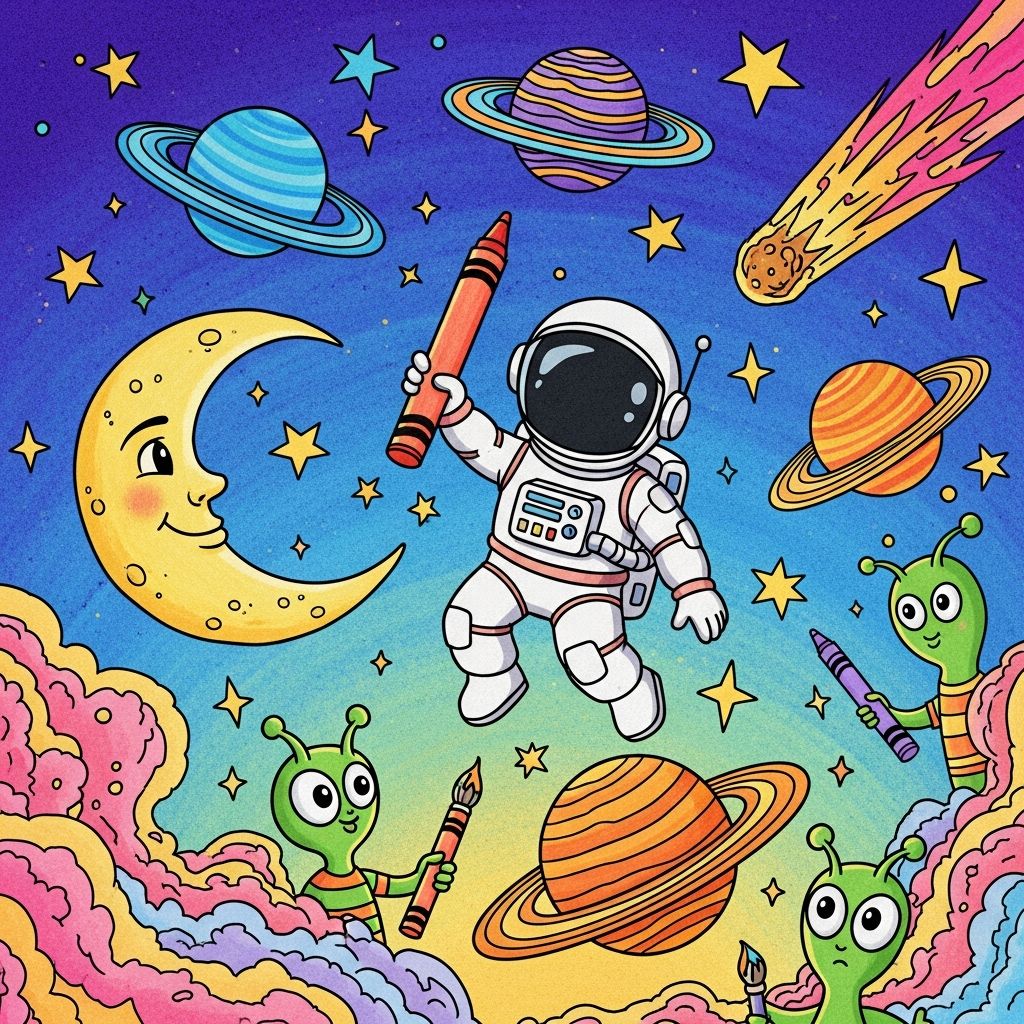
Outer space coloring pages do more than fill time on a rainy afternoon. They invite kids to explore rockets, planets, and distant galaxies while quietly building key skills like focus, coordination, and creative thinking.
Why Space-Themed Coloring Captivates Kids
Children are naturally drawn to big questions: What is beyond the clouds? How do astronauts float? Space coloring pages give shape and color to these questions, turning abstract ideas into pictures they can hold in their hands. The mix of stars, planets, and imaginative aliens keeps kids engaged longer than many everyday themes.
Because outer space is largely unknown, it encourages children to stretch their imagination. A rocket can be bright pink, Saturn’s rings can sparkle in rainbow shades, and a tiny astronaut can be a stand-in for your child on a make-believe mission. This blend of science and fantasy makes space scenes perfect for open-ended play.
Hidden Learning Benefits of Coloring
Coloring is often seen as a quiet pastime, but it is also a powerful learning tool. When kids grip crayons, stay within lines, and decide which colors to use, they practice important physical and mental skills without realizing they are learning.
- Fine motor skills: Controlling crayons and pencils strengthens the small muscles in the hands and fingers that are needed for writing and self-care tasks like buttoning clothes.
- Hand-eye coordination: Guiding color into specific shapes or tiny stars trains the eyes and hands to work together more smoothly.
- Focus and patience: Completing a detailed rocket or a full solar system scene can take time, gently increasing a child’s attention span.
- Color recognition and planning: Choosing color combinations for planets or spacesuits encourages basic decision-making and visual planning.
Because these benefits come wrapped in a fun, low-pressure activity, coloring is especially helpful for young children who learn best through play.
Space Topics You Can Explore While Coloring
Outer space coloring pages open the door to age-appropriate science conversations. Instead of lecturing, you can use each page as a gentle prompt to introduce new ideas while your child colors.
| Coloring Theme | Conversation Starters | Simple Facts to Share |
|---|---|---|
| Planets |
| Explain that planets travel around the Sun and each one has different temperatures, colors, and sizes. |
| Rockets and spaceships |
| Mention that rockets use powerful fuel and engines to break free from Earth’s gravity. |
| Astronauts |
| Share that spacesuits protect astronauts from extreme temperatures and help them breathe. |
| Stars and galaxies |
| Explain that stars are very hot balls of gas and many are much larger than our Sun. |
| Moons and comets |
| Note that some planets have many moons, and comets are icy objects that travel through space. |
By connecting each coloring sheet to a simple fact or question, you turn a casual activity into a memorable mini-lesson in space science.
Ideas for Different Age Groups
Outer space coloring can be tailored to toddlers, preschoolers, and older kids by adjusting how complex the designs and challenges are. Matching the page to your child’s age helps them enjoy success without feeling overwhelmed.
Toddlers and Young Preschoolers
- Choose large, simple shapes: big rockets, smiling planets, and chunky stars.
- Offer thick crayons or washable markers that are easy to grip.
- Skip strict rules; let them scribble and experiment with color freely.
- Point to shapes and name them: “This is Earth. These are stars. Here is the Moon.”
Older Preschoolers and Early Elementary Kids
- Select pages with several planets, basic details, and clearer outlines.
- Encourage staying near the lines while still allowing creative color choices.
- Introduce simple challenges, such as coloring the planets in size order or warm vs. cool colors.
- Add short facts: “This ringed planet is Saturn; its rings are made of ice and rock.”
Elementary and Beyond
- Offer intricate galaxies, space stations, and detailed astronauts.
- Suggest shading and blending techniques to make planets look more realistic.
- Combine coloring with research projects about particular planets or missions.
- Invite kids to design their own alien worlds or futuristic spaceships.
Creative Ways to Use Space Coloring Pages
Space-themed coloring sheets can do far more than end up on the fridge. With a bit of imagination, they can become decorations, learning tools, and even parts of larger crafts.
- Space mural wall: Tape completed pages together on a wall or poster board to build a giant, shared galaxy for the whole family or classroom.
- Solar system mobile: Cut out colored planets, punch holes at the top, and hang them from a hanger or hoop with string to create a dangling model.
- Story prompts: Ask your child to invent a short story about what is happening in their picture – Where is the rocket going? Who lives on that planet?
- Flashcards: Laminate small colored images of planets, rockets, and stars to use as vocabulary or memory matching cards.
- Classroom bulletin board: Teachers can group student artwork by theme (planets, astronauts, rockets) and add printed labels with basic facts.
Repurposing finished coloring pages keeps kids proud of their work and reinforces what they have learned during the activity.
Choosing the Right Materials
Supplies can make a big difference in how enjoyable coloring feels. The right tools allow children to experiment safely, create vivid pictures, and practice new techniques as they grow.
- Crayons: Great for beginners; they are sturdy, rarely leak, and come in many colors, including metallics that look striking on stars and rockets.
- Washable markers: Ideal when you want bold colors for planets and galaxies, especially if you have younger kids who press hard.
- Colored pencils: Better for older children who want to add details, shading, and subtle color blends to planets or nebulas.
- Paper quality: Thicker paper prevents bleeding and tearing, especially when kids like to color the same spot repeatedly.
- Optional extras: Add stickers, stencils, or a touch of glitter glue for stars and comet tails.
You do not need fancy supplies to start; a simple set of crayons and a printed page can still lead to rich, imaginative play.
Making Space Coloring Part of a Learning Routine
Outer space coloring fits naturally into many daily and weekly routines. With a bit of planning, you can turn it into a consistent way to wind down, transition between activities, or enrich a unit on space.
- Quiet time activity: Use coloring after school or before bed as a calm, screen-free way to relax.
- Weekend projects: Dedicate a weekend morning to finishing a larger scene together, then display it in a special spot.
- Lesson tie-ins: Pair coloring with space-themed books or simple documentaries and talk about similarities between the images and the stories.
- Reward system: Let kids earn a “new mission” coloring sheet when they complete reading or homework goals.
- Group sessions: Host a space coloring station at birthday parties, playdates, or classroom centers so kids can work side by side.
When coloring becomes a regular, predictable part of the day, children often look forward to it as their personal creative time.
Simple Tips for Parents and Teachers
A few practical strategies can help you get the most value from outer space coloring pages, whether you are using them at home or in a classroom. The goal is to keep the activity fun while also guiding children toward new skills.
- Keep a folder of printed space pages sorted by difficulty so you can quickly grab a sheet that fits the child’s mood and age.
- Model how to slow down and color in one small area at a time rather than rushing through the page.
- Comment on effort instead of neatness: “You spent a long time choosing colors for that planet,” rather than “You stayed inside the lines.”
- Rotate themes (planets this week, rockets next week, astronauts after that) so the activity feels fresh.
- Invite children to explain their artwork; describing choices encourages language skills and confidence.
Frequently Asked Questions About Space Coloring Pages
How old should my child be to start space coloring?
Children as young as two can enjoy simple space images with large shapes and very few details. At this age, focus on the experience of making marks and naming objects, rather than how the final picture looks.
Do colors need to be scientifically accurate?
For young children, strict accuracy is not important; a purple moon or striped green planet still helps them learn shapes and practice skills. As kids get older, you can gradually introduce more realistic colors and talk about why some planets look red, blue, or ringed.
How long should a coloring session last?
For toddlers, five to ten minutes may be enough, while older kids might enjoy working for twenty minutes or more. A good rule of thumb is to stop before your child becomes frustrated or restless, even if the page is not finished.
Can coloring really support school learning?
Yes, coloring connects to early writing skills, shape and color recognition, and even basic science knowledge. When you talk about planets, rockets, or gravity while your child colors, you reinforce vocabulary and curiosity that support later lessons.
What if my child dislikes staying in the lines?
Staying inside the lines is only one way to color and should not be the main focus, especially for younger kids. Encourage experimentation, praise creativity, and allow plenty of free drawing alongside structured coloring pages.
Launching a Universe of Imagination
Outer space coloring pages are a simple tool with big potential. They invite children to explore distant worlds with crayons in hand while quietly strengthening the skills they need for school and everyday life.
With a stack of space-themed pages, a few basic supplies, and a little time set aside, you can turn ordinary afternoons into journeys past the stars – no rocket fuel required.