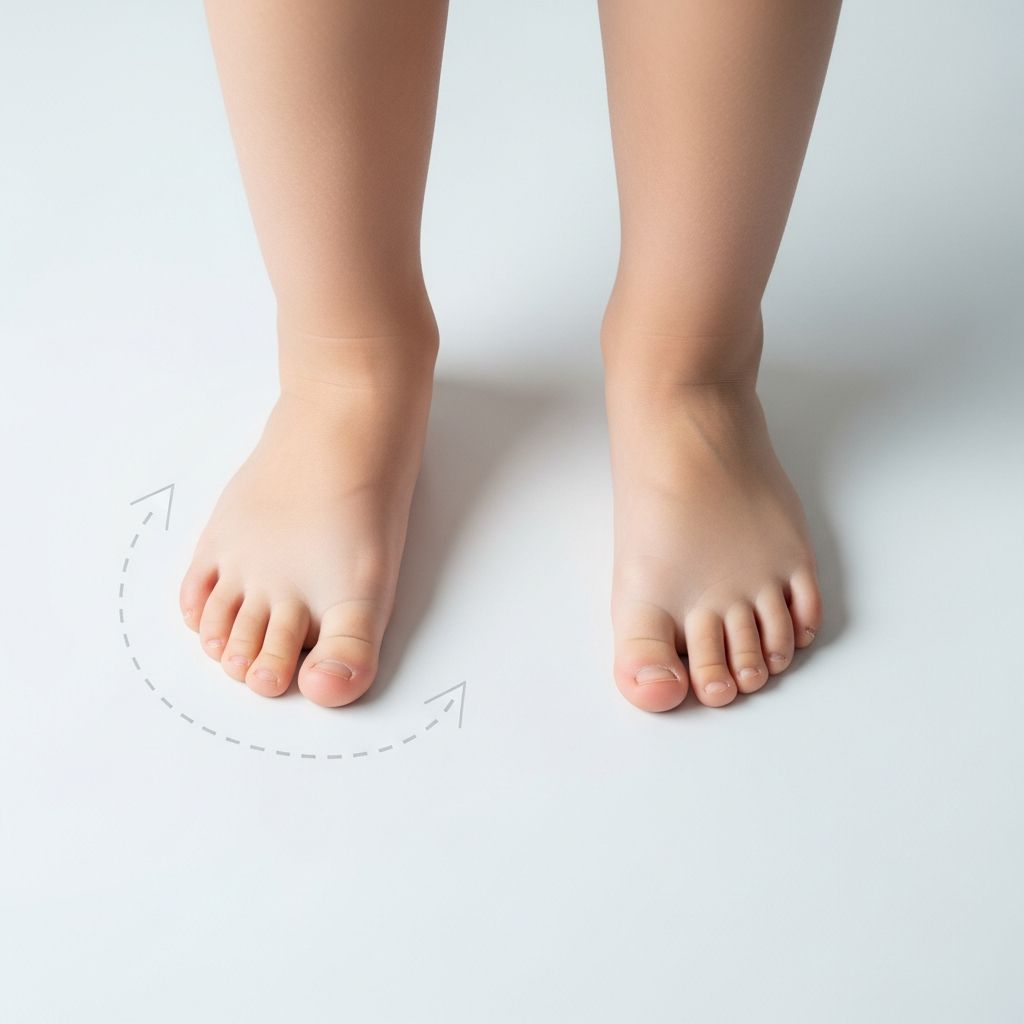
Many parents notice at some point that their child’s feet point outward when walking or running. This outward foot position is called out-toeing, and in most children it is a normal part of growth that improves with time. In a smaller number of cases, it can be a sign of an underlying bone, joint, or nerve problem that needs medical attention.
This guide explains what out-toeing is, why it happens, how doctors evaluate it, and what parents can realistically expect as their child grows.
What Does Out-Toeing Look Like?
Out-toeing describes a walking pattern (gait) in which one or both feet turn outward instead of pointing straight ahead. The angle can be mild and barely noticeable or more pronounced, giving a “duck-footed” appearance.
- The feet point away from the midline of the body when the child walks or stands.
- One foot may turn out more than the other, or both may be affected.
- Some children have a slightly waddling or side-to-side gait when the out-turn is large.
- In many toddlers, out-toeing appears when they first start walking and may slowly improve over several years.
Out-toeing is the opposite of in-toeing, where the feet point inward (often called “pigeon-toed”). Both are common reasons parents bring children to orthopedic or pediatric clinics.
Common Causes of Out-Toeing
Out-toeing can come from different parts of the leg and foot. The main sources are the hip, thigh bone, shin bone, and foot structure itself. In many children, more than one factor is present at the same time.
| Level of the Limb | Typical Cause | How It Affects Foot Position |
|---|---|---|
| Hip and thigh | External rotation contracture, femoral retroversion | Thigh bone and hip are rotated outward, making knees and feet turn out. |
| Shin (tibia) | External tibial torsion | Shin bone twists outward, turning the feet out relative to the knees. |
| Foot | Flat feet or forefoot abduction | Collapsing arch and splayed forefoot make the feet appear to angle outward. |
| Other conditions | Hip disorders, neuromuscular disorders | Abnormal bone shape or muscle control alters alignment and gait. |
1. Hip Position and Femoral Retroversion
Some children are born with the hip and upper thigh bone turned more outward than average. Doctors may describe this as femoral retroversion (the thigh bone angled backwards or externally) or as an external rotation contracture of the hip.
- Often related to fetal position in the womb, where hips are flexed and turned out.
- Out-toeing can be most noticeable when the child first starts walking.
- In many cases, this gradually improves as the child’s muscles strengthen and bones remodel with growth.
2. External Tibial Torsion (Twist in the Shin Bone)
The tibia, or shin bone, can also twist. When it is rotated outward more than usual, the condition is called external tibial torsion.
- The knees may face forward, but the feet point outward.
- It may be more noticeable in one leg than the other.
- Mild outward twist is normal in older children, but excessive rotation can affect gait and knee mechanics.
3. Flat Feet and Foot Alignment
Children naturally have flatter looking feet than adults, because their arches are still forming. In some kids, flat feet contribute to an out-turned foot position.
- When the arch collapses, the midfoot can roll inward and the front of the foot may swing outward (abduction).
- This can make the whole foot appear to be pointing out even if the hip and shin are normal.
- Many flat feet in children are flexible and painless, and they often improve with age.
4. Less Common or More Serious Causes
Out-toeing is usually harmless and part of normal development, but rarely it may be linked to other conditions that need early treatment.
- Slipped capital femoral epiphysis (SCFE): A disorder of the upper thigh bone near the hip in older children and teens that can cause out-toeing, hip pain, and limping.
- Legg–Calvé–Perthes disease: A disease affecting blood supply to the femoral head (top of the thigh bone), sometimes leading to limp and gait changes including out-toeing.
- Cerebral palsy and other neuromuscular conditions: Muscle tightness or weakness can produce rotational deformities of the hip, thigh, or foot and lead to out-toeing.
Because of these possibilities, persistent or worsening out-toeing, especially with pain or limping, should be evaluated by a pediatrician or pediatric orthopedic specialist.
Typical Signs and Symptoms
Most children with out-toeing feel well and are able to run, play, and keep up with their peers. However, parents may notice certain features in their child’s movement.
- Feet turned outward when walking or running.
- A waddling, side-to-side, or somewhat clumsy gait, especially when the outward angle is large.
- Occasional tripping or stumbling when learning to walk.
- Flat-looking feet when standing.
In many cases, out-toeing is painless. Some children with more severe rotation or with associated problems might experience:
- Limping that does not go away.
- Pain in the hip, thigh, knee, or foot, especially after activity.
- Difficulty running or keeping up in sports.
When Should Parents Call the Doctor?
Any concern about how a child walks is a valid reason to speak with a health professional. However, certain features make an evaluation more urgent.
Contact your child’s doctor if:
- Your child is limping, with or without pain.
- Out-toeing appears suddenly or becomes much worse over a short time.
- One foot or leg turns out much more than the other.
- Your child complains of pain in the hip, thigh, knee, or foot.
- There is a history of injury around the hip or leg.
- Your child is losing skills (for example, stops walking or refuses to bear weight).
These findings can signal a structural or neurologic problem that needs prompt assessment, especially in older children and teens where conditions like SCFE may present with out-toeing and pain.
How Doctors Evaluate Out-Toeing
A pediatrician or pediatric orthopedic specialist usually starts with a detailed history and a careful physical examination of your child’s legs, hips, and gait.
Medical History
Your child’s doctor may ask about:
- When you first noticed the out-toeing.
- Whether it is improving, stable, or getting worse over time.
- Any pain, tripping, or difficulty running or playing.
- Pregnancy and birth history (for example, breech position or tight womb space).
- Family history of out-toeing, hip disease, or neurologic conditions.
Physical Examination
During the exam, the doctor will:
- Observe your child walking and running to measure the angle of the feet and overall gait pattern.
- Check hip range of motion to see whether the hips turn inward or outward more than expected.
- Measure rotational alignment of the femur and tibia using standard clinical tests.
- Inspect the feet for flatness, flexibility, and alignment.
- Look for differences between the two legs and for any signs of muscle tightness, weakness, or neurologic issues.
Imaging and Additional Tests
Many children with uncomplicated out-toeing do not need X-rays or other imaging. When pain, asymmetry, or suspicion of a serious condition is present, tests may include:
- X-rays of the hip, knee, or ankle to look at bone shape and alignment.
- Advanced imaging (such as MRI) if hip disease or neuromuscular disorders are suspected.
- Gait analysis in specialized centers for complex cases or pre-surgical planning.
Treatment Options: What Parents Can Expect
Treatment depends on the cause and severity of out-toeing, as well as the child’s age and symptoms. Many children do not need active treatment; instead, they are monitored as they grow.
Observation and Reassurance
For most toddlers and young children with mild to moderate out-toeing, the recommended approach is simply to watch and wait.
- The bones of the legs naturally rotate as children grow, and mild rotational differences often improve on their own.
- Regular check-ups allow the doctor to track progress and ensure no concerning changes appear over time.
- Parents may be encouraged to record short videos of their child walking once or twice a year, so slow improvements are easier to see.
Physical Therapy and Exercises
Physical therapy may be recommended when muscle imbalance, weakness, or tightness contributes to the gait pattern, or when a child has trouble with balance and coordination.
- Strengthening exercises for hip and leg muscles.
- Stretching programs for tight muscles, such as the hip rotators or calf muscles.
- Balance and coordination training to improve overall movement skills.
Footwear, Orthotics, and Bracing
Supportive shoes or custom inserts (orthotics) may be used when flat feet or abnormal foot mechanics play a role in the appearance of out-toeing.
- Orthotics can help support the arch and improve foot alignment.
- They are usually considered when the child has pain, fatigue, or difficulty participating in activities.
- Rigid braces are rarely used today for rotational issues alone, as research shows limited benefit in most typical developmental cases.
Surgery
Surgical treatment for out-toeing is uncommon and reserved for specific situations.
- Severe external tibial torsion or femoral retroversion that causes pain, functional limitations, or major cosmetic concerns and does not improve with growth.
- Underling bone or joint diseases such as SCFE or Perthes disease that require operative management for hip preservation.
- Complex neuromuscular conditions where surgery is part of a broader plan to improve mobility.
When needed, a surgeon may perform a derotational osteotomy, cutting and rotating the affected bone into a more typical alignment and securing it with hardware. This is generally considered only after careful evaluation and when non-surgical options are insufficient.
Home Support: How Parents Can Help
Parents play an important role in supporting healthy development, even when no active medical treatment is required.
- Encourage active play: Running, climbing, and outdoor play help strengthen muscles and support normal growth.
- Choose appropriate footwear: Well-fitting shoes with flexible soles and good support; avoid high heels or overly stiff shoes for young children.
- Avoid forcing positions: Do not try to manually twist the feet or legs; this can cause discomfort and will not correct bone rotation.
- Track changes over time: Periodic photos or short videos of your child walking can help you and your doctor see subtle changes.
- Follow medical advice: Attend scheduled follow-up visits and follow through with physical therapy or orthotic recommendations when given.
Frequently Asked Questions (FAQs)
Is out-toeing always abnormal?
No. Mild out-toeing is common in toddlers and young children and often reflects normal variations in bone rotation or foot shape that tend to improve with age.
Can my child still play sports?
Most children with mild out-toeing participate fully in sports and play. Only when there is significant pain, tripping, or severe rotation might activity be limited, in which case a specialist should evaluate your child.
Will special shoes or braces fix out-toeing?
Supportive shoes and orthotics may help with comfort and foot alignment when flat feet are present, but they do not usually “untwist” the thigh or shin bones. Bracing alone has not been shown to reliably correct typical rotational variations.
Could out-toeing cause arthritis later in life?
Severe, persistent rotational deformities can increase stress on joints and may contribute to problems such as knee pain or early wear in some cases. However, mild variations that fall within normal developmental ranges are unlikely to lead to arthritis on their own.
How long should we wait before worrying?
For a toddler who is otherwise healthy, pain-free, and walking well, doctors often observe for several years while monitoring growth. Sudden onset, worsening deformity, pain, or limping at any age should prompt earlier evaluation.
References
- In-Toeing (Pigeon-Toed) and Out-Toeing (Duck-Footed). — UCSF Benioff Children’s Hospitals. 2022-03-01. https://www.ucsfbenioffchildrens.org/conditions/in-toeing-and-out-toeing
- Out-Toeing in Children: Causes, Symptoms and Treatment. — Pediatric Foot & Ankle, Phoenix Children’s Foot Doctor. 2021-09-15. https://pediatricfootankle.com/foot-conditions/out-toeing-femoral-retroversion/
- Out-Toeing. — OrthoKids (Pediatric Orthopaedic Society of North America). 2020-06-10. https://orthokids.org/conditions/out-toeing/
- All About Out-Toeing. — The Pediatric Orthopedic Center. 2021-04-20. https://pediatricorthopedics.com/all-about-out-toeing/
- In-Toeing | Out-Toeing. — Connecticut Children’s Medical Center, Orthopedics. 2022-05-05. https://www.connecticutchildrens.org/specialties-conditions/orthopedics/conditions/toe-and-out-toe
- Out-toeing. — Melbourne Podiatrists & Orthotics. 2019-11-12. https://www.melbournepodiatristsandorthotics.com.au/conditions/childrens-feet/out-toeing/