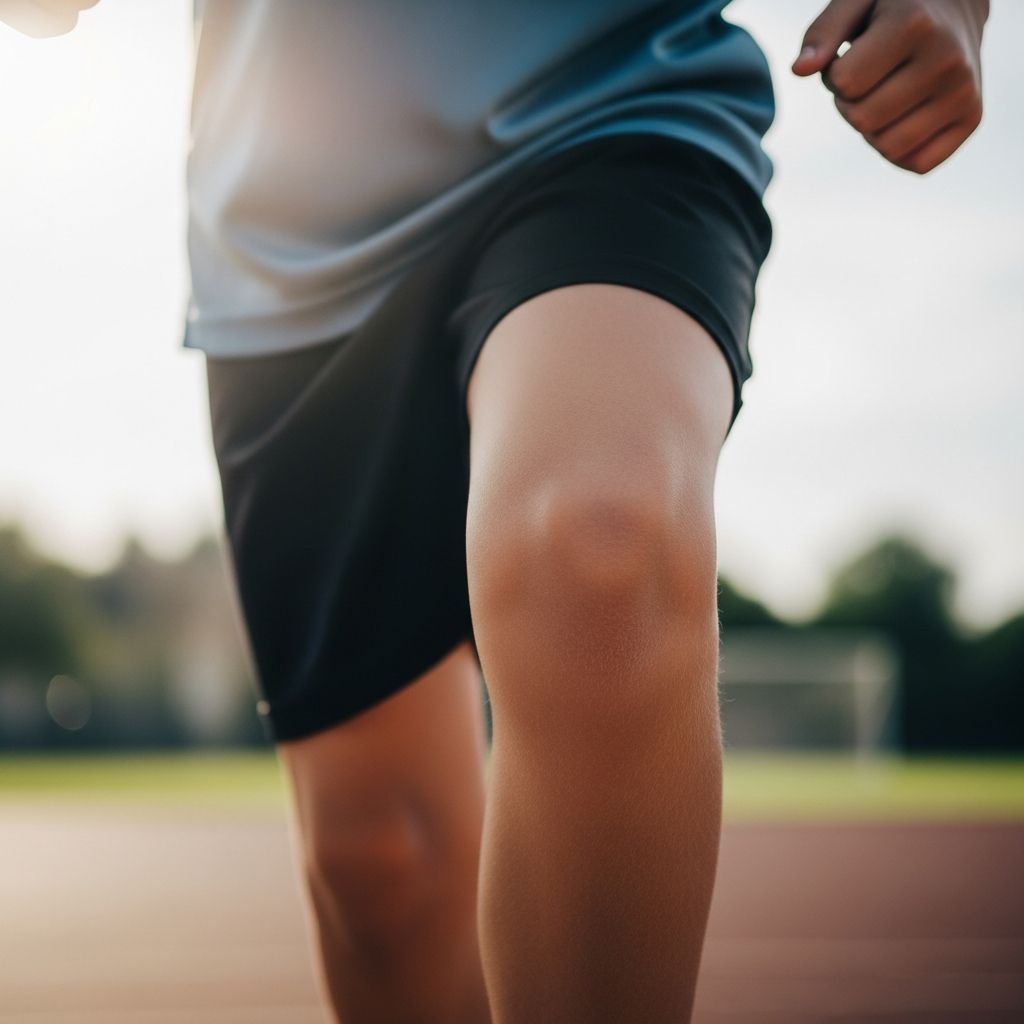
When a child who loves to run, jump, and play suddenly starts complaining about pain just below the kneecap, it can be worrying. One of the most common reasons for this kind of knee pain in growing kids and teens is a condition called Osgood-Schlatter disease, often shortened to OSD.
This guide explains Osgood-Schlatter disease in clear, parent-friendly language: what it is, why it happens, how it is diagnosed, and what you can do to help your child stay comfortable and active.
What Is Osgood-Schlatter Disease?
Osgood-Schlatter disease is an overuse injury of the knee that affects the area where the kneecap tendon attaches to the top of the shinbone (the tibia). This area is called the tibial tubercle (or tibial tuberosity) and includes a growth plate—a zone of softer, growing bone in children and adolescents.
- Main problem: Repeated pulling of the kneecap (patellar) tendon on the growing bone causes irritation and inflammation.
- Typical age: Occurs during growth spurts in late childhood and adolescence.
- Who gets it: Most common in active kids who do running and jumping sports, but it can occur in less active kids too.
- Which knee: Can affect one or both knees; one side is often worse than the other.
Although the word “disease” sounds serious, Osgood-Schlatter is not an infection or a permanent joint disease. It is a temporary, self-limited condition related to growth and activity, and most children improve with time and simple care.
Why Does Osgood-Schlatter Happen?
To understand why this condition occurs, it helps to picture how the knee works during sports.
- The large muscles in the front of the thigh (quadriceps) straighten the knee.
- These muscles attach to the kneecap, which then connects to the top of the shinbone through the patellar tendon.
- Every time a child jumps, sprints, or kicks, the quadriceps pull on the patellar tendon, which tugs on the tibial tubercle.
During a growth spurt, the bones often grow faster than the muscles and tendons, leaving them relatively tight. When tight quadriceps repeatedly pull on the growth plate at the top of the shinbone, that area can become irritated and painful.
Common Risk Factors
| Risk Factor | How It Contributes |
|---|---|
| Rapid growth spurt | Bone grows quickly, muscles and tendons lag behind and feel tight, increasing pull on the growth plate. |
| High-impact sports | Running, jumping, cutting, and kneeling sports (such as soccer, basketball, volleyball, gymnastics, football, and ballet) put repeated stress on the tibial tubercle. |
| Training load | Sudden increases in practice time, intensity, or frequency may overload the knee. |
| Tight leg muscles | Tight quadriceps or hamstrings further increase tension on the front of the knee. |
OSD is more common in children assigned male at birth, although this gap is narrowing as more children of all genders participate in vigorous sports.
Signs and Symptoms Parents May Notice
The hallmark feature of Osgood-Schlatter disease is pain just below the kneecap, on the upper part of the shinbone.
Typical Symptoms
- Aching or sharp pain at the bony bump below the kneecap (tibial tubercle).
- Pain that worsens with activity such as running, jumping, climbing stairs, or walking uphill.
- Discomfort or pain when kneeling or squatting deeply.
- Swelling or a visible bump at the top of the shinbone beneath the kneecap.
- Tenderness when you touch or press on the area.
- Limping or slowing down during or after sports, especially after intense play.
Symptoms often appear gradually and may:
- Flare up during sports seasons or tournaments.
- Improve with rest or reduced activity.
- Come and go over months, sometimes over the entire growth spurt period.
Despite the pain, many children with OSD can still walk and do normal daily activities, but sports and gym class often become uncomfortable.
How Doctors Diagnose Osgood-Schlatter Disease
There is no single test for Osgood-Schlatter disease. Diagnosis is usually based on a combination of your child’s symptoms, medical history, and a physical exam.
What to Expect at the Appointment
- History: The clinician will ask when the pain started, what activities make it worse, and whether your child recently had a growth spurt or increased training.
- Physical exam: The doctor will gently press around the kneecap and tibial tubercle, check for swelling, and look at your child’s walking and squatting.
- Flexibility and strength: They may test how tight the quadriceps and hamstrings are and measure muscle strength in the hips and thighs.
In many cases, x-rays are not required. However, an x-ray may be ordered if:
- The pain is severe or has an unusual pattern.
- There was a specific injury or fall.
- The clinician wants to rule out other problems, such as a fracture or different cause of knee pain.
When x-rays are done, they may show changes at the tibial tubercle, such as a prominent bump or irregularity where the tendon attaches.
Treatment: Helping Your Child Feel Better
The good news is that Osgood-Schlatter disease is usually treated with simple, non-surgical measures. Most children recover fully as the growth plate matures and closes.
Core Treatment Principles
- Reduce irritation of the growth plate.
- Manage pain and swelling.
- Maintain flexibility and strength.
- Keep kids as active as possible without worsening symptoms.
Common Treatment Options
- Activity modification:
- Temporarily cut back on running, jumping, deep squats, and kneeling—especially on hard surfaces.
- Encourage low-impact activities such as swimming or cycling if they do not cause pain.
- Aim for “discomfort is OK, sharp or worsening pain is not” as a simple rule of thumb.
- Ice: Applying a cold pack for 15–20 minutes after activity can reduce pain and swelling. Always place a thin cloth between the ice pack and the skin.
- Medication: Over-the-counter pain relievers such as acetaminophen or nonsteroidal anti-inflammatory drugs (NSAIDs) may be recommended. Always follow dosing instructions and talk to your child’s clinician before giving any medicine.
- Stretching and strengthening:
- Gentle stretches for quadriceps and hamstrings help relieve tension on the patellar tendon.
- Strengthening the hips and core can improve alignment and decrease strain on the knees.
- Physical therapy is sometimes prescribed to guide a safe, progressive program.
- Supportive gear:
- A soft knee strap or patellar tendon brace worn just below the kneecap may reduce pulling on the growth plate during sports for some kids.
- Well-cushioned shoes and, if needed, orthotics can help absorb impact.
- Short rest periods: In more painful phases, a brief break from high-impact sports (often a few weeks) may be needed before gradually returning to activity.
Surgery is rarely needed and is typically reserved for older teens or adults who have persistent symptoms after the growth plates have closed and after extensive non-surgical care.
Daily Life and Sports: What Parents Should Know
Many children with Osgood-Schlatter disease can continue participating in sports with modifications, as long as their pain remains mild and improves with rest.
Balancing Pain and Participation
Helpful guidelines:
- If your child has mild pain that goes away shortly after practice and does not limit performance, participation is usually reasonable.
- If pain causes limping, changes your child’s movement, or lingers for hours after activity, it is a sign to cut back.
- Plan rest days between intense practices or games to give the knee time to recover.
- Use ice, stretching, and prescribed exercises consistently, not just when pain is at its worst.
Coaches and physical education teachers should be informed so they can adjust drills, limit high-impact activities, and allow substitution or rest breaks during flares.
How Long Does It Last?
Osgood-Schlatter disease typically follows the timeline of the child’s growth:
- Symptoms often last several months and can wax and wane.
- For many, the condition improves significantly within 6–18 months, especially with good management.
- Discomfort usually resolves when the growth plate at the tibial tubercle closes at the end of the growth spurt.
A small bony bump may remain below the kneecap even after symptoms stop. In most people, this bump is painless and does not limit activity, though it can be tender if bumped directly on hard surfaces.
Possible Complications (and Why They’re Uncommon)
Serious complications from Osgood-Schlatter disease are uncommon when the condition is recognized and managed appropriately.
Potential issues include:
- Persistent tenderness or discomfort during kneeling in older teens and adults.
- Rarely, small bone fragments may remain at the patellar tendon attachment, which can sometimes cause continued pain after growth is complete.
- Muscle tightness or weakness if stretching and strengthening are not addressed.
These problems can usually be minimized by following treatment recommendations, building a regular stretching routine, and gradually returning to high-impact sports rather than jumping back in all at once.
When to Call the Doctor
While most knee pain below the kneecap in active kids is not an emergency, some signs warrant prompt medical attention.
Contact Your Child’s Clinician If:
- The knee pain is severe, sudden, or started right after a fall or direct blow.
- Your child cannot put weight on the leg or is refusing to walk.
- The knee looks very swollen, red, or feels warm, especially if your child also has a fever.
- Pain wakes your child from sleep or is present even at rest.
- There is locking, catching, or a feeling that the knee is giving way.
- Self-care (rest, ice, over-the-counter medication, and modified activity) has not improved symptoms over a few weeks.
These features may indicate a different or additional knee problem that needs evaluation.
Supporting Your Child Emotionally
For many kids, sports and physical activity are a big part of their identity and social life. Being told to rest or modify activity can feel frustrating or discouraging.
- Reassure your child that Osgood-Schlatter disease is temporary and very common in active kids.
- Emphasize that rest and rehabilitation are a way to protect their ability to play sports in the future, not a punishment.
- Help them find alternative activities (like upper-body workouts, swimming, or skill drills that don’t irritate the knee) to stay engaged with their sport.
- Celebrate small improvements, such as being able to climb stairs with less pain or complete a practice with fewer breaks.
Frequently Asked Questions (FAQs)
Is Osgood-Schlatter disease dangerous?
No. Osgood-Schlatter is not dangerous and is not a sign of permanent joint damage. It is an overuse injury of the growth plate that almost always improves with time, activity changes, and simple treatments.
Can my child keep playing sports?
Many children can continue sports with some modifications—such as shorter practices, fewer jumping drills, or switching to lower-impact activities—so long as their pain stays mild, does not cause limping, and settles with rest. If pain is severe or persistent, a temporary break is often recommended.
Will the bump below the kneecap go away?
The tenderness usually goes away as your child finishes growing, but a small firm bump may remain. This bump is typically painless and does not interfere with sports or daily life.
Does Osgood-Schlatter disease increase the risk of arthritis?
There is no strong evidence that Osgood-Schlatter disease leads to arthritis in the knee. It is a problem at the growth plate on the front of the shinbone, not inside the joint itself.
When should we see a specialist?
You may be referred to a sports medicine doctor or pediatric orthopaedic specialist if symptoms are severe, not improving with basic care, or if there is concern about a different knee condition. A physical therapist may also be helpful to create an individualized stretching and strengthening program.
References
- Osgood-Schlatter disease — Children’s Hospital of Philadelphia. 2021-10-01. https://www.chop.edu/conditions-diseases/osgood-schlatter-disease
- Osgood-Schlatter Disease (Knee Pain) — OrthoInfo, American Academy of Orthopaedic Surgeons. 2022-09-01. https://orthoinfo.aaos.org/en/diseases–conditions/osgood-schlatter-disease-knee-pain/
- Osgood Schlatter syndrome — Better Health Channel, Victorian State Government. 2023-03-15. https://www.betterhealth.vic.gov.au/health/conditionsandtreatments/osgood-schlatter-syndrome
- Osgood-Schlatter Disease in Children — Golisano Children’s Hospital, University of Rochester Medical Center. 2022-06-10. https://www.urmc.rochester.edu/childrens-hospital/orthopaedics/conditions-we-treat/osgood-schlatter-disease
- Osgood-Schlatter Disease — Kaiser Permanente Health Encyclopedia. 2021-05-01. https://healthy.kaiserpermanente.org/health-wellness/health-encyclopedia/he.osgood-schlatter-disease.abo3316