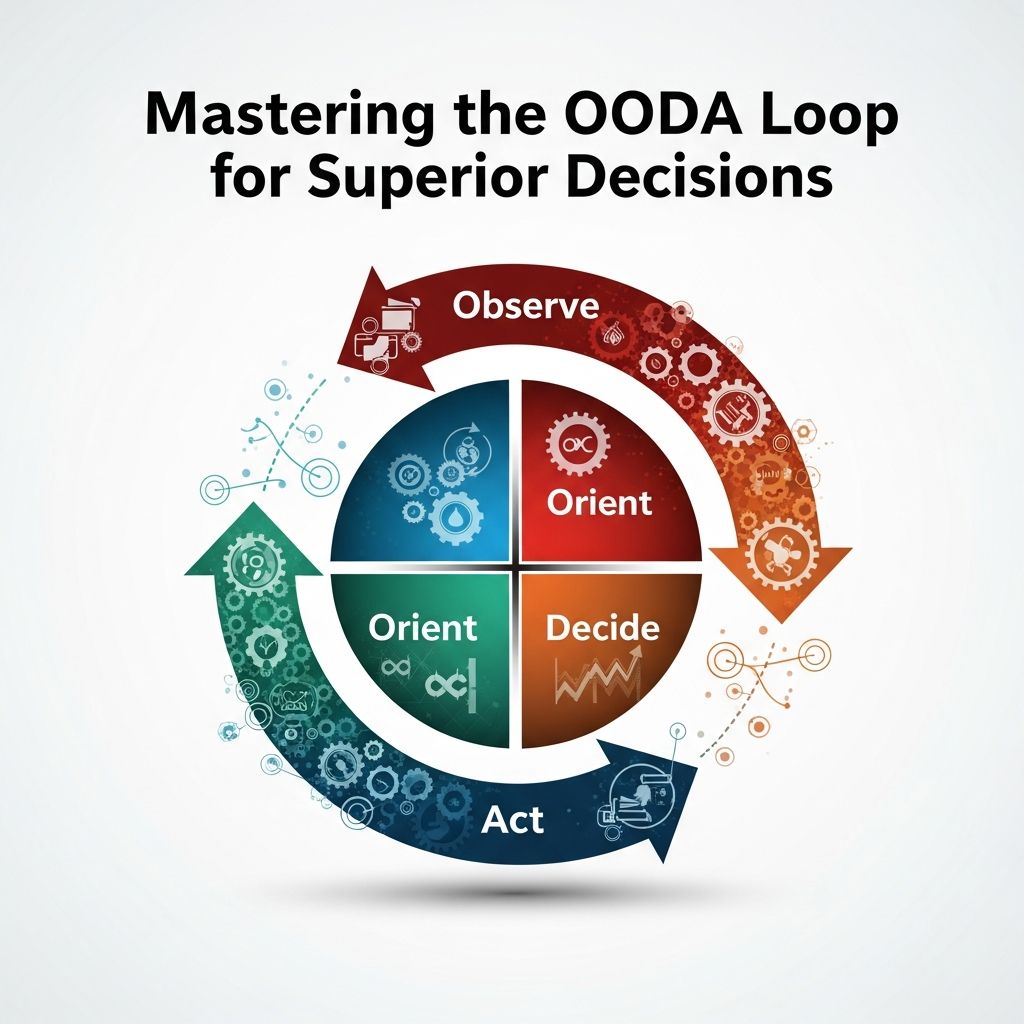
The **OODA Loop** stands as a cornerstone of effective decision-making, offering a dynamic cycle designed to thrive in fast-paced, unpredictable environments. Developed by U.S. Air Force Colonel John Boyd, this framework—Observe, Orient, Decide, Act—enables individuals and organizations to process information swiftly, adapt to changes, and gain a decisive edge over slower rivals.
Origins of the OODA Loop: From Fighter Jets to Universal Strategy
John Boyd, a legendary fighter pilot and military theorist, crafted the OODA Loop in the 1970s while analyzing aerial combat dynamics. He noticed that victorious pilots didn’t just rely on superior technology; they outthought and outmaneuvered opponents by cycling through decisions faster. Boyd’s insights stemmed from energy-maneuverability theory, emphasizing agility over brute force in dogfights.
Boyd extended this model beyond aviation, applying it to broader warfare, business competition, and personal challenges. The core idea: in chaotic settings, the side that iterates through the OODA cycle quickest disrupts the enemy’s rhythm, creating confusion and opportunities. Unlike rigid planning models like PDCA, OODA prioritizes late commitment and continuous feedback for true agility.
Today, its relevance spans defense systems, corporate boardrooms, and daily life, where volatility demands rapid adaptation.
Breaking Down the Four Stages of the OODA Loop
The OODA Loop is nonlinear and iterative, with each stage feeding into the next in a perpetual cycle. Here’s a detailed examination:
- Observe: Gather raw data from the environment. This includes market signals, competitor moves, customer sentiments, or personal cues like fatigue in high-pressure moments. Quality data is foundational—poor observations lead to flawed outcomes.
- Orient: The most critical phase, where you interpret observations through filters like experience, culture, biases, and mental models. Boyd viewed orientation as one’s ‘perception of reality,’ shaped by genetics, training, and context. Effective orientation reveals patterns and threats others miss.
- Decide: Evaluate options based on oriented insights. Weigh risks, resources, and goals to select the optimal path. In fast scenarios, this demands hypothesis testing and scenario planning.
- Act: Execute the decision boldly. Actions generate new data, looping back to Observe. Speed here amplifies the cycle’s power, turning decisions into momentum.
This structure ensures decisions aren’t static but evolve with feedback, fostering resilience.
Why Orientation Dominates the OODA Loop
Boyd emphasized **Orientation** as the loop’s hub, influencing every other step. It’s not passive analysis; it’s synthesizing data against your unique worldview. Multiple feedback loops converge here—past experiences, cultural norms, and real-time inputs—forming a holistic picture.
In practice, disrupting an opponent’s orientation (e.g., via misdirection in business or feints in combat) paralyzes their loop. Organizations enhance this by training teams to question assumptions and update mental models regularly.
| Stage | Key Focus | Common Pitfalls | Enhancement Tips |
|---|---|---|---|
| Observe | Data collection | Incomplete info, biases | Diverse sources, tools like analytics |
| Orient | Interpretation | Cognitive biases, rigidity | Mental model diversity, reflection |
| Decide | Option selection | Analysis paralysis | Prioritize speed, risk assessment |
| Act | Execution | Hesitation, poor timing | Empower action, measure results |
This table summarizes stage dynamics, highlighting pitfalls and countermeasures for practical application.
Applying OODA in Business: Gaining Competitive Advantage
In corporate arenas, OODA turns uncertainty into opportunity. Companies like Amazon use rapid observation of customer data to orient strategies, decide on features, and act via quick deployments—outpacing rivals.
Consider market disruptions: Observe shifting trends (e.g., AI boom), Orient via competitor analysis and internal capabilities, Decide on pivots like upskilling, and Act with product launches. This cycle builds agility, essential in volatile industries.
- Observe competitor pricing? Orient to your value prop; Decide discounts or differentiation; Act immediately.
- Crisis hits? Cycle faster to stabilize while others deliberate.
Training embeds OODA: simulations sharpen observation, workshops refine orientation, and agile sprints enforce decide-act rhythms.
OODA Loop in Everyday Life and Personal Development
Beyond battlefields and boardrooms, OODA empowers personal decisions. Facing a career crossroads? Observe job market and skills gaps; Orient with self-assessment; Decide on upskilling or switching; Act by networking or enrolling in courses.
In parenting or relationships, it aids: Observe child’s mood shifts, Orient to context and history, Decide interventions, Act with empathy. Iterating builds better outcomes over time.
Health choices follow suit: Observe symptoms, Orient via medical knowledge, Decide treatments, Act and monitor. This prevents reactive pitfalls.
Challenges and Limitations of the OODA Loop
No framework is flawless. **Information overload** hampers observation; biases distort orientation; over-speed risks rash decisions; execution falters without resources.
Environmental turbulence—regulations, geopolitics—demands constant recalibration. Mitigation: Cultivate diverse teams for richer orientation and use tech like AI for faster observation.
Critics note OODA suits short cycles better than long-term strategy, but hybrids with PDCA address this.
Strategies to Accelerate Your OODA Loop
- Build Observation Habits: Use dashboards, feedback loops, and curiosity to stay informed.
- Refine Orientation: Challenge biases via devil’s advocate exercises and cross-training.
- Streamline Decisions: Set heuristics for speed, like 80/20 rule.
- Optimize Action: Delegate authority, prototype fast, measure rigorously.
- Train Iteratively: Role-play scenarios to compress cycle time.
Leaders foster OODA cultures by rewarding speed and learning from loops.
Frequently Asked Questions About the OODA Loop
What makes the OODA Loop different from other decision models?
It emphasizes speed, iteration, and orientation over linear planning, ideal for chaos where agility trumps perfection.
Can non-experts use the OODA Loop effectively?
Yes—start small in daily choices; practice builds mastery for anyone.
How does technology enhance the OODA Loop?
AI aids observation and decision triage, accelerating cycles in defense and business.
Is the OODA Loop suitable for team decision-making?
Absolutely; shared observations and decentralized actions amplify group agility.
Who should learn the OODA Loop?
Leaders, entrepreneurs, professionals in dynamic fields, and anyone seeking better choices.
Integrating OODA transforms reactive habits into proactive mastery, applicable universally.
References
- Mastering the OODA Loop — Corporate Finance Institute. 2023. https://corporatefinanceinstitute.com/resources/management/ooda-loop/
- The OODA Loop — The Decision Lab. 2023. https://thedecisionlab.com/reference-guide/computer-science/the-ooda-loop
- OODA Loop — ModelThinkers. 2023. https://modelthinkers.com/mental-model/ooda-loop
- OODA loop — Wikipedia (citing primary Boyd works). 2023-10-15. https://en.wikipedia.org/wiki/OODA_loop
- Decision-making at the Speed of Relevance: The OODA Loop in Modern Defense Systems — RTI. 2023. https://www.rti.com/blog/the-ooda-loop-in-modern-defense-systems