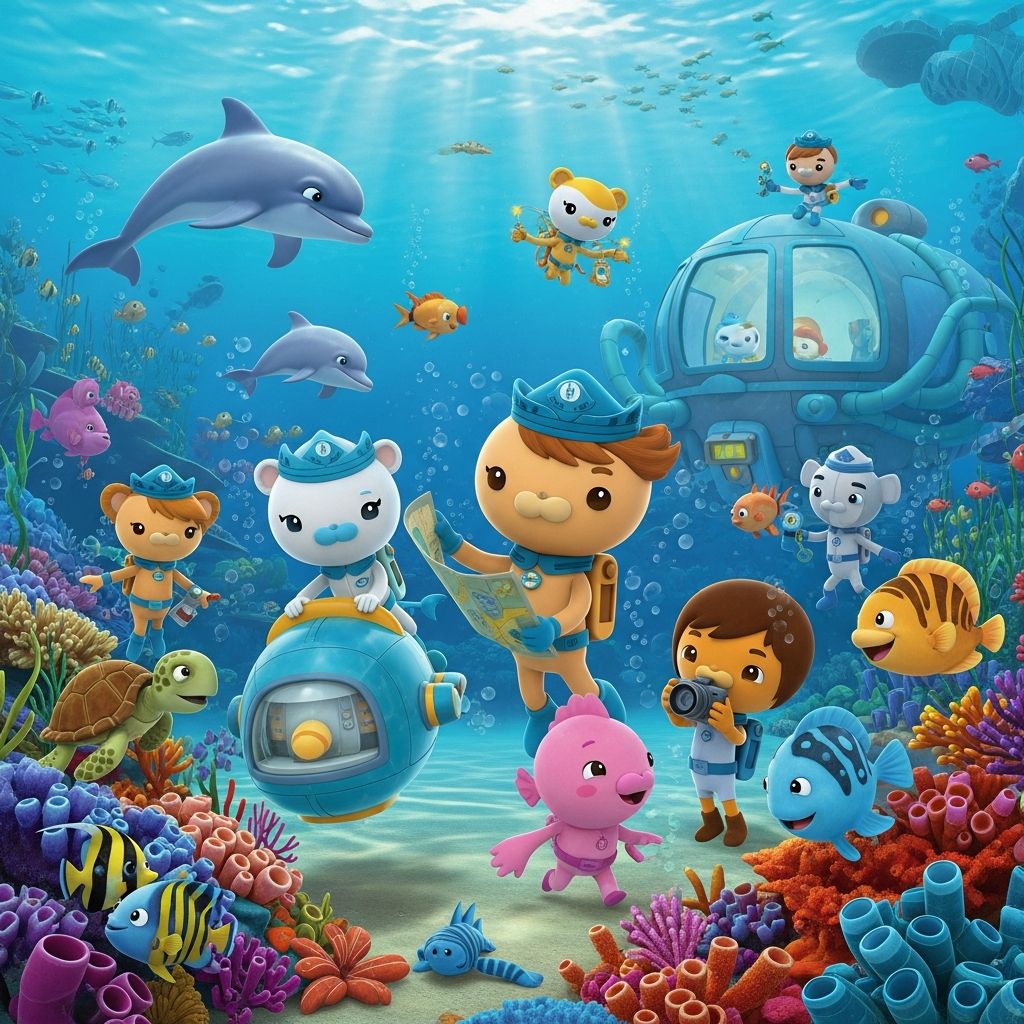
“Octonauts” is a rare children’s series that manages to deliver real information about the natural world without sacrificing fun, momentum, or charm. Unlike many preschool shows that focus heavily on interpersonal drama, this underwater adventure keeps the spotlight on exploration, problem-solving, and imaginative worldbuilding.
Set in a high-tech base beneath the ocean, the show follows a small crew of animal explorers who investigate marine mysteries and rescue creatures in trouble. The result is a format that feels more like a sci-fi adventure than a classroom lesson, even though kids walk away knowing far more about oceans and animals than before.
The World Of The Octonauts
At the heart of the series is the Octopod, a mobile undersea HQ packed with vehicles, labs, and gadgets that invite curiosity about how things work. The crew ventures out in various submersible “Gups,” each tuned to a different type of mission, from speed runs to heavy-duty rescues.
The main team is made up of stylized, anthropomorphic animals—a polar bear captain, a cat daredevil, a penguin medic, a rabbit engineer, and more—each with a distinct role and skill set. This mix echoes a classic adventure ensemble, giving kids clear, memorable personalities to follow while quietly introducing concepts like navigation, engineering, and first aid.
Action First, Lessons Second
Each episode revolves around a concrete problem: an injured sea creature, a dangerous current, an approaching storm, or a habitat under threat. The crew responds with reconnaissance, planning, and specialized gear, treating young viewers to suspenseful but age-appropriate peril.
Instead of pausing the story to deliver a lecture, the show builds facts into dialogue and visual details, so children absorb information while they’re focused on whether the mission will succeed. This structure respects kids’ attention spans and also makes the show rewatchable for adults, who experience it as an adventure series with educational bonuses.
Real Creatures, Real Concepts
One of the reasons parents often recommend “Octonauts” is that almost every creature on screen is based on an actual species, from familiar dolphins to obscure deep-sea invertebrates. Episodes introduce unusual animals like sea pigs, cone snails, and long-armed squid, along with their habitats and survival strategies.
The series uses recurring segments and visual cutaways to highlight real-world traits—camouflage, bioluminescence, symbiosis, migration—without making them feel like a list of facts. Over time, kids build a mental catalog of marine life that goes far beyond what they might encounter in a typical picture book.
STEM Skills Wrapped In Story
Behind the cute character designs is a surprisingly robust framework for introducing STEM thinking to very young audiences. Missions almost always unfold as mini engineering or science problems: identify the cause, test a hypothesis, adapt tools, and revise the plan if something fails.
Characters consult maps, sonar displays, and medical scanners, showing kids that tools and data are part of solving problems, not just grown-up background noise. Even the vehicles themselves demonstrate basic physics and design ideas—some are streamlined for speed, others reinforced for pressure, and a few are optimized for shallow reefs or icy waters.
Quiet Environmental Themes
Without turning into a grim lecture, “Octonauts” gradually acquaints kids with environmental issues like habitat loss, pollution, and climate-driven extreme weather. Special episodes and later spin-offs expand beyond the sea to show how floods, droughts, and wildfires affect animals and ecosystems on land.
The tone remains hopeful: the heroes model that problems can be faced with information, cooperation, and persistence rather than denial or panic. Kids learn that the planet is fragile but not helpless, and that even small actions—like relocating animals or clearing debris—can make a meaningful difference.
Characters Kids Actually Remember
Many children’s series blur together, but the personalities in “Octonauts” are distinct enough that kids quickly learn names, catchphrases, and signature skills. There is the steady captain, the thrill-seeking lieutenant, the meticulous engineer, the gentle medic, and the curious scientist, among others.
Light tension between characters—like clashes between reckless bravery and mechanical caution—adds humor and keeps episodes from feeling flat. Yet the disagreements remain grounded and brief, emphasizing mutual respect and complementary strengths over long-running feuds.
Why Adults Don’t Mind Watching
For parents, the biggest compliment to a kids’ show is that it is bearable on the tenth viewing, and “Octonauts” usually passes that test. The scripts move briskly, avoid saccharine speeches, and contain enough clever references and visual details to keep a grown-up’s attention.
The worldbuilding is surprisingly deep—consistent technology, recurring locations, and a sense of geography—so adults can follow the show almost like a serialized science-fiction universe. Even the running jokes and character taglines grow more charming over time rather than more grating, which is not something every franchise can claim.
Adventure Focused, Not Feelings-Obsessed
Many modern preschool shows place big emotional speeches at the center of every conflict, which can start to feel repetitive for both kids and caregivers. “Octonauts” takes a different route, letting characters express fear, excitement, or frustration in the middle of the mission rather than stopping the story for a moral.
There are clear values—courage, compassion, responsibility—but they emerge from what the crew does rather than what they say about themselves. Children see empathy in action when the team rescues a frightened animal or adapts plans to protect an ecosystem, making the lessons feel organic rather than forced.
Key Strengths At A Glance
| Aspect | How “Octonauts” Handles It | Why It Matters For Kids |
|---|---|---|
| Story Focus | Fast-paced rescue missions built around real animals and environments. | Keeps attention while naturally introducing science and geography concepts. |
| Educational Value | Accurate marine biology and earth science embedded in each plot. | Kids retain factual knowledge because it is tied to specific adventures. |
| Characters | Diverse crew with clear strengths and quirks, plus recurring side creatures. | Encourages kids to identify with different roles and problem-solving styles. |
| Visual Style | Bright, clean CGI with design touches that recall classic puppet and toy aesthetics. | Simple enough for toddlers, detailed enough to reward repeat viewing. |
| Values | Emphasis on teamwork, curiosity, and protection of vulnerable creatures. | Models pro-social behavior without heavy-handed lectures. |
What Kids Can Learn Without Realizing
Because the show rarely stops to tell viewers what they are “supposed” to learn, children absorb ideas almost by osmosis. They see that different animals have specialized adaptations, that environments vary dramatically, and that scientific instruments reveal hidden information.
They also see that problems are rarely solved by a single hero; instead, each mission combines navigation, medical care, engineering, and quick-thinking in the field. This kind of teamwork narrative gently pushes back against the trope of the lone savior and highlights the value of collaboration.
Tips For Parents Introducing “Octonauts”
- Watch the first few episodes together so you can help kids connect what they see on screen to real oceans, maps, and animals.
- Pause occasionally to look up pictures or short clips of the featured creatures in the real world, reinforcing that they are not just fantasy.
- Use simple follow-up questions like “Why did the Octonauts need that vehicle?” or “How did they help the animal?” to encourage recall and reasoning.
- Balance longer specials with regular episodes; the specials can dig deeper into environmental themes, while shorter stories are perfect for quick viewing.
Frequently Asked Questions About “Octonauts”
Is “Octonauts” appropriate for toddlers?
The series was designed with preschoolers in mind, and most episodes run under 15 minutes, making them manageable for short attention spans. While the characters do face danger, it is portrayed in a stylized, non-gory way, with clear resolutions and reassuring outcomes.
How educational is the show really?
Each story is built around a specific species, biome, or scientific idea, so kids encounter a steady stream of accurate facts over time. Many families report that children begin recognizing animals in books, aquariums, or documentaries specifically because they first saw them on the show.
Does it cover topics beyond the ocean?
Extensions of the franchise take the crew onto land, where they help animals in forests, deserts, and other ecosystems affected by extreme weather and environmental change. This expansion broadens the educational scope from marine biology to a more general understanding of earth systems and climate impacts.
Will adults enjoy watching it too?
Many parents find the pacing, worldbuilding, and visual design pleasant enough that they do not mind repeated viewings. The balance of humor, suspense, and gentle educational content makes it feel closer to a light family adventure series than a typical toddler-only cartoon.
How does it compare to other kids’ shows?
Unlike programs that lean heavily on catchy songs or repeated moral speeches, “Octonauts” relies on missions, discovery, and problem-solving to drive each episode. For families who want a show that sparks questions about the natural world while still feeling exciting, it often becomes a go-to choice on streaming platforms.