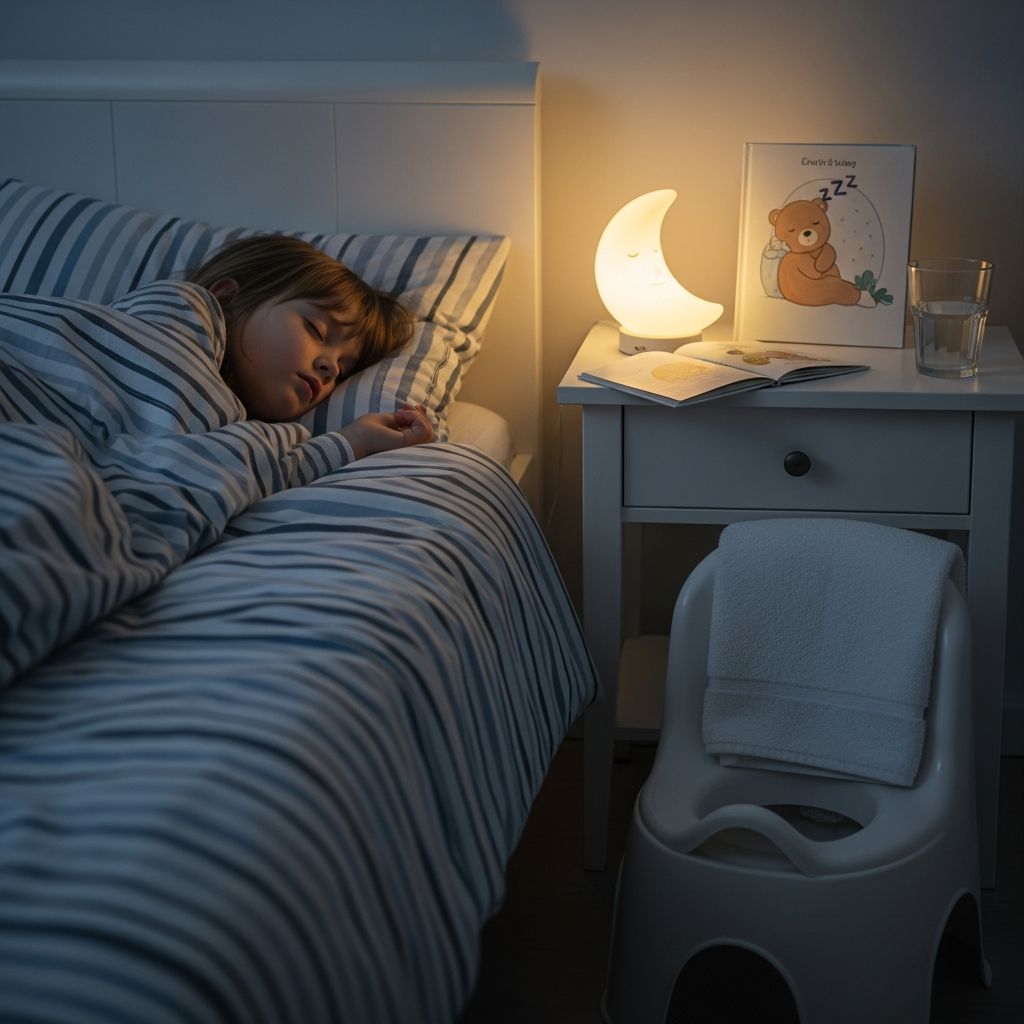
Nighttime potty training often feels like the “last big hurdle” after daytime success, but it does not have to be a battle. With realistic expectations, a calm plan, and the right tools, most children can move toward dry nights with much less stress for the whole family.
This guide walks you through how to know when your child might be ready, how to prepare your home and routines, and what to do when accidents inevitably happen. It focuses on gentle, child-centered strategies rather than pressure or punishment.
Understanding Nighttime Bladder Control
Daytime potty training and nighttime dryness are related, but they are not the same skill. During sleep, your child’s body needs to manage both bladder capacity and brain-bladder communication so that urine is either held until morning or your child wakes up to use the toilet.
Some children master this quickly, while others take several extra months—or even years—after daytime training. Genetics, deep sleep, and bladder size all play a role, which means your child is not “lazy” or “stubborn” if dry nights come more slowly.
Is Your Child Ready for Nighttime Training?
Before changing your nighttime routine, look for signs that your child has at least some capacity to stay dry for longer stretches while asleep. Pushing too early can create frustration, frequent wakeups, and power struggles that help no one.
- Morning diapers or pull-ups are often dry or only slightly damp several days in a row.
- Your child wakes up at night asking to use the toilet or reporting discomfort from a wet diaper.
- Daytime bladder control is mostly solid, with few accidents and the ability to “hold it” long enough to reach the bathroom.
- Your child shows interest in being a “big kid” at night—asking for underwear or talking about wanting a dry bed.
If several of these apply, your child may be ready to try a gentle nighttime plan. If not, it is perfectly acceptable to wait and revisit the idea in a few weeks or months.
Setting Realistic Expectations
Even after starting nighttime training, accidents are normal and expected. Some children have a cluster of dry nights right away and then regress; others make slow, uneven progress for a while before dry nights become the default.
To protect your own sanity and your child’s self-confidence, view this as a long-term transition rather than a quick project. A realistic mindset makes it easier to respond calmly when the sheets are wet at 2 a.m.
Preparing the Bedroom and Bathroom
A child who wakes up needing to pee in the dark needs a safe, clear path to the toilet. Simple environmental changes can remove barriers and make success more likely.
- Add a small nightlight in the hallway and bathroom so your child can see without becoming fully awake.
- Keep a potty chair in the bedroom for very young children or those who are afraid of the dark hallway.
- Dress your child in easy-off pajama bottoms and underwear—no complicated snaps or belts at night.
- Place tissues, wipes, and a change of underwear within reach for quick cleanups after accidents.
Protecting the Mattress and Bedding
Accidents will happen, so think of your bedding setup as your “sleep preservation plan.” The easier it is to clean up at 2 a.m., the more patient you can be with your child.
- Use a waterproof mattress protector or washable mattress pad under the fitted sheet.
- Consider layering bedding: protector + fitted sheet + thin protector + second fitted sheet. When the top layer is wet, you can strip it off and still have a dry bed ready.
- Keep an extra set of pajamas, underwear, and a small towel in the bedroom for fast changes.
| Item | What It Does | Best For |
|---|---|---|
| Waterproof mattress cover | Protects the mattress from urine and odors, making cleanup easier. | All families; essential baseline protection. |
| Absorbent pad or liner | Soaks up most of the accident so only a pad needs changing. | Children with frequent accidents or during early training. |
| Layered fitted sheets | Allows quick removal of the top sheet without remaking the whole bed. | Parents who want minimal disruption at night. |
| Waterproof pillow protector | Protects against leaks that may reach the pillow. | Children who toss, turn, or sleep very close to the top of the bed. |
Designing a Potty-Friendly Evening Routine
A predictable bedtime routine gives your child a sense of calm and also creates natural times to visit the toilet. The goal is to send your child to bed with an empty bladder and a relaxed body.
Many families find it helpful to build a “double pee” into the evening: one bathroom trip earlier in the routine and another just before lights out.
Sample Evening Routine
- Early evening: Offer most of the day’s fluids earlier, tapering drinks in the final 1–2 hours before bed (without forbidding water if your child is genuinely thirsty).
- Before bath or pajamas: First toilet visit, with plenty of time and no rush.
- After storytime and teeth: Second toilet visit, reinforcing the message that “we try before sleep even if we don’t feel a big urge.”
- Final step: Brief reminder—“If you need to pee later, you can call us or walk to the potty”—kept light and non-threatening.
Balancing Fluids and Comfort
Cutting off all liquids too early can cause thirst and bedtime battles, but unlimited drinks right before sleep increase the chance of a soaked bed. Aim for a balanced approach.
- Offer most drinks earlier in the day—breakfast, lunch, and afternoon snack—so your child is well hydrated before evening.
- In the last hour before bed, keep drinks small and purposeful rather than constant sipping.
- If your child plays sports or is very active in the evening, adjust slightly but still taper before lights out.
Deciding About Diapers, Pull-Ups, or Underwear
One big question is whether to use nighttime diapers or pull-ups during this stage. There is no single right answer; different families choose different paths depending on the child, the number of accidents, and how much laundry everyone can realistically manage.
- Continuing pull-ups can reduce mess and stress while you watch for more consistent morning dryness.
- Switching to underwear may help some children become more aware of wetness and build the habit of waking to pee.
- Hybrid approaches—such as underwear under a loose pull-up—can give your child the feeling of “big kid” underwear while still providing a backup layer.
Talk openly with your child about whichever choice you make so it feels like teamwork, not a secret or a punishment.
Responding to Accidents Calmly
No matter how careful the plan, there will be wet sheets at some point. How you respond in those tired moments shapes how your child feels about their body and about sleep.
- Use neutral, matter-of-fact language: “You peed while you were sleeping. Let’s get you cleaned up.”
- Avoid shaming phrases like “You’re too old for this” or “We talked about this already.”
- Involve your child in small cleanup tasks—handing you clean pajamas, putting wet clothes in the hamper—without turning it into a punishment.
- Once your child is dry and back in bed, keep extra conversation minimal so everyone can return to sleep.
Supporting Sleep While Training
Nighttime potty training should not come at the cost of everyone’s overall rest if it can be helped. If your child already struggles with sleep, introduce changes gradually and avoid turning the night into a series of fully awake bathroom trips.
- Keep lights dim and voices soft during any nighttime bathroom visits.
- Avoid engaging activities—no extra stories, screens, or long chats after accidents.
- Consider whether scheduled “wake-to-pee” trips help or hurt; for some children they reduce accidents, but for others they create more awakenings and confusion.
When Nighttime Accidents Are Still Frequent
If your child is older or has been dry during the day for a long time but still wets the bed most nights, it may be helpful to zoom out. Persistent accidents can reflect a mix of slow-to-mature bladder control, deep sleep, or underlying medical or emotional factors.
- Notice patterns: Are accidents clustered early in the night, near morning, or scattered randomly?
- Track fluid intake, constipation, stressors (like a new sibling or school), and big schedule changes.
- Discuss concerns with a pediatrician if accidents are very frequent, accompanied by pain, extreme thirst, snoring, or other unusual symptoms.
Encouraging and Motivating Your Child
Nighttime progress is often slow and invisible, so positive attention can help your child stay hopeful. The key is to celebrate effort and patterns, not demand perfection.
- Notice small wins, such as waking up to ask for help or having a drier pull-up than usual.
- Use simple, low-pressure rewards if they motivate your child—like stickers on a chart or choosing tomorrow’s pajamas after a dry night.
- Avoid taking rewards away after an accident; frame them around trying the routine rather than the outcome.
Common Nighttime Potty Training Myths
Misinformation can make parents feel guilty about completely normal development. Separating myths from reality helps you focus on what your child actually needs.
- Myth: “If my child is dry in the day, they should be dry at night too.”
Reality: Nighttime dryness usually lags behind daytime skills and often depends on biological readiness more than behavior. - Myth: “Bedwetting is always a sign of emotional problems.”
Reality: Many children wet the bed with no underlying emotional issue; it is often a normal stage of physical development. - Myth: “Punishment will teach my child to wake up.”
Reality: Criticism and consequences tend to create anxiety and shame, which can make nighttime problems worse.
Frequently Asked Questions
How long does nighttime potty training usually take?
There is a wide range of normal. Some children achieve mostly dry nights within a few weeks of starting, while others continue to have occasional or regular accidents for months. Progress is more important than a specific timeline.
Should I wake my child to use the toilet before I go to bed?
This strategy works well for some families and not at all for others. If you try it, keep the interaction minimal and avoid fully waking your child; if it leads to more night-waking or crankiness, it may not be worth continuing.
Is my child too old to still be wetting the bed?
Age alone does not tell the whole story. Many children continue to have nighttime accidents beyond the age that parents expect, especially if there is a family history of later nighttime dryness. Talk with a healthcare provider if you feel unsure or worried.
Can diet or constipation affect nighttime accidents?
Yes, a very full bowel can put pressure on the bladder and make it harder to stay dry at night. If your child often has hard stools, infrequent bowel movements, or discomfort, address that issue alongside nighttime potty efforts.
What should I say to my child after an accident?
Simple, calm statements are best: acknowledge what happened, help them get clean, and reassure them that bodies learn at different speeds. The less drama you attach to the accident, the safer your child will feel while their body catches up.
Key Takeaways for Parents
- Nighttime dryness is a developmental milestone, not just a matter of willpower.
- Setting up the environment—bedding, lighting, easy access to the toilet—can significantly reduce stress.
- Gentle routines, balanced fluids, and a calm response to accidents support both emotional security and sleep.
- Frequent or late-lasting bedwetting is common, and professional guidance is appropriate if you ever feel unsure.
With patience, practical preparation, and a focus on connection rather than perfection, most families find that dry nights eventually arrive—and the journey there can be much kinder than many parents fear.