Love handles – the soft fat that collects around the sides of your waist – are common, stubborn, and frustrating. But they are not permanent. With the right mix of exercise, nutrition, and daily habits, you can reduce excess fat around your midsection and build a stronger, more defined core.
This guide offers a practical, science-backed approach inspired by common love-handle workout advice, but reorganized and written from scratch to help you turn scattered tips into a clear plan.
Why Love Handles Are So Stubborn
Love handles are essentially subcutaneous fat stored around the hips and waist. Your body decides where it stores fat based on genetics, hormones, and sex-specific patterns – which is why some people gain more around the belly while others carry it in the thighs or hips.
- Spot reduction is a myth: Doing endless side crunches will not melt fat only from your waist. Fat loss happens across the whole body when you burn more energy than you consume.
- Hormones and lifestyle matter: Stress, sleep, and diet all influence where and how much fat you store.
- Gender differences: Men tend to store more fat around the abdomen, whereas women often accumulate more around hips and thighs, but both can develop love handles.
The good news is that combining whole-body training, targeted core work, and better nutrition can gradually reduce this fat and reveal a firmer waistline.
The Three Pillars of Losing Love Handles
To shrink love handles in a sustainable way, focus on three connected pillars:
- Overall fat loss through a modest calorie deficit
- Muscle-preserving strength training for the entire body
- Core and oblique conditioning to tighten and define your waist
Research suggests that combining resistance training with aerobic exercise is more effective for reducing body weight and abdominal fat than either one alone. High-intensity interval training (HIIT) can further improve fat loss and cardiovascular fitness in less time than traditional steady-state cardio.
A Weekly Training Blueprint
Below is an example of how you might organize your training week to target love handles while improving overall fitness. Adjust days and intensity to your schedule and current fitness level.
| Day | Focus | Key Elements |
|---|---|---|
| Day 1 | Full-Body Strength + Obliques | Compound lifts, loaded carries, rotational core drills |
| Day 2 | Cardio or HIIT | Intervals of brisk walking, running, cycling, or rowing |
| Day 3 | Active Recovery | Light walking, mobility, stretching |
| Day 4 | Strength + Core Stability | Lower-body lifts plus planks and anti-rotation work |
| Day 5 | Cardio or HIIT | Intervals or moderate continuous cardio |
| Day 6 | Core & Conditioning | Circuits that blend core drills and bodyweight conditioning |
| Day 7 | Rest | Sleep, recovery, gentle movement |
Core Principles for Love-Handle Workouts
Any effective love-handle routine should respect these principles:
- Progressive overload: Gradually increase difficulty by adding resistance, reps, sets, or reducing rest.
- Full range of motion: Move through comfortable yet challenging ranges to engage more muscle and support joint health.
- Balanced training: Train the front, sides, and back of your core, not just one area, to prevent imbalances and back pain.
- Regular frequency: Aim for at least 3–4 training sessions per week to create meaningful change.
Sample Strength & Oblique Workout
Perform this workout 1–2 times per week, leaving at least one day between sessions. Warm up for 5–10 minutes with light cardio and dynamic movements before you start.
Block A: Big Compound Lifts
- Goblet Squat – 3 sets of 8–12 reps
Hold a dumbbell or kettlebell at your chest. Sit your hips back and down, keep your chest proud, and drive through your feet to stand. - Dumbbell Row – 3 sets of 8–12 reps per side
Support one hand on a bench or sturdy surface, hinge at the hips, and pull the weight toward your rib cage, squeezing your shoulder blade.
Block B: Oblique Builders
- Suitcase Carry – 3 rounds of 30–45 seconds per side
Hold a heavy weight in one hand at your side and walk slowly. Fight the urge to lean. This challenges your obliques to keep your torso upright. - Side Plank with Hip Lift – 3 sets of 10–15 reps per side
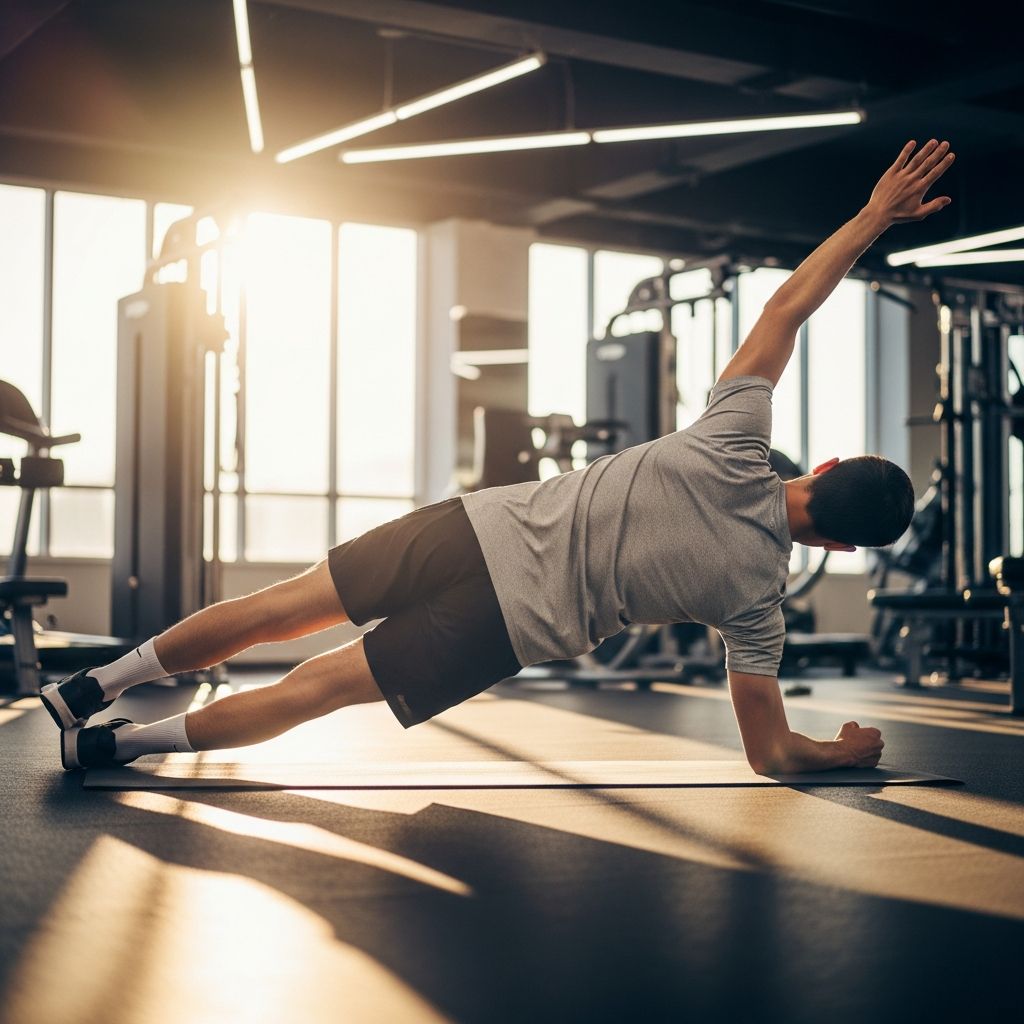
From a side plank, gently drop your hip toward the floor and lift it back up without twisting. Keep your body in a straight line. - Rotational Lunge (Bodyweight or Light Dumbbells) – 3 sets of 10 reps per side
Step into a forward lunge and rotate your torso toward the front leg. Step back and repeat on the other side.
Block C: Finisher (Optional)
- Mountain Climbers – 3 rounds of 30 seconds on, 30 seconds off
Maintain a strong plank position while driving knees toward your chest at a brisk, controlled pace.
Using Cardio and HIIT to Support Fat Loss
Cardiovascular exercise helps increase your daily calorie burn and supports heart and metabolic health. You can choose steady-state cardio (like brisk walking or cycling) or higher-intensity intervals depending on your fitness level and preference.
Steady-State Cardio Ideas
- Brisk walking for 30–45 minutes
- Moderate cycling outdoors or on a stationary bike
- Swimming laps at a comfortable but continuous pace
Simple HIIT Session (Beginner-Friendly)
Try this 15–20 minute HIIT session 1–2 times per week, after a warm-up:
- 1 minute of fast walking, light jogging, or cycling
- 1 minute of very easy pace
- Repeat for 8–10 cycles
Reviews of HIIT research show that this style of training can reduce body fat and improve cardiorespiratory fitness as effectively or more effectively than traditional lower-intensity continuous exercise, in less total time.
Nutrition Habits That Make the Biggest Difference
Training without nutritional changes is like rowing upstream with one oar. To reduce love handles, you need a mild, sustainable calorie deficit and food choices that support training and recovery.
Key Nutrition Strategies
- Emphasize minimally processed foods: Vegetables, fruits, lean proteins, legumes, whole grains, nuts, and seeds provide fiber, vitamins, and minerals while helping control hunger.
- Prioritize protein: Adequate protein intake helps preserve lean muscle during weight loss and improves satiety.
- Limit added sugars and ultra-processed snacks: These foods are calorie-dense and easy to overeat, leading to fat gain around the abdomen.
- Watch liquid calories: Sugary drinks, alcohol, and high-calorie coffee drinks add up quickly without filling you up.
- Stay hydrated: Water supports digestion, exercise performance, and may help prevent mistaking thirst for hunger.
Simple Plate Template
To avoid complicated counting, use an easy visual guideline for most meals:
- Half the plate: non-starchy vegetables (greens, peppers, broccoli, etc.)
- One quarter: lean protein (fish, poultry, beans, tofu, eggs)
- One quarter: whole grains or starchy vegetables (brown rice, oats, quinoa, potatoes)
- Small amount of healthy fats (olive oil, avocado, nuts, seeds)
For people with specific medical conditions such as diabetes, heart disease, or kidney disease, nutrition should be tailored with help from a qualified healthcare professional.
Lifestyle Factors That Influence Belly Fat
Beyond workouts and meals, your everyday habits can either support or sabotage your efforts.
Sleep
- Short sleep and poor sleep quality are associated with higher body weight and more abdominal fat.
- Adults should generally aim for 7–9 hours of quality sleep per night.
Stress Management
- Chronic stress can influence appetite and may promote fat storage around the abdomen via hormones such as cortisol.
- Tools like walking, breathing exercises, time outdoors, or brief mindfulness sessions can help manage stress.
Daily Movement
- Even outside the gym, aim to sit less and move more – walking breaks, taking stairs, doing short stretching sessions.
- Higher daily step counts are linked to better cardiometabolic health and lower risk of weight gain over time.
Tracking Progress Without Obsessing
Love handles do not vanish overnight. Monitoring progress in several ways can keep you motivated while avoiding fixation on a single number.
- Measurements: Use a tape measure around your waist and hips every 2–4 weeks.
- Photos: Front, side, and back photos taken monthly under similar lighting and posture can reveal subtle changes.
- Performance: Track reps, weights, and how challenging workouts feel. Strength and cardio improvements are meaningful wins.
- Non-scale victories: Looser clothing, better sleep, steadier energy, and improved mood all matter.
Common Mistakes When Trying to Lose Love Handles
Avoid these traps that can slow or stall your progress:
- Only doing side crunches: Ab-only routines without attention to diet or full-body training rarely change your waistline.
- Extreme dieting: Very low-calorie diets can cause fatigue, muscle loss, and rebound weight gain.
- Inconsistency: Sporadic effort makes it difficult to create the sustained energy deficit needed for fat loss.
- Ignoring recovery: Insufficient rest can impair workout quality and increase injury risk.
- Chasing quick fixes: Gadgets and miracle programs promising local fat melting lack scientific support.
Frequently Asked Questions (FAQs)
Can I target love handles specifically with certain exercises?
No exercise can burn fat from only one area. Oblique exercises strengthen the muscles under your love handles, but visible fat reduction comes from overall fat loss using a combination of cardio, strength training, and nutrition.
How often should I train my core if I want to reduce love handles?
Training your core 2–4 times per week is sufficient for most people, as long as you include both stability and rotational work and allow at least one day of rest between intense sessions.
How long does it usually take to see changes around my waist?
It varies widely. Many people notice subtle changes in 4–8 weeks with consistent training and nutrition, but larger transformations usually require several months of steady effort. Factors include your starting point, genetics, stress, sleep, and how closely you follow your plan.
Is HIIT better than regular cardio for losing love handles?
HIIT can reduce body fat and improve fitness in less time, but it is also more demanding and not suitable for everyone. Moderate continuous cardio can be just as effective if it helps you stay consistent and accumulate enough weekly activity.
Do I need gym equipment to get rid of love handles?
No. You can build an effective plan with bodyweight moves like squats, lunges, planks, and mountain climbers, combined with walking or jogging. Weights, bands, or machines are tools that can make progression easier but are not required.
References
- Physical Activity Guidelines for Americans, 2nd edition — U.S. Department of Health and Human Services. 2018-11. https://health.gov/sites/default/files/2019-09/Physical_Activity_Guidelines_2nd_edition.pdf
- 17 Simple Ways to Get Rid of Love Handles — Healthline. 2023-06-23. https://www.healthline.com/nutrition/get-rid-of-love-handles
- Healthy Eating for a Healthy Weight — Centers for Disease Control and Prevention (CDC). 2023-06-30. https://www.cdc.gov/healthyweight/healthy_eating/index.html
- Walking and the Regulation of Body Weight — D. J. Bassett Jr. & M. M. Ainsworth, Sports Medicine. 2010-04-01. https://doi.org/10.2165/11532020-000000000-00000