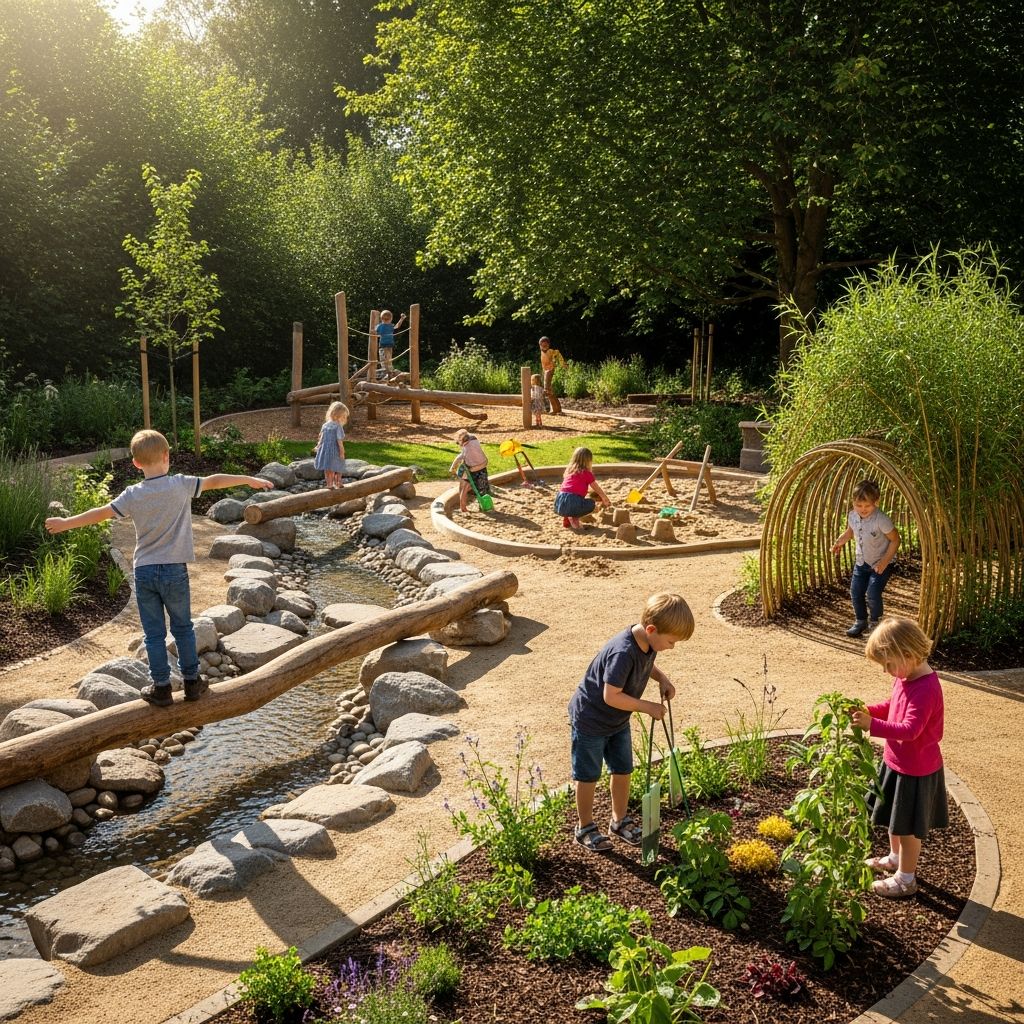
Natural playgrounds are outdoor play areas that rely on trees, plants, rocks, sand, water, and other organic materials instead of primarily metal and plastic structures. They invite children to climb, dig, build, and explore in ways that feel more like being in a forest or meadow than on a conventional playground. This article explains what natural playgrounds are, the advantages they offer children, the problems and risks adults should keep in mind, and how families and communities can design and maintain these spaces responsibly.
What Is a Natural Playground?
A natural playground, sometimes called a nature play space, is a play environment built around elements such as logs, boulders, hills, plants, loose branches, sand, and water features, often arranged to encourage open-ended, imaginative play. Unlike traditional playgrounds that center around fixed equipment with one obvious use, natural playgrounds are intentionally flexible: the same log can be a balance beam, a fort wall, or a pretend ship depending on how children approach it.
Designers of natural playgrounds usually focus on blending the play area with the surrounding landscape, supporting biodiversity, and offering varying textures and levels (like slopes, tunnels, and mounds). The goal is to give children an immersive, sensory-rich setting that feels like wild nature while still being deliberately planned and supervised.
Key Features of Natural Playgrounds
Although every nature-based play space looks different, most share several common components that help support children’s physical, cognitive, and emotional development.
- Living elements: Trees, shrubs, grasses, and flower beds that provide shade, color, seasonal change, and habitat for wildlife.
- Landscape forms: Hills, mounds, ditches, and winding paths that encourage climbing, rolling, running, and exploring.
- Loose parts: Sticks, pinecones, stones, leaves, and moveable logs that children can rearrange for building and creative projects.
- Natural surfaces: Sand, soil, mulch, and grass that create a variety of walking and crawling sensations.
- Water features: Streams, pumps, basins, or simple mud areas where children can pour, dam, and experiment.
- Minimal fixed equipment: If present, structures are often wooden and integrated into the landscape instead of dominating it.
Benefits of Natural Playgrounds for Children
When thoughtfully designed and maintained, natural playgrounds support a wide range of developmental outcomes for children. These benefits reach beyond physical fitness and extend into social, emotional, and cognitive domains.
Physical Health and Motor Skills
Natural playgrounds encourage whole-body movement. Children climb over logs, scramble up slopes, jump from rocks, and balance on uneven surfaces, which helps develop core strength, coordination, and balance. Because the environment is less predictable than a flat plastic structure, children must constantly adjust their posture and movements.
This kind of varied movement can also support cardiovascular fitness and stamina. Running along winding paths, hauling branches, or pushing wheelbarrows filled with sand all provide moderate to vigorous physical activity. For many children, it feels more like exploring than “exercise,” which can make them more willing to stay active for longer periods.
Social and Emotional Development
Natural playgrounds often lend themselves to cooperative play because many of the activities—such as building dens out of branches or creating channels for water—are easier or more fun in a group. This situation naturally encourages children to negotiate roles, share materials, and resolve conflicts, strengthening communication and social problem-solving skills.
Being in a greener, more organic environment can also be calming. The presence of plants, birds, and natural sounds may reduce stress and support emotional regulation. Children who sometimes feel overwhelmed by loud, crowded indoor spaces may find the open, nature-rich setting of a natural playground more soothing and less overstimulating.
Cognitive Skills and Creativity
Natural playgrounds offer what educators call “loose parts play.” When children are given flexible materials—like sticks, stones, and fabric—they must imagine possibilities, plan structures, test ideas, and adapt when something does not work. This trial-and-error approach supports creativity, spatial reasoning, and critical thinking.
Observation and curiosity are also stimulated. Children notice insects, patterns in bark, the way water flows, or how mud changes when it dries. They ask questions, invent experiments, and create stories around what they discover, which can enrich language development and early scientific thinking.
Connection to Nature and Environmental Awareness
Playing in a naturalistic space, rather than just looking at nature from a distance, can help children form emotional ties to the outdoors. When children spend time caring for plants, watching seasonal changes, or observing animals, they start to develop a sense of responsibility and empathy for the natural world.
These everyday experiences can lay the groundwork for later environmental stewardship. Children who frequently play in natural settings are more likely to value green spaces as they grow up and to support conservation and sustainable practices in their communities.
Problems and Challenges of Natural Playgrounds
Natural playgrounds are not without drawbacks. Parents, caregivers, schools, and municipalities need to weigh these challenges while planning or using nature-based play spaces. With careful management, many problems can be reduced, but they should not be ignored.
Safety Risks and Supervision
Uneven surfaces, hidden roots, and climbable trees carry different risks than flat plastic platforms. While manageable risk can be beneficial for learning, adults must still aim to prevent serious injuries. Clear sightlines, regular inspections, and age-appropriate design are essential.
Depending on the layout, it can be harder to see every corner of a natural playground compared to a compact traditional structure. Supervisors may need training on where children tend to cluster, how to set boundaries, and how to balance allowing exploration with intervening when play becomes unsafe.
Maintenance and Upkeep
Living landscapes change continually, meaning that maintenance demands can be higher and less predictable than those for standard equipment. Grass may wear down to mud, plants can become overgrown, and wooden features can rot or splinter over time. Keeping the space safe requires ongoing assessment and repairs.
There are also seasonal considerations. After storms, branches might fall; after heavy use, paths might erode. Communities must budget for pruning, mulching, replanting, and replacing worn materials. Without consistent care, a natural playground can quickly shift from charmingly wild to neglected and potentially hazardous.
Weather, Allergies, and Pests
Because natural playgrounds are usually fully outdoors, they are sensitive to weather. Rain and snow can make surfaces slippery or muddy, while extreme heat can make prolonged play uncomfortable. Families and schools need flexible schedules, appropriate clothing policies, and sometimes alternative indoor options.
Plants and soil can also host allergens, insects, and small animals. While exposure to nature is generally beneficial, children with severe allergies or specific health vulnerabilities may need extra planning, such as avoiding certain plants, using insect repellent, or timing visits to lower-pollen periods.
Accessibility and Inclusion
Not all natural playground designs automatically work well for children with mobility challenges, sensory sensitivities, or other disabilities. Uneven paths, loose gravel, and steep slopes can be difficult to navigate with wheelchairs, walkers, or strollers. Designers must intentionally include accessible routes, resting areas, and varied activity zones.
Inclusive nature play might mean combining firm, stable surfaces with natural elements, offering sensory gardens at different heights, and providing quiet nooks alongside more energetic spaces. The aim is for every child to enjoy contact with nature, not only those who can run and climb easily.
Natural vs. Traditional Playgrounds
Both natural and conventional playgrounds can support healthy child development, but they do so in different ways. Understanding these differences can help parents and communities decide how best to invest limited space and resources.
| Aspect | Natural Playgrounds | Traditional Playgrounds |
|---|---|---|
| Core materials | Logs, rocks, plants, earth, water | Metal frames, plastic slides, rubber surfacing |
| Type of play | Open-ended, imaginative, flexible use | More structured, equipment-driven activities |
| Development focus | Creativity, risk assessment, nature connection | Repetitive motor skills like swinging and sliding |
| Maintenance pattern | Ongoing landscape care and inspections | Periodic equipment checks and part replacements |
| Accessibility | Requires intentional design to be fully inclusive | Often easier to make paths and ramps compliant |
| Environmental impact | Can support biodiversity and reduce heat | May rely on manufactured materials and coatings |
Design Tips for Parents and Communities
Whether planning a schoolyard renovation or improving a backyard, adults can use basic design principles to create safe, engaging, and sustainable natural play spaces. Not every project needs to be large or expensive; even small, well-thought-out changes can have big effects on children’s play.
- Start with the existing landscape: Notice where shade falls, how water drains, and which plants already thrive, then integrate play areas around those patterns.
- Offer varied levels and textures: Combine flat areas with gentle slopes, stepping stones, sand patches, and grassy zones to give children multiple ways to move.
- Include loose parts: Provide safe branches, planks, crates, and natural materials that can be rearranged so children can build and experiment.
- Plan for visibility: Arrange plantings and features so adults can see major play zones from key supervision points.
- Involve children in planning: Ask kids what they enjoy outdoors and incorporate their ideas, which can increase their sense of ownership and care.
Safety and Risk Management
Safety in natural playgrounds revolves around embracing reasonable risk while minimizing the chance of serious harm. Instead of removing every possible challenge, adults should focus on recognizing hazards and designing the environment so that falls or mistakes are unlikely to be catastrophic.
- Choose suitable fall surfaces around climbing areas, using materials like engineered wood fiber or deep mulch where appropriate.
- Inspect logs, bridges, and balancing beams regularly for rot, sharp edges, or instability.
- Set clear boundaries, such as fences or hedges, to distinguish the play area from roads or parking lots.
- Develop simple rules with children, such as “one at a time on narrow logs” or “feet first when sliding down slopes.”
- Provide basic first-aid supplies and ensure supervisors know what to do in case of minor injuries.
Practical Tips for Parents Using Natural Playgrounds
Parents and caregivers can make the most of natural playgrounds by preparing children and themselves for the unique conditions these spaces provide. With a bit of planning, visits can be both enjoyable and low-stress.
- Dress children in comfortable, weather-appropriate clothing that can get dirty, including sturdy shoes with good grip.
- Pack essentials like water, sun protection, and, in some regions, insect repellent or allergy medication when advised by a health professional.
- Talk with children about safe climbing levels and how to test branches or rocks before putting full weight on them.
- Allow time for unstructured exploration rather than directing every game or activity.
- Encourage children to help with simple cleanup tasks, such as returning loose parts to common areas, to nurture responsibility.
Frequently Asked Questions (FAQs)
Are natural playgrounds safe for young children?
Natural playgrounds can be safe for toddlers and preschoolers when they are designed with age-appropriate features, such as low climbing elements, gentle slopes, and soft fall zones. Close supervision is especially important for very young children, along with clear boundaries that prevent wandering into hazards like parking lots or deep water.
Do natural playgrounds cost more than traditional playgrounds?
Upfront costs vary widely depending on the size of the site and the complexity of the design. Some natural playgrounds can be created affordably by reusing local materials and planting hardy vegetation, while others involve professional landscape architects and engineered structures. Over time, maintenance needs may differ from traditional playgrounds, with more spending on landscape care and less on manufactured equipment.
What about mud, dirt, and mess?
Mud and dirt are part of the experience of nature play and contribute to sensory learning, but they can also be a concern for families who need to return to school or work afterward. Planning ahead by bringing extra clothes, towels, or simple cleaning supplies can help balance the benefits of getting messy with everyday practicalities.
Can children with disabilities use natural playgrounds?
Yes, children with disabilities can enjoy natural playgrounds when accessibility is intentionally incorporated into the design. Features such as firm, level paths; raised sand or water tables; sensory gardens; and quiet, shaded areas can make the space inviting and usable for a wide range of abilities.
How can a community start a natural playground project?
Community projects often begin with a small group of motivated parents, educators, or neighbors who assess available land, gather ideas, and explore local regulations. From there, they may seek partnerships with schools, municipal departments, nonprofits, or landscape professionals to develop a plan, raise funds, and organize volunteer workdays for planting and construction.
Bringing Nature Back into Everyday Play
Natural playgrounds reflect a broader desire to reconnect children with the living world, especially in urban and suburban areas where daily contact with wild spaces can be limited. By combining thoughtful design, regular maintenance, and inclusive planning, families and communities can create play environments that are both adventurous and nurturing.
Even when space or budgets are small, adding natural elements to children’s play areas—such as plants, logs, and loose materials—can enrich play experiences, support healthy development, and help foster a lifelong appreciation for the outdoors.