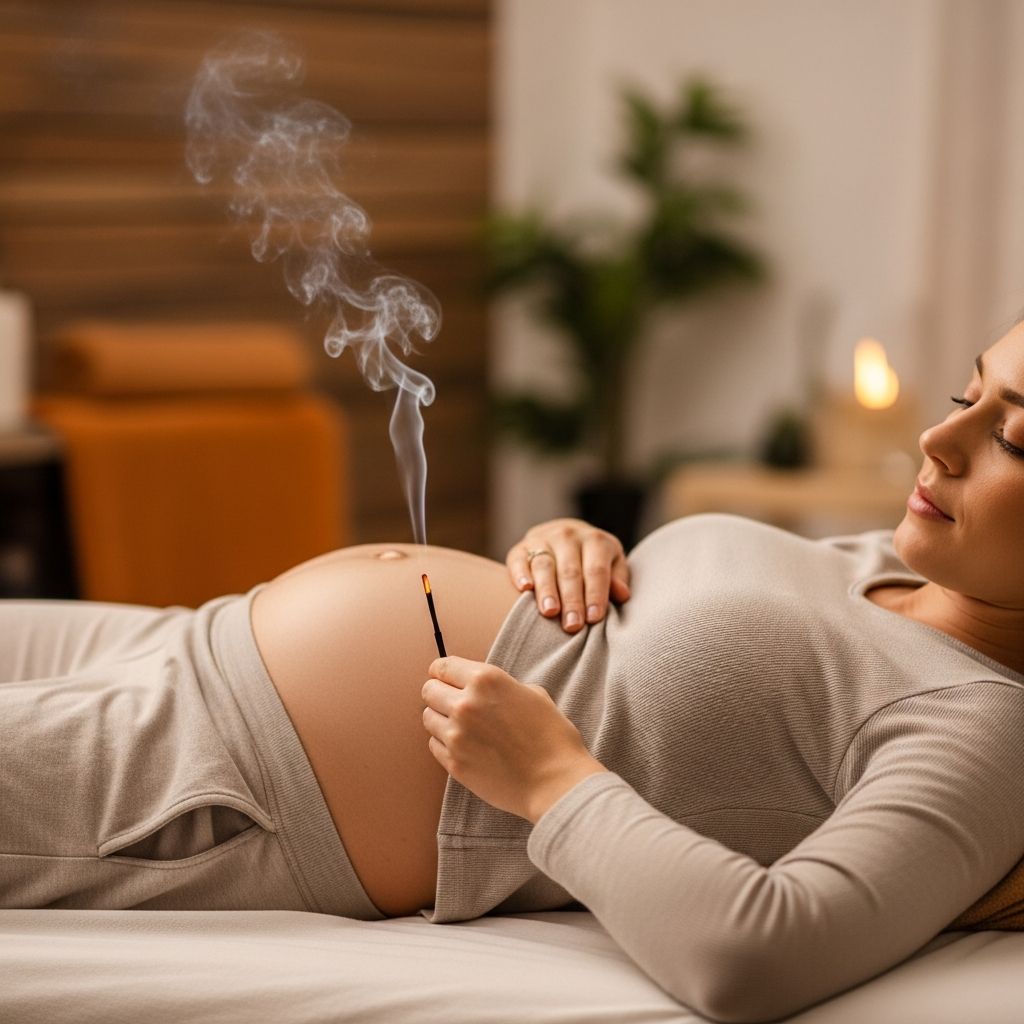
Moxibustion, a key element of traditional Chinese medicine, applies heat from burning mugwort to specific body points to encourage fetal repositioning from breech to head-down. Moderate-certainty evidence indicates it may lower non-cephalic birth rates when added to standard care.
Understanding Breech Presentation Challenges
Breech presentation occurs when the baby positions buttocks or feet first, affecting 3-4% of term pregnancies. This raises cesarean delivery risks, as vaginal birth becomes complex. External cephalic version (ECV) attempts manual turning around 36-37 weeks, but success varies at 50-60%.
Expectant parents seek non-invasive options like moxibustion, rooted in stimulating energy flow (qi) via heat at acupuncture points, notably BL67 near the outer pinky toe. This aims to boost uterine tone and fetal activity for natural rotation.
Core Principles of Moxibustion Therapy
Derived from “moxa” (mugwort, Artemisia vulgaris) combustion, this technique avoids needles, using indirect heat via sticks or cones held near skin. Sessions last 10-20 minutes daily for 7-14 days, starting 32-36 weeks gestation.
Therapists target meridians to dispel “cold” and invigorate blood flow, potentially relaxing pelvic muscles and enhancing baby flips. Unlike acupuncture, warmth penetrates deeply without skin breach.
Scientific Evidence on Effectiveness
Cochrane analysis of 7 trials (1152 women) shows moxibustion plus usual care yields moderate-certainty evidence of reduced non-cephalic births (RR 0.87, 95% CI 0.78-0.99). Versus sham, one trial (272 women) reports similar benefits (RR 0.74, 95% CI 0.58-0.95), hinting specific effects.
No strong reduction in cesarean rates (RR 0.84-1.04), but lower oxytocin use during labor (RR 0.28, 95% CI 0.13-0.60). Combined with acupuncture, small studies suggest cesarean drops (RR 0.80), though evidence quality limits conclusions. A randomized trial confirms efficacy when paired with ECV.
| Comparison | Trials/Women | Effect (RR, 95% CI) | Evidence Certainty |
|---|---|---|---|
| Non-cephalic at birth vs. usual care | 7/1152 | 0.87 (0.78-0.99) | Moderate |
| ECV need | 4/692 | 0.62 (0.32-1.21) | Low |
| Cesarean vs. sham | 1/272 | 0.84 (0.68-1.04) | Moderate |
| Oxytocin use | 1/260 | 0.28 (0.13-0.60) | Moderate |
How Moxibustion Sessions Work
Treatment begins with point location: BL67 bilaterally. Patient lies comfortably; practitioner lights moxa stick, holding 1-2 inches from skin until warm (not burning). Rotate positions for even heat.
- Duration: 15-30 minutes per foot, twice daily.
- Frequency: 10-14 consecutive days.
- Posture aids: Bridge pose or hands-knees to gravity-assist turning.
- Self-administration: Trained patients use at-home kits under guidance.
Monitor fetal movements; increased activity signals response. Professional oversight ensures safety.
Broad Pregnancy Benefits Beyond Breech
Moxibustion eases multiple discomforts. It counters fatigue, joint pain, and digestive issues like IBS by warming yang energy. For fertility, it addresses cysts; during gestation, fights colds via cold-dispersal.
Studies note heightened fetal activity aiding position shifts. NHS guidelines endorse for breech, citing uterine muscle toning.
Potential Risks and Safety Considerations
Common effects: heightened fetal motion, mild contractions, nausea, headaches—often transient. Rare burns from improper use cause scarring or infection.
Systematic review of 64 cases flags allergies, vomiting, fetal distress, premature birth, even death (rare). Smoke may irritate; avoid in asthma. Pregnancy precautions: No use if prior C-section, low placenta, bleeding, or ruptured membranes.
| Event | Frequency | Source |
|---|---|---|
| Increased fetal movements | Most common | Cochrane |
| Uterine contractions (mild) | Frequent | NHS |
| Burns/scarring | Reported | Reviews |
| Nausea/headache | Common | Trials |
| Fetal distress/preterm | Rare | Case reports |
Direct moxa heightens burn risk; prefer indirect. Inform providers of pregnancy. Adverse reporting gaps in trials urge caution.
Who Should Consider This Therapy
- Singleton breech at 32-36 weeks.
- No contraindications like growth restriction or bleeding.
- Preference for drug-free options pre-ECV.
Consult obstetricians; integrate with prenatal care. Licensed practitioners minimize risks.
Practical Tips for Best Results
- Seek certified TCM providers experienced in obstetrics.
- Combine with postural techniques: knee-chest position 3x daily.
- Track baby position via ultrasound follow-ups.
- Hydrate, avoid smoke exposure.
- Stop if discomfort or reduced movements; seek medical help.
Success hinges on early start, consistency, and holistic approach.
Frequently Asked Questions
Is moxibustion safe during pregnancy?
Generally safe for breech correction 32-37 weeks under guidance, with mild side effects like contractions common but no serious concerns per NHS. Avoid contraindicated cases.
How many sessions to turn a breech baby?
Typically 10-14 daily sessions of 20 minutes each, starting before 37 weeks for optimal fetal movement stimulation.
Does moxibustion reduce C-sections?
Probably not significantly; moderate evidence shows little difference versus sham or usual care.
Can I do moxibustion at home?
Yes, after professional training to avoid burns; use indirect method and monitor closely.
What if moxibustion fails?
Proceed to ECV or plan cesarean; it may still ease labor via reduced oxytocin need.
Expert Perspectives and Future Research
Integrative medicine grows; moxibustion complements Western care. Gaps persist in long-term safety, optimal protocols. Ongoing trials refine protocols, emphasizing standardized reporting.
Parents weigh evidence: 13% relative risk reduction for head-down birth appeals, balanced against minor risks. Shared decision-making empowers choices.
References
- Moxibustion Can Help with Your Pregnancy — Acupuncture Mama. Accessed 2026. https://acupuncturemama.com/how-moxibustion-can-be-beneficial-for-pregnancy/
- Moxibustion for turning a baby in breech position — Cochrane. 2020 (updated). https://www.cochrane.org/evidence/CD003928_moxibustion-turning-baby-breech-position
- Safety of Moxibustion: A Systematic Review of Case Reports — Wiley Online Library. 2014-11-27. https://onlinelibrary.wiley.com/doi/10.1155/2014/783704
- Moxibustion: What Is It and Does It Work? — Cleveland Clinic. Accessed 2026. https://health.clevelandclinic.org/moxibustion
- Moxibustion: Definition, Technique, Benefits, and Risk Factors — WebMD. Accessed 2026. https://www.webmd.com/balance/what-is-moxibustion
- Moxibustion — Maidstone and Tunbridge Wells NHS Trust. 2016-11. https://www.mtw.nhs.uk/wp-content/uploads/2016/11/Moxibustion-RWF-OPLF-PWC107.pdf
- Moxibustion for Correction of Breech Presentation: A Randomized Controlled Trial — JAMA. 2000. https://jamanetwork.com/journals/jama/fullarticle/188144