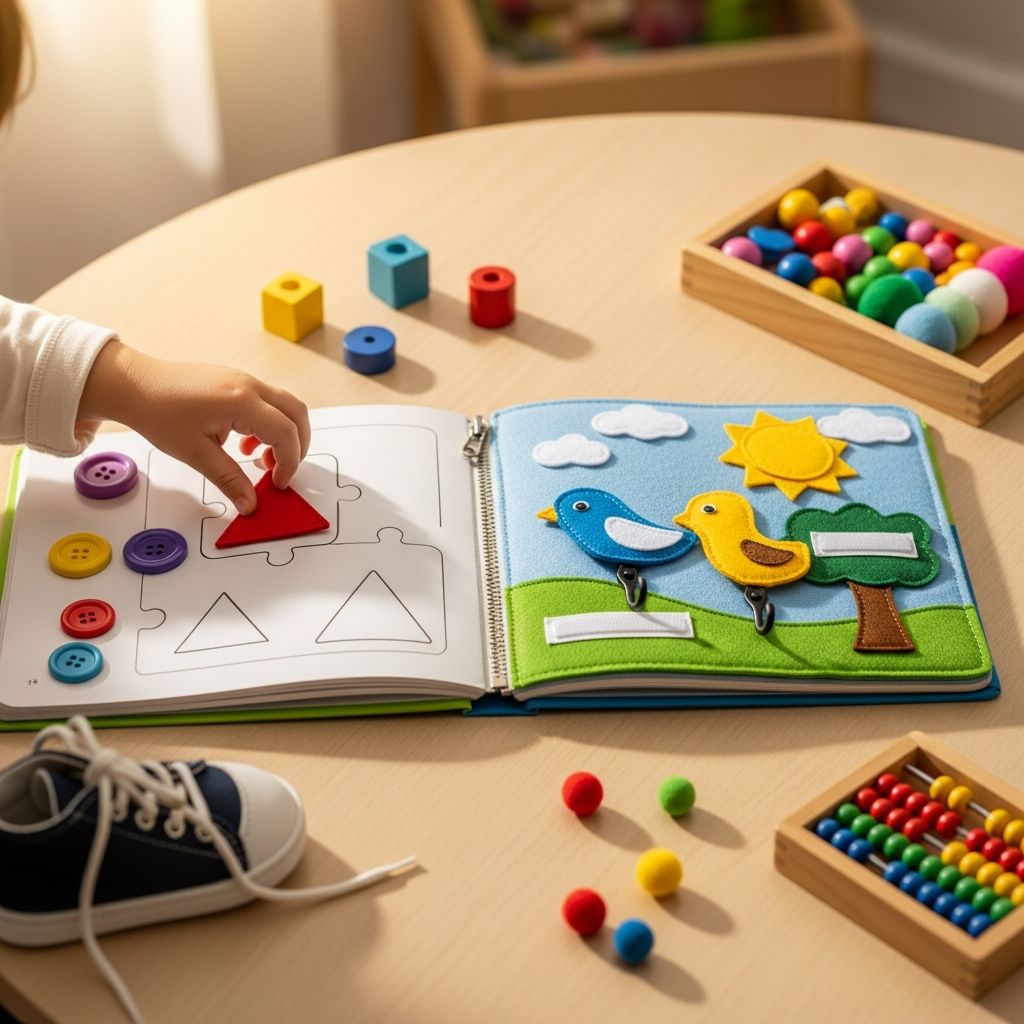
Montessori busy books are portable, interactive activity binders designed to engage young children in self-directed learning. These tools draw from Montessori principles, emphasizing hands-on exploration to develop practical skills, independence, and curiosity in toddlers aged 2 to 6.
Understanding the Montessori Philosophy Behind Busy Books
The Montessori method, developed by Dr. Maria Montessori, prioritizes child-led learning in prepared environments that encourage natural discovery. Busy books embody this by offering compact, multi-page activities that mimic real-life tasks, allowing children to manipulate objects like zippers, buttons, and snaps at their own pace.
Unlike traditional worksheets, these books transform passive observation into active participation. Children build confidence as they master challenges independently, aligning with Montessori’s focus on intrinsic motivation rather than external rewards. This approach supports holistic development, integrating sensory, motor, and cognitive growth seamlessly.
Core Elements That Make Busy Books Effective
At their heart, Montessori busy books feature durable, felt or fabric pages with practical life simulations. Common components include:
- Lacing and threading: Develops hand-eye coordination and sequencing skills.
- Fasteners practice: Zipping, buttoning, buckling to refine pincer grasp and dexterity.
- Matching and sorting: Color, shape, or pattern recognition to boost cognitive processing.
- Sensory panels: Textures, flaps, and pockets for tactile exploration.
- Simple puzzles: Sliding pieces or shape sorters for problem-solving.
These elements are modular, enabling parents to customize pages based on a child’s interests or milestones. Portability makes them ideal for travel, waiting rooms, or quiet time, ensuring learning opportunities anywhere.
Key Developmental Benefits for Young Learners
Montessori busy books deliver targeted advantages across multiple domains, backed by educational research on play-based learning.
Boosting Fine Motor Skills and Coordination
Activities requiring precise manipulation strengthen small hand muscles, crucial for later tasks like writing or self-feeding. Regular use improves hand-eye coordination, with children progressing from fumbling to fluid motions.
Fostering Independence and Self-Confidence
Self-contained designs encourage solo play, teaching persistence and autonomy. Completing a zipper or puzzle instills pride, reducing reliance on adult intervention and building emotional resilience.
Enhancing Cognitive and Problem-Solving Abilities
Tasks demand logical thinking, memory, and pattern recognition. Sorting shapes or sequencing laces sharpens focus and critical reasoning, preparing preschoolers for academic challenges.
Promoting Sensory Integration and Creativity
Diverse textures and visuals stimulate sensory processing, while open-ended elements spark imagination. Children extend play beyond pages, inventing stories or combining activities creatively.
Supporting Language and Social Skills
Themed pages (e.g., animals, daily routines) introduce vocabulary through labeling and narration. Parent-child discussions during play enhance communication and emotional expression.
Quick Comparison of Benefits:
| Skill Area | Busy Book Activity Example | Long-Term Outcome |
|---|---|---|
| Fine Motor | Buttoning a shirt flap | Improved handwriting readiness |
| Cognitive | Shape matching puzzle | Better problem-solving |
| Emotional | Independent task completion | Increased self-esteem |
| Sensory | Texture exploration | Enhanced sensory awareness |
Age-Appropriate Ways to Introduce Busy Books
Tailor usage to developmental stages for maximum engagement.
For 2-3 Year Olds: Simple Sensory Starts
Begin with large, easy-grasp fasteners and bold colors. Focus on one or two pages daily for 10-15 minutes to avoid overwhelm. Supervise to model techniques, then step back.
For 4-5 Year Olds: Complex Challenges
Introduce multi-step sequences like dressing a doll or counting games. Extend sessions to 20-30 minutes, encouraging verbal narration to build language.
For 5-6 Year Olds: Advanced Integration
Incorporate math concepts (e.g., number lacing) or storytelling prompts. Rotate pages weekly to maintain novelty and skill progression.
Pro tip: Rotate books bi-weekly to sustain interest and track progress with a simple journal noting mastered skills.
DIY Guide: Crafting Your Own Montessori Busy Book
Creating a custom busy book is affordable and therapeutic. Materials needed: heavy felt sheets, Velcro, zippers, buttons, embroidery floss, and scissors.
- Plan themes: Choose 8-12 pages around routines like ‘morning prep’ or ‘kitchen helpers.’
- Cut and assemble bases: Stitch or glue felt pages to a binder ring or folder.
- Add interactives: Sew on fasteners securely, ensuring no small loose parts.
- Incorporate printables: Laminate matching cards or numbers for reusability.
- Test safety: Washable, non-toxic, and choke-proof for toddlers.
Online templates abound, but personalize with family photos or cultural motifs for deeper connection.
Integrating Busy Books into Daily Routines
Seamlessly weave them into life for consistent growth.
- Morning warm-up: Practice dressing skills before outings.
- Travel companion: Quiet entertainment for car rides or flights.
- Pre-nap wind-down: Calming focus activities to ease transitions.
- Family learning time: Group extensions like group sorting games.
Aim for 20-30 minutes daily to balance with free play, preventing over-reliance.
Real Parent Experiences and Expert Insights
Parents report toddlers staying engaged 2-3x longer than with toys, with noticeable dexterity gains in months. Montessori educators praise them for bridging home-classroom learning, aligning with prepared environment ideals. One review noted: ‘My 3-year-old now zips her jacket solo—huge win!’
Frequently Asked Questions
What age are Montessori busy books best for?
Ideal for 2-6 year olds, with simpler pages for younger toddlers and advanced tasks for preschoolers.
How long should sessions last?
20-30 minutes daily maximizes benefits without fatigue.
Are they worth the investment?
Yes—durable ones last years, outperforming disposable toys in skill-building.
Can I make one myself?
Absolutely; DIY versions are customizable and cost-effective.
Do they replace formal education?
No, they supplement by building foundational skills for school readiness.
References
- Montessori Busy Book — Little Cloudy. 2023-05-15. https://little-cloudy.com/blogs/quiet-books/montessori-busy-book-1
- Montessori Busy Book For Kids To Develop Learning Skills — Little Cloudy. 2023-07-20. https://little-cloudy.com/blogs/quiet-books/montessori-busy-book-for-kids-to-develop-learning-skills
- Are Busy Books Worth It? A Parent’s Honest Review — JoyCat. 2024-01-10. https://joycat.com/blogs/article/are-busy-books-worth-it-a-parent-s-honest-review
- Top Benefits of Using Busy Books for Children — The Toddler House. 2023-11-05. https://thetoddlerhouse.in/blogs/busy-book/top-benefits-of-using-busy-books-for-children
- An Introduction to Busy Books — Hi Buy Mama. 2023-09-12. https://hibuymama.com/blogs/news/why-busy-books-an-introduction-to-busy-books
- The Science of Play: How Montessori Education and Busy Books Unlock a Child’s Potential — My First Book. 2024-02-28. https://myfirstbook.us/blogs/busy-book-blogs/the-science-of-play-how-montessori-education-and-busy-books-unlock-a-childs-potential