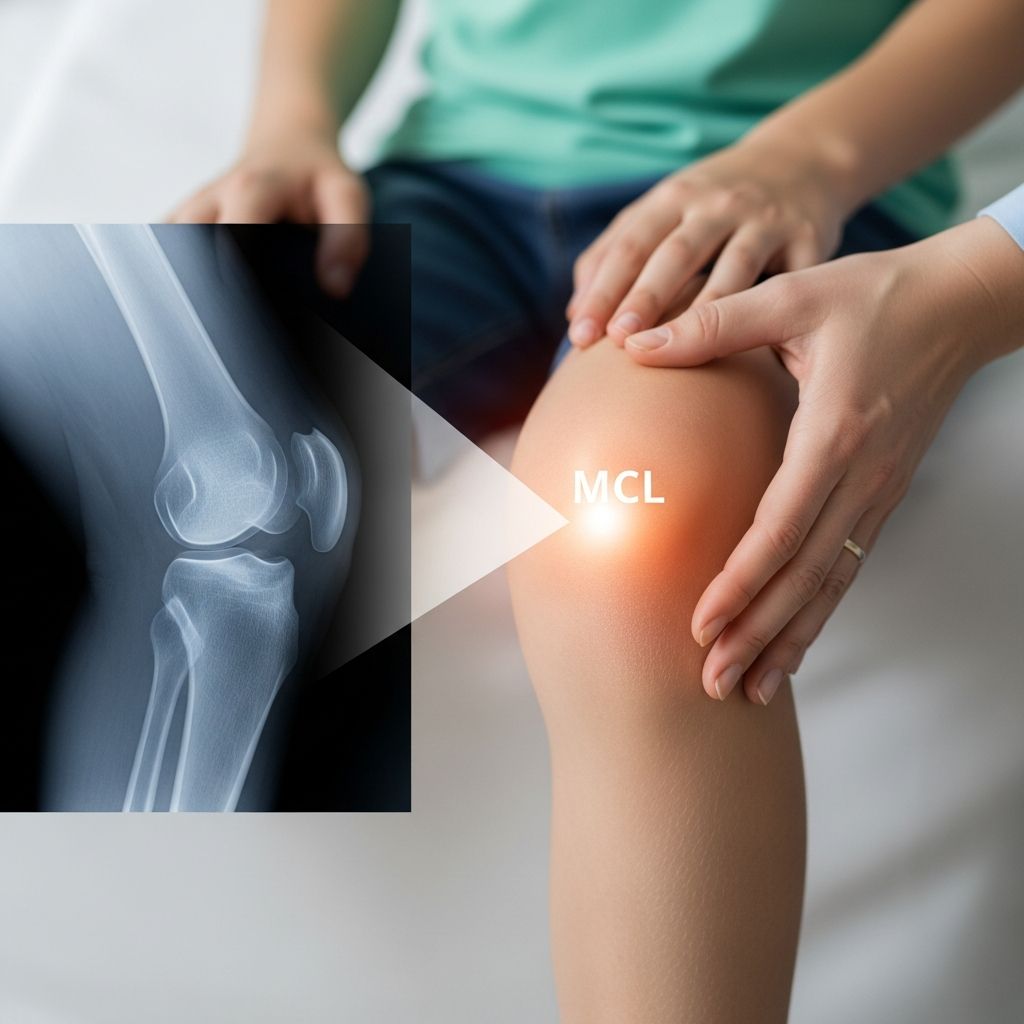
The medial collateral ligament (MCL) is one of the key stabilizing structures on the inner side of the knee, and it is a common site of injury for active children and teenagers who run, jump, and play sports.
What Is the MCL and Why Does It Matter?
The MCL is a strong band of tissue that connects the thighbone to the shinbone along the inner edge of the knee, helping to keep the joint from buckling inward. When this ligament is stretched beyond its normal limits or torn, kids can develop pain, swelling, and a feeling that the knee is not stable.
Because the MCL controls side-to-side stability, an injury to this ligament can make everyday activities like walking, climbing stairs, or getting in and out of a car uncomfortable or even impossible for a while. Understanding what the MCL does helps parents recognize why a seemingly small twist or blow to the knee can cause such a big problem for a young athlete.
- The MCL runs along the inside (medial side) of the knee joint.
- It resists forces that push the lower leg outward, preventing the knee from caving inward.
- It works together with other ligaments and muscles to keep the knee steady during quick changes in direction.
How MCL Injuries Happen in Young Athletes
MCL injuries usually occur when a force pushes the lower leg outward while the upper leg stays in place, stretching the ligament on the inside of the knee. This is especially common in contact sports and activities that involve cutting, pivoting, or sudden changes of direction.
Although adults and teens can injure the MCL in similar ways, younger children may be slightly less prone to pure ligament tears because their growth plates can be more vulnerable than the ligament itself. However, as kids grow into pre-teens and teens, the risk of true MCL sprains and tears increases, especially with higher levels of competition.
Common Situations That Lead to MCL Injury
- Being hit on the outer side of the knee during football, soccer, hockey, or basketball.
- Twisting the knee while the foot is planted, such as when pivoting or cutting.
- Landing awkwardly from a jump with the knee collapsing inward.
- Skiing falls where the lower leg twists outward relative to the thigh.
Non-sport injuries can also occur, such as slipping on ice or tripping over an object and landing with the knee bent awkwardly. Whenever the knee is forced inward suddenly, the MCL is placed at risk.
Grades of MCL Injury: From Mild Sprain to Complete Tear
Doctors often classify MCL injuries into three main grades based on how much the ligament fibers have been damaged. This grading helps guide treatment decisions and gives families a rough idea of what to expect for recovery time.
| Grade | Description | Typical Symptoms | Approximate Recovery Range* |
|---|---|---|---|
| Grade 1 | Mild overstretching of the ligament without significant tearing. | Mild inner-knee pain, slight tenderness, minimal or no swelling, knee usually feels stable. | About 1–3 weeks, depending on the child and activity level. |
| Grade 2 | Partial tear of the ligament fibers. | Moderate pain and swelling on the inner knee, some looseness or sense of “giving way,” difficulty with cutting or pivoting. | Roughly 3–6 weeks or more, especially for return to sports. |
| Grade 3 | Complete (full-thickness) tear of the ligament. | Significant pain and swelling, marked instability, walking may be very painful or limited. | Often 6–12 weeks or longer; sometimes associated with other ligament injuries. |
*Recovery ranges are general estimates and can vary widely based on age, overall health, other injuries, and adherence to rehabilitation.
Signs and Symptoms Parents Should Watch For
Right after an MCL injury, some kids report feeling a popping or snapping sensation on the inner side of the knee, followed quickly by pain. Swelling can develop within minutes to hours and may make it hard to fully bend or straighten the leg.
- Pain along the inner edge of the knee, especially when pressing on the area.
- Swelling or puffiness around the inside of the joint.
- Stiffness or a feeling that the knee does not move as smoothly as usual.
- Sensation that the knee may buckle, wobble, or “give way” when walking or changing direction.
- Difficulty bearing weight, squatting, or using stairs.
In more severe injuries, a child may be unable or unwilling to walk, and the knee can look visibly puffy or bruised on the inner side. Even if the child can still put some weight on the leg, persistent pain or instability after a knee injury warrants medical evaluation.
When to Seek Medical Care for a Suspected MCL Injury
Any child or teen who has significant knee pain, swelling, or trouble walking after an injury should be seen by a healthcare professional. Early assessment helps rule out fractures, growth plate injuries, and other ligament damage such as an ACL tear or meniscus injury.
Parents should not rely on the child’s ability to walk as proof that the injury is minor, because some lower-grade MCL tears still allow limited walking, especially after the initial swelling subsides. When in doubt, it is safer to rest the knee, avoid sports, and schedule a prompt evaluation.
Red-Flag Symptoms Requiring Urgent Attention
- Severe pain that does not improve with rest and ice.
- Large, rapid swelling that appears within a short time after the injury.
- Inability to put weight on the leg or stand.
- Obvious deformity or the feeling that the knee is stuck and will not move.
- Numbness, tingling, or coldness in the lower leg or foot.
How Doctors Diagnose MCL Injuries in Children
Diagnosis usually begins with a careful history and physical examination, during which the clinician asks how the injury happened and what the child felt at the moment of impact. The doctor then gently checks the range of motion, areas of tenderness, and the stability of the knee by applying controlled pressure from different directions.
Imaging tests may be used to confirm the diagnosis or rule out other problems. X-rays help detect fractures or growth plate injuries, and they are particularly important in growing children. An MRI can show the exact location and severity of the MCL tear and reveal any associated injuries to other ligaments or the meniscus.
Key Elements of the Evaluation
- Medical history, including sports participation and previous knee injuries.
- Hands-on stability tests to assess how much the knee opens on the inner side.
- Assessment of swelling, bruising, and range of motion.
- Imaging, when needed, to clarify the extent of damage.
Treatment Options: From Home Care to Advanced Therapies
Most isolated MCL injuries in children and teens can be managed without surgery, especially lower-grade sprains and partial tears. The primary goals of treatment are to reduce pain and swelling, protect the healing ligament, restore strength and motion, and gradually return the child to normal activities and sports.
Early Care in the First Few Days
In the first 48–72 hours, basic home care measures are often recommended, unless the injury is clearly severe or accompanied by concerning symptoms. Parents should always confirm treatment steps with the child’s healthcare provider, but typical early strategies include:
- Rest: Limiting activities that cause pain, especially running, jumping, and sports.
- Ice: Applying a cold pack wrapped in a thin cloth to the inner knee for about 15–20 minutes at a time, several times per day.
- Compression: Using an elastic bandage or soft brace, if recommended, to help control swelling.
- Elevation: Propping the leg up on a pillow so the knee is above the level of the heart when resting.
- Pain relief: Using medications only as prescribed or approved by the child’s doctor.
Bracing, Crutches, and Physical Therapy
Depending on the grade of injury, a child may be given a hinged knee brace that protects the inner side of the knee while allowing gentle bending and straightening. Some kids will also use crutches temporarily to reduce the load on the injured leg and allow the ligament to begin healing.
As pain and swelling improve, structured physical therapy often becomes the focus. A pediatric physical therapist can guide the child through exercises to restore motion, build strength in the quadriceps and hamstrings, and retrain balance and coordination. This step is critical for reducing the risk of re-injury once the child returns to sports.
Is Surgery Ever Needed for MCL Tears in Kids?
For many children and teens, even moderate MCL tears heal well with non-surgical treatment, especially when the injury is isolated and the ligament ends are still reasonably aligned. Surgery is less common for pure MCL injuries in young people compared with some other knee ligaments.
However, surgery may be discussed in particular situations, such as when there is a complete tear with significant instability, the ligament has pulled away from the bone in a way that will not heal well on its own, or when the MCL tear occurs together with major injuries to other ligaments like the ACL. Orthopedic surgeons weigh the child’s age, level of activity, and overall knee stability to decide whether operative repair or reconstruction is appropriate.
Recovery Timeline: What Parents Can Expect
Recovery from an MCL injury is a gradual process and varies with the severity of the tear, the presence of other injuries, and how quickly treatment begins. Mild sprains may improve significantly within a couple of weeks, while more serious tears can require several months before full sports participation is safe.
Parents often find it helpful to think of recovery as a series of stages rather than a fixed number of days. Some children progress quickly, while others need more time to rebuild confidence and strength, particularly after a painful injury that briefly sidelined them from activities they love.
Typical Phases of Recovery
- Acute phase: Focus on pain and swelling control, gentle movement as allowed, and protecting the ligament.
- Subacute phase: Gradual increase in range-of-motion exercises, light strengthening, and walking tolerance.
- Strength and control phase: More challenging exercises to restore muscle power, balance, and joint control.
- Return-to-sport phase: Sport-specific drills, supervised practice, and eventually full participation once cleared.
Returning Safely to Sports and Physical Activities
The decision to return to sports should be made jointly by the child, parents, and healthcare team, often including the physical therapist and the sports medicine physician or orthopedic specialist. Rushing back too soon can increase the chance of re-injury or make the child fearful of using the knee normally.
Before full return to competition, most experts recommend that the child be able to jog, sprint, cut, and jump without pain or a feeling of instability. Strength and flexibility should be close to or equal to the uninjured leg, and the child should feel confident performing sport-specific movements such as kicking, pivoting, or landing from a jump.
Questions to Ask Before Sport Clearance
- Can my child run, stop, and change direction without pain?
- Does the injured knee feel as strong and steady as the other knee?
- Has a healthcare provider or physical therapist tested my child’s balance and strength?
- Is there a plan to gradually increase practice intensity instead of jumping straight into full games?
Emotional Impact: Supporting an Injured Young Athlete
For many kids and teens, sports are a central part of their identity, social life, and daily routine. Being sidelined by an MCL injury can lead to frustration, sadness, or worry about losing their place on the team or falling behind friends.
Parents can help by acknowledging these feelings, maintaining open communication with coaches, and encouraging healthy ways to stay involved and connected. For example, a child might keep the scorebook, help with drills that do not stress the knee, or focus on upper-body conditioning and schoolwork during the recovery period.
- Reassure your child that taking time to heal now protects their long-term ability to play.
- Celebrate small milestones, like walking without a limp or completing a new exercise at therapy.
- Consider new hobbies or interests that do not involve intense knee loading.
Preventing Future MCL Injuries
No strategy can completely eliminate the risk of sports injuries, but parents, coaches, and young athletes can take steps to reduce the chance of another MCL problem. Preventive measures focus on proper technique, muscle strength, flexibility, and smart training habits.
Practical Prevention Tips
- Encourage a dynamic warm-up with light jogging, leg swings, and movement drills before practices and games.
- Promote strength training programs that target the hips, thighs, and core to support knee stability.
- Teach and reinforce proper landing technique with knees aligned over the feet, not collapsing inward.
- Support regular rest days and seasonal breaks to avoid overuse and fatigue-related injuries.
- Ensure that shoes and field surfaces are appropriate for the sport and in good condition.
For some athletes who have had a significant MCL injury, wearing a sport-appropriate knee brace during the initial return-to-play period may be recommended. Ongoing communication with healthcare providers and coaches helps tailor prevention strategies to the child’s specific sport and position.
Frequently Asked Questions about MCL Injuries in Kids
1. Can my child walk with an MCL tear?
Some children with mild or moderate MCL injuries can still walk, although it may be uncomfortable and the knee may feel unsteady. The ability to walk does not rule out a significant ligament injury, so any persistent pain or limp after a knee injury should be evaluated.
2. How long before my child can play sports again?
Return-to-sport timelines depend heavily on the grade of the injury, the child’s overall health, and whether other structures in the knee were damaged. Mild sprains might allow a return within a few weeks, while more serious tears often require several months of structured rehabilitation before full participation is considered safe.
3. Will an MCL injury affect my child’s growth?
Most isolated MCL injuries do not directly interfere with growth, especially when treated promptly and appropriately. However, injuries that involve the growth plates or multiple structures in the knee require close monitoring by specialists to ensure that the joint develops normally over time.
4. Is physical therapy really necessary for a minor MCL sprain?
Even less severe sprains can benefit from at least a brief course of guided exercises, especially for active children who plan to return to running or jumping sports. Physical therapy helps restore strength and coordination and teaches safe movement patterns that can protect the knee in the future.
5. Can an MCL injury come back?
While many children fully recover and return to their previous level of activity, the risk of re-injury exists, particularly if the child returns too quickly or skips rehabilitation exercises. Maintaining strength, flexibility, and good technique, along with following medical advice on timing of return to sports, reduces this risk.
Understanding how MCL injuries happen, how they are treated, and how to support a child through recovery empowers parents to make informed decisions and advocate for safe, healthy sports participation. With timely care and a thoughtful return-to-play plan, most children and teens can get back to the activities they enjoy with a strong and stable knee.