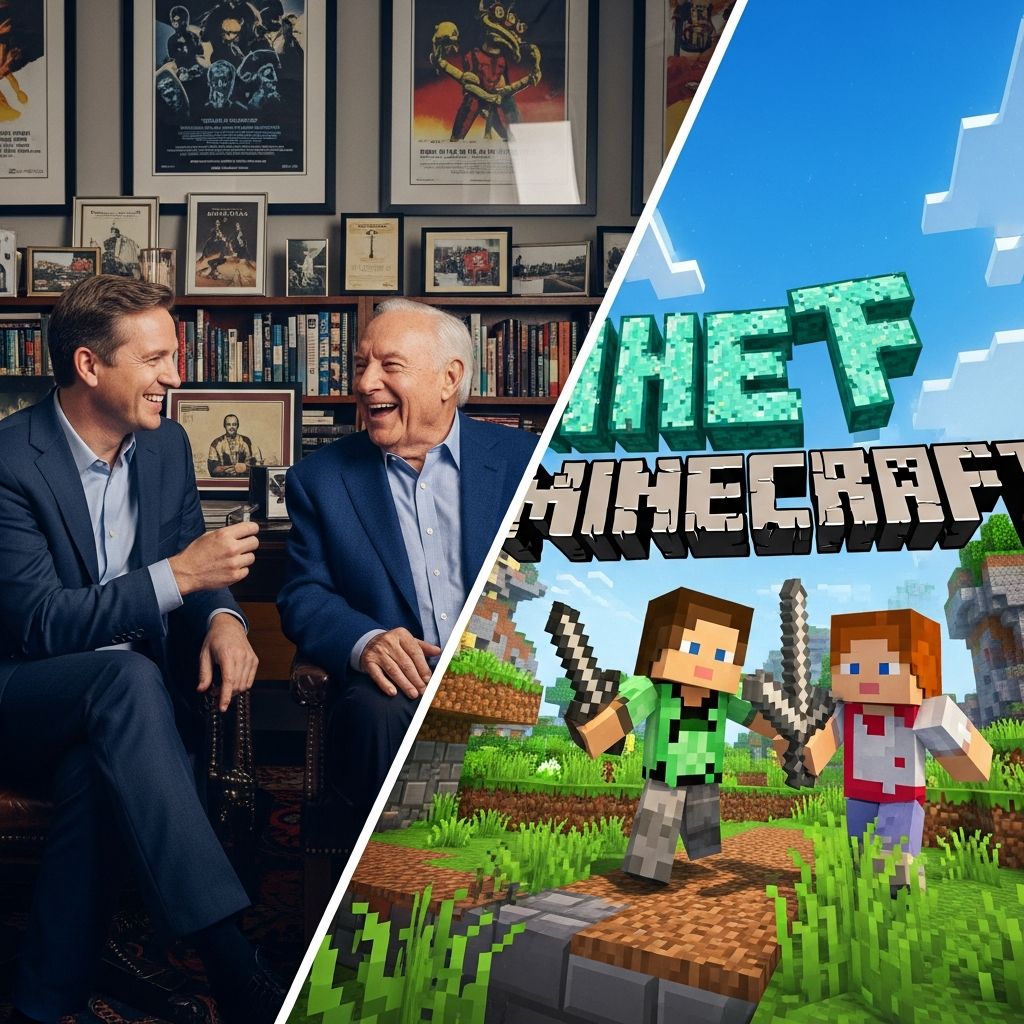
When a horror author known for zombie apocalypses writes an official novel about Minecraft, it sounds like a punchline his comedian father might deliver. Yet for Max Brooks, son of legendary filmmaker and comedian Mel Brooks, the journey from World War Z to the blocky world of Minecraft became a surprisingly tender story about family, fear, and how parents can connect with their kids through the things they love.
This article explores how Max Brooks blends humor, anxiety, and world-building, what his relationship with his father reveals about creative families, and how Minecraft became a bridge between generations—along with practical insights for parents navigating their kids’ digital obsessions.
The Unlikely Journey from Zombies to Blocks
Max Brooks first gained widespread recognition for turning zombie lore into thoughtful, meticulously researched fiction that felt eerily realistic. Rather than treating monsters as simple jump scares, he used them as a framework to explore government failures, human resilience, and the psychology of survival. His work showed that what looked like horror on the surface was really about people confronting their deepest fears.
Years later, Brooks surprised many readers by writing Minecraft: The Island, the first official novel based on the globally popular sandbox game. To some, it seemed like a sharp pivot from grim zombie warfare to a minimalist world of cubes and creepers, but he approached Minecraft with the same seriousness he brought to apocalyptic fiction: as a way to examine how an ordinary person adapts to a strange, unforgiving environment.
Growing Up Brooks: Comedy, Pressure, and Possibility
Being the child of Mel Brooks, one of the most influential comic filmmakers of the 20th century, meant that Max was born into an atmosphere of relentless wit, performance, and high expectations. Comedy wasn’t just a job in the Brooks household; it was a language, a shield, and sometimes a source of pressure. Mel’s wild energy and instinct for the punchline contrasted with Max’s more anxious, introspective temperament.
Instead of trying to imitate his father’s style, Max gradually developed his own creative identity through horror and speculative fiction. Where Mel weaponized laughter, Max leaned into dread and world-building, showing that children of famous parents don’t have to walk the same path to belong to the same creative lineage.
Two Generations, Two Kinds of Humor
If Mel Brooks specializes in breaking tension with outrageous gags, Max Brooks often creates tension and lets it sit just long enough to feel unsettling. Their tones may differ, but both father and son use humor as a way to approach topics that might otherwise feel overwhelming—war, prejudice, destruction, or failure. In both cases, jokes serve as a kind of emotional armor.
In conversations between them, the contrast is part of the charm. Mel tends to pounce on any opportunity for a bit, while Max often doubles as the straight man and the analyst, explaining his world-building choices with a seriousness that his father gleefully undercuts. Together, they demonstrate that humor doesn’t have one fixed form inside a family; each person can wield it differently and still be part of the same comedic ecosystem.
Minecraft as a Survival Story
Minecraft might look like a children’s pastime from the outside, but Max Brooks recognized it as a survival narrative hiding in plain sight. A lone character wakes up in a mysterious world, surrounded by danger, with only basic tools and a short amount of daylight to get ready for what comes next. It echoes the core question that drives much of his horror work: How do you stay alive in an environment that doesn’t care about you?
In writing about Minecraft, Brooks frames the player’s journey as a crash course in resilience and problem-solving. Every night survived, every shelter built, and every resource gathered reflects a series of choices about risk, preparation, and learning from mistakes. The game’s blocky simplicity becomes a low-stakes rehearsal for handling real-world uncertainty.
From Screen Time to Story Time: Parenting Lessons from a Pixelated World
For many parents, Minecraft can feel like a mysterious black box—an activity that absorbs their children’s focus but looks, from the outside, like mindless tapping and stacking. Brooks’s approach suggests a different perspective: instead of treating Minecraft as a distraction, see it as a living laboratory for creativity and collaboration. That shift in mindset opens space for honest, curiosity-driven conversations.
Parents don’t have to love the game itself to value what their kids are doing in it. Asking children to explain their builds, quests, or strategies turns screen time into story time. The child who once seemed “lost in a game” becomes a tour guide to a world they helped create, and that act of explanation builds confidence, communication skills, and emotional connection.
- Encourage kids to describe what they are building and why.
- Ask how they solve problems in the game—nightfall, enemies, scarce resources.
- Invite them to teach you basic controls, even if you feel clumsy.
- Use moments of in-game frustration to talk about persistence and coping with failure.
Fear, Anxiety, and the Safe Space of Fiction
Max Brooks has been open in other contexts about his struggles with anxiety and how worst-case scenarios tend to live rent-free in his imagination. That tendency might sound like a burden, but he found a way to turn it into fuel. By pouring his fears into meticulously constructed fictional worlds, he gained a sense of control over the things that kept him up at night.
In that sense, Minecraft and horror share an unexpected kinship: both provide bounded environments where danger is real but manageable. There is always another tool to craft, another wall to reinforce, another strategy to try. For anxious kids and adults alike, fictional survival challenges can function as rehearsal spaces for bravery, letting them experiment with courage without real-world consequences.
How Mel Brooks Helped Shape a World-Builder
While Max ultimately chose horror and speculative fiction over slapstick comedy, his father’s influence still runs through his work. Mel Brooks built movies that felt like entire worlds—historical epics turned inside out by absurdity, where no era or institution was too sacred to mock. That instinct to take big concepts and reshape them for maximum impact is something Max translated into his own style.
Instead of rearranging history for laughs, Max reassembles it as a cautionary tale. His fictional pandemics and global crises borrow structure from real events, then exaggerate them to highlight vulnerabilities in institutions and communities. Underneath the zombies and monsters lies the same question that fuels Mel’s comedies: What happens when human systems meet chaos, and how do people respond?
Table: Horror, Comedy, and Minecraft as Learning Tools
The Brooks family’s creative spectrum—from Mel’s films to Max’s novels to Minecraft’s open worlds—offers a useful way to think about how different kinds of storytelling help children and adults process the world.
| Medium | Primary Emotion | Core Lesson | How Families Can Use It |
|---|---|---|---|
| Classic Mel Brooks–style comedy | Laughter and relief | Nothing is too serious to question or play with. | Watch together and talk about how humor can defuse fear or tension. |
| Max Brooks–style horror and world-building | Tension and curiosity | Preparation, empathy, and strategy matter when systems break down. | Discuss what characters could have done differently and how to plan for crises. |
| Minecraft gameplay and stories | Wonder and engagement | Trial and error, resourcefulness, and creativity lead to growth. | Turn play sessions into chances for kids to explain choices and solve problems aloud. |
When Kids Are the Experts and Parents Are the Newbies
One of the most striking dynamics in modern families is the role-reversal that happens with technology. Children often master games and platforms faster than their parents, which can leave adults feeling excluded or defensive. Max Brooks’s willingness to step into the Minecraft universe, a space dominated by younger players, models a different approach: embrace the discomfort and let your child be the expert.
Instead of arguing about how much time kids spend in digital worlds, parents can ask to be guided through them. That simple act of humility—admitting you don’t know how something works and letting your child teach you—can soften power struggles and build trust. It tells kids their interests matter, not just their grades or chores.
The Power of Collaborative Storytelling
Minecraft, in both game and novel form, is essentially a collaborative story machine. The game sets the rules of physics and danger, but players decide what kind of narrative fills that framework: lonely survivalist, daring explorer, engineer, architect, prankster, or community builder. By adding officially licensed fiction to this ecosystem, Max Brooks turned player experiences into something richer and more reflective.
Families can mirror this process at home. After a play session, parents might invite kids to narrate their adventures as if they were chapters in a book or episodes in a series. Over time, these retellings help children see their digital actions as part of a larger narrative about persistence, creativity, and learning from errors—skills that transfer far beyond the screen.
Practical Ways Parents Can Use Minecraft and Storytelling
Parents who feel overwhelmed by their children’s love of Minecraft or other games don’t have to master every mechanic to make the most of them. A few simple habits can transform an activity that once felt isolating into a shared source of growth and bonding.
- Set shared goals: Plan a build together, like a house, farm, or town, and divide the tasks.
- Talk through tough moments: When a character dies or a structure is destroyed, ask how your child feels and what they might do differently next time.
- Blend analog and digital: Have kids sketch their builds on paper, outline a story about their character, or write a journal from the in-game perspective.
- Rotate roles: One session the child leads, another the parent suggests challenges or puzzles to solve.
- Connect to real-world skills: Point out when they are budgeting resources, planning ahead, or collaborating, and name those skills explicitly.
Frequently Asked Questions
Is Minecraft really educational, or is that just wishful thinking?
Minecraft is not a curriculum in a box, but it naturally encourages planning, spatial reasoning, experimentation, and basic systems thinking. Kids constantly form hypotheses, test them, and adjust their strategies in response to feedback from the game world. With a bit of guidance from adults, those habits can be linked directly to science, engineering, and problem-solving skills used in everyday life.
How can I connect with my child if I do not enjoy video games?
You do not have to become a gamer to show genuine curiosity. Focus on asking questions about why your child enjoys the game, what their proudest creations are, or which in-game moments were hardest. By centering the conversation on their experiences and emotions rather than the controls or graphics, you can share the heart of the activity without needing to love the medium itself.
What can parents learn from Max Brooks’s career path?
Max Brooks’s trajectory—from growing up under a legendary comedian to building a career in horror and speculative fiction—illustrates that children do not need to copy their parents’ talents to honor their legacy. What matters more is helping kids identify how their unique interests, even if they seem odd or niche, can be developed into strengths. Supporting curiosity and perseverance is more powerful than nudging kids toward a specific genre or profession.
How do I talk to my child about fear and anxiety using stories and games?
Fictional challenges offer a gentle doorway into heavy topics. When characters in games or books face danger or uncertainty, ask your child what they think those characters are feeling and what choices they have. These discussions help kids practice naming emotions, imagining solutions, and recognizing that fear is not a flaw but a signal that can be managed with preparation and support.
Can shared humor really help with serious family conversations?
Humor, whether in classic films or spontaneous family jokes, can make difficult subjects feel more approachable. Laughing together lowers defenses and creates a sense of safety, which makes it easier for kids to admit worries or mistakes. Used thoughtfully—not to dismiss concerns but to lighten the mood—it can be a powerful tool for connection and resilience.
Carrying the Torch in a Different Light
Max Brooks never tried to become a carbon copy of his father, and that is precisely what makes their relationship so compelling. Mel Brooks carved out a place in cultural history by laughing at the world’s absurdities, while Max turned to horror, history, and even Minecraft to confront its uncertainties. Both approaches, in their own way, help people cope with fear and chaos.
For families navigating a fast-changing, often overwhelming world, their story offers a hopeful lesson: it is possible to respect tradition while forging a new path, to use both jokes and monsters to teach resilience, and to turn even a pixelated landscape into a stage where parents and children learn, create, and grow together.