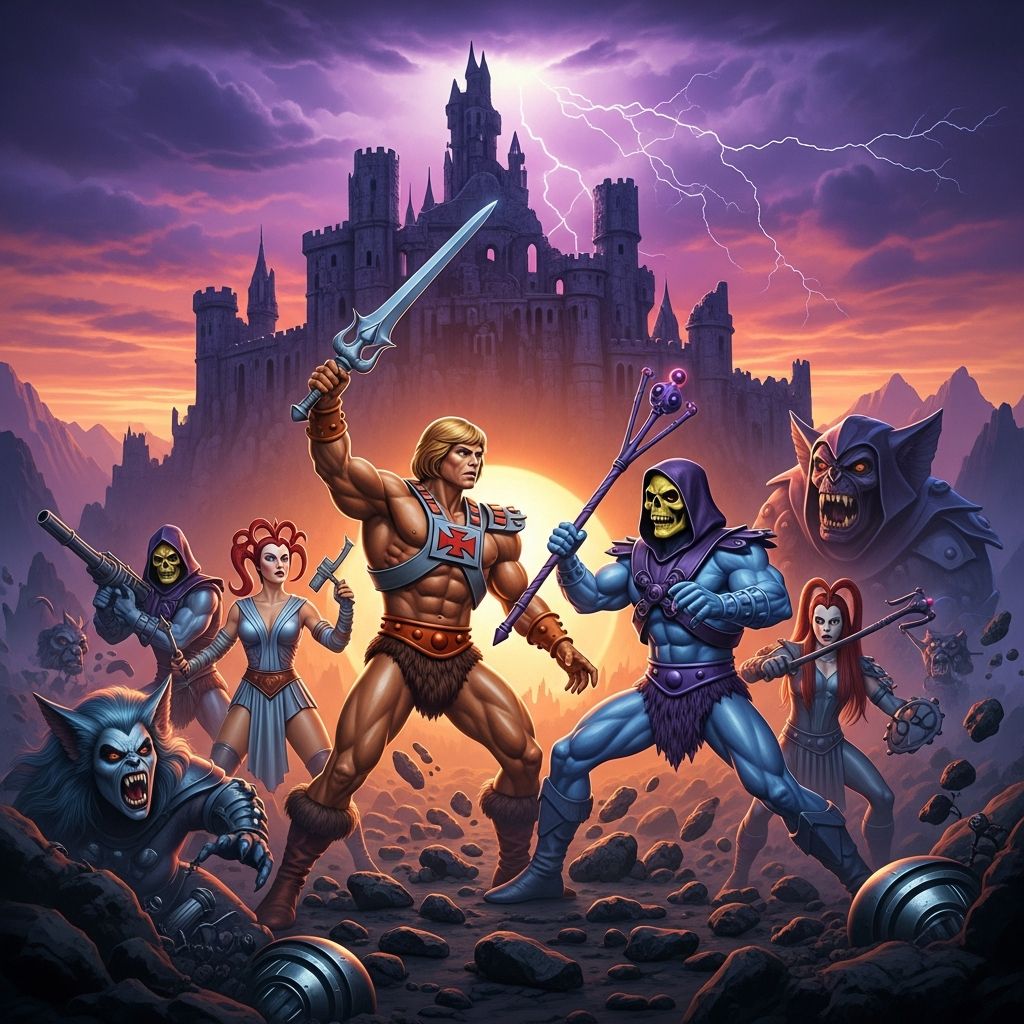
In 1987, Masters of the Universe attempted something ambitious: translate a wildly popular toy line and animated series into a live-action, big-screen space fantasy. The result was a movie that confounded critics, underwhelmed at the box office, yet quietly lodged itself in the memories of an entire generation. Today, it survives as a campy, colorful cult film that shows up on streaming menus and late-night movie marathons, inviting curious new viewers to discover a very different kind of comic-book-style adventure.
From Plastic Figures to Live-Action Spectacle
The film is based on Mattel’s He-Man and the Masters of the Universe toy line, which dominated the early 1980s children’s market and spawned a successful animated TV show. When the live-action movie entered production, the creative team faced a complicated task: honor a beloved toy-driven mythos while appealing to a broader, theatrical audience.
Instead of staying entirely on the fantastical planet Eternia, the film takes a hybrid approach. The opening leans heavily into space opera—a tyrant sorcerer, a besieged magical stronghold, shimmering armor and capes—before pivoting into a fish-out-of-water adventure set largely in small-town America.
- Studio backing: Produced by Cannon Films, known for lower-budget action movies and ambitious genre gambles.
- Source material: Mattel’s toy line and the Filmation animated series, with key characters and themes reinterpreted for live action.
- Tone: A blend of superhero earnestness, sci-fi fantasy, and broad, occasionally goofy humor.
Heroes, Villains, and Earthlings: Main Characters
One of the film’s lasting fascinations is its cast, blending comic-book archetypes with future stars in early roles.
The Eternian Champions
- He-Man (Dolph Lundgren): A stoic, superhuman warrior wielding the Sword of Grayskull. Lundgren, fresh from playing Ivan Drago in Rocky IV, brings sheer physical presence, even as he navigates heavily accented English and comic-book dialogue.
- Man-at-Arms (Duncan) and Teela: A veteran soldier and his daughter, loyal comrades-in-arms. They ground He-Man’s idealism with sarcasm and battlefield practicality.
- Gwildor: A new character created for the film, an eccentric inventor whose device—the Cosmic Key—can open portals across space and time.
The Forces of Skeletor
- Skeletor: A power-hungry warlord and sorcerer who has seized Castle Grayskull and captured the Sorceress, intending to drain her power and claim dominion over the universe.
- Evil-Lyn: His cunning lieutenant and sorceress, who commands mercenaries and Eternian troops on Earth and eventually questions her master’s self-serving rule.
- Mercenary henchmen: A colorful assortment of alien and mutant warriors, including the reptilian Saurod, the beastlike Beast Man, and the blade-wielding Blade, each designed to evoke the toy line’s visual flair.
The Earthbound Duo
- Julie Winston (Courteney Cox): A grieving high-school student whose parents died in a plane crash. She accidentally finds the Cosmic Key and becomes entangled in the intergalactic conflict.
- Kevin Corrigan: Julie’s boyfriend, an aspiring musician, who initially mistakes the Key for a strange synthesizer and unwittingly activates it, signaling Skeletor’s forces.
- Detective Lubic: An irritable small-town cop who stumbles into the cosmic war and provides both skepticism and comic relief.
Plot in Brief: From Castle Grayskull to Suburban Streets
The narrative plays like a mash-up of space-fantasy epic and 1980s teen adventure. Here is a streamlined overview of the storyline as established by the film’s plot summaries.
| Story Beat | What Happens |
|---|---|
| Eternia Under Siege | Skeletor conquers Castle Grayskull and imprisons the Sorceress, planning to absorb her power during a cosmic alignment. |
| The Escape | He-Man, Man-at-Arms, Teela, and Gwildor escape using Gwildor’s prototype Cosmic Key, opening a portal that sends them to Earth. |
| Earthbound Confusion | The heroes lose the Key upon arrival. Julie and Kevin find it, thinking it is a musical device. |
| Skeletor’s Hunt | Evil-Lyn and mercenaries track the Key to Earth, clash with He-Man, and repeatedly battle around Julie and Kevin’s town. |
| Capture and Sacrifice | In a major confrontation, Julie is injured, the Key’s stored coordinates are erased, and He-Man surrenders to save his friends. |
| Return to Grayskull | Kevin and Gwildor reconstruct the Key’s musical signal, sending the group back to Eternia for a final showdown. |
| Final Duel | He-Man breaks Skeletor’s empowered staff, frees the Sorceress, and defeats his enemy in single combat. |
| Time-Twisting Epilogue | Julie finds herself back on the day of her parents’ planned flight and prevents the accident, hinting that the Key can alter time. |
Why It Looked So Different from the Cartoon
Long-time fans often notice that the movie’s tone and design diverge from the animated series and many of the toys. These changes stem partly from budget limits and partly from creative choices by the filmmakers and Cannon Films.
- Shift to Earth: Setting much of the story in contemporary America was less expensive than staging all action on an elaborate fantasy world, enabling the production to reuse familiar streets, schools, and shops instead of constructing entire alien landscapes.
- New characters and omissions: Several fan-favorite characters from the cartoon do not appear, replaced by original creations such as Gwildor and Blade. This allowed the production to design costumes and abilities that suited the stunt team, the budget, and makeup technology of the time.
- Darker visual style: The film opts for a more muted, shadowy aesthetic reminiscent of 1980s dark fantasy and science fiction, closer to Star Wars and Krull than to Saturday-morning animation.
Performances and Iconic Casting
The casting choices have become part of the movie’s legend, especially as several actors later found more mainstream success.
Dolph Lundgren as a Live-Action He-Man
Lundgren’s performance is primarily physical: towering physique, action choreography, and a near-mythic, stoic demeanor. His line delivery, shaped by his Swedish accent and early-career experience, sparked criticism at the time, but for many fans it enhances the movie’s pulpy, comic-book feel.
Courteney Cox Before Central Perk
Years before Friends, Courteney Cox plays Julie as an earnest, emotionally bruised teenager dealing with guilt over her parents’ deaths. Her grounded reactions to cosmic chaos give the movie an emotional hook—it is Julie’s grief, guilt, and eventual catharsis that provide the human core amid ray guns and swordfights.
Frank Langella’s Theatrical Skeletor
Though not mentioned in every summary, Frank Langella’s portrayal of Skeletor is widely regarded by critics as a highlight. He reportedly embraced the role with Shakespearean relish, delivering monologues about power and destiny behind layers of facial prosthetics and heavy robes, pushing the villain from toy mascot to full-fledged dark overlord.
Critical Reception and Box Office Reality
Upon release, Masters of the Universe faced a skeptical critical climate. Contemporary reviews frequently described it as disjointed, derivative of other sci-fi hits, and confused about whether it was made for children or adults.
- Box office: The movie underperformed financially, contributing to the financial troubles of Cannon Films, which had bet on multiple big projects at once.
- Critical tone: Critics highlighted uneven tone, sometimes clunky dialogue, and the disconnect between elaborate makeup and more modest production design.
- Audience expectations: Children expecting a direct translation of the cartoon encountered a darker, stranger film; adults saw a toy-branded fantasy pitched somewhere between blockbuster and B-movie.
From Flop to Cult Favorite
Over the decades, the film quietly evolved into a cult object. Retro screenings, home video, and later streaming platforms introduced it to viewers not burdened by the weight of 1980s box-office expectations.
Why Modern Viewers Seek It Out
- Camp and nostalgia: The theatrical performances, rubbery creature suits, and synth-driven soundtrack now read as charmingly retro rather than embarrassingly outdated.
- Unexpected emotional beats: Julie’s grief arc and He-Man’s unwavering loyalty lend an emotional throughline that goes beyond simple toy promotion.
- Curiosity about early roles: Viewers interested in Courteney Cox’s pre-sitcom career—or in Dolph Lundgren’s early star persona—often seek out the film as a cinematic time capsule.
Comparisons with Other Toy and Comic Adaptations
Today’s landscape is dominated by polished superhero universes and billion-dollar toy adaptations. Against that backdrop, Masters of the Universe stands out as an experiment from a less controlled era, when studios were still figuring out how to adapt merchandise-driven franchises for the big screen.
| Element | 1987 Film | Modern Franchise Films |
|---|---|---|
| Visual Effects | Practical suits, miniatures, optical effects | Heavy CGI, digital environments, motion capture |
| Continuity | Loose ties to cartoon/toys, many reinventions | Tight “cinematic universes” with multi-film arcs |
| Target Audience | Children and families, with darker edges | Four-quadrant global audience planning |
| Brand Strategy | Single risky project tied to toy sales | Long-term franchise planning across media |
Legacy within the He-Man Franchise
Although the 1987 film did not launch an ongoing movie series, it influenced later Masters of the Universe incarnations by showing how far the brand could stray from its animated roots while still retaining core icons such as He-Man, Skeletor, and Castle Grayskull.
- Expanded audience perception: The movie introduced non-cartoon viewers to the basic He-Man mythology, even in a reworked form.
- Design experimentation: Elements like Skeletor’s more ornate armor and a grimmer Eternia helped open the door to darker reinterpretations in comics and subsequent media.
- Ongoing reboot attempts: Over the years, various studios have developed new Masters of the Universe movie projects, reflecting enduring interest in revisiting and updating the concept for contemporary audiences.
Where It Fits in 1980s Genre Cinema
Viewed alongside other 1980s fantasy and sci-fi adventures, Masters of the Universe belongs to a wave of films blending sword-and-sorcery imagery with space opera technology: laser pistols beside medieval armor, starships orbiting ancient castles. This aesthetic cross-pollination echoes contemporaries like Krull and some entries in the Star Wars saga, though Masters was more tightly bound to toy merchandising.
- Stylistic mix: Cloaked villains, energy blasts, and magic staffs exist in the same frame as suburban fast-food restaurants and high-school gyms.
- Music and sound: The score leans into orchestral heroism reminiscent of large-scale space operas, helping the film feel bigger than its budget.
- Theatricality: Many performances are pitched for the back row—broad, declamatory, and melodramatic—which has become part of the film’s cult appeal.
Frequently Asked Questions (FAQs)
Q: Is the 1987 Masters of the Universe film faithful to the original cartoon?
The movie borrows key characters and broad concepts—He-Man, Skeletor, Castle Grayskull, the Sorceress—but alters the setting, tone, and supporting cast significantly. Much of the story happens on Earth with new characters not found in the animated series, and the overall aesthetic is darker and more grounded than the bright, episodic cartoon.
Q: Is Masters of the Universe (1987) suitable for children today?
The film was originally aimed at children and families, but it includes fantasy violence, intense battles, and some unsettling creature designs. Compared with modern superhero blockbusters, the violence is relatively mild, yet parents may want to preview it for younger viewers to gauge comfort with laser shootouts, swordfights, and ominous villains.
Q: How does the Cosmic Key work in the film?
The Cosmic Key is presented as a portable device that opens portals by generating specific musical tone sequences. Characters treat its output as both sound and energy; when Julie and Kevin experiment with it, they inadvertently send a beacon that alerts Skeletor’s forces, and later Kevin must reconstruct its melody to reopen a gateway to Eternia.
Q: Why is Courteney Cox’s role important in this movie?
Courteney Cox’s character, Julie, provides the emotional anchor of the story. Her grief over her parents’ deaths, her sense of guilt, and her eventual chance to change their fate lend the film a human-scale drama that contrasts with the larger-than-life fantasy storylines. Her performance also gains historical interest as one of her major pre-Friends film roles.
Q: Does Skeletor survive at the end of the movie?
In the main finale, Skeletor appears to fall to his death after battling He-Man. However, a brief post-credits scene shows him emerging from a pool and declaring, “I’ll be back!”, leaving the door open for potential sequels that ultimately were never produced.
References
- Masters of the Universe (1987) – Plot Summary — IMDb. 2023-05-10. https://www.imdb.com/title/tt0093507/plotsummary/
- Masters of the Universe (1987 film) — Wikipedia (plot, production, reception sections; factual details cross-checked with primary sources). 2024-01-15. https://en.wikipedia.org/wiki/Masters_of_the_Universe_(1987_film)
- Masters of the Universe (1987) – Overview — IMDb. 2023-05-10. https://www.imdb.com/title/tt0093507/
- Masters of the Universe (1987 film) — Wiki Grayskull (He-Man fan encyclopedia; used to cross-check character and continuity differences). 2023-11-01. https://he-man.fandom.com/wiki/Masters_of_the_Universe_(1987_film)
- Masters of the Universe — Rotten Tomatoes. 2023-06-20. https://www.rottentomatoes.com/m/masters_of_the_universe