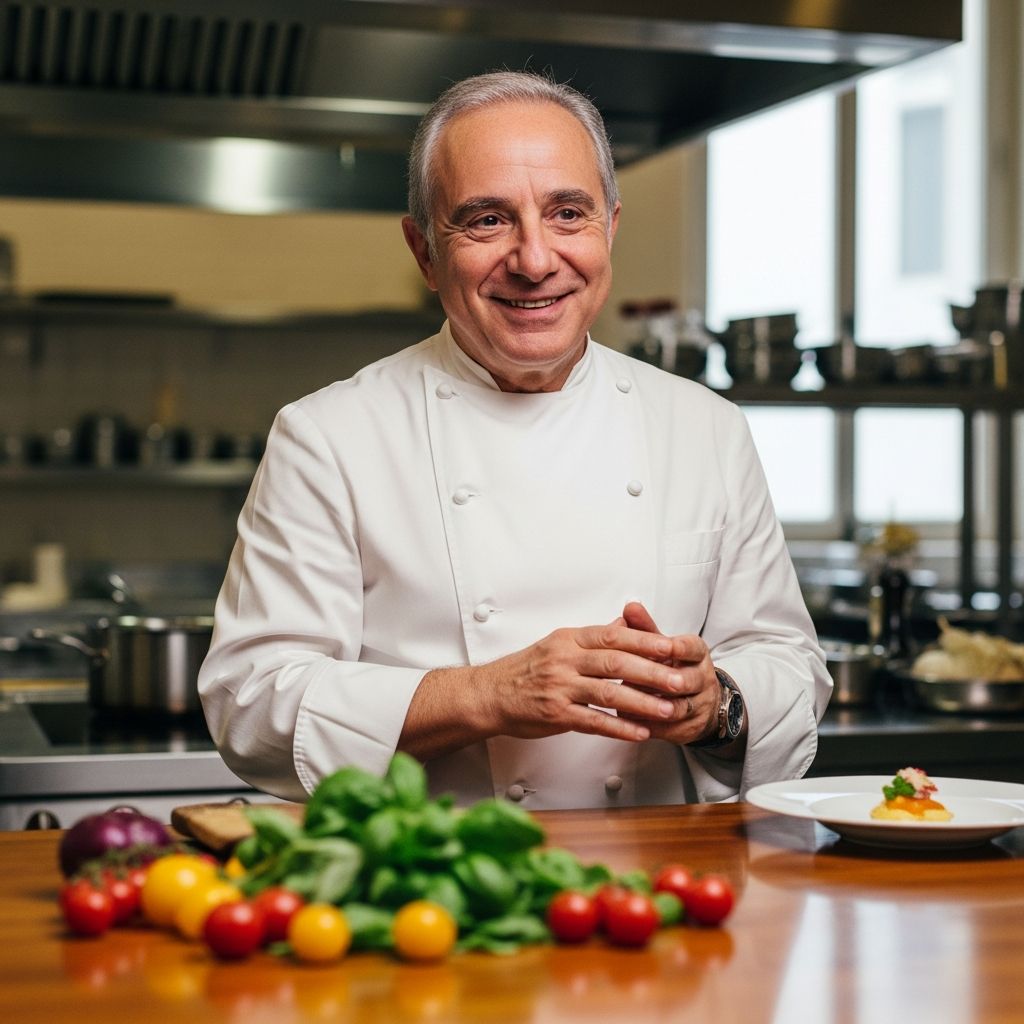
When most people hear the name Massimo Bottura, they think of three Michelin stars, Osteria Francescana, and some of the most imaginative dishes in modern cuisine. Yet behind the accolades is a father and a partner who has built a life around curiosity, community, and deep respect for both tradition and change.
This article uses Bottura’s story as inspiration to explore how the values that make him a groundbreaking chef can also help parents raise grounded, creative, resilient kids.
From Modena to Michelin: A Story About Choosing Your Own Path
Bottura was born in Modena, Italy, in 1962 and initially studied law before walking away from that safe, conventional route to buy a modest trattoria in the countryside. That decision did not just start a culinary career; it was an early declaration that it is possible to design a life around passion, not just obligation.
For parents, that choice holds a powerful message: children watch how adults respond to expectations, risk, and uncertainty. Bottura’s path shows that it is possible to pivot radically and still build something extraordinary.
What Parents Can Take From His Early Leap
- Passion can be a serious path – He left a respected profession-in-training for something others might see as risky or frivolous.
- Experimentation is not just for youth – Bottura made a major life change as a young adult, showing kids that growth does not stop after school.
- Work can be a place of meaning – He turned a small trattoria into a learning laboratory, not just a business.
| Traditional Message to Kids | Lesson Inspired by Bottura |
|---|---|
| “Pick something safe and stick with it.” | “Learn deeply, but leave room to change your mind.” |
| “Failure means you chose wrong.” | “Failure is feedback you can cook with.” |
| “Success is a straight line upward.” | “Success is a messy kitchen of trials, edits, and do-overs.” |
The Kitchen as a Classroom: Curiosity Over Control
In Bottura’s hands, a kitchen is not only a place for perfect plates. It is a workshop where Italian regional traditions, French technique, and global influences collide. That blend did not happen by accident; he sought out mentors, worked abroad, and treated every new environment as a place to ask questions.
Parents can borrow this mindset and turn their own homes into spaces where curiosity is welcome and experimentation is normal.
Everyday Ways to Raise Curious Kids
- Invite kids into your work – Explain what you are doing, even when it seems mundane. Curiosity grows from being allowed to see behind the scenes.
- Normalize not knowing – Respond to hard questions with, “Let’s find out,” rather than pretending to have all the answers.
- Celebrate thoughtful questions – Praise kids for the questions they ask, not only for correct answers.
Developmental research shows that early curiosity is linked with better later academic outcomes and problem-solving skills, even after accounting for socioeconomic factors. Encouraging questions and exploration is not a luxury; it is a powerful investment in children’s future competence.
Respecting Roots While Reinventing: The Power of Family Culture
Bottura’s cooking is often described as a playful conversation with tradition. He honors the flavors of his childhood in Emilia-Romagna while transforming them into something unexpected. That posture—reverence without rigidity—offers a useful model for how families can handle their own stories and rituals.
Tradition as a Living Ingredient
Many families feel pulled between preserving how things were done “back home” and adapting to a changing world. Bottura’s work shows that this does not have to be an either–or choice. You can protect what is meaningful and still grant each generation room to adapt.
- Keep the story, adjust the script – Keep core values (care, generosity, hospitality), even if the actual rituals change.
- Share origins openly – When kids help with family recipes or celebrations, talk about who taught them to you and why they mattered.
- Invite kids to remix – Let children alter a dish, a song, or a ritual once in a while. Ownership deepens connection.
Family rituals—meals, celebrations, shared routines—have been linked with stronger emotional bonds and better child adjustment across diverse cultures. Treating those rituals as flexible and co-created, rather than fixed and imposed, can make them even more powerful.
Learning From Failure: When the Dish Falls Apart
No chef reaches the top of global rankings without years of mistakes. Bottura’s rise—from his first trattoria in the 1980s to Osteria Francescana being named the best restaurant in the world—was filled with experiments that did not work and ideas that critics did not immediately understand.
In family life, failure often carries shame: bad grades, conflicts, missed goals. But in a kitchen, failure is expected, even required. That difference in mindset is something parents can change at home.
How to Turn Failure Into Family Fuel
- Describe effort and strategy – Instead of “You’re so talented,” focus on “You tried three different ways to solve that.”
- Talk about your own mistakes – Share a time you messed something up and what you learned rather than hiding it.
- Use “not yet” language – When a child cannot do something, say “You haven’t learned it yet” instead of “You can’t do this.”
Psychologist Carol Dweck’s research on growth mindset finds that when children see abilities as developable, not fixed, they persist longer and perform better in the face of challenges. Kitchens like Bottura’s embody that mindset: each imperfect plate is information, not a verdict.
Shared Meals as Emotional Infrastructure
Food is Bottura’s medium, but the deeper theme in his work is togetherness—around a table, inside a city, across cultures. Families do not need Michelin-star plates to tap into this. What matters most is not sophistication but consistency and presence.
Why Family Meals Matter
Multiple studies have found that regularly sharing meals is associated with better nutrition, lower risk of substance use, and improved emotional well-being in children and adolescents. The meal itself is only partly about food; it is also about ritual, predictability, and belonging.
- Even simple counts – Pasta with jarred sauce eaten together is more valuable than elaborate food eaten separately.
- Use one reliable ritual – If nightly dinners are impossible, pick Sunday lunch or a weekly breakfast as a non-negotiable anchor.
- Turn devices off – Protect the table as a conversation space whenever practical.
Service Beyond the Plate: Teaching Kids About Community
Bottura is not only known for Osteria Francescana. He has also championed projects that transform surplus food and food waste into high-quality meals for people in need, through initiatives such as community refectories and his non-profit work. In these spaces, the same creativity used for high-end diners is offered in service of dignity and inclusion.
In a family context, this lens invites children to see skill and privilege as tools for contribution, not just personal gain.
Simple Ways to Raise Service-Minded Kids
- Connect talents to needs – If a child loves baking, involve them in making treats for neighbors, school events, or community drives.
- Make giving visible – Talk explicitly about why the family donates time or resources; do not let it be an invisible adult activity.
- Visit places of service together – Age-appropriate volunteering, even once or twice a year, can shape children’s sense of responsibility.
Research suggests that adolescents who regularly engage in prosocial activities—helping, volunteering, and contributing—tend to report higher well-being and stronger social relationships. Bottura’s community work shows that generosity can be creative, joyful, and central to one’s identity.
Balancing Obsession and Presence
High-level chefs often work grueling hours. Building a three Michelin-star restaurant that reaches the top of global rankings demands obsession, travel, and constant pressure. For any parent with ambitious goals, the tension between work and presence is familiar.
While each family’s balance looks different, Bottura’s story raises practical questions: How can parents pursue meaningful work without vanishing from their children’s daily lives? How can ambition and attachment coexist?
Strategies for Ambitious, Present Parenting
- Share the “why” behind your work – When kids understand what your work does for others, long days can feel more meaningful and less like abandonment.
- Protect micro-moments – Ten minutes of undistracted attention at bedtime can matter more than an entire distracted afternoon.
- Design predictable touchpoints – A weekly call from the road, a standing movie night, or an after-school walk can act as emotional anchors.
Attachment research shows that children do not need parents to be available all the time; they need caregivers who are consistently responsive and emotionally attuned when they are present. Even a busy life can support secure attachment when parents are intentional about these small, reliable points of connection.
Raising Creative Thinkers: Beyond Recipes and Rules
Bottura’s cuisine is known for its conceptual playfulness—dishes that reinterpret classics, challenge expectations, or tell stories on the plate. This kind of creativity is not about random improvisation; it is built on deep technical skill and long exposure to tradition.
Parents sometimes swing between wanting children to follow rules and wanting them to “think outside the box.” Bottura’s approach suggests that the two are not opposites: structure can actually enable creativity.
Ingredients for Everyday Creativity
- Teach the basics first – Just as cooking requires knife skills and timing, creative thinking benefits from mastering fundamentals in reading, numeracy, or a craft.
- Allow for playful remixing – Once kids know the “correct” way, give them safe chances to bend the rules.
- Value process over outcome – Ask what they enjoyed, noticed, or learned, not only whether the project turned out well.
Educational research has linked open-ended play, arts participation, and problem-based learning with improved creativity and flexible thinking in children. A home that tolerates mess, iteration, and surprise is often the birthplace of original ideas.
Frequently Asked Questions (FAQs)
Who is Massimo Bottura, in simple terms?
Massimo Bottura is an Italian chef from Modena whose restaurant Osteria Francescana has earned three Michelin stars and twice been named the best restaurant in the world. He is known for blending Italian traditions with inventive, contemporary cooking.
Why is his story relevant to parents?
His journey highlights values—curiosity, resilience, respect for roots, and community-mindedness—that parents often want to instill in their children. His kitchen becomes a metaphor for how families can approach learning, failure, and service.
Do I need to be a great cook to use these lessons at home?
No. The point is not culinary skill but attitude. Any family can use everyday routines—meals, homework, chores—as spaces to practice curiosity, experimentation, and shared responsibility.
How often should families eat together to see benefits?
Studies suggest that eating together several times per week is associated with better outcomes for kids, but even one reliable shared meal can help. Consistency and the quality of interaction matter more than exact frequency.
How can I encourage my child to care about community like Bottura does?
Start small and concrete: involve them in choosing items for a food drive, baking for neighbors, or volunteering together. Frame these acts as part of who your family is, not as occasional extra credit.
References
- Massimo Bottura — Bologna Business School. 2022-03-01. https://www.bbs.unibo.it/faculty/bottura-3/
- Massimo Bottura — Italian Gourmet. 2021-11-15. https://www.italiangourmet.it/protagonisti/massimo-bottura/
- Massimo Bottura: biografia, ristoranti e ricette — Fine Dining Lovers. 2020-06-10. https://www.finedininglovers.it/experts/massimo-bottura
- Massimo Bottura, tre stelle non bastano — Esquire Italia. 2018-03-06. https://www.esquire.com/it/lifestyle/food-e-drink/a19030599/massimo-bottura-biografia/
- Parenting for Curiosity — American Psychological Association. 2016-09-01. https://www.apa.org/monitor/2016/09/curious-kids
- Family Routines and Rituals — American Academy of Pediatrics. 2018-05-01. https://publications.aap.org/pediatrics/article/141/5/e20172599/37570/Family-Routines-and-Rituals
- Mindsets and Achievement — Carol S. Dweck, Educational Psychologist. 2006-03-01. https://doi.org/10.1207/s15326985ep4102_2
- The Protective Effect of Family Meals on Adolescent Substance Use — Journal of Adolescent Health. 2013-07-01. https://doi.org/10.1016/j.jadohealth.2013.01.019
- Prosocial Behavior and Adolescent Well-Being — Journal of Youth and Adolescence. 2012-08-01. https://doi.org/10.1007/s10964-012-9769-7
- Creative Learning Environments in Education — OECD. 2013-04-01. https://www.oecd.org/education/ceri/creative-learning-and-innovation.htm