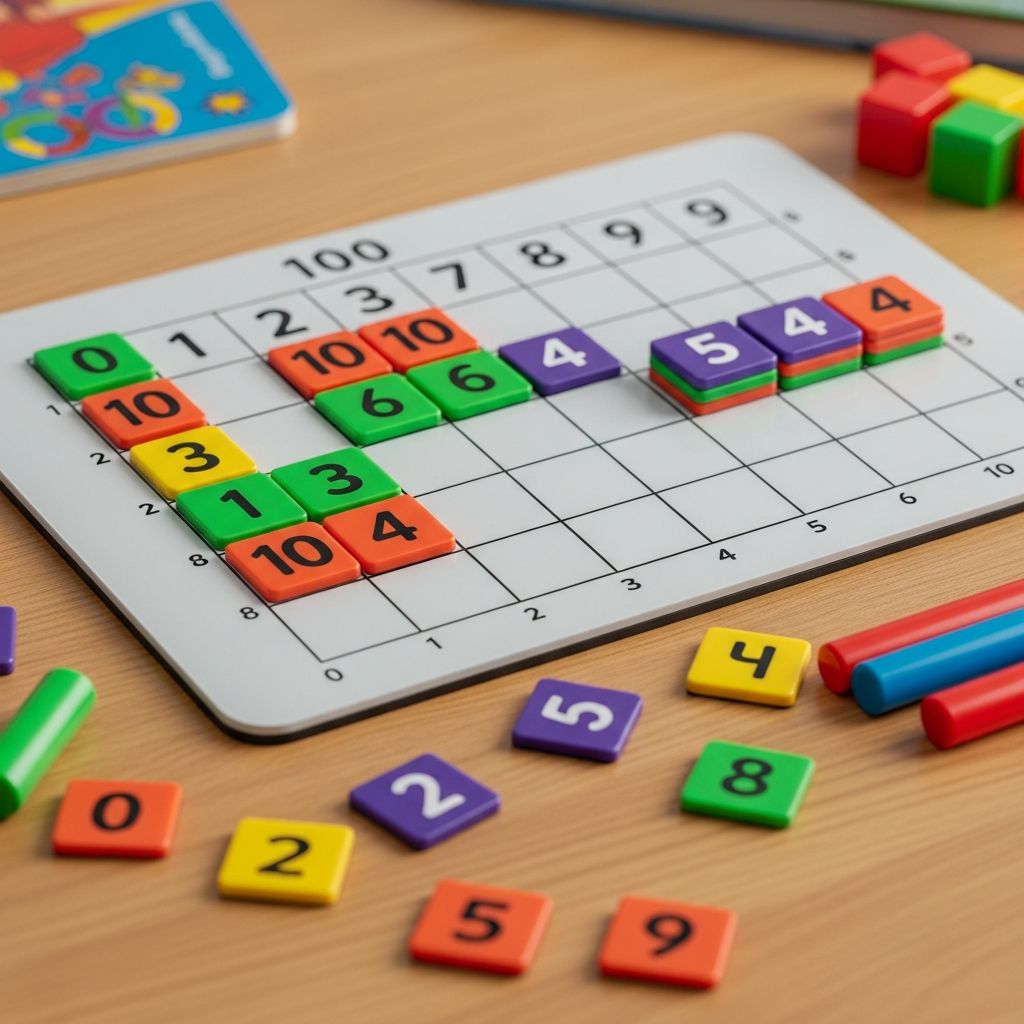
A magnetic 100 board is a simple but powerful math manipulative that helps children see, touch, and understand numbers from 1 to 100 in concrete ways. It is often used in early elementary math to build place value understanding, number sense, and confidence with basic operations.
What Is a Magnetic 100 Board?
A magnetic 100 board is typically a sturdy board or mat divided into a 10 by 10 grid, labeled from 1 through 100 in order. It usually comes with magnetic number tiles that fit into each square, allowing children to move, remove, and rearrange numbers to explore different math ideas. Many versions are designed to be large enough for group demonstrations and small enough for tabletop work.
Because the tiles can be taken off and placed back on, a magnetic board encourages interactive play rather than passive observation. Children can physically build the sequence of numbers, notice patterns in rows and columns, and experiment with how numbers relate to one another. This interactivity supports multiple learning styles and helps make abstract concepts more accessible.
- Grid layout: 10 rows and 10 columns, labeled 1–100.
- Magnetic tiles: Removable numbered squares that stick to the board.
- Durable materials: Often made for classroom use, with bright, clear printing.
Why Use a Magnetic 100 Board for Place Value?
Place value is the foundation of all later math learning, and children often struggle when it remains purely symbolic. The 10 by 10 structure of a 100 board naturally highlights the idea of tens and ones, since every row represents a new set of ten and each column shows how the ones digit repeats in a pattern. By seeing that 23 is in the second row and third column, for example, learners can connect the digits to their actual meaning.
Using the board, children can decompose and compose numbers visually: removing tiles, shifting them by 10 spaces, or lining them up vertically to show tens and ones. This direct manipulation helps students understand that 57 is 5 tens and 7 ones, instead of just two unrelated digits. Over time, they begin to recognize place value patterns without needing the physical support.
| Feature | Place Value Concept | Example Activity |
|---|---|---|
| Rows of ten | Groups of ten; tens place | Count how many full rows come before 64 to see 6 tens. |
| Columns | Ones digit patterns | Find all numbers ending in 3 and read them aloud. |
| Sequential layout | Counting and order | Build from 1 to 30 using tiles and describe what changes. |
Building Early Number Sense
Number sense describes a child’s intuitive feel for numbers, including how they relate, how big or small they are, and how they can be combined or broken apart. A magnetic 100 board gives a clear visual of the number line compacted into a square, allowing learners to see where each number falls in relation to others. This helps children answer questions like which numbers come before or after, which are greater or less, and how far apart two values are.
Teachers and parents can use the board to play quick games that strengthen number sense. Asking children to locate a mystery number given a few clues, or to find all numbers in a certain range, turns abstract comparison tasks into hands-on challenges. Over time, these simple interactions support flexible thinking about numbers, which is essential for mental math and problem solving.
- Recognizing number order and patterns from 1 to 100.
- Judging relative size of numbers visually on the grid.
- Developing confidence in counting forward and backward.
Teaching Skip Counting and Patterns
One of the strongest uses of a 100 board is teaching skip counting, which lays the groundwork for multiplication and understanding factors. By placing markers or turning over tiles every 2, 3, 5, or 10 numbers, students can see patterns emerge in rows, columns, and diagonals. These repeating patterns help them remember sequences and recognize multiples of key numbers.
For example, when students skip count by 5s, they often notice that the numbers end in 0 or 5, and that the pattern forms a consistent vertical and horizontal arrangement. When they skip count by 2s, they realize that every other number on the board is even. These visual experiences make the idea of multiples more concrete than simply reciting sequences aloud.
- Highlight multiples of 2, 3, 5, and 10 with colored magnets.
- Compare patterns formed by different skip counts.
- Connect skip counting patterns to early multiplication facts.
Using the 100 Board for Addition
The board is a natural tool for exploring addition, because moving along rows and columns directly models adding ones and tens. Sliding a marker one space to the right represents adding 1, while moving it down one full row represents adding 10. This creates a strong connection between movement on the board and changes in the digits of a number.
To introduce addition, an adult can place a marker on a starting number and then count aloud as the marker moves to show each step of an equation. Children see that 23 plus 4 is just four moves to the right, or that 23 plus 10 means going straight down to 33. These patterns help them predict results and transition more smoothly into written algorithms later.
- Model 1-step and multi-step additions on the grid.
- Show how adding 10 affects only the tens digit.
- Use different colored markers for the starting number and the sum.
Using the 100 Board for Subtraction
Subtraction can be modeled just as easily by reversing the direction of movement. Stepping left across the board shows subtracting ones, while moving up a row shows subtracting tens. This reversibility helps learners understand that subtraction is the inverse of addition, not an unrelated operation.
Working with concrete movements on the board is especially helpful for children who struggle with the idea of “taking away” quantities they cannot see. Rather than imagining 10 being removed from an abstract number, they can see the location change and count how many steps it took. This reinforces the meaning of subtraction and supports early understanding of differences between numbers.
- Practice subtracting 1, 2, or 3 by moving left.
- Model subtracting 10, 20, or 30 by moving up whole rows.
- Compare addition and subtraction moves that start at the same number.
Supporting Place Value Concepts Explicitly
Beyond simple movement, a magnetic 100 board can be used to make place value ideas explicit. Children can build numbers by selecting a tile for the tens row and another for the ones column, then checking where that combination appears on the board. This helps them see that the tens digit controls which row a number lives in, while the ones digit controls its position horizontally.
Adults can pose questions like “What number has 4 tens and 6 ones?” and ask children to locate it on the grid. Once they find 46, students begin to associate the language of tens and ones with actual positions. Over time, they can also use the board to compare numbers with similar digits and notice how small changes in the tens place create large shifts on the board.
| Prompt | Student Task |
|---|---|
| Find a number with 3 tens and 2 ones. | Locate 32 on the third row, second column. |
| Show a number one ten more than 47. | Move from 47 down to 57. |
| Find a number that is 5 more than 18. | Move five spaces to the right and name the result. |
Game Ideas and Activities
To keep students engaged, many families and teachers turn 100 board practice into quick games rather than formal lessons. Simple activities like guessing mystery numbers, racing to reach a target value, or filling gaps in a partially completed board can all be done in short bursts. These playful interactions help reduce math anxiety and make repetition feel more like a challenge than a chore.
Games can be adjusted to different ages and skill levels by changing which numbers are in play or how many clues are given. Younger children might focus on numbers up to 20 or 50, while older students can try more complex skip counting or multi-step mental calculations before checking their answers on the board. A magnetic surface makes it easy to reset the game quickly and try again.
- Mystery Number: Give clues like “It is greater than 40 and less than 60, and in the same column as 2.”
- Race to 100: Players roll dice and move markers according to the sum, narrating their moves.
- Fill the Blanks: Remove random tiles and ask children to replace the missing numbers correctly.
Benefits for Different Learners
A magnetic 100 board supports a wide range of learners, including those who benefit from visual, tactile, or kinesthetic experiences. Students who struggle with attention can stay more engaged when they are actively placing tiles or moving markers. The large, colorful numbers also help children who are still forming number symbol recognition.
Because the board is flexible, adults can adapt tasks for children who are ahead or behind typical grade-level expectations. Advanced learners can explore patterns in prime numbers, factors, or even early concepts related to multiplication arrays, while students who need more support can focus on simple counting and one-step movements. This makes the board a useful tool across multiple years of math instruction.
- Visual support for seeing number sequences and patterns.
- Hands-on interaction to maintain engagement.
- Easy differentiation by adjusting the complexity of tasks.
Classroom and Home Use Tips
In a classroom, a large demonstration-size magnetic 100 board can be mounted on a whiteboard for whole-group instruction, while smaller versions at student desks allow for individual practice. Teachers often introduce new concepts on the large board before asking students to explore on their own, using consistent language about moving up, down, left, and right. Routines like a daily number of the day can incorporate quick 100 board activities to maintain skills.
At home, a magnetic 100 board fits easily on a refrigerator or metal surface, turning everyday spaces into math practice opportunities. Short, informal sessions—such as finding a few numbers while waiting for dinner—keep practice light and low-pressure. Parents can use the board to connect math to real-life situations, such as counting days on a calendar or tracking points in family games.
- Store all tiles in labeled containers to prevent loss.
- Establish simple clean-up routines so children can reset the board independently.
- Incorporate the board into short, frequent math moments rather than long drills.
Durability and Practical Considerations
When choosing a magnetic 100 board, durability and ease of use are important. Look for boards made from sturdy materials with strong magnets that keep tiles in place during use. Clear printing and color contrast help children distinguish numbers quickly and reduce visual strain. If the board is intended for classroom use, a size that is visible from across the room makes group instruction more effective.
Organization also matters, especially when multiple children use the same set. Some boards come with built-in storage or labeled compartments for tiles, which can save time and prevent frustration. Considering these practical details makes the board more likely to be used regularly and effectively, rather than sitting unused on a shelf.
FAQs About Magnetic 100 Boards
What age is a magnetic 100 board best for? Most children begin using a 100 board in early elementary grades, typically around ages 5 to 8, when they are learning to count to 100, recognize numerals, and explore basic addition and subtraction. Older students can still benefit when reviewing place value or practicing mental math strategies. Do children need to know numbers before using the board? No. The board can actually help with learning numbers. Adults can start by introducing small sections, such as 1 to 20, and gradually expand. Matching tiles to printed numbers and counting along rows builds recognition and confidence over time. How often should a magnetic 100 board be used? Short, frequent sessions are more effective than long drills. Using the board for a few minutes several times a week keeps skills fresh and allows children to explore different concepts, from simple counting to place value and operations. Can the board support more advanced math? Yes. Beyond basic counting and operations, the board can be used to explore multiples, factors, even and odd numbers, and early multiplication patterns. As students’ skills grow, tasks can become more challenging while still using the same familiar tool. Is a magnetic 100 board only for school use? No. Many families use magnetic boards at home for extra practice, homeschooling, or simply to make math part of everyday life. The portability and ease of setup make them practical for home learning spaces as well as classrooms.
Conclusion: A Simple Tool With Big Impact
A magnetic 100 board brings together counting, place value, and basic operations in one flexible, hands-on resource. By moving tiles and markers across the grid, children build a deep, intuitive understanding of how numbers are organized and how they behave in different operations. Whether used at home or in the classroom, this simple tool can make early math more visual, interactive, and enjoyable for young learners.