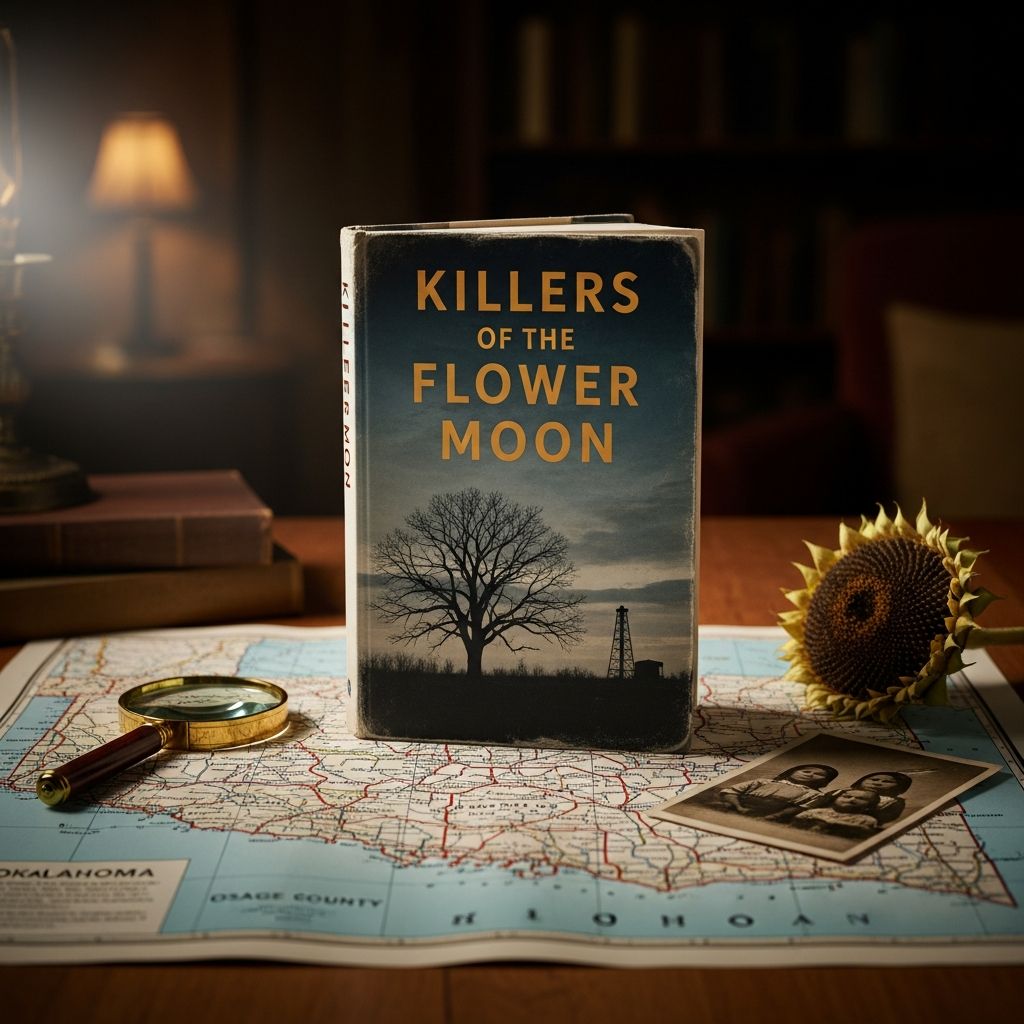
Martin Scorsese’s film adaptation of Killers of the Flower Moon has pushed a largely hidden chapter of American history into the spotlight. But the movie is only one doorway into this story. David Grann’s nonfiction book, Killers of the Flower Moon: The Osage Murders and the Birth of the FBI, offers a far deeper, more unsettling, and more detailed portrait of the crimes against the Osage Nation and the federal investigation that followed.
If you have seen the film, are planning to, or are simply curious about the real history, the book is not just a tie-in—it is essential reading.
What the Book Is Really About
At its core, Grann’s book weaves together three interlocking stories:
- The Osage Reign of Terror — a murderous campaign in 1920s Oklahoma, when wealthy Osage citizens were systematically killed for their oil wealth.
- The birth of a modern FBI — how a young J. Edgar Hoover used the case to professionalize a new federal investigative agency.
- The long shadow of historical violence — Grann’s own twenty-first-century investigation into additional victims and what their families still endure.
The film can dramatize characters and key events, but the book meticulously reconstructs the broader machinery of exploitation, racism, and corruption that made the murders possible.
The Real History: From Dispossession to Oil Wealth
To understand why the Osage were targeted, you must first understand how they came to live on that land.
In the nineteenth century, the Osage were repeatedly displaced from their homelands as the United States expanded westward. Eventually they purchased rocky land in what is now Oklahoma—considered marginal for agriculture by white settlers. Under U.S. law, Native peoples were often coerced into allotment systems that broke up communal lands into individual parcels, making them easier to control and acquire.
Then everything changed: large oil deposits were discovered beneath Osage land. The Osage retained collective mineral rights, known as headrights, which gave them a share in oil revenues. Because oil companies had to lease the land, Osage citizens began to receive enormous royalty checks. Around the 1920s, they became, per capita, some of the richest people in the world.
| Aspect | Osage Situation | White Response |
|---|---|---|
| Land ownership | Bought reservation land; retained mineral rights | Pressure to break up and control allotments |
| Wealth | Huge oil royalties, visible prosperity | Resentment, racist caricatures, political backlash |
| Legal status | U.S. citizens but heavily restricted | Guardianship system imposed on many Osage |
Guardianships: A System Built for Exploitation
Congress and federal officials claimed that many Native citizens were “incompetent” to manage their own money and forced them into court-appointed guardianships. A white guardian—often a local businessman, rancher, or lawyer—controlled nearly every major expenditure.
This system:
- Turned Osage adults into legal dependents in their own homeland.
- Gave local white guardians control over vast oil incomes.
- Created powerful incentives to inherit headrights through marriage, fraud, or murder.
Grann’s book shows how this legal structure laid the groundwork for the murders: it normalized white control over Osage wealth and obscured financial motives behind “mysterious” deaths.
The Reign of Terror: Murders in Plain Sight
In the early 1920s, a disturbing pattern emerged in Osage County: Osage citizens with valuable headrights began dying in large numbers, often in suspicious circumstances.
Victims were:
- Shot execution-style and left by roadsides or in ravines.
- Poisoned slowly, their illnesses misdiagnosed by complicit doctors.
- Killed in house explosions disguised as accidents.
Officially, at least two dozen Osage deaths are associated with this period, but Grann and other historians argue the true toll may be far higher—potentially in the hundreds—based on mortality data and archival research.
Local law enforcement rarely investigated effectively. Sheriffs, deputies, doctors, coroners, and judges often had financial connections to Osage headrights or to the white businessmen who stood to gain from Osage deaths. Private detectives hired by Osage families were intimidated, bribed, or killed.
The Case That Built the FBI
When Osage leaders petitioned the federal government for help, the newly formed Bureau of Investigation (which would later become the FBI) eventually took the case.
This was a turning point for federal law enforcement:
- Director J. Edgar Hoover wanted to prove that a modern, professional, evidence-based investigative agency could handle complex cases.
- He placed former Texas Ranger Tom White in charge of the Osage investigation.
- White built a small undercover team, including an American Indian agent, to infiltrate local communities.
The bureau’s early work was flawed—initial investigations were mishandled or misdirected—but White eventually pursued a quieter, methodical strategy: following money flows, interviewing witnesses in secret, and cultivating informants from the criminal underworld.
Unmasking a Conspiracy
The book’s narrative centers on one extended Osage family whose members are systematically targeted. Grann shows how the killers used:
- Intermarriage — white men marrying Osage women to position themselves as heirs.
- Corrupt professionals — doctors, undertakers, lawmen, and local officials who falsified records or looked away from evidence.
- Terror and intimidation — threats, violence, and witness tampering that kept the community silent.
Tom White’s team eventually focuses on a prominent local cattleman and political power broker who, according to trial records and later historical assessments, orchestrated a wide network of killings to control multiple headrights. Federal prosecutors bring cases in state and federal courts, facing hung juries, appeals, and attempts to buy or intimidate witnesses.
Some conspirators are ultimately convicted and sentenced to life in prison, yet many suspicious deaths are never fully investigated, and several likely killers are never tried.
Where the Film Stops and the Book Keeps Going
Film adaptations, even when ambitious, must compress events, characters, and subplots into a few hours. Grann’s book, however, offers a layered structure that goes well beyond a single procedural storyline.
Three Timelines, One Ongoing Story
- Chronicle of the murders — an immersive narrative of daily life, fear, and grief in Osage County during the 1920s.
- Chronicle of the investigation — a detailed inside look at the Bureau of Investigation’s evolving tactics and institutional politics.
- Modern chronicle — Grann’s own research into unsolved deaths and conversations with descendants, showing how the trauma persists.
The film can foreground certain relationships—for example, between one Osage woman and her white husband—while the book can roam more widely: into court records, guardianship archives, financial ledgers, and oral histories that reveal a broader pattern of systemic violence.
Why Reading the Book Matters
Reading Killers of the Flower Moon alongside or apart from the film matters for at least four reasons.
1. It Restores Individual Lives to the Historical Record
True crime often risks turning victims into background figures. Grann reverses that pattern. He dwells on:
- Everyday moments—family gatherings, jokes, small decisions—that make each victim more than a statistic.
- The personal cost borne by survivors and descendants who grew up amid silence and unanswered questions.
For Osage readers, this is not just a story about a case; it is about relatives, ancestors, and the persistence of community memory.
2. It Shows How Law and Racism Worked Together
What happened in Osage County was not a random outbreak of violence. It was enabled by:
- Federal policy frameworks that undermined Native sovereignty and facilitated non-Native control of Native wealth.
- Local economic dependence on oil revenues, which incentivized some white residents to seize control of headrights at any cost.
- Everyday racism that made officials and newspapers treat Osage deaths as unimportant or inevitable.
The book places the murders within the broader history of U.S. Indian policy and resource exploitation, echoing patterns seen in other contexts where Indigenous lands held valuable minerals or oil.
3. It Explains a Turning Point in Federal Policing
For readers interested in legal history, the book also offers a case study of how the United States shifted from loosely organized regional law enforcement to a centralized, professional federal agency.
By the time of the Osage case, Hoover was imposing new standards on agents: suits and ties, formal training, typed reports, and a public image of scientific rigor. The investigation, despite missteps, became one of the bureau’s first high-profile successes, helping justify its growing power in later decades.
4. It Shows History as Ongoing, Not Finished
One of the most powerful sections of the book recounts Grann’s realization that the official list of victims was incomplete. By examining guardianship files and mortality statistics, he identified suspicious patterns that pointed to many additional deaths never recognized as homicides.
This matters because it reframes the story: the Reign of Terror was not just a closed legal case resolved by a handful of convictions; it was part of a deeper structure of violence that extended beyond any single prosecution.
Who Should Read Killers of the Flower Moon?
The book speaks to several kinds of readers:
- History enthusiasts interested in overlooked episodes of U.S. history.
- True-crime readers looking for a meticulously documented, ethically serious account rather than sensationalism.
- Students of law and public policy examining how legal systems can both enable and restrain exploitation.
- Viewers of the film who want to understand what was condensed or left out on screen.
How to Approach the Book: Tips for Readers
Killers of the Flower Moon is accessible but emotionally heavy. To get the most from it:
- Allow time for the first section, which carefully sets up Osage family relationships and early deaths; the payoff in later chapters is significant.
- Take notes or mark names—especially in the opening chapters—so you can track how people are connected.
- Pause between sections if needed; the material includes repeated murders, betrayals, and institutional failures.
- Seek out Osage perspectives—interviews, essays, or statements from Osage citizens—after you finish, to balance any outsider viewpoint.
Frequently Asked Questions (FAQs)
Do I need to read the book before watching the film?
No. The film stands on its own as historical drama. However, reading the book either before or after will provide crucial context, more complete victim stories, and a clearer picture of the broader conspiracy.
How accurate is the book historically?
The book is nonfiction and heavily researched. Grann draws on court transcripts, FBI files, financial records, and interviews with descendants. While any historical reconstruction involves interpretation, his core account of the Osage murders and the federal investigation is consistent with archival evidence and historical scholarship.
Is the book very graphic or disturbing?
The subject matter is inherently disturbing—it involves serial murders, betrayal, and systemic racism. Grann does not linger on gore, but he does describe methods of killing and the emotional impact on families. Readers sensitive to violence may want to proceed slowly.
Is this only a true-crime book, or is it broader than that?
While it uses the tools of narrative true crime—suspense, character focus, investigative detail—it is also a work of history. It examines federal Indian policy, the development of the FBI, and how wealth and race intersected in early twentieth-century America.
What should I read or watch after finishing it?
You might explore other scholarship on the Osage Nation, works on U.S. Indian law and policy, or histories of the FBI. Listening to contemporary Osage voices—through interviews, documentaries, or community statements—can deepen your understanding of how this history is remembered today.
References
- Killers of the Flower Moon (book) — Wikipedia (summary of Grann’s work and historical context, citing primary sources). 2023-10-15. https://en.wikipedia.org/wiki/Killers_of_the_Flower_Moon_(book)
- Killers of the Flower Moon by David Grann — Plot Summary — LitCharts. 2023-05-01. https://www.litcharts.com/lit/killers-of-the-flower-moon/summary
- Killers of the Flower Moon: Full Book Summary — SparkNotes. 2023-06-10. https://www.sparknotes.com/lit/killers-of-the-flower-moon/summary/
- Killers of the Flower Moon — David Grann, official book page. 2017-04-18. https://www.davidgrann.com/book/killers-of-the-flower-moon
- Killers of the Flower Moon: The Osage Murders and the Birth of the FBI — National Book Foundation. 2017-11-15. https://www.nationalbook.org/books/killers-of-the-flower-moon-the-osage-murders-and-the-birth-of-the-fbi/