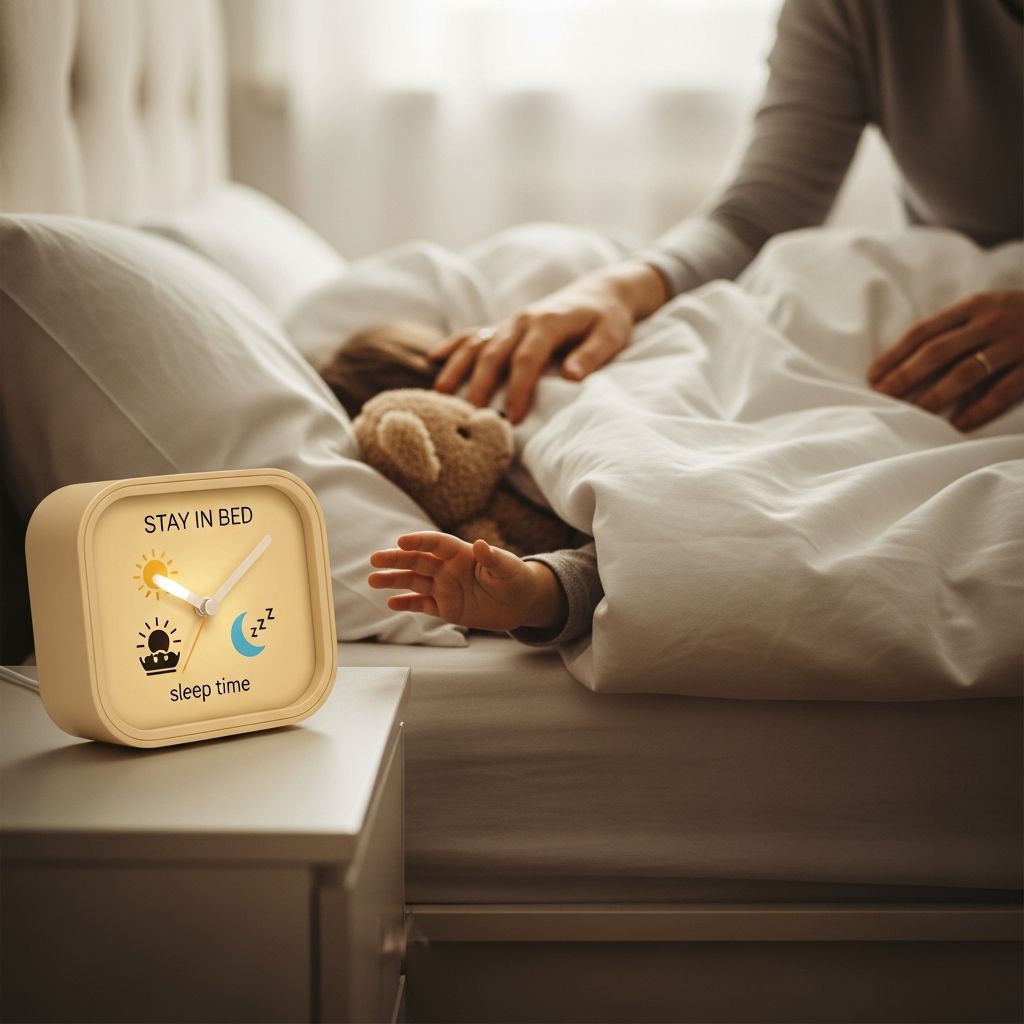
If your child bounces out of bed at sunrise (or earlier), a “stay-in-bed” clock can be a surprisingly powerful tool to reclaim everyone’s sleep and sanity. These simple, child-friendly clocks give kids a clear signal for when it’s time to rest and when it’s okay to start the day, using colors, lights, or symbols instead of complicated numbers.
What Is a Kids’ Stay-in-Bed Clock?
A kids’ stay-in-bed clock (often called a sleep-training or “OK to wake” clock) is designed less to wake children up and more to tell them when not to get up yet. Instead of relying on numbers, it usually uses:
- Colored lights (for example, red for “stay in bed,” green for “okay to get up”)
- Simple images (a sleeping animal vs. an awake animal)
- Icons or faces (closed eyes vs. open eyes) that toddlers can understand
The goal is to give young children a visual cue that matches your family’s expectations: “When the clock looks like this, I stay in bed or play quietly; when it changes, I can get up.” Over time, this habit can shift very early wake-ups toward more reasonable mornings while reducing power struggles.
Why Early Mornings Are So Hard on Families
Many toddlers and preschoolers naturally wake with the first light of day, long before the rest of the household is ready to function. That can create daily battles and leave everyone exhausted. Common challenges include:
- Children calling out or leaving their rooms repeatedly before a reasonable hour
- Parents starting the day physically and mentally drained
- Confusion for kids about when it is truly “morning” versus “still nighttime”
Because young children cannot reliably read a digital clock, they rely on you to decide whether it’s time to get up. A stay-in-bed clock removes some of that back-and-forth by outsourcing the answer to a neutral tool: the clock itself.
Key Benefits of Sleep-Training Clocks
When used consistently, these clocks do more than buy parents a bit of extra sleep. They can support emotional and behavioral development too. Here are several important benefits:
- Clear boundaries: The clock sets a simple rule that is easy to see, not just hear, which helps children respect limits.
- More predictable mornings: Instead of chaotic 5 a.m. wake-ups, mornings gradually shift toward a consistent, agreed-upon time.
- Greater independence: Kids learn to check the clock themselves, giving them a sense of control and responsibility.
- Less arguing: Rather than debating every early wake-up, parents can gently point to the clock’s signal.
- Support for healthy sleep habits: Consistent messaging about sleep and wake times encourages better body-clock regulation.
Are Sleep Clocks Right for Your Child?
Sleep-training clocks work best when a child is old enough to understand simple instructions and notice colors or pictures. Many families find them helpful between ages two and five, though some older children enjoy using them as part of their routine.
Consider whether your child can:
- Understand a basic rule like “red means stay in bed, green means it’s time to get up”
- Recognize colors or simple images on a screen or toy
- Stay in bed (or at least stay in their room) with gentle reminders
If your child is still a baby or cannot yet grasp cause-and-effect, focus first on foundational sleep habits. For toddlers and preschoolers who can follow simple directions, a stay-in-bed clock can be a powerful next step.
Types of Kids’ Sleep Clocks
Not all clocks work the same way. Understanding the different styles can help you choose one that fits your family’s needs and your child’s personality.
Color-Based Light Clocks
Color-based clocks use changing lights to show when it’s time to sleep or wake. For example, they might glow red at bedtime, amber during quiet play, and green in the morning. These are especially helpful for younger toddlers who respond well to bright, simple visual cues.
- Easy for visual learners who understand color before they understand numbers
- Can double as a nightlight with adjustable brightness
- Often include white noise or soothing sounds to support sleep
Picture or Character Clocks
Picture-based clocks use images—a sleeping character, a sun, a moon, or closed/open eyes—to represent sleep and wake times. These can feel like a story or game, which many young children find engaging.
- Great for kids who love animals or characters
- Makes the concept of day and night more concrete
- Can be explained in playful, age-appropriate language
Hybrid and Smart Clocks
Some modern sleep-training clocks combine lights, images, sounds, and smartphone controls. You might be able to adjust wake-up times from your phone, change colors, or schedule different rules for weekdays and weekends.
- Flexible settings for changing nap schedules and school routines
- App control for adjusting times without entering the bedroom
- Extra features like sound machines, timers, or reading lights
How to Choose the Right Sleep Clock
With so many options, the “best” clock is the one that your child will understand and you will actually use. Before buying, think through these factors:
- Age & understanding: Simple color cues may be ideal for a 2-year-old, while an older preschooler might enjoy a character-based or slightly more complex clock.
- Brightness: Look for a dimmable light that will not interfere with sleep or over-brighten a dark room.
- Sound features: Decide if you want white noise, lullabies, or a gentle wake-up sound, or if you prefer silent light changes.
- Power source: Consider whether battery backup is important in case of power outages.
- Ease of programming: If setup is complicated, you are less likely to stick with it.
Feature Overview Table
| Feature | Why It Matters | Best For |
|---|---|---|
| Color signals | Gives a simple visual cue for sleep and wake times. | Toddlers who recognize colors but not numbers. |
| Picture icons | Makes day/night concepts concrete and playful. | Preschoolers who love stories and characters. |
| Adjustable brightness | Prevents the nightlight from disrupting sleep. | Any child sensitive to light in a dark room. |
| Sound machine | Masks household noise and supports falling asleep. | Families in noisy homes or apartments. |
| App control | Lets you tweak schedules without entering the room. | Parents who like tech-friendly flexibility. |
Introducing the Clock to Your Child
Success with any stay-in-bed clock starts with a thoughtful introduction. Treat it as a new helper, not a punishment. The more your child feels involved, the more willing they are to follow the rules.
Step-by-Step Setup
- Pick a wake time you can live with. Choose a goal wake-up time that feels realistic for your child’s age and sleep needs, even if it is earlier than your ideal. You can always adjust later.
- Show and name the signals. In daylight, sit together and show the clock. Explain in simple language what each color or picture means.
- Practice during the day. Play a game where you pretend it is nighttime and morning, and act out what to do when the clock changes.
- Start with small goals. Rather than expecting your child to suddenly sleep an extra hour, begin with a short extension (for example, 10–15 minutes) and gradually move the wake time later.
- Be consistent with your response. Each morning, react the same way: praise when they wait for the signal, and calmly redirect if they get up too early.
Sample Script to Explain the Clock
You can adapt this kind of simple explanation:
“When your clock is red, it means your body is still resting. You can stay in bed or look at your books quietly. When your clock turns green, that’s our special sign that it’s morning and you can come out to see us.”
Keep the language positive and focus on what your child can do (rest, cuddle a toy, look at books) rather than only what they cannot do.
Making the Clock Part of a Calming Bedtime Routine
A sleep-training clock works best when it lives inside a predictable evening routine. Children feel safer when they know what is coming next, and the clock can be the final step that signals “time for sleep.”
- Start with winding-down activities like a bath, dim lights, or quiet play.
- Follow with pajamas, teeth brushing, and a short story or song.
- End by turning on the clock’s “night” setting together and saying a consistent phrase like, “When the light is this color, we stay in bed until it changes.”
Repeating this pattern night after night creates strong associations in your child’s mind: this clock color plus this routine equals sleep time. That predictability often reduces resistance and bedtime battles.
Handling Early Wake-Ups and Setbacks
No tool is magic, and there will be mornings when your child tests the new rule or simply wakes early. Expect a learning curve and treat mistakes as practice, not failure.
What to Do If They Get Up Too Early
- Stay calm and brief. Gently walk your child back to bed, point to the clock, and remind them of the rule: “The light is still red; that means it’s time to rest.” Avoid long conversations.
- Offer quiet options. If they are truly wide awake, allow low-key activities in bed—looking at books, cuddling a stuffed animal—as long as they remain in their sleep space.
- Be consistent for several days. Kids learn by repetition. Changing rules or giving in “just this once” makes it harder for the clock rule to stick.
Gradually Shifting Wake Time
If your child is used to waking very early, jumping straight to a much later wake time can be frustrating. Instead:
- Set the clock to just a little later than their usual wake time at first.
- Once they consistently wait for the signal, move the wake time 10–15 minutes later.
- Repeat this shift over days or weeks until you reach your ideal schedule.
This gradual approach respects your child’s body clock and increases the chances of natural, not forced, later wake-ups.
Frequently Asked Questions (FAQs)
1. What age should we start using a stay-in-bed clock?
Many families introduce these clocks between ages two and three, when children can understand simple rules and recognize colors or pictures. The key is not a specific birthday but your child’s developmental readiness to connect the clock’s signal with a behavior—staying in bed until it changes.
2. Will a sleep-training clock actually make my child sleep longer?
The clock itself does not force sleep, but it can help nudge wake times later by reinforcing a regular morning schedule. When children stay in a calm, dark environment until a consistent time, their internal body clocks often adjust, and they may begin to sleep a bit longer rather than fully waking at the first sign of dawn.
3. What if my child is scared of the dark and needs a nightlight?
Many stay-in-bed clocks double as nightlights with adjustable brightness. Look for a soft, warm glow and dim it enough that it feels comforting without lighting up the whole room. If your clock does not have a built-in nightlight, you can use a separate, very low-level light and still rely on the clock’s colors or images for signals.
4. How long does it take for kids to learn the new routine?
Every child is different, but many families see improvement within one to two weeks of consistent use. During that learning period, stay patient and repeat the same expectations each night and morning. Over time, the clock’s signal becomes a normal part of how your child understands sleep and wake times.
5. Can we use the clock for naps too?
Yes, many parents use the same tool for both naps and nighttime. Using a shorter “nap time” setting during the day can help children stay in bed for a reasonable rest period, even if they do not sleep the whole time. Having one consistent system for all sleep times can reduce confusion.
6. What if my child ignores the clock completely?
If your child seems uninterested at first, focus on making the clock part of a fun story rather than a command. Involve them in setting it up, give lots of praise for even small successes, and avoid harsh consequences for missteps. If you remain steady and positive, many children eventually embrace the clock as their own special sleep helper.
Final Thoughts: A Small Tool with Big Impact
Kids’ stay-in-bed clocks are not a cure-all, but they can be a gentle, effective way to create structure around mornings and nights. By turning an abstract rule—”it’s not morning yet”—into something your child can see and predict, you reduce conflict and support better sleep habits for the whole family.
With the right clock, a calm introduction, and a consistent routine, that pre-dawn pitter-patter of feet outside your bedroom door can gradually shift to a more peaceful, well-timed start to the day.