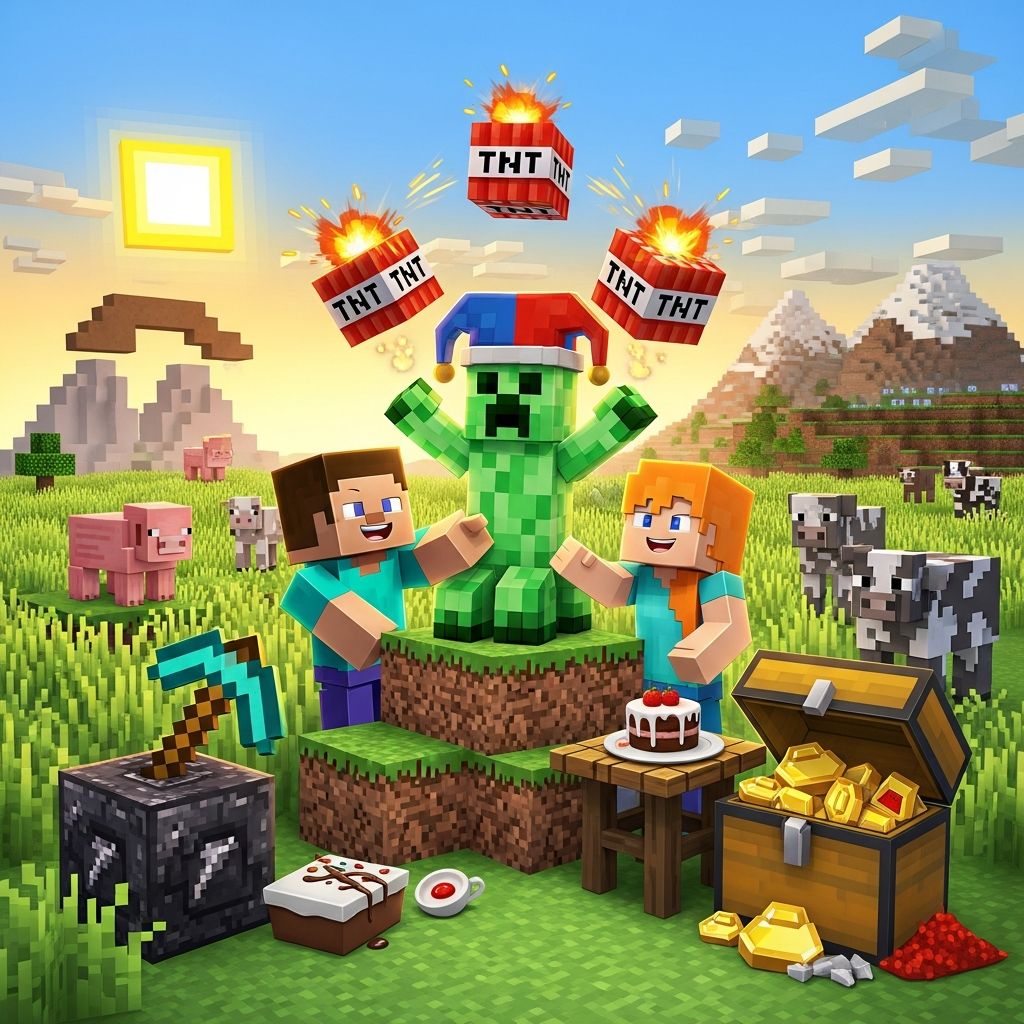
Minecraft is more than a game; for many kids it is a favorite world to imagine, build, and share with friends. Using Minecraft jokes is an easy way for parents, caregivers, and teachers to connect with young fans and bring some light-hearted fun into everyday life.
This guide collects a variety of clean Minecraft-themed jokes, plus ideas for turning simple puns into family games, classroom warm-ups, or party activities. All jokes and explanations are written from scratch to be kid-friendly and easy for adults to share.
Why Minecraft Humor Works So Well With Kids
When children tell jokes about a world they know well, like Minecraft, they are doing more than trying to be funny. They are practicing language, timing, and social skills. Research on humor in childhood suggests that laughing together can strengthen family bonds and help kids manage everyday stress.
Minecraft is especially powerful for humor because it combines:
- Simple visuals – Blocks, tools, and mobs are easy for kids to picture and describe.
- Clear rules – Kids quickly learn what creepers, zombies, and villagers can and cannot do, making rule-breaking jokes extra funny.
- Shared experiences – Many players have survived their first night, fallen into lava, or been surprised by a creeper, so jokes feel relatable.
The game’s popularity also means kids can tell Minecraft jokes at school or online and know someone else will understand the reference.
Quick One-Liner Minecraft Jokes
One-liners are short jokes that work well in lunch boxes, birthday cards, or quick text messages. Here are some original, kid-ready examples:
- Why did the Minecraft player bring a ladder to the cave?
Because they heard the ores were on another level! - What do you call a very polite creeper?
A “please-per” who only explodes after asking nicely. - Why did Steve sit on his crafting table?
He wanted to make a bench mark. - How do villagers stay in touch?
They send each other block mail. - What’s a skeleton’s favorite instrument?
The trom-bone it found in a dungeon chest. - Why was the bed jealous of the furnace?
Because the furnace got to stay up all night smelting. - What do Minecraft bees say when they win a game?
“That was un-bee-lievably easy!”
Encourage kids to invent their own one-liners by choosing a Minecraft object (like a pickaxe) and a real-world idea (like school) and trying to combine them into a silly sentence.
Riddles That Use Minecraft Logic
Riddles are slightly longer jokes that make kids think before they laugh. They can be a great warm-up for class or a rainy-day activity. Here are some original Minecraft riddles:
- Riddle: I’m full of blocks but not a chest. You never see me, but I load your quest. What am I?
Answer: The Minecraft world seed. - Riddle: I shine without being a torch, I guide you without being a map, and players cheer when I appear. What am I?
Answer: Diamonds. - Riddle: I chase you at night, hate the sunlight, and drop something useful for brewing. Who am I?
Answer: A witch. - Riddle: I can be tamed, I can protect, and I love bones more than any mob. What am I?
Answer: A wolf (or tamed dog). - Riddle: I’m not a bed, but you can respawn near me. I’m not a house, but I keep your armor safe. What am I?
Answer: A respawn anchor or a chest near a spawn point, depending on how kids want to argue it!
To turn this into a group game, ask one child to read the riddle aloud while others guess. Give hints by slowly revealing details: the dimension, the type of block, or whether it is a mob or an item.
Knock-Knock Fun With Minecraft Themes
Knock-knock jokes are familiar to most kids, and adding Minecraft details makes them feel fresh again. Here are some clean, original examples:
- Knock, knock.
Who’s there?
Ender.
Ender who?
Ender-stand that I just teleported into your house! - Knock, knock.
Who’s there?
Snow.
Snow who?
Snow use running, the snow golem already saw you. - Knock, knock.
Who’s there?
Craft.
Craft who?
Craft the door open, I left my pickaxe inside! - Knock, knock.
Who’s there?
Ghast.
Ghast who?
Ghast in time, I caught that fireball.
Children love taking over and changing the answers, which supports creativity and flexible thinking. Parents can model how to stay silly without becoming mean, which is important for social development.
Mob-Themed Jokes: Creepers, Zombies, and More
Mobs are a big part of Minecraft’s personality, and each one is ripe for playful jokes. You can even assign each family member a favorite mob and have them come up with jokes that fit its behavior.
Creeper Comedy
- Why did the creeper get a job in construction?
Because it’s great at making sudden renovations. - What did the creeper say before the school test?
“I’m going to ace-splode this!”
Zombie Zingers
- Why do zombies make terrible librarians?
They keep trying to return their brains instead of books. - How does a baby zombie travel so fast?
It always takes the short-cut through tall grass.
Skeleton Silliness
- Why did the skeleton bring extra arrows to school?
In case there was a pop quiz in archery. - Why don’t skeletons play soccer?
They don’t have the guts to block the goal.
Enderman and Nether Jokes
- Why is an enderman bad at hide-and-seek?
Because every time you blink, it changes hiding spots. - Why did the blaze start a band?
Because it already had the hottest tracks.
Turning Minecraft Jokes Into Family Activities
Instead of just reading jokes, try using them to start small games or conversations. This can be especially helpful for parents who do not play Minecraft but want to share their child’s interest.
| Activity Idea | How It Works | What Kids Practice |
|---|---|---|
| Minecraft Joke Jar | Write one joke per slip, store them in a jar, and let a child pull one out at dinner or before bedtime. | Reading aloud, turn-taking, family conversation. |
| Build-the-Punchline | Parent says the setup (“Why did the creeper…”), kids invent their own punchline, then you share one you prepared. | Creative thinking, vocabulary, confidence in sharing ideas. |
| Classroom Warm-Up | Teachers start the day with one Minecraft riddle, giving hints before revealing the answer. | Listening skills, logical reasoning, community building. |
| Party “Comedy Stage” | At a Minecraft-themed party, kids take turns going up to a pretend stage to tell their favorite blocky joke. | Public speaking, bravery, positive peer feedback. |
Tips for Parents: Keeping Minecraft Jokes Age-Appropriate
Most official versions of Minecraft are designed to be family-friendly, but jokes that kids hear online can sometimes cross the line into mean or inappropriate content. Here are some guidelines for adults:
- Encourage kind humor. Steer children away from jokes that target real people, cultures, or sensitive topics. Focus instead on silly situations with mobs and blocks.
- Talk about “too far” jokes. If a joke makes someone uncomfortable, use it as a chance to explain why we avoid laughing at others’ real pain.
- Stay involved in their online spaces. If kids share jokes on chat or social platforms, remind them that typed words are easy to misunderstand and can hurt more than they intended.
- Model laughing at mistakes. When you mispronounce a mob name or craft the wrong item, show that it is okay to laugh at yourself gently. This helps kids build resilience.
Educational Benefits Hidden Inside Minecraft Jokes
While this article focuses on fun, there are real learning advantages to joke-telling about games kids already love:
- Language skills: Puns require noticing that one word can have multiple meanings, a skill linked to vocabulary growth and reading comprehension.
- Critical thinking: Riddles push kids to use clues, patterns, and game knowledge to reach an answer, supporting problem-solving abilities used in school subjects like math and science.
- Social understanding: Learning what makes peers laugh, and when a joke misses, helps children practice perspective-taking and empathy.
- Creativity: Inventing original Minecraft jokes is a form of storytelling that blends imagination with rules from the game’s world.
Because Minecraft already appears in some classrooms as a learning tool for subjects such as history and computer science, using Minecraft jokes can fit naturally into educational settings without feeling forced.
Simple Prompts to Help Kids Invent Their Own Minecraft Jokes
If children are unsure where to start, try giving them light prompts instead of expecting a finished joke immediately. Some easy options:
- Finish the sentence: “The creeper walked into the village and…”
- Swap the setting: Ask, “What would happen if a skeleton had to go to school in the real world?”
- Mix two mobs: “What do you get when you cross a villager with a spider?”
- Time travel: “How would an ancient pharaoh react if he suddenly spawned in a desert temple?”
Write down the best jokes or even create a “family joke book.” This not only motivates kids to keep creating but also documents how their humor changes as they grow.
Frequently Asked Questions (FAQs)
Q: From what age can kids enjoy Minecraft jokes?
Even preschoolers can enjoy very simple jokes about creepers or blocks, as long as the language is easy and adults are ready to explain the punchline. School-age children usually understand puns and riddles better, making Minecraft humor especially fun from about age 6 and up.
Q: Do I need to play Minecraft to understand these jokes?
You do not have to be an expert, but knowing the basic idea of blocks, building, and a few common mobs (like creepers, zombies, and villagers) helps. Many parents learn just enough about the game through short guides or by watching their child play.
Q: Can I use Minecraft jokes in the classroom?
Yes. Short jokes or riddles can be used as brain breaks, writing prompts, or rewards. Because Minecraft is widely known, it can help you connect with students who might be quieter or less engaged in other activities.
Q: How can I keep Minecraft humor safe online?
Remind children not to share personal information when posting jokes in public spaces, and encourage them to report or leave chats where jokes turn into bullying. Setting ground rules for what is considered respectful humor in your family or classroom can also help.
Q: What if my child tells a joke that is unkind or inappropriate?
Stay calm and explain why the joke could hurt someone, then help them reword it in a kinder way. This turns a small mistake into a learning moment about empathy and digital citizenship.
References
- McGhee, P. E. Understanding and Promoting the Development of Children’s Humor. — Kendall/Hunt Publishing. 2002-01-01. https://psycnet.apa.org/record/2002-18136-000
- Mojang Studios. Minecraft: Parents’ Guide. — Mojang / Microsoft. 2021-06-15. https://www.minecraft.net/en-us/parents
- Martin, R. A. The Psychology of Humor: An Integrative Approach. — Elsevier / Academic Press. 2007-04-16. https://doi.org/10.1016/B978-012372564-6/50008-9
- American Academy of Pediatrics. Media and Young Minds. — Council on Communications and Media. Pediatrics. 2016-11-01. https://doi.org/10.1542/peds.2016-2591
- Short, D. Teaching Scientific Concepts Using a Virtual World – Minecraft. — Proceedings of Society for Information Technology & Teacher Education International Conference. 2012-03-01. https://www.learntechlib.org/p/39705/