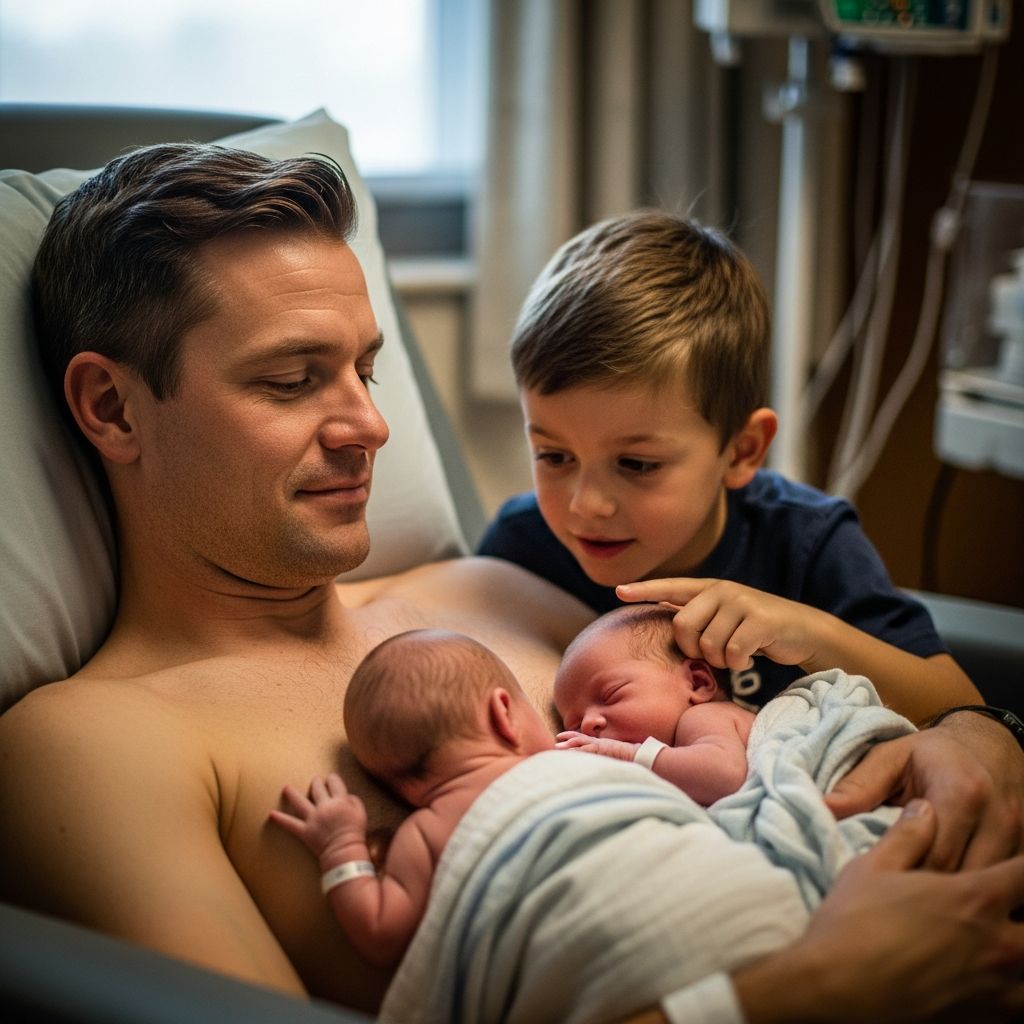
A touching photograph has captured global attention, depicting a father and his young son engaging in skin-to-skin contact with their newborn premature twin siblings. This practice, known as kangaroo care, demonstrates not only emotional family bonds but also critical medical benefits for vulnerable infants.
Understanding Kangaroo Care: A Lifesaving Practice
Kangaroo care involves placing a newborn, often premature, directly on a parent’s bare chest. This method mimics the warmth and security of the mother’s pouch for marsupials, hence the name. Originally developed in Colombia in the 1970s due to incubator shortages, it has since gained worldwide recognition for its efficacy in neonatal intensive care units (NICUs).
For premature babies born as early as three months ahead of schedule, traditional incubators provide essential support. However, kangaroo care offers superior outcomes in several key areas. A parent’s chest maintains more stable body temperature than mechanical devices, helps stabilize breathing patterns, promotes faster weight gain, and fosters calmness in the infant.
The Viral Moment: Family Involvement in Neonatal Bonding
The image in question originated from a Swedish birth advocacy page and was shared by Danish group Forældre og Fødsel before gaining massive traction via South Africa’s NINO Birth page. It shows a father shirtless, holding one tiny twin against his chest, while his young son, resting on the father’s lap, mirrors the action with the other sibling.
These twins, weighing around 700 grams (1.5 pounds) each, represent the fragility of extreme prematurity. Yet, the photo illustrates how even siblings can participate, extending the healing power of touch beyond parents. Shared over 17,000 times, it resonates because it humanizes NICU experiences, often seen as cold and clinical.
Scientific Benefits Backed by Research
Professor Uwe Ewald, a Swedish neonatologist, has championed kangaroo care’s integration into routine practice, even for the smallest preemies. His teachings emphasize that parental skin contact outperforms incubators in temperature regulation—a parent’s body adapts dynamically to the baby’s needs.
- Improved Breathing: Skin-to-skin stimulates the baby’s respiratory system, reducing apnea episodes common in preemies.
- Weight Gain: Infants gain weight 50% faster due to enhanced metabolic stability and breastfeeding cues.
- Infection Reduction: Parental skin harbors beneficial bacteria, lowering risks from hospital-acquired pathogens.
- Neurodevelopment: Prolonged contact supports brain growth, reducing long-term cognitive delays.
Studies confirm these advantages. A landmark review by the World Health Organization notes kangaroo care shortens hospital stays and cuts mortality rates in low-birth-weight infants.
Fathers’ Vital Role in Early Infant Care
While mothers often receive focus postpartum, fathers provide irreplaceable contributions through kangaroo care. It equalizes bonding, releasing oxytocin in both parent and child, strengthening attachments that last a lifetime. For dads, it builds confidence and involvement from day one.
In the viral photo, the father’s initiative ensures both twins receive equal attention, vital when maternal recovery limits her participation. This model encourages all family members to engage, transforming passive observers into active caregivers.
Global Adoption and Innovations in Neonatal Care
Sweden and Denmark lead in family-centered NICUs, prioritizing skin-to-skin even for ventilated infants. Hvidovre Hospital in Denmark hosted Ewald’s workshops, implementing protocols for continuous parental holding.
| Country/Region | Kangaroo Care Policy | Key Outcomes |
|---|---|---|
| Sweden | Mandatory for all preemies >700g | 47% reduced infection rates |
| Colombia (origin) | Standard since 1980s | 51% lower mortality |
| USA | Growing in NICUs | Shorter hospital stays |
This table highlights varying adoption levels and impacts, underscoring the need for broader implementation worldwide.
Extending Kangaroo Care to Siblings and Beyond
The inclusion of the young brother in the photo breaks new ground. Sibling involvement promotes empathy, reduces jealousy, and integrates the newborn into the family dynamic early. Pediatric guidelines now support supervised sibling skin-to-skin for emotional health.
Beyond immediate family, kangaroo care extends to grandparents and partners, creating a support web. Programs like those from the March of Dimes advocate training for extended touch therapy in NICUs.
Practical Tips for Implementing Skin-to-Skin at Home and Hospital
- Preparation: Ensure baby is stable; use a soft wrap to secure them vertically on chest.
- Duration: Aim for 1-2 hours sessions, multiple times daily for optimal benefits.
- Monitoring: Watch for signs of distress; consult NICU staff for ventilated infants.
- Comfort: Dim lights, minimize noise to enhance relaxation.
- Dad-Specific: Wear a front-carrying shirt post-discharge for continued bonding.
These steps make kangaroo care accessible, empowering parents regardless of setting.
Emotional Impact: Stories from Parents and Experts
Parents report profound connections formed during these sessions. One father shared how holding his 28-weeker twins synchronized their heartbeats, a rhythm felt palpably. Experts like Ewald stress emotional resilience gained, buffering parental stress amid uncertainty.
The photo’s virality amplifies these narratives, inspiring NICU policy shifts toward humanity over machinery.
Frequently Asked Questions (FAQs)
Is skin-to-skin safe for extremely premature babies?
Yes, when medically supervised. Babies as small as 700g benefit, with protocols ensuring stability.
How does kangaroo care help fathers bond?
It triggers oxytocin release, mimicking maternal hormones, fostering equal attachment.
Can siblings participate in kangaroo care?
Supervised yes; it builds family unity and reduces sibling rivalry.
What if the baby is on a ventilator?
Specialized positioning allows safe skin-to-skin; consult neonatologists.
How long should kangaroo care sessions last?
Ideally continuous when possible; even hourly sessions yield gains.
Challenges and Future Directions
Barriers include NICU overcrowding and staff training gaps. Yet, advocacy grows, with WHO endorsing kangaroo care as standard for low-resource settings. Future research explores long-term IQ boosts and mental health outcomes.
Innovations like wearable monitors during sessions promise wider safety nets.
This father’s story reminds us: in vulnerability, touch heals deepest. As NICUs evolve, such images pave the way for compassionate, evidence-based care.
References
- Image Of Father And Son Holding Newborn Twins Skin-To-Skin Will Give You All The Feels — Scary Mommy. 2016-05. https://www.scarymommy.com/father-son-twins-skin-to-skin-viral-photo
- Father And Son Practicing Skin-To-Skin Contact With Twin Babies Go Viral — Bored Panda. 2016. https://www.boredpanda.com/babies-skin-to-skin-contact-sweden/
- Boy helps dad give skin-to-skin contact to newborn twins in adorable viral photo — KIRO 7 News. 2016-05-18. https://www.kiro7.com/news/trending-now/boy-helps-dad-give-skintoskin-contact-to-newborn-twins-in-adorable-viral-photo/299270119/
- Kangaroo mother care: a systematic review of barriers and enablers — World Health Organization (via PubMed). 2021. https://www.who.int/publications/i/item/9789240020317
- Kangaroo Care Guidelines — March of Dimes. 2023-10-01. https://www.marchofdimes.org/find-support/topics/neonatal-intensive-care-unit-nicu/kangaroo-skin-skin-care-your-baby
- Effectiveness of Kangaroo Care in Low Birthweight Infants — NIH/NICHD. 2022. https://pubmed.ncbi.nlm.nih.gov/34928685/
- Immediate “Kangaroo Mother Care” and Survival of Infants with Low Birth Weight — New England Journal of Medicine. 2020-06-18. https://www.nejm.org/doi/full/10.1056/NEJMoa1916677
- Fatherhood in the NICU: A Father’s Kangaroo Care Experience — American Academy of Pediatrics. 2024. https://publications.aap.org/pediatrics/article/153/Supplement_2/e2023063325/196000