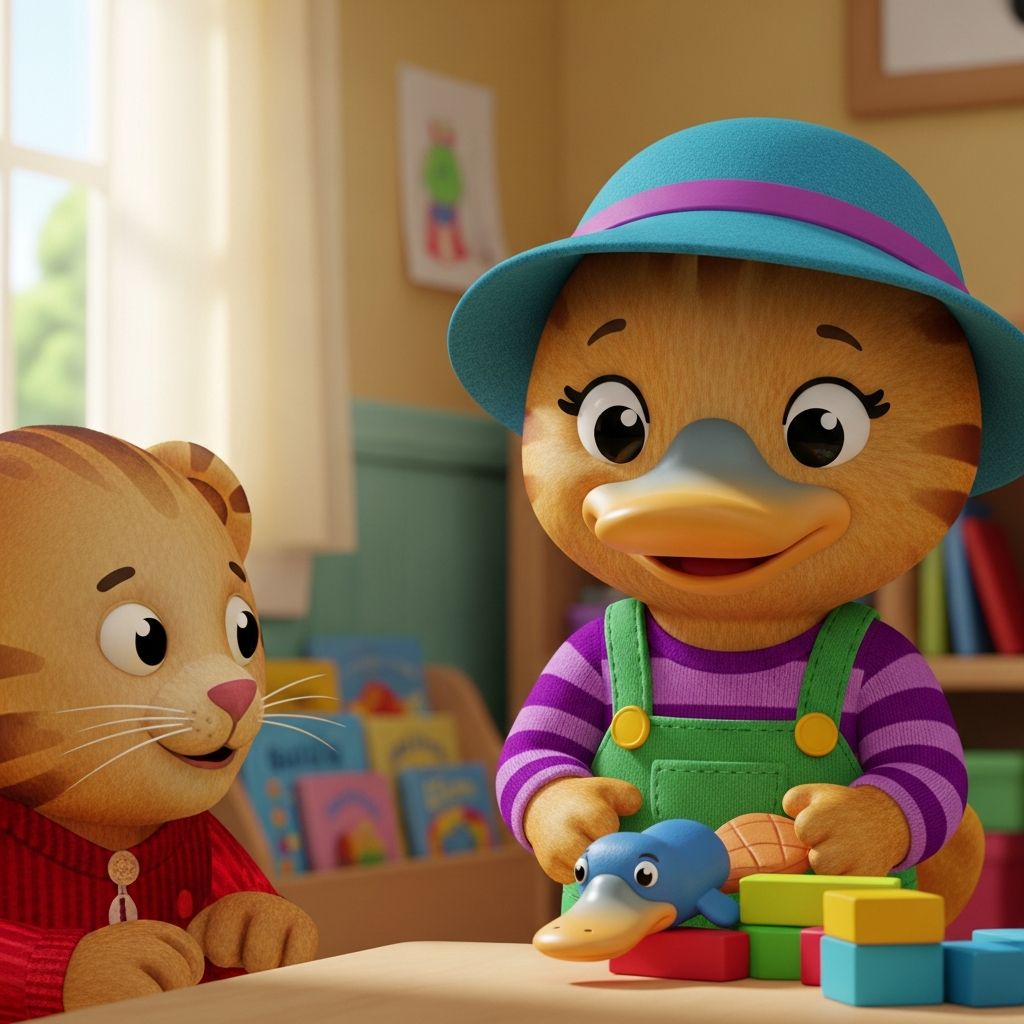
Preschool television is full of colorful characters, but every once in a while a new face appears on screen who feels surprisingly important. Jodi Platypus, the newest neighbor on Daniel Tiger’s Neighborhood, is exactly that kind of character: gentle, curious, a little overwhelmed by change, and quietly groundbreaking for children and parents watching together.
Rather than existing as a sidekick for Daniel, Jodi brings her own stories, struggles, and strengths. Through her, the show explores topics that many young kids are facing right now: moving to a new home, missing old friends, living in a nontraditional family, and noticing that people can be different yet still belong together.
Meet Jodi Platypus: A Different Kind of Neighbor
Jodi is introduced when her family moves into Daniel’s neighborhood, giving young viewers a front-row seat to everything that comes with starting over in a new place. For many preschoolers, relocation is a major emotional event. Studies show that residential moves are common in childhood, and frequent moves can be stressful if children do not receive consistent support and reassurance.
By following Jodi’s experiences, the show offers a model for what that support can look like—both from caring adults and from peers like Daniel.
Key traits that make Jodi stand out
- Curious and cautious: She wants to explore, but she is honest when she feels nervous or unsure.
- Openly emotional: She cries, worries, and misses her old home without being shamed for it.
- Social learner: She slowly builds trust by playing, asking questions, and observing others.
- Respectfully different: Her family structure, routines, and language add variety to the show’s world.
These traits mirror what child psychologists call social-emotional competence—the developing ability to understand and express emotions, build relationships, and manage challenges. Watching a character like Jodi handle those challenges out loud helps children put words to feelings they may not understand yet.
Why Representation of Different Families Matters
One of the most noticeable things about Jodi is her family. She lives with her mother, Dr. Plat, and her grandmother, Nana, along with her twin brothers. That setup immediately broadens the types of families represented on screen.
According to national data, millions of children in the United States live in single-parent households or are being raised with significant help from grandparents and extended family. Yet many preschool shows still center almost exclusively on two-parent households.
How Jodi’s family helps kids
- Normalizes nontraditional homes: Kids who see themselves in Jodi’s family learn that their home is not “less than” anyone else’s.
- Teaches inclusion: Children from more traditional homes learn that families can look many ways and still be loving and stable.
- Promotes respectful curiosity: Daniel’s questions about Jodi’s family model how to be curious without being rude.
- Highlights grandparent care: Many children are cared for daily by grandparents; seeing Nana in an active role reflects that reality.
| On-Screen Message | What Kids Learn |
|---|---|
| Families can include parents, grandparents, or other caregivers. | Love and safety define a family more than who lives in the house. |
| Daniel asks questions about Jodi’s home life kindly. | It is okay to notice differences if you stay respectful and open. |
| Jodi’s mom and Nana share responsibilities. | Caregiving can be a team effort, and many adults may look after a child. |
Moving, Change, and the Big Feelings That Come With It
For young children, moving is not just about boxes and addresses—it is about losing the familiar and learning to trust the new. Researchers note that transitions like relocation can trigger anxiety, sleep disturbances, or regression in behavior if kids do not have enough emotional support.
Jodi’s storyline turns those abstract concerns into something concrete and relatable:
- She misses her old room and friends.
- She fixates on a special object from her previous home.
- She feels overwhelmed at a neighborhood gathering with new faces.
Each of these moments gives caregivers an opening to talk about feelings that often stay hidden.
Skills Jodi models for kids who are facing change
- Naming emotions: Saying “I feel sad,” “I’m nervous,” or “I miss my old home” teaches children to label what is going on inside.
- Using comfort objects: A favorite book, toy, or blanket becomes a bridge between “old” and “new,” a strategy many therapists recommend as children adjust to change.
- Taking time to warm up: Jodi does not instantly love every new situation, and that slow warming is portrayed as acceptable.
- Accepting help: She lets adults and friends soothe, guide, and include her.
Friendship Across Differences
On the surface, Jodi and Daniel are very different: species, family structure, and life experiences. Yet their friendship is built on simple shared joys—books, pretend play, trains—and mutual curiosity. This reflects what developmental psychologists describe as early peer relationships, where shared activities and companionship are at the core of friendship.
What their friendship shows young viewers
- Common ground is powerful: Liking the same game or story can be enough to start a friendship.
- Differences are not barriers: Having different routines or families does not prevent connection.
- Questions build understanding: When Daniel asks about twins or Nana, he learns more without judging.
- Empathy in action: Daniel is excited about his new neighbor, but he adjusts his expectations when he sees that Jodi is sad or overwhelmed.
Why Catchphrases and Repeated Phrases Work for Kids
Jodi comes with her own enthusiastic catchphrase, adding to the show’s library of memorable lines that kids quickly echo at home. Catchphrases are not just cute; repetition and predictable language patterns help children learn social rules, emotional scripts, and even early literacy skills.
How repeated phrases support learning
- Memory and recall: Simple, repeated sayings are easy for preschoolers to remember and use in new situations.
- Emotional shorthand: Phrases paired with specific feelings (like excitement or calm) help kids connect words with inner states.
- Shared family language: When parents use the same phrases from the show, it creates continuity between screen time and real life.
Social-Emotional Learning in Action
Daniel Tiger’s Neighborhood is widely recognized for centering social-emotional learning (SEL), and Jodi’s arrival deepens that focus. SEL refers to the process through which children learn to manage emotions, set goals, show empathy, build relationships, and make decisions responsibly.
SEL themes Jodi reinforces
- Self-awareness: Jodi often expresses when she is confused, shy, or happy, modeling honest self-reflection.
- Self-management: With adult support, she learns to cope with homesickness and nervousness.
- Relationship skills: She practices joining groups, sharing, and taking turns with new friends.
- Social awareness: By noticing others’ feelings and routines, she learns how to fit into a new community.
Several education organizations, including CASEL (the Collaborative for Academic, Social, and Emotional Learning), highlight the long-term benefits of early SEL exposure—from better classroom behavior to improved academic outcomes. Characters like Jodi bring those abstract skills to life in ways young children can easily understand.
How Parents Can Use Jodi’s Story at Home
Jodi’s presence on the show is helpful on its own, but her episodes also double as conversation starters. Parents and caregivers can use her experiences to open low-pressure discussions about their children’s own feelings and fears.
Practical ways to build on what kids see
- Talk about moving and change: After an episode about Jodi’s move, ask, “Have you ever felt like Jodi, missing somewhere or someone?”
- Compare family structures: Look at your own family and Jodi’s. Ask, “Who lives in our home? Who else loves and takes care of you?”
- Create a comfort routine: If your child is facing change (new school, new babysitter), help them choose one item or ritual that can stay the same, just like Jodi clings to familiar objects.
- Practice welcoming new kids: Role-play “meeting a new neighbor” or “saying hi to a new classmate” based on how Daniel treats Jodi.
Why Jodi Feels So Timely
In recent years, families have faced an unusual amount of disruption—moves, school changes, shifting caregiving arrangements, and periods of social isolation. Experts note that young children are especially sensitive to instability, and consistent, warm relationships are one of the strongest protective factors for their mental health.
Jodi’s stories repeatedly return to three stabilizing forces:
- Reliable caregivers: Her mom and Nana show up, explain, comfort, and follow through.
- Predictable routines: Bedtime, meals, and neighborhood rituals anchor her in the new environment.
- Supportive peers: Daniel and the other kids offer friendship and inclusion instead of exclusion.
Seeing these supports in action helps kids internalize what safety and connection can look like, even when life changes around them.
Frequently Asked Questions (FAQs)
Who is Jodi Platypus on Daniel Tiger’s Neighborhood?
Jodi Platypus is Daniel Tiger’s new neighbor, a young platypus who moves into the neighborhood with her mom, twin brothers, and grandmother. Through her experiences, the show explores moving to a new home, diverse families, and big feelings around change.
Why is Jodi’s family structure important for kids to see?
Jodi lives with a single mother and a grandmother, reflecting the reality of many children who grow up in single-parent or multi-generational households. Seeing such families portrayed positively helps normalize different home situations and encourages kids to respect diversity in their peers’ lives.
How does Jodi help children cope with moving or change?
Jodi openly misses her old home, relies on comforting objects, and slowly adjusts to new spaces and people. Her story reassures kids that feeling sad or worried about change is normal and that those feelings can ease with time, support, and new routines.
What can parents do to reinforce the lessons from Jodi’s episodes?
Parents can talk with children about their own feelings after watching, create small rituals to provide stability during transitions, and practice welcoming behaviors toward new classmates or neighbors. Using phrases and ideas from the show makes it easier for kids to connect screen lessons with real life.
How does Jodi fit into Daniel Tiger’s focus on social-emotional learning?
Jodi deepens the show’s social-emotional themes by bringing in experiences of moving, homesickness, and nontraditional family life. She demonstrates self-awareness, coping strategies, and empathy in ways that align with widely accepted social-emotional learning frameworks used in early childhood education.
References
- Residential mobility, well-being, and mortality — Lawrence B. Brown et al., Social Science & Medicine. 2012-04-01. https://doi.org/10.1016/j.socscimed.2012.01.039
- 2013 CASEL Guide: Effective Social and Emotional Learning Programs — Preschool and Elementary School Edition — Collaborative for Academic, Social, and Emotional Learning (CASEL). 2013-01-01. https://casel.org
- Living Arrangements of Children: 2019 — U.S. Census Bureau. 2021-03-01. https://www.census.gov/library/publications/2021/demo/p70-173.html
- Peer Relationships in Early Childhood — Ross D. Parke & Gary W. Ladd, in Handbook of Peer Interactions, Relationships, and Groups. 2009-01-01. https://psycnet.apa.org/record/2009-24043-000
- Nurturing Care for Early Childhood Development — World Health Organization, UNICEF, World Bank Group. 2018-05-01. https://www.who.int/publications/i/item/9789241514064