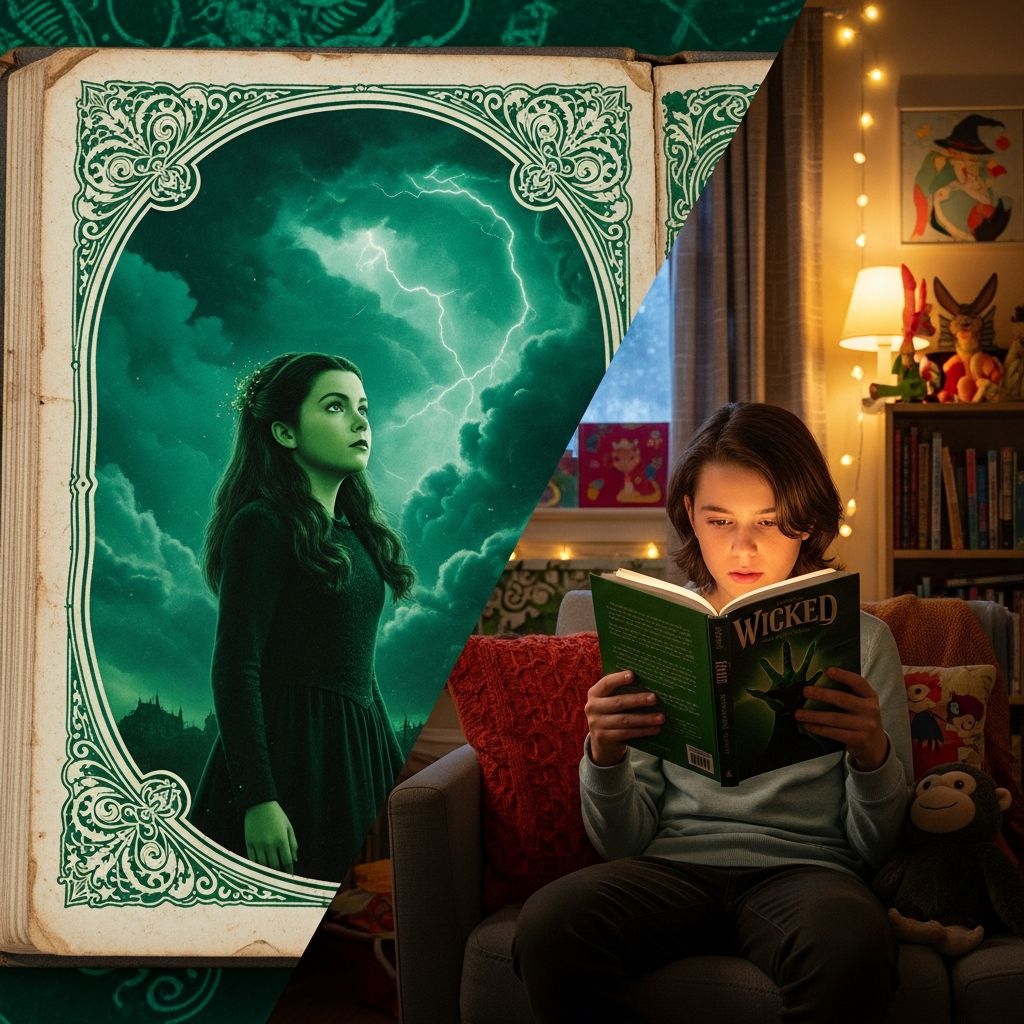
Parents often discover Gregory Maguire’s novel Wicked: The Life and Times of the Wicked Witch of the West after their kids fall in love with the musical, then wonder if the book is an obvious next step—or a little too dark, dense, and adult. This guide walks you through the themes, content, and emotional weight of the book so you can make a thoughtful decision for your own child.
Understanding What “Wicked” Actually Is
Many kids come to Wicked expecting a colorful fantasy connected to The Wizard of Oz, but the book is really an adult literary novel that uses Oz as a backdrop for exploring politics, morality, and identity. The tone is much more serious and somber than a typical middle-grade or young adult fantasy.
Rather than focusing on adventure and quests, the novel follows Elphaba—the future Wicked Witch—from birth through school, activism, and disillusionment, with long stretches of introspection and world-building. That slower, more reflective style can be either fascinating or frustrating for younger readers, depending on their maturity and patience.
Big Themes Parents Should Know About
The heart of the book lies in questions that are often discussed in high school literature classes, not in typical children’s chapter books. Before handing it to a tween or teen, it helps to know what kinds of ideas they will be wrestling with.
- Good and evil are blurry: The novel constantly asks whether anyone is truly “good” or “wicked,” or whether people are shaped by their circumstances and the stories others tell about them.
- Power and corruption: Government control, propaganda, and the abuse of authority are central plot drivers, and Elphaba’s choices often come out of her resistance to injustice.
- Otherness and prejudice: Elphaba’s green skin, Animals (with a capital A) who can talk, and marginalised groups in Oz all face discrimination and violence.
- Faith and doubt: Characters debate religion, destiny, and whether any higher power is watching or caring, sometimes in cynical or unsettling ways.
- Loss, trauma, and regret: Death, grief, and the weight of past choices give the story a melancholy tone, especially in later sections.
These themes are not just briefly touched on; they are woven deeply into the plot and character arcs. For some thoughtful teens, this depth is exactly the appeal. For others, it can feel heavy, confusing, or emotionally draining.
Content Parents Often Ask About
Although Wicked is set in a fantasy world, its content is closer to adult fiction than to a typical teen fantasy series. It does not shy away from sexuality, complex relationships, or scenes that may disturb more sensitive readers.
- Sexual content: There are references to sex, desire, and adult relationships, including scenes that are not graphic in a purely explicit sense but are clearly meant for mature readers and not handled with a YA “fade to black” approach.
- Violence: Violence is present in both personal and political forms—attacks, killings, and oppression are described, sometimes with unsettling detail.
- Substance use: Characters drink and use substances in ways that fit the darker, more adult tone of the book.
- Language and tone: The language is not wall-to-wall profanity, but it is written for adults and occasionally includes rough or crude expressions.
- Psychological intensity: The most intense parts are not the battles, but the emotional turmoil: guilt, obsession, moral compromise, and despair.
None of this makes the book “bad” or inappropriate by default, but it does mean that it may not align with every family’s comfort level or every tween’s emotional readiness.
Reading Level and Literary Style
One of the biggest surprises for parents is that Wicked is not only mature in content but also quite demanding in style. It assumes a lot of background knowledge and stays away from the straightforward, fast-paced language many tweens are used to.
- The prose is dense, with long descriptive passages, philosophical asides, and political conversations that can feel slow if a reader expects constant action.
- The narrative is nonlinear at times, jumping through different phases of Elphaba’s life, asking the reader to keep track of names, timelines, and subplots.
- The vocabulary is advanced enough that even strong middle-school readers may occasionally struggle or miss nuance.
For a teen who devours classics, complex fantasy, or literary fiction, this may be welcome. For a tween whose favorite reads are light, snappy series, the book may feel like wading through mud.
Rough Age Guidelines (With Lots of Wiggle Room)
No single age fits every child, but it can help to think of rough bands rather than a hard cutoff. Your knowledge of your child always matters more than any general rule.
| Age Range | General Fit | Key Considerations |
|---|---|---|
| 10–12 (younger tweens) | Usually not a good match; themes and style are typically too mature and complex. | May be disturbed by darker scenes; may find the writing confusing or boring rather than engaging. |
| 12–14 (older tweens / early teens) | Possible for advanced, emotionally mature readers, but requires careful parental guidance. | Good candidates are kids who already handle serious topics in books and enjoy slow, character-driven stories. |
| 15–17 (mid–late teens) | Often an appropriate time to consider the book, especially for readers interested in literary fantasy and moral ambiguity. | Still worth discussing sexual content, politics, and philosophical themes before and after reading. |
| 18+ (young adults) | Best fits the original target audience: adults and older teens with patience for dense, thematic fiction. | More likely to grasp the nuances of satire, social commentary, and character psychology. |
Plenty of families decide to wait until later high school or beyond for this book, not because it is “forbidden,” but because the story tends to land better when readers have a bit more life experience and literary stamina.
Questions to Ask About Your Specific Child
Instead of treating age as the only factor, it can help to think through your child’s temperament and reading history. Use these questions as a quick self-check.
- Does my child usually gravitate toward light, hopeful stories or toward darker, more serious books?
- How have they handled intense themes in other media (movies, shows, or novels)? Do they ruminate, have nightmares, or bounce back easily?
- Are they comfortable encountering morally gray characters whose choices are never fully resolved or rewarded?
- Do they have the patience for long, descriptive chapters with relatively little action?
- Is there space in our relationship to talk honestly about the book’s adult themes without shame or secrecy?
If you answer “yes” to most of these questions, your teen may be ready for Wicked, especially if you read alongside them or stay available for conversation.
Helping Kids Differentiate the Musical and the Book
A lot of the confusion comes from assuming that if a child loves the musical, they are automatically ready for the novel. The two share characters and some plot beats, but they differ dramatically in tone and focus.
- The musical highlights friendship, redemption, and soaring emotion, even while touching on injustice and sacrifice.
- The book leans harder into politics, social unrest, and philosophical questions, with a more cynical and sometimes bleak outlook.
- The stage version simplifies and softens certain storylines that, in the book, are more tangled, darker, and more morally uncomfortable.
Before a tween picks up the novel, it is helpful to say clearly: “This is not the musical on the page.” That simple warning can prevent disappointment and manage expectations.
Alternatives for Younger or Sensitive Readers
If your child is fascinated by Oz and drawn to the idea of understanding the witch’s backstory but Wicked feels like too much right now, there are gentler paths that still feed their curiosity and love of retellings.
- Revisit the original Oz books: L. Frank Baum’s series is whimsical, episodic, and far more child-friendly, while still offering plenty of imagination and adventure.
- Explore middle-grade retellings: Look for age-appropriate spins on classic tales that focus on friendship, bravery, and identity without adult-level content.
- Use the musical as the stopping point: Enjoy the soundtrack, talk about the characters’ choices, and let the stage version be your child’s main window into the story for now.
- Pause and save the book for later: Let them know that reading Wicked can be something to look forward to in a few years, when they will get more out of it.
Framing “wait until you’re older” as an invitation, not a rejection, can help kids feel trusted and respected rather than shut down.
How to Read It Together (If You Say Yes)
If you decide your tween or teen is ready, you can reduce the risk of confusion or distress by being an active partner in their reading rather than simply handing over the book and hoping for the best.
- Skim first: Even reading a few chapters and flipping through the rest can alert you to scenes you might want to preview, skip, or discuss.
- Set expectations: Explain that the book is slower, darker, and more complex than the musical, so they are not blindsided.
- Check in regularly: Ask what they think of Elphaba, which parts feel confusing, and whether any scenes were uncomfortable.
- Model critical thinking: Talk about how stories frame people as “heroes” or “villains,” and how Wicked complicates that pattern.
- Normalize stopping: Give your child permission to put the book down if it stops being enjoyable, without shame or a sense of failure.
Treating Wicked as a conversation starter rather than a solitary test of maturity can make the reading experience safer and richer for both of you.
Key Takeaways for Time-Pressed Parents
For families juggling school, activities, and limited downtime, deciding whether to add a long, demanding novel to the mix is not a small thing. It helps to keep the core considerations in mind.
- The book is written for adults, not children. Its complexity and mature themes are a feature, not a bug.
- Most younger tweens are not ideal readers for it. Waiting will often mean a better, more meaningful experience later.
- Thoughtful, advanced readers in mid–late teens are the sweet spot. They are more likely to appreciate the nuance and less likely to be overwhelmed.
- Your judgment matters more than marketing labels. No rating system can substitute for knowing your own child’s sensitivities and strengths.
Ultimately, there is nothing wrong with deciding that now is not the right time—or that it is perfectly fine, as long as you stay engaged and ready to talk.
FAQs About “Wicked” and Tweens/Teens
Is “Wicked” appropriate for a 10- or 11-year-old?
In most cases, no. Even strong readers at this age are still developing emotional and cognitive frameworks for the kinds of political, sexual, and philosophical issues the book explores. For many families, it makes more sense to wait until at least mid-teens.
My teen loved the musical. Does that mean they will love the book?
Not necessarily. The musical is emotional and accessible, while the book is slower and more cerebral. Some teens who adore the show are disappointed by how heavy and complex the novel feels, especially if they expected a similar tone.
Is “Wicked” considered a young adult novel?
No. It is often shelved in general fiction or adult fantasy. Some libraries and bookstores may place it near YA titles because of the popularity of the musical and the age of some characters, but the original target audience is adults.
What if my teen encounters content I would have preferred to avoid?
Use it as an opening for honest conversation. Ask how they felt, what they understood, and what questions they have. You cannot erase what they have read, but you can help them process it thoughtfully and align it with your family’s values.
Is there a “clean” or toned-down version of the book?
There is not an official edited edition of the novel. However, some families choose to read it aloud or together so that they can skip or gloss over specific scenes while still engaging with the larger story and themes.
Would you recommend starting with “Wicked” or another book in the series?
The series is built around the themes and style established in Wicked, so starting with a later book will not make things easier. If the first novel feels like too much, that is usually a sign to pause the entire series rather than trying to jump ahead.