Creating Safe Water Experiences for Your Infant
Water play offers infants wonderful opportunities for sensory exploration, physical development, and enjoyment. However, introducing your baby to aquatic environments requires careful attention to safety protocols and developmental readiness. Understanding both the risks and the best practices allows you to provide enriching water experiences while protecting your child from preventable accidents.
The foundation of all water safety begins with recognizing that infants have limited physical capabilities. Babies lack the neck strength and muscle control necessary to protect themselves in aquatic settings. This fundamental limitation means that even small amounts of water can pose significant risks, requiring constant vigilance from caregivers.
Understanding Critical Water Safety Principles
The most important principle in infant water safety is continuous, attentive supervision. This means maintaining constant visual contact and staying within arm’s reach of your child at all times when water is present. Supervision cannot be delegated to other children and must remain an adult’s primary focus—not a secondary task performed while multitasking.
Infants can experience drowning in remarkably shallow water depths. Research indicates that drowning can occur in as little as one to two inches of water, and it can happen silently and within seconds. This tragic reality underscores why even seemingly minor water hazards demand serious attention.
Multiple layers of protection work together to create safer environments. These layers include physical barriers, monitoring systems, rescue equipment, emergency preparedness, and adult supervision. No single measure is sufficient; instead, they work synergistically to reduce risks.
Bath Time Safety Protocols
For most families, a baby’s first water experiences occur during bath time. Creating a safe bathing routine establishes foundational water safety habits. Before beginning any bath, gather all necessary supplies—wash cloths, towels, clothing, and diapers—within immediate reach. This preparation prevents the need to leave your infant unattended to retrieve forgotten items.
Temperature control represents a critical safety consideration during bathing. Infants have more sensitive skin than adults and can suffer serious scalds rapidly. Test water temperature using your wrist or elbow before placing your baby in the tub. Health authorities recommend that the maximum temperature at your faucet should not exceed 120 degrees Fahrenheit. Many families can adjust their water heater settings to maintain this temperature, providing ongoing protection across all household water sources.
Bath seats and support devices require careful consideration. While these products provide convenience, they create risks if used improperly. Bath seats can tip over, and infants can slip out of them. If you choose to use a bath seat, it should only be used with close, direct adult supervision—never as a substitute for attentive oversight. Your hand should remain on your baby throughout the bathing process.
The statistics surrounding bathtub drowning are sobering. Most child drownings occurring inside homes happen in bathtubs, and more than half of these incidents involve children under one year of age. In the vast majority of cases, these tragedies occur during brief lapses in adult supervision. If you need to answer the door, take a phone call, or retrieve a forgotten item, your baby must come with you, even if they are in a supportive device.
Beyond the Bathtub: Indoor Water Hazards
Water dangers in bathrooms extend beyond the bathtub. Toilets represent overlooked drowning hazards, as infants can topple headfirst into the bowl and lack the strength to extract themselves. Address this risk by consistently closing toilet lids and installing safety locks or latches on all toilet seat covers. These devices prevent small fingers from lifting lids during unsupervised bathroom exploration.
Remove bathtub drain plugs when the tub is not in use. This prevents dangerous situations where a curious child might turn on the faucet, causing the tub to fill with water. Additionally, maintain bathroom security by keeping doors closed and using safety latches or door knob covers to restrict access to bathrooms without adult permission.
Other household water containers can pose unexpected risks. Five-gallon buckets, garden ponds, and even small wading pools have been sites of infant drowning incidents. Empty all buckets immediately after use and store them upside down and out of reach. Keep bathroom doors secured to prevent unsupervised access to any water source.
Portable and Inflatable Pool Safety
Many families use inflatable or soft-sided pools for home water recreation. These portable pools carry the same drowning risks as permanent in-ground pools. Children can enter inflatable pools easily but often struggle to exit them. Always empty portable pools immediately after use and store them upside down, away from children’s reach. This removes temptation and prevents water accumulation during storage.
When using any temporary pool setup, apply the same rigorous safety standards as permanent pools. Designate a dedicated adult water watcher whose sole responsibility is monitoring children. This person should not read, use their phone, or perform other tasks—their attention must remain fixed on the children.
Permanent Pool Protection Strategies
Residential swimming pools require comprehensive protection systems. These systems should include multiple layers of defense rather than relying on any single safeguard. The most fundamental requirement is four-sided fencing that completely surrounds the pool and separates it from the house and yard.
Pool fencing specifications are critical. Fences should be at least four feet high with no openings under the fence or between slats exceeding four inches in width. This height and spacing prevents children from crawling under or squeezing through gaps. Gates must be self-closing and self-latching, opening away from the pool. The latch mechanism should be positioned at least 54 inches from the ground, placing it beyond the reach of most young children.
Check all gates regularly to ensure proper functioning, and keep gates locked at all times when the pool is not in use. Remove toys from the pool area during non-swim times, as these objects attract children and tempt them to access the pool without supervision.
Beyond fencing, install additional protective devices. Power-activated safety covers, door alarms leading to the pool, and pool alarms provide extra layers of protection. Drain covers and safety vacuum release systems (SVRSs) prevent entrapment hazards, particularly important since children’s hair, limbs, and clothing can become caught in drains. If your child has long hair, use hair bands to keep hair secured away from drain covers.
Cover hot tubs and spas immediately after use and maintain them in locked, covered status when not actively in use. Keep rescue equipment accessible near the pool, including life jackets, life buoys, and reach tools. Store a phone near the pool with emergency contact numbers readily available.
Introducing Infants to Water Activities
Most experts recommend beginning formal water exposure around six months of age, though family bathing can begin earlier. When introducing your baby to swimming or water play, use waterproof diapers and change them frequently to prevent accidents. Start with very brief water exposures in controlled environments where you can maintain complete physical contact with your child.
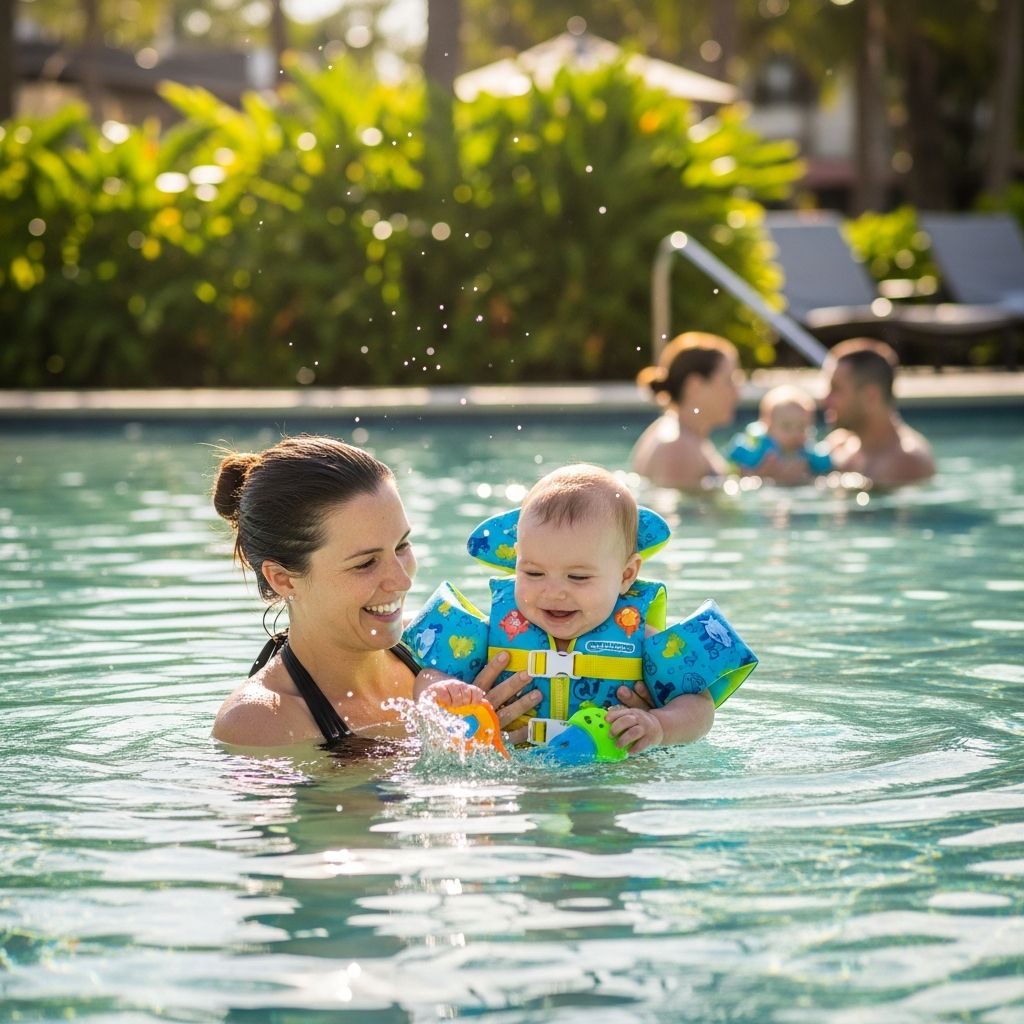
Life jackets designed for infants provide an additional safety layer during water activities. A properly fitted life jacket keeps your baby’s head above water and provides flotation support. However, life jackets are safety additions that complement—never replace—adult supervision and touch contact. Water wings, rafts, and plastic rings are designed for play rather than safety and should never be used in place of life jackets or adult supervision.
Teach your child to wait for your permission before entering any body of water. This foundation of water respect and obedience begins in infancy and develops as your child matures. Choose swimming venues with trained lifeguards present, though this does not diminish your personal responsibility to maintain close supervision.
Emergency Preparedness and Response
Despite all precautions, emergencies can occur. Cardiopulmonary resuscitation (CPR) training represents one of the most valuable investments a parent can make. CPR knowledge provides confidence and potentially life-saving capability if your child experiences a water-related emergency. Take a formal CPR course and refresh your training regularly to maintain competency and confidence.
Establish a system where if a child is ever missing during water activities, adults immediately check the water first. This protocol recognizes that drowning can occur silently and quickly, requiring prompt response. Keep emergency contact information posted near pools and water areas, and maintain a phone in immediate reach.
Outdoor Water Hazards Beyond Pools
Before your baby begins crawling or walking, survey your yard and surrounding areas for water hazards. Wells, irrigation ditches, drainage channels, and open post holes created during construction represent significant risks. Exercise caution around these features, and keep your child away from construction sites where water accumulation might occur.
Establish a system of constant supervision whenever your baby is outdoors. This means watching your child attentively even in your own yard, as water hazards can exist in unexpected locations. Neighborhood ponds, decorative water features, and even swimming holes in local parks require the same safety vigilance as backyard pools.
Additional Household Safety Considerations
Hot beverages pose dual hazards to infants. Never carry both a hot drink and your baby simultaneously, as an accidental collision could spill scalding liquid on your child. Place mugs, bowls, and other hot liquid containers away from table edges where babies might reach them from a lap or by pulling a table cloth. Don’t leave boiling liquids unattended on the stove, especially on front burners where curious children might reach them as they learn to stand and explore.
Establish family rules about responsible beverage placement and adult behavior around water and hot liquids. These rules should become automatic habits that protect your baby without requiring constant conscious decision-making.
Supervision Strategies for Water Activities
During social gatherings involving water, organize a formal water watch rotation. Designate specific adults to take turns serving as the dedicated water watcher for set time periods. Each designated watcher’s only responsibility is monitoring children in or near the water. This system prevents the common problem where multiple adults assume someone else is watching, creating dangerous gaps in supervision.
Maintain a designated water watcher even when lifeguards are present at public swimming venues. Lifeguards cannot provide the individualized, immediate supervision that infants require. Your personal responsibility to watch your child does not diminish simply because professional supervision is available.
Developmental Readiness for Water Experiences
| Age Range | Water Experience Level | Safety Considerations |
|---|---|---|
| 0-3 Months | Bath time only | Constant touch supervision, temperature control, never leave unattended |
| 3-6 Months | Bath time and warm shallow water | Waterproof diapers, maintain arm’s reach at all times |
| 6-12 Months | Introduction to pools with flotation aids | Life jacket usage, continuous direct supervision, water watcher designation |
Creating Positive Water Associations
While safety is paramount, water activities should remain enjoyable for infants. When safety protocols are followed consistently, babies develop positive associations with water through supervised play and exploration. Singing songs, playing with water toys, and allowing your baby to experience water on their own terms creates confidence in aquatic environments.
A baby who learns early that water is safe (when adults supervise properly) and fun (through play and exploration) develops comfort with water that often translates into better swimming skills and water safety awareness as they grow. This positive foundation begins when you combine rigorous safety practices with joyful water experiences.
Frequently Asked Questions
Q: At what age can babies start swimming lessons?
A: Most experts recommend beginning formal water exposure around six months of age. However, family bathing can begin from birth. Always verify specific lesson programs meet safety standards and maintain appropriate teacher-to-infant ratios.
Q: Can I use inflatable water wings instead of life jackets?
A: No. Water wings and similar products are designed for play, not safety. Use Coast Guard-approved life jackets specifically designed for infants, and remember that no flotation device replaces direct adult supervision.
Q: What should I do if my baby gets water in their nose or mouth during water play?
A: Brief exposure to small amounts of water is normal. However, if your baby coughs, struggles, or shows respiratory distress, remove them from the water immediately. If symptoms persist or worsen, seek medical attention. Learning CPR helps you respond appropriately to emergencies.
Q: Is it necessary to drain my pool when my child is not actively swimming?
A: While complete draining is not required, you should cover and secure portable pools after use and ensure permanent pools are properly fenced and gated. Water covers and drain covers should always be in place when the pool is not actively supervised.
Q: How often should I refresh my CPR training?
A: CPR certifications typically expire after two years. Refresh your training regularly to maintain competency and confidence in applying these life-saving techniques if an emergency occurs.
References
- Infant Water Safety: Protect Your New Baby from Drowning — American Academy of Pediatrics. 2024. https://www.healthychildren.org/English/safety-prevention/at-play/Pages/Infant-Water-Safety.aspx
- Water Safety for Children Birth to 5 Years — Seattle Children’s Hospital. 2024. https://www.seattlechildrens.org/health-safety/injury-prevention/water-safety-for-children-birth-to-5-years/
- Swimming Safety for Babies — Safe Kids Worldwide. 2024. https://www.safekids.org/safetytips/field_age/babies-0-12-months/field_risks/swimming-and-water
- Pool Safely: Drowning Prevention Information and Resources — U.S. Consumer Product Safety Commission. 2024. https://www.poolsafely.gov
- Drowning Prevention and Water Safety — American Academy of Pediatrics. 2024. https://www.aap.org/en/patient-care/drowning-prevention-and-water-safety/
- Swim Safety — American Red Cross. 2024. https://www.redcross.org/get-help/how-to-prepare-for-emergencies/types-of-emergencies/water-safety/swim-safety.html