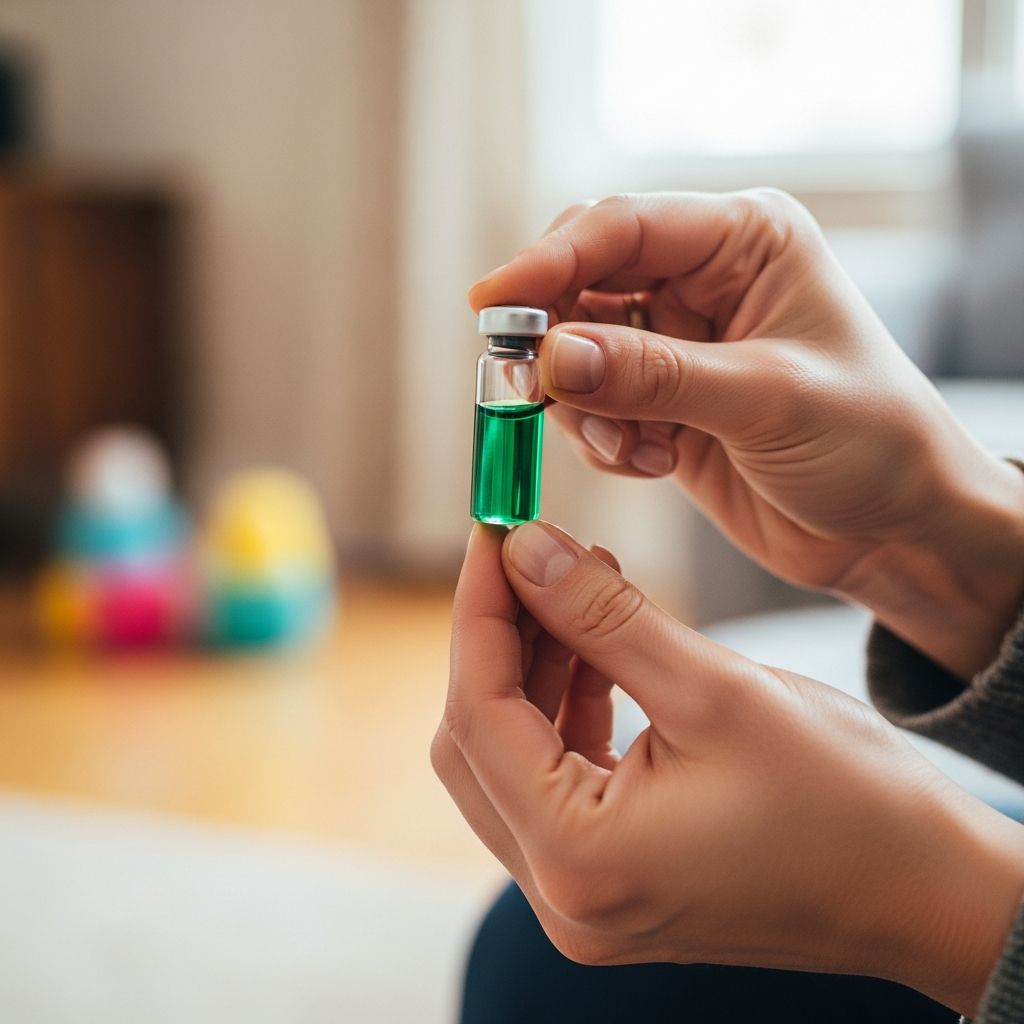
Indocyanine green, often shortened to ICG, is a medical dye that helps doctors see blood flow and certain organs more clearly during tests and procedures. When used correctly, it is a valuable tool for diagnosing and treating many conditions in children.
What Is Indocyanine Green?
Indocyanine green is a special type of fluorescent dye (a cyanine dye) that glows under near-infrared light, a kind of light that the human eye cannot see on its own. Doctors use cameras and filters that detect this light, allowing them to watch how the dye travels through the bloodstream in real time.
Key features of ICG include:
- Injected into a vein (usually in the arm or hand)
- Binds to blood proteins, so it stays inside the blood vessels
- Cleared quickly by the liver and leaves the body through bile
- Has a very short half-life (about 3–4 minutes in the bloodstream)
Because ICG leaves the bloodstream quickly and does not enter most other tissues, it can give doctors a clear, short-lived “snapshot” of circulation and organ function.
Why Might a Child Need ICG?
Doctors may recommend ICG when they need more detailed information than standard tests can provide. In children, ICG can be used in tests and procedures involving the:
- Heart and blood vessels – to look at how blood flows through the heart or major vessels
- Lungs – to study circulation between the heart and lungs
- Liver and bile ducts – to evaluate liver function and bile drainage, such as in suspected biliary atresia
- Eyes – to examine blood vessels in the back of the eye using angiography
- Bowels and other organs – to check blood supply during or after surgery
- Lymphatic system – to trace lymph flow or locate lymph nodes
In many cases, ICG is used not only to diagnose problems but also to guide treatment in the operating room, such as confirming that tissue has good blood supply before a surgeon finishes a procedure.
How Does ICG Work Inside the Body?
ICG is designed to highlight the bloodstream and certain organs in a very controlled way.
Step-by-step: What Happens After Injection
- Injection into a vein: A small amount of ICG solution is injected into your child’s vein.
- Binding to plasma proteins: The dye quickly attaches to proteins in blood plasma, which keeps it inside the blood vessels rather than spreading into tissues.
- Near-infrared light exposure: Special equipment shines near-infrared light on the area being examined.
- Fluorescence: ICG absorbs this light and then emits its own light (fluorescence) at a slightly different wavelength, which cameras can capture.
- Real-time imaging: The camera sends images to a screen, allowing the team to watch blood flow or organ function live.
- Liver clearance: The liver removes the dye from the blood and moves it into bile, which then travels into the intestine and out of the body.
Why Near-Infrared Light Matters
Near-infrared light passes through tissues more deeply than visible light, which helps doctors see structures that would otherwise be hard to view. In eye tests, for example, ICG angiography lets doctors see deeper blood vessels in the choroid than with standard fluorescein dyes.
Common Pediatric Uses of ICG
ICG has been used in medicine for decades for adults and children. Below are some typical ways it may help in pediatric care.
| Body System / Area | How ICG Helps | Example Situation |
|---|---|---|
| Heart and circulation | Measures blood flow, cardiac output, and circulation patterns. | During or after cardiac catheterization to assess heart function. |
| Liver and bile ducts | Evaluates liver blood flow and how quickly the liver clears the dye. | Helps assess liver function or bile drainage problems such as biliary atresia. |
| Eye (retina and choroid) | Shows deep eye blood vessels using ICG angiography. | Diagnosing abnormal blood vessels or swelling at the back of the eye. |
| Surgical fields (bowel, skin, organs) | Checks blood supply to tissues during operations. | Ensuring a segment of bowel or a surgical flap has enough blood flow before closing. |
| Lymphatic system | Maps lymph vessels and nodes using fluorescent imaging. | Locating lymph nodes that may need biopsy in certain cancers or complex lymphatic problems. |
How Is ICG Given to a Child?
ICG is usually part of a larger test or procedure. Your child’s care team will explain how it fits into the overall plan.
Before the Test or Procedure
- Your child may need to avoid food or drinks (be “NPO”) for a set time if sedation or anesthesia is planned.
- The team will review allergies, especially to iodine or contrast dyes, because ICG solutions contain a small amount of sodium iodide.
- You will be asked to sign a consent form after risks and benefits are explained.
- Depending on the test, your child may have blood pressure, heart rate, and oxygen levels checked beforehand.
During the Test
- A nurse or doctor places an IV line (small plastic tube) into a vein in your child’s arm, hand, or sometimes foot.
- The ICG dose is injected through the IV, often followed by a small saline flush to move it quickly into the bloodstream.
- Special cameras and lights are turned on to capture the fluorescence as the dye circulates.
- The team watches images on a screen and may take photos or video for later review.
- Your child may be awake, sedated, or under general anesthesia depending on the procedure (for example, awake for many eye tests, asleep for most surgeries).
After the Test
- ICG leaves the bloodstream quickly, so the fluorescent signal fades within minutes.
- The IV is removed once no longer needed.
- Your child may return to normal eating and drinking when medically safe, especially if anesthesia was used.
- The care team will monitor for any side effects before sending your child home or back to their room.
Is ICG Safe for Children?
ICG has been used in people for more than 60 years and has a wide safety margin when used at recommended doses. It is considered nontoxic at medical doses and is excreted by the liver without being broken down into active substances.
Possible Side Effects
Most children do not have major side effects, but as with any medicine, problems can occur. Report anything unusual to the medical team right away.
- Mild warm feeling or flushing during injection
- Nausea or an upset stomach
- Headache
- Temporary changes in skin color near the IV site
Rarely, more serious reactions can happen, such as:
- Allergic reactions (rash, itching, swelling, breathing difficulty)
- Drop in blood pressure or heart rhythm changes
Because the solution contains a small amount of sodium iodide, the team is especially cautious in children with a history of iodine or contrast dye reactions.
Who May Not Be Able to Get ICG?
The doctor will review your child’s health history and decide whether ICG is appropriate. They may avoid or adjust its use if your child has:
- A history of severe allergic reactions to ICG, iodine-containing products, or certain contrast dyes
- Serious, unstable liver disease, since clearance of ICG depends on liver function
- Certain rare metabolic conditions where the risk of dye administration is higher (your specialist would discuss this in detail)
Benefits of Using ICG in Pediatric Care
Doctors choose ICG when its advantages outweigh the small risks. Benefits can include:
- Clearer images of blood flow and organ function than some other methods
- Real-time guidance during surgery, helping surgeons protect healthy tissue and improve outcomes
- Quick results because the dye circulates and clears rapidly
- The ability to reduce the need for more invasive tests in some situations
In surgery, for example, visualizing blood supply with ICG can help surgeons confirm that a section of intestine, a flap of skin, or part of an organ is healthy enough before it is left in place, which may lower the risk of complications.
How ICG Helps Doctors Make Decisions
The pictures and videos created with ICG do more than show where the dye goes. They give doctors measurable information they can use to plan treatment.
- In heart and circulation tests, ICG can help estimate cardiac output (the amount of blood the heart pumps per minute).
- In liver function studies, the rate at which ICG disappears from the blood helps show how well the liver is working.
- In eye angiography, patterns of fluorescence help identify abnormal blood vessels, leaks, or areas not receiving enough blood.
- During surgery, areas that glow brightly are usually well supplied with blood, while dark areas may be at risk, guiding where to cut or repair.
Questions to Ask Your Child’s Doctor
If your child’s team recommends a test or procedure that uses ICG, consider asking:
- Why is ICG needed for my child’s situation?
- Are there other tests that could be used instead, and why is this one preferred?
- How much dye will be given, and how long will the test or procedure take?
- What are the specific side effects or risks for my child?
- How will the results change the treatment plan?
- Does my child need anesthesia or sedation, and what are those risks?
Frequently Asked Questions (FAQs)
Q1: Will my child feel the ICG dye when it is injected?
Most children only feel the brief pinch of the IV placement. Some describe a short-lived warm sensation or flushing when the dye goes in, but this usually passes quickly.
Q2: How long does ICG stay in the body?
ICG is cleared from the bloodstream in just a few minutes, mainly by the liver. Small amounts may remain in the body for a longer period as it moves through bile and the intestines, but it does not continue to fluoresce or affect tests after the early phase.
Q3: Can I be with my child during the test?
This depends on the type of test. For many imaging procedures, a parent can stay in the room or nearby. For surgery or procedures needing anesthesia, you can often stay until your child is asleep and rejoin them in recovery afterwards, according to hospital policy.
Q4: Does ICG interact with my child’s medicines?
ICG is generally used as a one-time diagnostic dye, and it does not commonly interact with most medications. However, always give the care team a full list of all medicines, vitamins, and supplements your child takes so they can check for any relevant concerns.
Q5: Is ICG the same as other contrast dyes used in CT or MRI?
No. ICG is a fluorescent dye used mainly with near-infrared imaging, while CT and MRI contrast agents are different substances used with X-rays or magnetic fields. However, some children who are allergic to certain contrast agents may also be at higher risk of reacting to ICG, so allergy history is important to share.
Q6: Will I see any change in my child’s urine or stool?
Because ICG is removed mainly through bile into the intestines, there is usually no clear change that parents can see. Any color change would be subtle and short-lived. If you notice unusual changes that worry you, contact the care team.
Key Takeaways for Parents
- Indocyanine green (ICG) is a fluorescent medical dye used to make blood flow and certain organs easier to see during tests and procedures.
- It is injected into a vein, stays in blood vessels by binding to plasma proteins, and is cleared quickly by the liver.
- ICG can help evaluate the heart, lungs, liver, eyes, bowels, and lymphatic system, and often guides surgeons during operations.
- When used appropriately, it has a strong safety record, though allergic and other reactions are possible and your child will be monitored.
- Understanding why it is being used and what the team hopes to learn can help you feel more comfortable and prepared.
References
- Indocyanine green solution — National Cancer Institute Drug Dictionary. 2024-02-15. https://www.cancer.gov/publications/dictionaries/cancer-drug/def/indocyanine-green-solution
- Indocyanine green (ICG): An old drug with novel applications — Chang H, et al., Medicine (Baltimore). 2021-09-24. https://pmc.ncbi.nlm.nih.gov/articles/PMC8532591/
- Indocyanine green — Drug information summary, DrugBank. 2023-06-01. https://go.drugbank.com/drugs/DB16024
- Indocyanine green angiography — Aetna Clinical Policy Bulletin. 2023-08-25. https://www.aetna.com/cpb/medical/data/100_199/0111.html
- Indocyanine green — General medical overview. 2023-10-10. https://en.wikipedia.org/wiki/Indocyanine_green