Sphero’s Ultimate Lightning McQueen is far more than a remote-controlled car with a famous paint job. It is a compact, character-driven robot that blends Pixar animation, mechanical engineering, and mobile app design into a single play experience inspired by Disney Pixar’s Cars 3 movie release.
This article unpacks how the toy works, what makes it feel like the on-screen Lightning McQueen, and why it marked a turning point for app-connected toys.
The Vision: Turning a Movie Character into a Robot
When Sphero partnered with Disney and Pixar, the goal was to create a toy that did more than drive in circles. They set out to recreate Lightning McQueen’s personality through robotics, rather than simply licensing his likeness.
To achieve this, engineers and animators worked together to align three pillars:
- Visual fidelity: Matching Lightning’s proportions, colors, and facial expressions as closely as possible to the animation model.
- Expressive motion: Using robotics to mimic the character’s signature movements like leaning, shuffling, and reacting to bumps.
- Interactive storytelling: Letting kids and fans interact with Lightning through an app, mini-games, and reactive behaviors tied to the Cars films.
This cross-discipline approach is similar to how other Pixar tie-in toys were developed, but Ultimate Lightning McQueen pushed deeper into robotics and animation than typical merchandising efforts.
Hardware Under the Hood: Motors, Processors, and Sensors
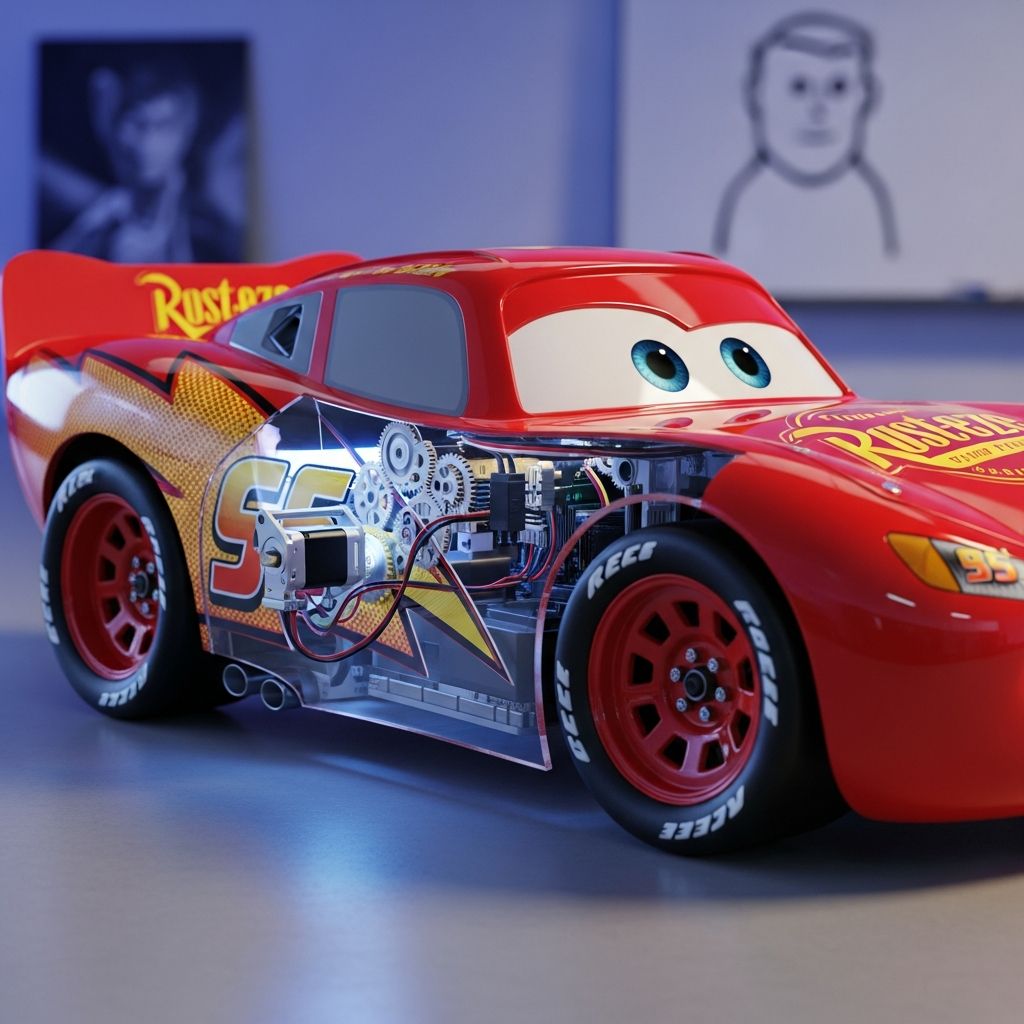
At the core of Ultimate Lightning McQueen is a dense collection of electronics and mechanics designed to reproduce both driving performance and personality.
Multi-motor architecture
Sphero’s car uses six independent motors to achieve smooth driving, drifting, suspension movement, and facial animation.
- Dedicated drive motors for propulsion and steering.
- Additional motors for emotive suspension, letting the car lean, lift, or dip as if reacting physically to emotions or events.
- A specialized motor system for the animatronic mouth that moves as the character speaks.
Compared with typical remote-controlled toys that rely on two basic drive motors, this configuration allows much more nuanced movement.
Onboard processing and electronics
The car contains multiple processors that coordinate motor control, sensors, audio playback, and display output. According to enthusiast breakdowns and product documentation, the complete assembly includes over 450 individual parts, highlighting the toy’s mechanical complexity.
Sensing the environment and the player
To make Lightning feel alive, Sphero embedded an array of sensors:
- Capacitive touch panels along the roof, hood, doors, and rear area allow the car to react when a child taps or strokes different body panels.
- Ambient light sensors automatically adjust the head and tail lights so they come on in darker rooms, similar to real automotive lighting systems.
- Orientation sensing lets the toy detect when it is lifted, flipped, or placed upside down, triggering humorous reactions.
These components let the toy respond in character, rather than simply following joystick commands.
Bringing Lightning’s Face to Life
One of the most striking aspects of Ultimate Lightning McQueen is its ability to portray emotion. Sphero had to translate film-quality animation into physical hardware small enough to fit under a toy’s hood.
LCD eyes and expressive animation
Instead of using printed decals, Sphero installed an LCD screen behind the windshield to display Lightning’s eyes, allowing them to blink, squint, widen, and track movement dynamically.
The display is trapezoidal rather than rectangular, carefully shaped to match the film’s proportions. Animators used professional animation tools (such as Autodesk Maya, often used in film production) to design movement cycles that were later converted into robot-ready sequences.
Animatronic mouth and synchronized audio
The front bumper doubles as an animatronic mouth, flexing and moving while the car speaks. This was engineered not just as a cosmetic piece, but as a fully actuated part powered by its own mechanism.
Unlike some earlier Sphero products where sound came primarily from the app or mobile device, Ultimate Lightning McQueen includes an integrated speaker system. Voice lines, engine sounds, and reactions come from the car itself, greatly enhancing the illusion that Lightning is a living character sitting on the floor.
Authentic voice performance
To anchor the illusion, Sphero worked with Disney to incorporate original voice work by Owen Wilson, the actor who voices Lightning McQueen in the films. The toy includes dozens of phrases, quips, and reactive lines so that it can respond appropriately in different play contexts.
| Feature | How It Enhances Character |
|---|---|
| LCD eyes | Shows emotion through blinking, eye direction, and expression changes. |
| Animatronic mouth | Makes speech feel physical, matching mouth movement to dialogue. |
| Integrated audio | Voice and engine sounds come directly from Lightning’s body. |
| Emotive suspension | Leaning and bouncing give a sense of mood and weight. |
Driving Experience: From RC Racer to Animated Actor
Although the toy is heavily character-focused, it still functions as a capable app-controlled car with a strong emphasis on drifting and smooth steering.
Control and handling
Ultimate Lightning McQueen is controlled through a dedicated mobile app via Bluetooth connection, allowing wireless operation over a distance of roughly 30 meters (about 98 feet) in open conditions.
- A virtual joystick interface on the app gives intuitive steering for players familiar with game controllers.
- The car can reach speeds of approximately 6 mph, fast enough to feel exciting while still manageable indoors.
- Specially designed tires and drive control algorithms support drifting maneuvers, letting Lightning slide around turns in a way reminiscent of scenes from the films.
Sphero iterated on earlier control schemes used for its spherical robots to make the driving experience less frustrating and more accessible to children, reducing the learning curve compared with products like the original BB-8 robot.
Battery life and charging
The car’s onboard battery delivers around 40 minutes of active play after a charge of roughly two hours, depending on driving style and feature usage. Charging is handled via a standard USB connection rather than a proprietary dock, lining up with Sphero’s broader product strategy.
Indoor-first design and durability considerations
While robust enough for typical indoor use, Ultimate Lightning McQueen is not designed as an off-road vehicle. Tech reviewers and early product briefings noted that it performs best on smooth surfaces and may not withstand repeated high-speed collisions or rough terrain the way some hobby-grade RC cars do.
This trade-off reflects Sphero’s focus on animatronics and expressiveness rather than pure stunt capability.
App Features: Play Modes Beyond Simple Steering
The companion app transforms Lightning from a basic vehicle into an interactive, scenario-driven toy. Many of the most memorable features live inside these software experiences.
Cinematic companion mode
One standout feature lets players watch the original Cars film with Lightning McQueen “in the room.” In this movie-reactive mode, the toy listens for specific parts of the soundtrack and responds by speaking, moving, or reacting when iconic scenes play.
This type of synchronized experience reflects a broader trend of connected toys that bridge physical objects with digital media, an area that researchers in human-computer interaction have identified as particularly engaging for children when well designed.
Racing and challenge modes
For players who want more game-like interaction, the app includes several structured modes:
- Ghost racing: Players race against a virtual performance trace, encouraging them to beat their own times and refine control.
- Pit stop mini-games: Inspired by racing strategy, these let kids identify virtual car parts and “repair” vehicles under time pressure, combining reflexes with basic problem-solving.
- Skill progression: Achievements and unlockable content reward continued play, similar to progression systems in video games.
Acting and animation studio
Another inventive feature is the animation or acting studio, where users can queue up pre-defined lines, movements, and reactions to create their own short performances.
This mode has subtle educational benefits:
- Children practice sequencing actions, an early computational thinking skill.
- They learn cause-and-effect as they preview and adjust Lightning’s routines.
- They experiment with basic storytelling by deciding what Lightning says and does in what order.
Educational researchers have noted that programmable toys and robots can help children develop problem-solving and logical reasoning in playful contexts, especially when open-ended creation is encouraged.
Designing for Kids and Collectors
Ultimate Lightning McQueen sits at the intersection of high-end collectible and advanced children’s toy. Its price point at launch placed it above mass-market remote-controlled cars, positioning it as a premium product for fans and families invested in the franchise.
Appeal to children
For kids, the appeal is straightforward:
- They can interact with a beloved movie character who talks back and reacts.
- Driving and drifting feel like controlling scenes from the film.
- The app’s games and modes provide variety and goals beyond free play.
The design emphasizes immediate feedback, expressive motion, and humor, aligning with best practices in children’s interactive product design highlighted in academic studies of toy usability and engagement.
Appeal to adult fans and technophiles
For adults, especially Pixar enthusiasts and gadget collectors, the toy showcases:
- Detailed animation and sculpt work that respects the film’s visual style.
- Technological sophistication, from multi-motor actuation to advanced animation.
- A glimpse into how robotics and consumer products are converging around entertainment IP.
Ultimate Lightning McQueen in the Context of Connected Toys
Ultimate Lightning McQueen arrived during a wave of connected play products that used apps, sensors, and robotics to enhance traditional toys. Industry analysts have tracked growth in this segment as companies explore new ways to blend physical and digital play.
Compared with many early app-connected toys that felt like simple remote-control devices with a screen-based interface, Sphero’s car prioritized:
- Character authenticity over generic form factors.
- Expressive behavior instead of purely functional movement.
- Narrative features such as movie-reactive modes and acting studios, which turn the toy into a storytelling partner.
This direction aligns with broader trends in robotics research and consumer products where designers aim to create emotionally engaging machines, not just utilitarian devices.
Frequently Asked Questions (FAQs)
What makes Ultimate Lightning McQueen different from a regular RC car?
Unlike standard RC cars that focus primarily on speed and steering, Ultimate Lightning McQueen includes six motors, an LCD eye display, an animatronic mouth, capacitive touch sensors, and an integrated speaker system. These elements let it drive and act like the movie character, with expressive movements and dialogue.
Does the car need the app to work?
Core features like driving, special maneuvers, and interactive modes are accessed through the companion app over Bluetooth. Without the app, the toy can still power on and deliver some basic personality behaviors, but the full play experience relies on the mobile software.
Is Ultimate Lightning McQueen suitable for outdoor use?
It is primarily designed for indoor play on smooth surfaces. Reviewers and product briefings recommend avoiding rough terrain, water, or high-impact crashes, as the detailed animatronic components and suspension are tuned for precision rather than off-road durability.
How long does the battery last on a charge?
Under typical mixed-use play, the car provides about 40 minutes of operation from a roughly two-hour charge, though driving aggressively at top speed or using sound and animation heavily can shorten that time slightly.
Does it offer any educational value?
While marketed primarily as an entertainment product, the app’s acting studio and racing modes introduce kids to sequencing, cause-and-effect, and basic problem-solving. Research on programmable toys suggests that such features can support early computational thinking skills when children experiment freely and create their own routines.
References
- Sphero’s Cars 3 Lightning McQueen racing car is ‘the most advanced robotic toy ever’ — TechRadar. 2017-05-24. https://www.techradar.com/news/spheros-cars-3-lightning-mcqueen-racing-car-is-the-most-advanced-robotic-toy-ever
- Cars 3: Sphero Ultimate Lightning McQueen In-Depth Review — Dan the Pixar Fan. 2017-06-07. http://www.danthepixarfan.com/2017/06/cars-3-sphero-ultimate-lightning.html
- Designing Connected Play: Understanding Children’s Perceptions of Smart Toys — Journal of Interaction Design & Architecture (IxD&A). 2019-06-01. https://ixdea.org/index.php/journal/article/view/325
- Computational Thinking in K–12: A Review of the State of the Field — Grover & Pea, Educational Researcher. 2013-01-01. https://doi.org/10.3102/0013189X12463051
- Global Entertainment and Media Outlook — PwC. 2017-06-01. https://www.pwc.com/gx/en/industries/tmt/media/outlook.html
- Sphero’s latest app-controlled toy is a ‘Cars 3’ tie-in — Engadget. 2017-05-24. https://www.engadget.com/2017-05-24-sphero-ultimate-lightning-mcqueen-cars-3.html