The first weeks with a new baby can feel like a blur, and memory alone is rarely enough to keep track of when your little one last ate, how long they slept, or how many wet diapers you saw that day. Thoughtful tracking—whether with a notebook or an app—can turn that blur into a clearer picture that supports your baby’s health and your own peace of mind.
Why Track at All? The Real Benefits for Tired Parents
Tracking isn’t about perfection; it is about noticing patterns that are impossible to see when you’re short on sleep. A simple log of sleep and feedings can help you answer questions from your pediatrician, understand your baby’s unique rhythm, and recognize when something might be off earlier rather than later.
Many parents also find tracking emotionally reassuring. When the nights feel endless, seeing that your baby actually did eat every few hours and slept more than you remember can reduce anxiety and build confidence in your caregiving.
- Helps you share accurate information with doctors and lactation consultants.
- Makes it easier for partners and other caregivers to stay in sync.
- Provides a sense of control during a period that often feels unpredictable.
What Information Is Worth Tracking?
New parents are often overwhelmed by the idea of logging every tiny detail. The good news is that you do not have to track everything to get meaningful insights. Focusing on a few core areas is usually enough for most families, especially in the first three months.
Core sleep details
- Start and end time of naps and overnight sleep.
- Where baby slept (crib, bassinet, contact nap, stroller, car seat, etc.).
- How baby fell asleep (rocked, fed to sleep, placed down drowsy, etc.).
Core feeding details
- Time of each feeding.
- Method (breast, bottle, pumped milk, formula, combo).
- Estimated amount (in minutes per side for breast or ounces for bottle).
Other optional data points
- Diaper counts: number of wet and dirty diapers per day.
- Medications: time and dose of any prescribed or over-the-counter medicines.
- Mood notes: unusually fussy periods, illness, or major changes at home.
Paper, Spreadsheet, or App? Choosing a Tracking Style That Fits You
Before downloading the first app you see, it helps to think about your personality and your household. The best tracking method is the one you will realistically use at 3 a.m. with one hand while holding a baby with the other.
Common tracking options
| Method | What it looks like | Main advantages | Possible downsides |
|---|---|---|---|
| Paper log or notebook | A printed chart on the fridge or a small notebook near the couch or bed. | Always visible, no tech skills needed, easy for grandparents or sitters. | Can get messy, hard to search or total up, no automatic reminders. |
| Spreadsheet (phone or computer) | Simple table with dates, times, and notes stored in a document. | Flexible, customizable, can be shared with a partner online. | Typing while holding a baby can be tough, no push notifications. |
| Dedicated tracking app | Mobile app designed for logging sleep, feeding, diapers, and more. | One-tap logging, charts and averages, data sync across caregivers. | Can encourage over-tracking, may require subscriptions, adds screen time. |
| Hybrid approach | Basic info on paper with occasional summaries entered into an app. | Reduced screen time, backup of key data, room for quick scribbles. | Requires a bit of extra time to transfer notes, not ideal for everyone. |
How Baby Tracking Apps Can Help (and When They Don’t)
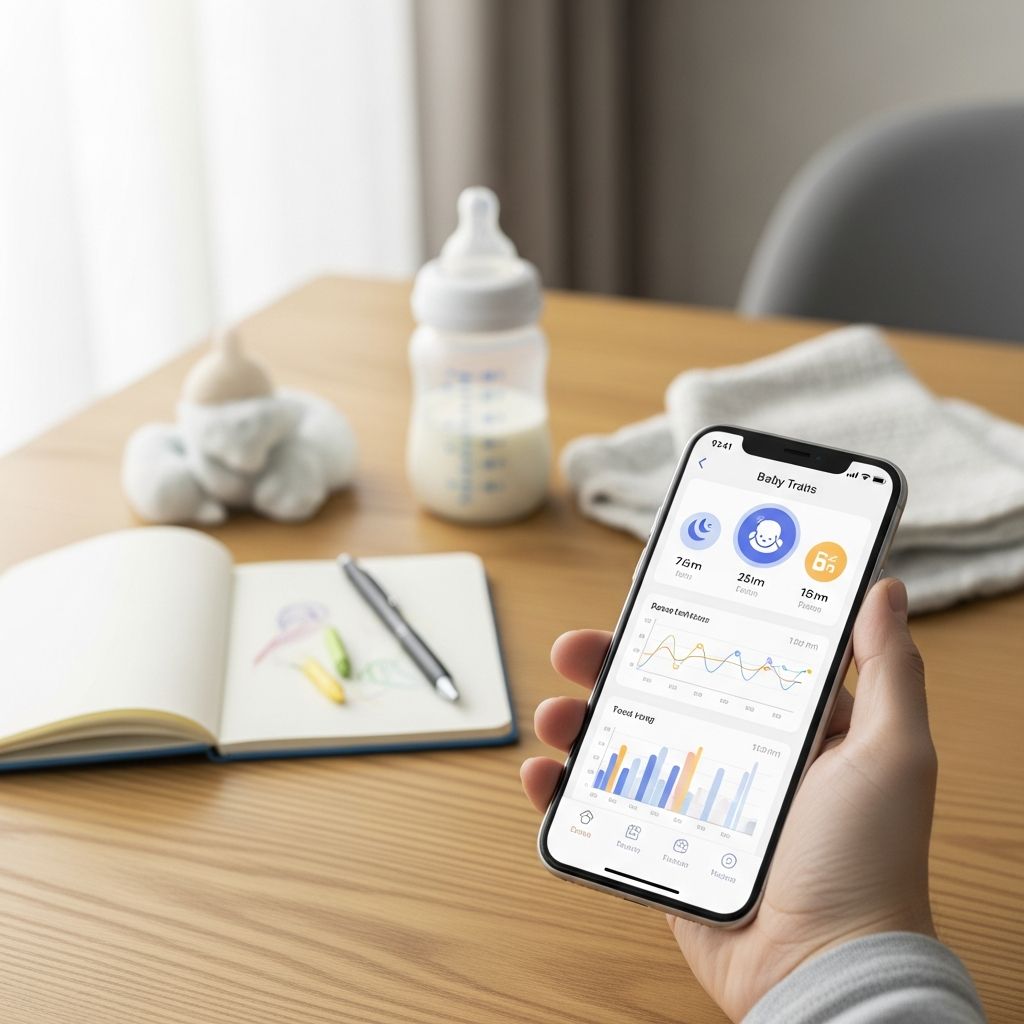
Baby tracking apps have become popular because they make logging faster and can transform raw data into easy-to-read summaries. Many apps allow multiple caregivers to log events on a shared account, so both parents can see when baby last ate or slept in real time.
At the same time, there is a risk of over-focusing on the numbers. Refreshing charts every hour or comparing your baby’s sleep totals to internet averages can increase anxiety instead of reducing it. The key is to treat the app as a tool, not a judge of how “good” your baby or your parenting is.
Useful features to look for
- One-tap logging from the home screen for common events like feeds and naps.
- Clear visual charts that show daily totals and weekly trends.
- Secure data storage and easy export options if you want to share logs with a doctor.
- Support for multiple caregivers, ideally with simple account sharing.
- Ability to turn off non-essential notifications and social features.
Setting Realistic Tracking Goals by Age
How intensely you track will likely change as your baby grows. In the earliest weeks, detailed logs can be helpful for monitoring feeding and diaper output. As your baby becomes more predictable, many parents naturally simplify to a lighter approach that focuses on big-picture patterns.
Newborn stage (0–8 weeks)
During the newborn period, doctors are most concerned that your baby is gaining weight, staying hydrated, and waking for feeds often enough. Detailed tracking during this time can be particularly useful, especially if you are establishing breastfeeding or navigating weight checks.
- Log every feeding with time and method (breast, bottle, pumped milk, formula).
- Track all wet and dirty diapers to confirm your baby is eliminating regularly.
- Write down naps and overnight sleep in broad strokes to see total daily sleep.
Young infant (2–4 months)
As your baby grows, sleep and feeding patterns usually start to become more predictable, though there are still plenty of developmental leaps and growth spurts. Many parents find it helpful to keep tracking but with slightly less intensity.
- Continue logging every feeding, but consider shorter notes if the pattern is stable.
- Track the start and end time of naps and bedtime to see natural rhythms.
- Note any major changes, like travel, illness, or vaccines, that might affect sleep.
Older infant (4–12 months)
Once your baby is older, you may no longer need to track every single diaper or minute of sleep. Instead, tracking can shift toward supporting routines, such as nap schedules and solid-food meals, and spotting changes that might indicate teething, illness, or regression.
- Log overall nap and night sleep durations rather than micro-details.
- Track solid meals, new foods introduced, and any reactions.
- Make quick notes of unusual nights or phases so you can see when they pass.
Sample Daily Log: What a Simple Tracking Day Can Look Like
To make tracking feel less abstract, it helps to see an example. Below is a simplified snapshot of a single day for a roughly 8-week-old baby. Your baby’s exact times and amounts will look different; the point is the structure, not the schedule.
| Time | Event | Details |
|---|---|---|
| 6:15 a.m. | Feeding | Breastfeeding, about 15 minutes each side. |
| 7:00–8:00 a.m. | Nap | Slept in bassinet, fell asleep after rocking. |
| 8:15 a.m. | Feeding | Bottle, 3.5 ounces pumped milk. |
| 9:30–10:15 a.m. | Nap | Contact nap on caregiver. |
| 10:20 a.m. | Diaper | Wet and dirty. |
| 11:00 a.m. | Feeding | Breastfeeding, one side only, about 12 minutes. |
| 12:15–1:00 p.m. | Nap | Stroller nap during walk. |
| 1:10 p.m. | Feeding | Bottle, 4 ounces formula. |
| 2:30–3:15 p.m. | Nap | Slept in crib, placed down drowsy but awake. |
| 3:30 p.m. | Feeding | Breastfeeding, both sides. |
| 5:00–5:30 p.m. | Nap | Short catnap in carrier. |
| 5:45 p.m. | Feeding | Bottle, 3 ounces pumped milk. |
| 7:00 p.m. | Bedtime routine | Bath, feeding, lullaby, lights out. |
| 7:30 p.m.–1:00 a.m. | Night sleep | One longer stretch, no feeds noted. |
| 1:05 a.m. | Feeding | Quick breastfeed, back to sleep. |
Looking at a log like this over several days, you might notice that late-afternoon naps are short or that the first night stretch is consistently the longest. That knowledge can help you plan your evening and set realistic expectations.
Practical Tips to Keep Tracking Manageable
The most common reason parents abandon tracking is that it starts to feel like one more full-time job. A few small tweaks can keep it sustainable and useful instead of overwhelming.
- Decide on a “good enough” level of detail. You do not need laboratory-level precision; rounded times and simple notes are fine.
- Place your tracking tool where you use it most. Keep a notebook near the feeding chair or your phone on a charging stand beside the bed.
- Divide responsibilities. One caregiver might handle nighttime logging while another updates daytime events.
- Set a time limit. Spend no more than a minute logging each event; if it’s taking longer, simplify your system.
- Review patterns briefly once or twice a week. Zooming out is more helpful than obsessing over every single entry.
Keeping Data Private and Protecting Your Boundaries
When using digital tools, it is worth thinking about privacy and emotional boundaries. Some apps gather data for analytics or offer social features that invite comparison with other babies. You are allowed to opt out of any element that does not feel good to you.
- Read basic privacy settings and disable features you do not need, such as public sharing or social feeds.
- Consider using generic labels instead of your baby’s full name if that makes you more comfortable.
- Give yourself permission to step back from tracking if it starts to feel obsessive or stressful.
How to Use Your Logs with Health Professionals
Tracking pays off when you bring your notes to appointments. Instead of trying to remember how often your baby has been feeding or how many diapers you’ve changed, you can show a clear snapshot of the past few days or weeks.
- Before the visit, quickly total up average feeds per day, total wet diapers, and approximate hours of sleep.
- Mark any days that stood out—such as illness, vaccines, or major schedule disruptions—so your doctor can interpret the data in context.
- Use your log to back up questions like, “Nights suddenly got shorter last week—could this be a growth spurt or something else?”
When to Stop Tracking (or Scale Back)
There is no universal age when parents “should” stop tracking, but there are signs that your system has outlived its usefulness. If you rarely check the data, feel more stressed when you log, or notice that your baby’s patterns are steady and predictable, it may be time to simplify.
- Consider keeping only a sleep log once feedings are well established and your pediatrician is satisfied with growth.
- Shift to tracking only unusual days—such as illness, travel, or big routine changes—instead of every single detail.
- Remember that the goal is to support you, not to create a permanent record of your baby’s life in minute-by-minute detail.
SEO-Friendly FAQs About Tracking Baby’s Sleep and Feedings
Do I really need to track every feeding and nap?
In the early weeks, close tracking can be helpful, especially for monitoring weight gain, diaper output, and feeding frequency. Over time, most families naturally move toward tracking only the essentials, such as overall sleep totals or major routine changes, and that is perfectly appropriate.
Is it better to use a baby tracking app or a paper log?
Neither option is inherently better; the best method is the one you will consistently use. Apps can provide charts and easy sharing, while paper logs can be faster for low-tech caregivers and reduce screen time during the night.
How long should I track my baby’s sleep?
Many parents track daily sleep in detail for the first few months, then scale back as their baby’s routine stabilizes. You might continue to use a lighter version of tracking during major transitions, such as moving from three naps to two, starting daycare, or traveling across time zones.
What if tracking makes me more anxious?
If logging every detail increases your worry, it is a sign to simplify. Try tracking only feeds and diapers for medical check-ins or take a break altogether and rely on general impressions, returning to tracking temporarily if your doctor recommends it.
Can tracking help my baby sleep through the night?
Tracking alone will not make a baby sleep through the night, but it can reveal patterns that help you adjust routines. For example, you might notice that an earlier bedtime or a longer wake window before bed is associated with fewer night wakings, which you can then test intentionally.
What should I bring to my pediatrician from my logs?
For most routine visits, an overview of average feeds per day, diaper counts, and approximate daily sleep hours is enough. If you are concerned about a specific issue, such as frequent night waking or slow weight gain, bring a week’s worth of detailed logs focused on that area.
Ultimately, tracking your baby’s sleep and feedings is a tool, not a mandate. Use it to support your instincts, make informed decisions, and communicate clearly with professionals and loved ones—then feel free to loosen your grip on the data once it has served its purpose.