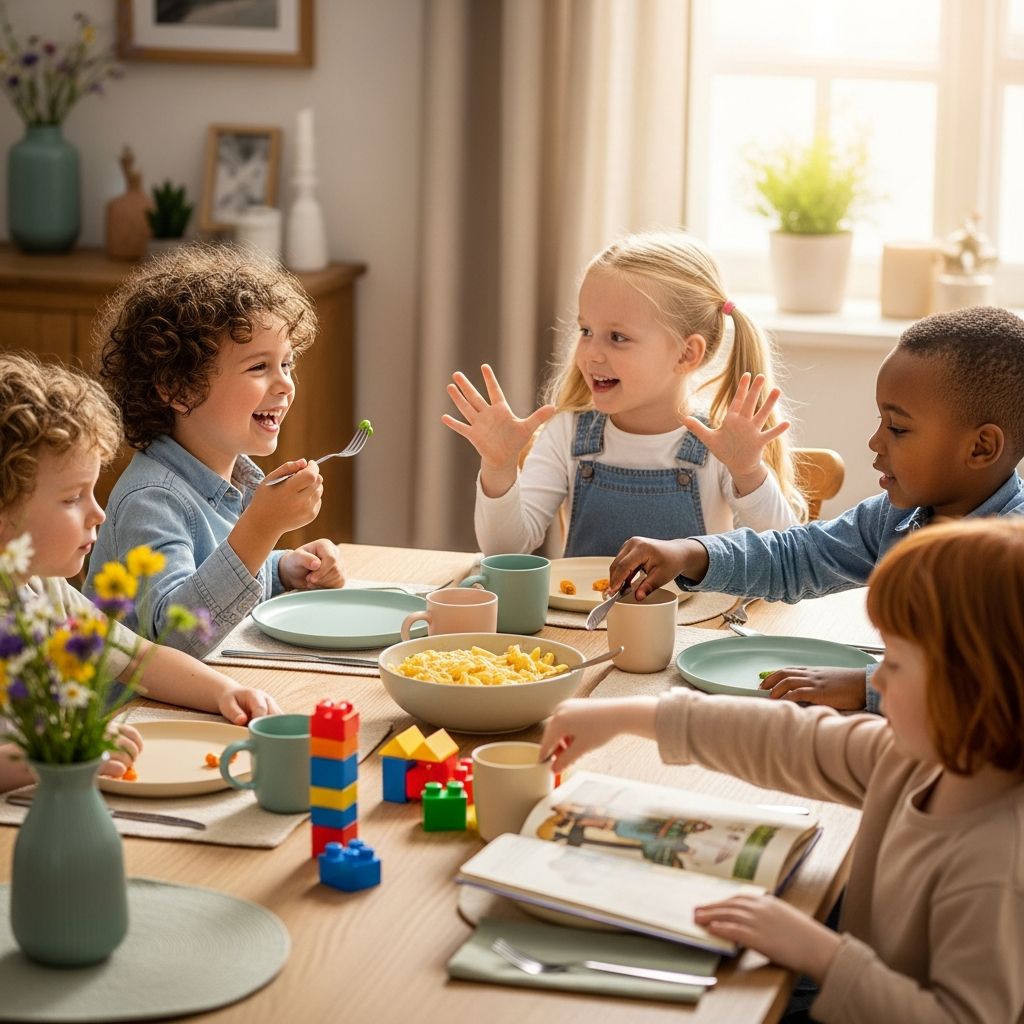
Many parents dream of calm, cheerful dinners and instead find themselves nagging, bribing, or battling a strong-willed 4–5 year old who will not stay seated, throws food, or ignores every rule. The good news is that with realistic expectations, clear routines, and a focus on connection rather than punishment, most families can move from nightly chaos to mostly pleasant meals.
This guide offers a research-informed, compassionate approach to helping young children learn basic table manners and respect meal-time boundaries while still honoring their developmental needs and big feelings.
Why Dinner Is So Hard for 4–5 Year Olds
Understanding what is happening inside your child’s brain and body makes their behavior easier to respond to calmly and effectively.
- Limited self-control: Executive functions like impulse control and flexible thinking are still developing in early childhood, continuing through adolescence.
- Long day, low resources: By dinner time many children are tired, hungry, and emotionally depleted, making cooperation harder.
- Movement needs: Preschoolers naturally need frequent movement; sitting still for long periods is genuinely difficult, not defiance.
- Seeking connection: If your child has missed you all day, they may use disruptive behavior as a quick way to get intense attention.
- Testing limits: Four- and five-year-olds are wired to experiment with power and independence; the dinner table is a daily stage for that testing.
When we see misbehavior as a signal rather than a personal attack, we can respond with firm limits and empathy instead of escalating conflict.
Realistic Goals: What 4–5 Year Olds Can (and Can’t) Do
Before changing your child’s behavior, it helps to adjust your expectations to their age and abilities.
| Skill Area | Reasonable Expectation at 4–5 | Unrealistic Expectation at 4–5 |
|---|---|---|
| Staying Seated | Remain at the table for about 15–20 minutes with support and reminders. | Sit perfectly still and silent for an entire adult-length meal. |
| Polite Language | Use simple phrases like “please,” “thank you,” and “please pass the bread” with prompting. | Remember and use complex etiquette rules without help. |
| Food Comments | Learn to say “I don’t like it” instead of “yuck,” with coaching. | Never complain or react strongly to disliked foods. |
| Using Utensils | Eat mostly with fork or spoon; begin to practice cutting soft foods. | Use utensils with adult-level coordination and neatness. |
| Conversation | Take short turns speaking and listening in simple back-and-forth. | Participate in long, complex adult conversations without interrupting. |
Clarifying Your Family’s Dinner Priorities
Not every rule matters equally. Before tackling specific behaviors, decide what is truly most important for your family right now.
- Safety basics: No standing on chairs, no throwing utensils, no running with food in the mouth.
- Health and eating: Enough time seated to reasonably eat; food not used as a toy or weapon.
- Respect: No aggressive behavior toward others; effort toward kind language about food and people.
- Connection: At least a few minutes of shared conversation or checking in with each other.
Choose one or two priority rules to focus on first. Trying to fix everything at once leads to constant correction and frustration for everyone.
Step 1: Prepare for Success Before Anyone Sits Down
What happens before dinner dramatically shapes how your child behaves at the table.
Time Meals with Appetite and Energy in Mind
- Avoid very late dinners: Younger children handle rules better earlier in the evening when they are less exhausted.
- Offer a predictable snack: A balanced afternoon snack (protein + complex carbs) 2–3 hours before dinner supports steadier blood sugar and behavior.
- Build in a movement break: Ten to fifteen minutes of active play before dinner can make sitting more manageable.
Create a Simple, Predictable Routine
- Wash hands.
- Help with one small task (put napkins or spoons on the table, carry unbreakable items).
- Come to the table when called the first time (with a clear transition warning, such as “In 5 minutes we are going to the table”).
- Start with a brief ritual: a gratitude round, a short song, or a deep breath together.
Routines give children a sense of control and predictability, which reduces power struggles.
Teach the Rules Calmly Outside the Heat of the Moment
Children learn table manners best when they are not already dysregulated or in trouble.
- Choose a calm time earlier in the day to talk about “how we eat together.”
- Use very few rules, stated positively, such as:
- “Food stays on the table.”
- “Bottom on the chair while we eat.”
- “We use kind words about food.”
- Role-play with stuffed animals or take turns pretending to be the child and the parent.
- Practice using polite phrases (“please pass…,” “no thank you”) in a light, playful way.
Step 2: Make the Table a Place Your Child Wants to Be
Children are much more likely to follow rules in spaces where they feel connected, capable, and included.
Engage Rather Than Entertain
The goal is not to distract your child from being at the table, but to invite them into the shared experience of the meal.
- Ask simple questions:
- “What was something funny that happened today?”
- “If you could eat any color of food tonight, what color would you choose?”
- Use conversation starters in a small jar that everyone, including the child, can pull from.
- Encourage older siblings and adults to ask the child direct questions so they feel part of the conversation.
Give Age-Appropriate Responsibilities
- Place napkins, spoons, or plastic cups at each seat.
- Carry a small bowl or basket of bread to the table.
- Be in charge of a simple part of the routine: ringing a “dinner bell” or announcing “dinner time.”
Feeling helpful increases cooperation and pride, which often reduces attention-seeking misbehavior.
Limit Competing Distractions
Research and expert guidance suggest that screens at meals can reduce family conversation and attention to hunger/fullness cues.
- Turn off televisions and put phones away for both adults and children.
- If your family sometimes uses devices at other times, label dinner as “talk time” or “family time” to differentiate.
Step 3: Responding Calmly to Common Dinner Challenges
No routine eliminates all misbehavior, but how you respond in the moment can either fuel or de-escalate the conflict.
Leaving the Table Repeatedly
If your 4–5 year old pops up and down from their chair:
- Offer a clear choice: “You may sit with us while we eat, or you may be done and leave your plate here.”
- Follow through kindly: If they keep leaving, calmly say, “It looks like you are done,” and remove their plate without anger.
- Avoid chasing or pleading: This turns leaving the table into a powerful tool for attention.
- Keep a consistent policy on snacks: Decide in advance whether there will be a later snack and under what conditions, and apply the rule consistently.
Food Throwing and Messy Play
Some mess is part of learning to eat, but deliberate food-throwing is a clear limit.
- State the rule once, calmly: “Food stays on the table. If you throw food, that tells me you are done.”
- If it happens again, gently remove the plate: “You threw food again, so you are done for now. We can try again at the next meal.”
- Offer other outlets for sensory play outside mealtimes (playdough, water play) so the table is not the primary place for that need.
Rude Comments About Food
Many children loudly declare “yuck” without understanding how it affects others.
- Teach an alternative phrase ahead of time: “I don’t care for this,” or “This is not my favorite.”
- Gently correct in the moment: “We don’t say ‘yuck’ about food. You can say, ‘No thank you’ instead.”
- Model neutral language yourself: “This isn’t my favorite, but I’ll have a little,” shows respectful honesty.
Using Hands Instead of Utensils
At 4–5, many children can manage a fork and spoon but may default to fingers when hungry or distracted.
- Demonstrate: “Watch how I scoop the peas with my spoon.”
- Give simple cues: “Fork, please,” rather than a lecture.
- Offer child-sized utensils with easy-to-grip handles to improve success.
Connecting Instead of Controlling: The Emotional Side of Dinner
How your child feels at the table is as important as what they do. Emotional safety increases cooperation and learning.
Use Encouragement, Not Bribes or Threats
While external rewards can sometimes change short-term behavior, overuse of rewards and punishments around food can undermine internal regulation and increase power struggles.
- Replace “ If you get up, no dessert” with “Dessert is part of our meal on Fridays; everyone who joins dinner gets some.”
- Notice effort: “You stayed at the table the whole time we talked about your day. That took a lot of focus.”
- Avoid using dessert as a primary bargaining chip; it can increase pressure and anxiety around eating.
Validate Feelings While Holding Limits
Being kind does not mean giving up on boundaries. Young children need both empathy and firmness.
- “You really want to run and play right now. It’s hard to sit when your body wants to move. We’ll have playtime after we finish eating.”
- “You’re disappointed that there are no chicken nuggets tonight. It’s okay to feel upset. The dinner tonight is pasta and vegetables.”
- Stay calm and neutral; your steady tone teaches that big feelings are safe and manageable.
Repair After Rough Meals
If a dinner ends in tears, yelling, or punishment, you can still use it as a learning opportunity.
- Later, when everyone is calm, briefly revisit: “Dinner was really hard tonight for both of us.”
- Take some responsibility for your side: “I yelled, and that probably felt scary. I’m going to practice taking a breath next time.”
- Invite collaboration: “What might help you stay at the table tomorrow? Should we try a shorter dinner or a new conversation game?”
Long-Term Habits: Building Manners Gradually
Table manners are not learned in one week; they are built over years through repetition, modeling, and gentle correction.
Start With a Few Core Skills
- Sit at the table for a reasonable amount of time.
- Use simple polite words.
- Keep food and utensils on the table.
Once these are mostly in place, add new skills slowly, such as:
- Passing dishes instead of reaching across others.
- Using a napkin instead of sleeves.
- Waiting until everyone is served before starting to eat.
Model the Manners You Want
Children learn more from what they observe than from what they are told.
- Use “please” and “thank you” yourself when asking for food.
- Refrain from making harsh comments about the meal or your own body at the table.
- Show how to stay seated and engage in conversation, even when you are tired.
Sample Gentle Dinner Rules for 4–5 Year Olds
You can adapt these to your family’s values and culture, but keeping them short and positive makes them easier to remember.
- “We wash hands and help set up before we eat.”
- “Food and dishes stay on the table.”
- “Bottom on the chair while eating.”
- “We use kind words with people and food.”
- “When we are done, we say ‘I’m finished’ and ask to get down.”
Frequently Asked Questions (FAQs)
Q: How long should a 4–5 year old be expected to sit at the dinner table?
A: For many preschoolers, 15–20 minutes is a realistic goal, gradually increasing with practice. Expecting them to sit as long as adults, especially at the end of a long day, is usually unrealistic and often backfires.
Q: What should I do if my child refuses to come to the table at all?
A: Give a clear advance warning (for example, a 5-minute notice), then invite them once calmly. If they refuse, you can still proceed with the family meal, saving a plate for later if that fits your family policy. Avoid pleading or chasing; keep the tone neutral and consistent so coming to dinner is a routine expectation, not a negotiation.
Q: Is it okay to insist my child eats certain foods before leaving the table?
A: Evidence-based guidance on responsive feeding suggests parents decide what, when, and where food is served, while children decide whether and how much to eat. Pressuring children to eat specific foods is linked with more resistance and less positive attitudes toward those foods over time.
Q: How can we handle dessert without constant bargaining?
A: Some families serve a small dessert with the meal, treating it as just another food, which can reduce its power. Others offer dessert on certain days regardless of exact intake. The key is to avoid making dessert the main reward or punishment for behavior or eating, as this can increase anxiety and conflict around meals.
Q: What if other caregivers (grandparents, babysitters) use very different dinner rules?
A: You cannot control every setting, but you can calmly explain your home’s approach and why it matters to you. When your child is with you, keep expectations consistent and predictable. Children can learn that “different houses have different rules,” especially when routines at home are clear and steady.
References
- Teach Your Kids Table Manners — Scholastic Parents. 2017-03-01. https://www.scholastic.com/parents/family-life/guides-to-life-learning/teach-your-kids-table-manners.html
- 15 Table Manners for Kids That Are Easy to Master — Children’s Nutrition (UK). 2022-05-10. https://childrensnutrition.co.uk/full-blog/kids-table-manners/
- Social and Emotional Development in Early Childhood — Centers for Disease Control and Prevention (CDC). 2023-03-31. https://www.cdc.gov/ncbddd/childdevelopment/positiveparenting/preschoolers.html
- Parenting Young Children: Feeding and Nutrition — American Academy of Pediatrics / HealthyChildren.org. 2022-09-15. https://www.healthychildren.org/English/ages-stages/toddler/nutrition/Pages/Feeding-and-Nutrition-Your-Toddler.aspx
- Family Meals and Child Academic and Behavioral Outcomes — Fiese et al., Child Development. 2012-01-01. https://doi.org/10.1111/j.1467-8624.2011.01641.x