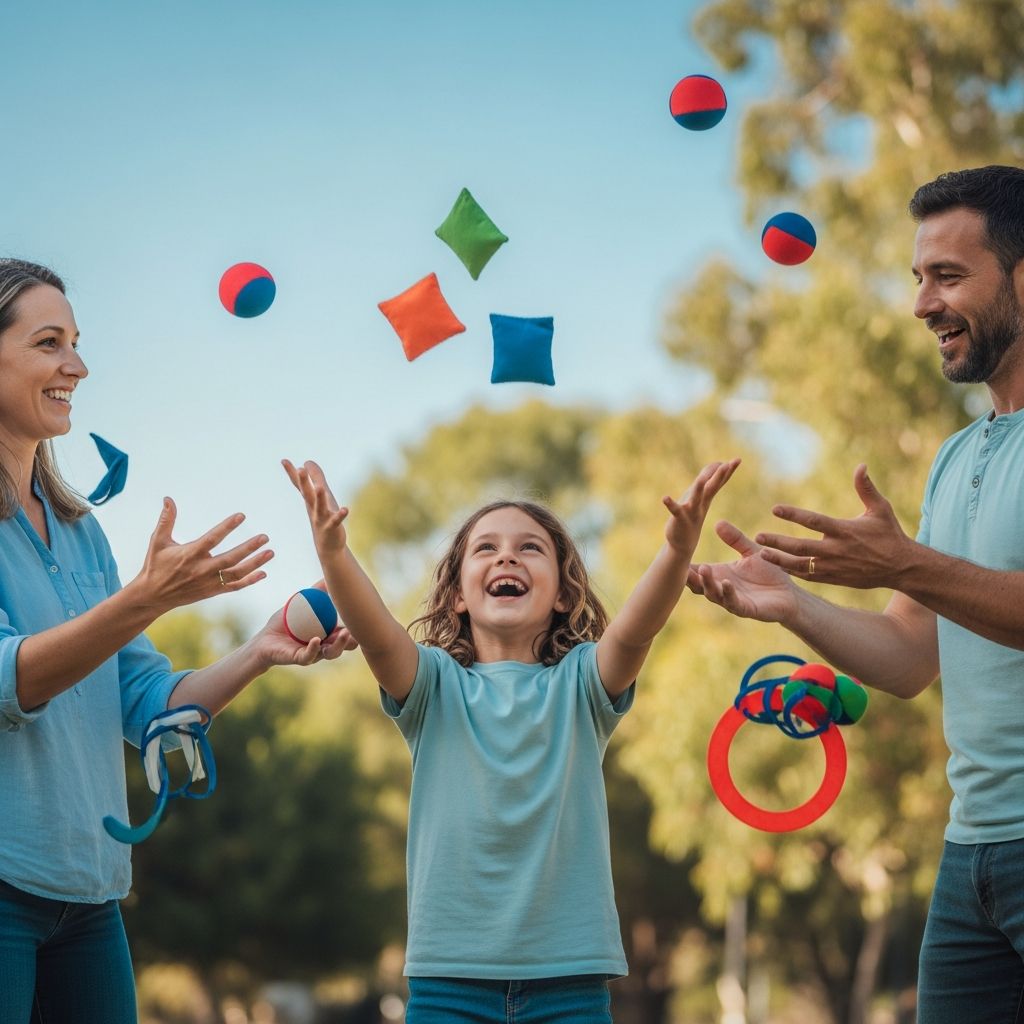
Juggling looks like a magic trick, but for kids it can become a playful way to build confidence, focus, and coordination while having a lot of laughs with you. With a few soft objects, a little structure, and plenty of encouragement, most children can learn basic juggling patterns far more quickly than adults expect.
Why Juggling Is Great for Kids
Before getting into how to teach juggling, it helps to know why it is worth your time and your child’s effort. Juggling is more than a circus trick; it is a compact workout for the body and the brain.
- Builds coordination: Kids practice timing, hand-eye coordination, and bilateral control as both hands share the workload.
- Improves focus and patience: Because progress comes in small steps, children learn to tolerate mistakes and keep trying.
- Boosts confidence: Mastering a visible, impressive skill gives children a sense of pride they can show off to friends and family.
- Encourages problem-solving: When balls keep dropping, kids start experimenting with height, speed, and rhythm to fix the pattern.
- Makes movement fun: Juggling is active, but it feels like a game rather than exercise.
Choosing the Right Age and Equipment
Children as young as about five or six can begin learning simple juggling progressions, though older kids may progress more quickly. Younger children benefit from slow, floaty objects and very short practice bursts.
- Best starting ages: Ages 6–10 usually have enough coordination and attention span to enjoy structured practice.
- Adjust expectations: Younger kids might focus on one- or two-object activities rather than three-ball patterns.
Recommended Juggling Props
Fancy equipment is not required; the right kind of soft, safe objects will make learning smoother and less frustrating.
- Beanbags: Ideal because they do not roll away when dropped and are gentle to catch.
- Light balls: Small, slightly squishy balls work if beanbags are not available.
- Scarves or lightweight fabric: Great for nervous beginners because they float slowly, giving kids extra time to react.
- DIY options: Small socks filled with rice or lentils and tied off make simple home beanbags.
| Prop Type | Speed | Best For | Pros | Cons |
|---|---|---|---|---|
| Scarves | Very slow | Young or anxious beginners | Easy to track; soft; non-intimidating | Trickier to use outdoors on windy days |
| Beanbags | Moderate | Most kids age 6+ | Do not roll; comfortable to catch; durable | Need to be purchased or made |
| Soft balls | Faster | Kids with good coordination | Common household item; versatile | Roll away on every drop; more chasing |
Setting Up a Juggle-Friendly Practice Space
A calm, safe space helps kids focus on learning instead of worrying about breaking things or tripping. A few simple adjustments can keep frustration low and fun high.
- Choose an open area: A patch of lawn, a cleared living room, or a wide hallway works well.
- Remove clutter: Move fragile objects, drinks, and furniture edges out of the way.
- Keep it soft: Practicing over carpet or grass makes drops quieter and less stressful.
- Limit distractions: Turn off TVs and loud music, and put pets and siblings at a safe distance.
Warm-Up Games to Get Kids Moving
Rather than diving straight into three-ball patterns, start with playful activities that wake up your child’s hands, eyes, and imagination. Short games help them feel successful right away.
Simple Object Awareness Games
- Pass and freeze: Stand facing your child and gently toss one object back and forth. Randomly call “freeze” and both of you stop moving while holding the object.
- Body balance challenge: Have your child balance a beanbag on different body parts: head, shoulder, back of the hand, or top of the foot.
- Roll and chase: Sit on the floor facing each other and roll a ball back and forth, then add a second ball once the first feels easy.
Focus and Reaction Games
- Name that color: Use different colored objects and call out which color your child should catch or let drop.
- Clap and catch: Toss a single ball straight up, clap once, and catch it. Gradually add more claps between the throw and the catch.
- Spin and grab: Have your child toss a scarf, turn around once, and try to catch it before it touches the ground.
Teaching the First Throw: One Object Mastery
Everything in juggling grows from a single, well-placed throw. If kids rush past this step, three-ball juggling will feel chaotic. Spending time here makes later steps surprisingly smooth.
Good Throwing Technique
- Ask your child to stand with feet roughly shoulder-width apart and elbows relaxed by their sides.
- Have them toss a single object from one hand to the other in a gentle arc that peaks just above eye level.
- Encourage them to keep their hands in front of the body rather than chasing the object with big arm movements.
- Suggest they watch the top of the arc rather than staring at their hands.
Fun One-Object Variations
- Toss hand to hand while stepping slowly in a circle.
- Throw higher and lower to see how the timing changes.
- Pass under a leg, behind the back, or around the waist before catching again.
- Walk forward and backward while keeping the throw consistent.
Moving to Two Objects: Learning Rhythm
Two objects introduce rhythm and timing, which are the heart of juggling. Many kids want to grab both objects in one hand immediately, so emphasize the idea of taking turns between hands.
Alternating Throws Exercise
- Give your child one object in each hand.
- Have them toss the object in the right hand to the left hand using the same arc as the one-object practice.
- Once that feels comfortable, introduce a simple rhythm: “throw, throw, catch, catch.” The second throw should begin just as the first one reaches its peak.
- Encourage them to pause after each short sequence instead of trying to keep the pattern going forever.
Two-Object Games for Kids
- Mirror juggling: Stand in front of your child and perform the same two-object pattern together so they can copy your timing.
- Switch and stop: Ask them to complete two good sequences and then stop with one object in each hand, emphasizing control.
- Walking pattern: Each time they finish a “throw, throw, catch, catch” sequence, take one small step forward or backward together.
Introducing Three Objects: Building the Classic Cascade
Once your child can consistently perform a smooth two-object pattern, they are ready to experiment with three. The goal is not to juggle endlessly at first; it is to link a few correct throws in a row.
First Three-Object Attempts
- Place two objects in your child’s dominant hand and one in the other hand.
- Explain that the pattern is made of the same crossing throws they already practiced, just repeated more times.
- Start by aiming for three accurate throws in a row, not an ongoing pattern. For example: right-to-left, left-to-right, right-to-left, then let everything fall.
- Gradually increase to four, then five throws before a planned stop or drop.
Helpful Coaching Cues
- “Slow down your throws” rather than “throw higher” to prevent wild arcs.
- “Keep your hands low” to avoid big circles that tire the arms quickly.
- “Look at the top of the arc” to keep their eyes calm and focused.
- “Let the drop happen” so they do not lunge or dive for every falling object.
Common Mistakes and How to Fix Them
Struggling is a natural part of learning to juggle. Kids often think drops mean failure, but drops actually reveal what to fix next. Naming the mistake in simple language can help your child correct it quickly.
| What It Looks Like | Likely Cause | Try This Fix |
|---|---|---|
| Objects fly forward and get chased | Throws are angled outward instead of straight up | Practice in front of a wall and aim to have objects come back toward the body, not hit the wall |
| All objects thrown at once | Nervousness and rushing the pattern | Return to “throw, throw, catch, catch” with two objects, counting out loud together |
| Hands travel all over the place | Trying to chase bad throws instead of improving them | Ask your child to imagine their elbows glued lightly to their sides while they throw |
| Looking down at hands | Fear of missing the catch | Play a game where they must keep their chin level and say the color of each object at the top of its arc |
Keeping Practice Fun and Encouraging
Kids stick with juggling when practice feels like play, not a test. Short, frequent sessions work far better than long, exhausting ones. Aim for progress, not perfection.
Motivation Tips for Parents
- Limit formal practice to 5–10 minutes, then switch to a silly game or different activity.
- Celebrate tiny wins: one extra throw, a calmer face, or fewer wild chases.
- Let your child teach a sibling, friend, or even you what they have learned so far.
- Consider recording short “before and after” videos so they can see their own improvement.
Game Ideas to Break Up Training
- Drop-count challenge: See how long they can juggle or practice patterns before the first drop, then try to beat that number.
- Freeze-tag juggling: Play music while they juggle. When the music stops, they must freeze with whatever objects remain in their hands.
- Story juggling: Ask your child to tell a short story or explain a joke while juggling to build confidence under mild pressure.
Easy Tricks Once the Basic Pattern Is Learned
After your child can keep three objects going for a few cycles, simple tricks keep the skill fresh and exciting. Start with moves that only slightly change the pattern.
- High throw: Occasionally toss one object higher than the others and continue the pattern underneath it.
- Under-the-leg throw: Once in a while, lift one leg and throw a single object under it before returning to normal juggling.
- Walking cascade: Take slow, steady steps forward or sideways while keeping the juggling rhythm.
- Turnaround: Practice making a slow half-turn or full turn while keeping the pattern going.
Safety and Comfort Considerations
Juggling is generally low-risk, but a few precautions help keep everyone comfortable and injury-free. Gentle reminders about posture and surroundings go a long way.
- Use soft objects so accidental hits do not hurt.
- Encourage gentle throws rather than powerful, fast ones.
- Protect breakable items by practicing away from lamps, TVs, and windows.
- Give kids a chance to rest shoulders and wrists if they feel tired or sore.
FAQ: Teaching Kids to Juggle
How long does it usually take for a child to learn basic juggling?
Every child is different, but many kids can manage a few good three-object throws after several short sessions spread over a week or two. Consistent, low-pressure practice matters more than total time spent in a single day.
What if my child keeps getting frustrated and wants to quit?
Frustration is normal when learning a challenging, visible skill like juggling. Help by shortening practice sessions, returning to easier one- or two-object games, and praising effort rather than focusing only on whether the full pattern works.
Is it better to start with scarves or balls?
Scarves give younger or nervous children more time to react, which can make early success more likely. Older kids or those who already play ball sports might enjoy starting directly with beanbags or soft balls.
Can left-handed kids learn to juggle just as well?
Yes. Juggling uses both hands in an alternating rhythm, so left-handed children are not at a disadvantage. You can simply place the first extra object in whichever hand feels most natural to your child.
Should my child learn alone or with a group?
Both options work. One-on-one time with a parent allows for personalized tips, while small groups add excitement, friendly competition, and opportunities for partner games that keep everyone engaged.
Bringing It All Together
Teaching your child to juggle does not require special talent, only patience, playfulness, and a willingness to celebrate small steps. By starting with one-object control, moving through two-object rhythms, and tackling three-object patterns in short bursts, you can turn a seemingly complex circus skill into a shared family adventure.
Over time, your child will not only gain an eye-catching new talent but also learn resilience, focus, and the satisfaction of mastering something that once felt impossible. Those lessons, along with the memories of laughing over dropped beanbags on the living room floor, are what make juggling such a rewarding family project.