Helping children develop the ability to think for themselves is one of the most valuable gifts parents can give. Independent thinking equips kids to navigate challenges, make informed decisions, and adapt to an ever-changing world. Research shows that explicit instruction in reasoning skills not only improves problem-solving but can also boost creativity and cognitive abilities.
Why Independent Thinking Matters for Young Minds
Independent thinking goes beyond rote learning; it involves analyzing information, evaluating options, and forming reasoned conclusions. Studies demonstrate that children trained in critical thinking show significant gains in IQ measures and analytical skills. For instance, programs teaching hypothesis testing and logical evaluation led to better performance on standardized tests like the Otis-Lennon School Ability Test.
In elementary years, these skills lay the foundation for academic success across subjects and real-life applications. Critical thinking encourages flexibility, curiosity, and resilience, countering myths that it stifles creativity—in fact, it enhances inventive problem-solving.
Building a Foundation Through Everyday Conversations
Daily interactions offer prime opportunities to spark independent thought. Start by modeling curiosity: when your child asks ‘why,’ respond with thoughtful explanations rather than directives, encouraging them to probe deeper.
- Ask open-ended questions: Instead of ‘Did you like school?’, try ‘What made that lesson interesting, and why?’ This prompts reflection and multiple perspectives.
- Explore alternatives: For decisions like choosing a game, discuss pros and cons: ‘What might happen if we pick this one? What about the other?’
- Clarify ideas: Have kids rephrase concepts in their own words to solidify understanding and spot inconsistencies.
These habits foster metacognition—thinking about thinking—which research links to improved reasoning from an early age.
Hands-On Activities to Sharpen Problem-Solving
Practical exercises make abstract skills tangible. Puzzles and games build strategy and patience, teaching kids to test hypotheses and adapt.
| Activity | Skills Developed | Age Range | Example |
|---|---|---|---|
| Jigsaw Puzzles | Pattern recognition, persistence | 4-8 | Start with 20-piece sets, discuss strategies |
| Board Games (e.g., Connect 4) | Game theory, foresight | 5-9 | Analyze moves post-game |
| Pretend Play Scenarios | Creative solutions, empathy | 3-7 | Role-play fixing ‘world hunger’ |
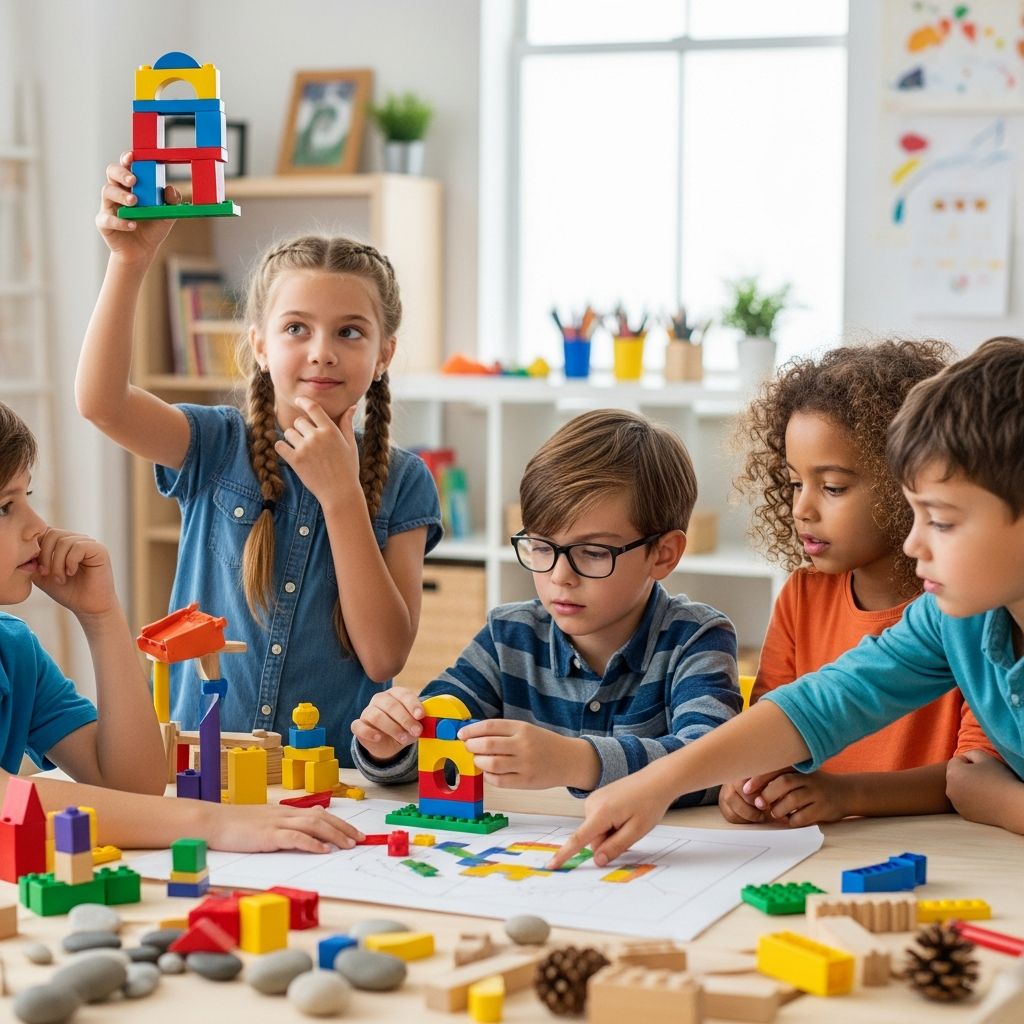
| Building Challenges | Hypothesis testing, iteration | 6-9 | Use blocks to bridge gaps |
Incorporate group play to expose kids to diverse viewpoints, enhancing decision-making.
Encouraging Risk-Taking and Learning from Mistakes
Critical thinkers embrace uncertainty. Support calculated risks by praising effort over perfection: ‘What did you learn from that try?’ This builds resilience and metacognitive awareness.
- Expose to new situations: Enroll in clubs or try unfamiliar foods, debriefing afterward.
- Avoid over-correction: Guide gently when stuck, letting them lead solutions.
- Discuss current events age-appropriately to broaden perspectives beyond self.
Studies affirm that avoiding hypercriticism allows children to experiment freely, fostering innovation.
Integrating Reflection and Writing Practices
Reflection cements learning. End activities with ‘What worked? What would you change?’ prompts.
Writing sharpens arguments: Journal about daily puzzles or lab-like experiments at home. One study found biology students who wrote explanations gained analytical prowess over those quizzed.
Daily Reflection Routine
- Recap the day: ‘What problem did you solve?’
- Evaluate: ‘Why did that approach succeed?’
- Plan ahead: ‘Next time, how might you improve?’
This metacognitive practice, effective even for young kids, promotes self-awareness.
Classroom and Home Synergy for Lasting Impact
Partner with educators for consistency. Advocate for curricula with explicit reasoning lessons, proven superior for skill gains.
At home, connect schoolwork to life: ‘How does this math apply to baking?’ Group discussions on books or news build debate skills.
Age-Specific Strategies for Growing Thinkers
Ages 3-5: Curiosity Ignition
Focus on play-based exploration. Ask ‘What if?’ during block play.
Ages 6-9: Reasoning Refinement
Introduce logic games and pros/cons lists. Encourage questioning sources.
Frequently Asked Questions
What if my child resists thinking independently?
Start small with low-stakes choices. Patience and modeling build confidence gradually.
How much time daily for these activities?
10-15 minutes of focused interaction suffices; integrate into routines for sustainability.
Does this work for all kids?
Yes, adapted to developmental stages. Research supports broad efficacy.
Can games alone teach critical thinking?
Games aid but pair with debriefs for deeper learning.
How to handle mistakes?
Frame as learning: ‘Great effort—what’s next?’
By weaving these strategies into family life, parents cultivate thinkers ready for any challenge. Consistent practice yields resilient, innovative children.
References
- Teaching critical thinking: An evidence-based guide — Parenting Science. 2023. https://parentingscience.com/teaching-critical-thinking/
- 7 Ways to Teach Critical Thinking in Elementary Education — Walden University. 2023. https://www.waldenu.edu/online-bachelors-programs/bs-in-elementary-education/resource/seven-ways-to-teach-critical-thinking-in-elementary-education
- Critical Thinking for Kids — Bright Horizons. 2024. https://www.brighthorizons.com/article/children/developing-critical-thinking-skills-in-children
- Helping Students Hone Their Critical Thinking Skills — Edutopia. 2023. https://www.edutopia.org/article/teaching-critical-thinking-middle-high-school/
- Parents’ Guide to Critical Thinking: Ages 5-9 — Reboot Foundation. 2023. https://reboot-foundation.org/parent-guide/ages-5-to-9/
- 5 Activities for Your Child That Teach Critical Thinking — Engineering For Kids. 2024-03-01. https://www.engineeringforkids.com/about/news/2024/march/5-activities-for-your-child-that-teach-critical/