Menstruation marks a key milestone in puberty, signaling the body’s readiness for reproduction, and parents play a vital role in demystifying it for their children. Starting these discussions early fosters confidence and normalizes bodily changes, helping kids navigate this phase without fear or confusion.
Building a Foundation: Starting Conversations Early
Introduce the topic of periods gradually rather than in one overwhelming session, allowing children to absorb information at their own pace. By age 6 or 7, most children grasp basic concepts, making it an ideal time to begin with simple explanations during everyday moments.
- Seize natural opportunities like spotting period products in stores or on TV commercials to spark curiosity.
- Respond to direct questions, such as a young child inquiring about a tampon, with straightforward answers like, “It’s for catching monthly vaginal bleeding that prepares the body for a potential baby.”
- Involve both girls and boys to promote understanding and empathy across genders.
This ongoing dialogue positions parents as reliable sources, countering misinformation from peers or online sources. Assess what your child already knows by asking open questions, then layer in details as they mature.
The Biology Behind Menstruation: Simple Explanations for Young Minds
Periods result from hormonal shifts that thicken the uterus lining monthly in anticipation of pregnancy; without fertilization, it sheds as blood through the vagina. Ovaries release eggs influenced by hormones like estrogen and progesterone, cycling roughly every 28 days.
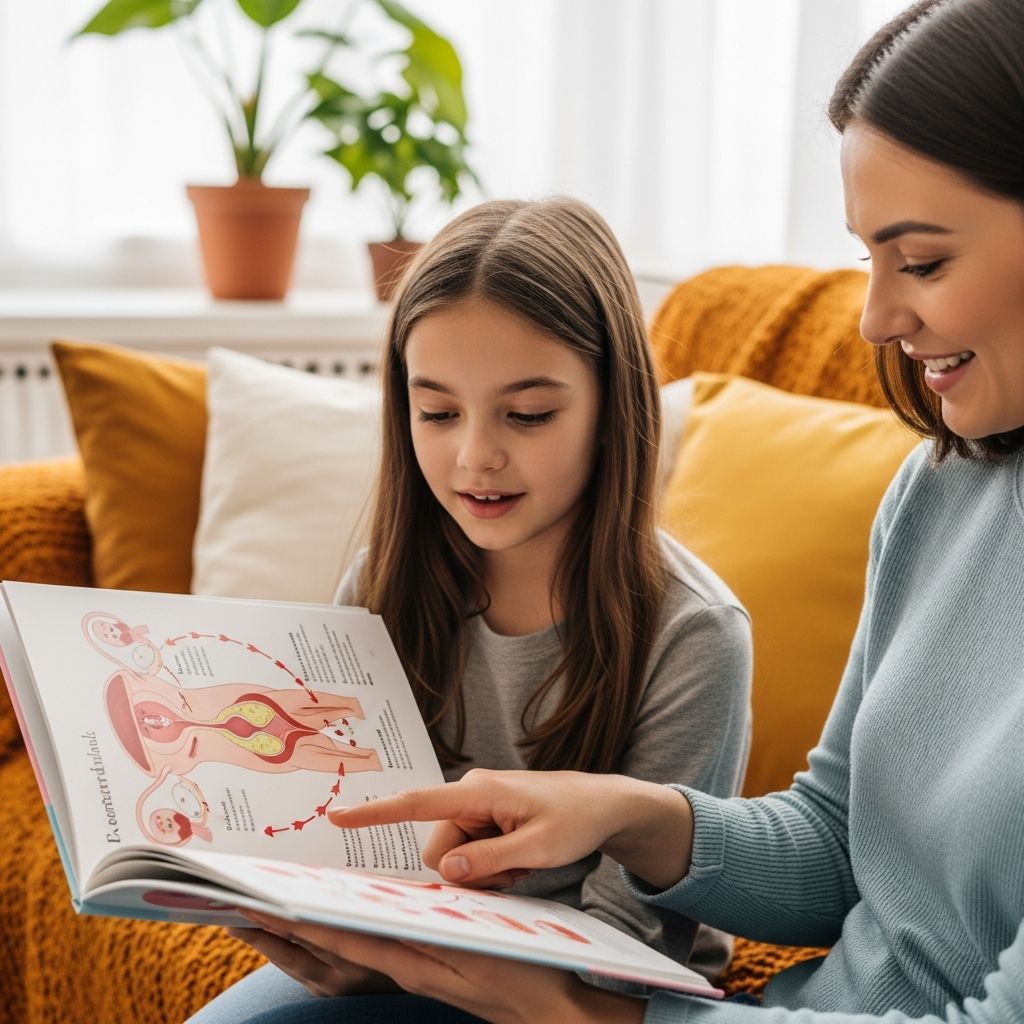
For younger kids, use relatable analogies: the uterus acts like a nurturing monthly nest for a possible baby, resetting if unused. Diagrams of female anatomy—highlighting ovaries, uterus, and vagina—aid visualization without overwhelming details.
| Body Part | Role in Menstruation |
|---|---|
| Ovaries | Produce eggs and hormones that trigger uterine lining buildup. |
| Uterus | Develops a lining monthly; sheds it if no pregnancy occurs. |
| Vagina | Passageway for menstrual blood to exit the body. |
Emphasize that menstruation is healthy and painless in itself, a sign of proper development from girl to woman.
Recognizing the Signs: When Periods Are on the Horizon
Girls typically experience their first period between ages 10 and 15, averaging 12, about two years after breast development begins. Vaginal discharge, resembling clear mucus, often appears 6-12 months prior as an early indicator.
- Track family history, as genetics influence timing.
- Monitor puberty signs like pubic hair growth or height spurts.
- Prepare with supplies in advance to ease the surprise.
Irregular cycles are common initially, stabilizing over months. Periods occur every 21-35 days, lasting 3-7 days, with heavier flow at the start.
Managing Symptoms: From PMS to Daily Discomforts
Premenstrual syndrome (PMS) involves emotional and physical changes like mood swings, bloating, acne, or anxiety before bleeding starts, resolving soon after. Reassure kids these are temporary and normal.
Common period experiences include:
- Mild cramping from uterine contractions.
- Headaches or fatigue due to hormonal fluctuations.
- Changes in appetite or sleep patterns.
Lifestyle tips help: balanced diet, hydration, light exercise, and rest. Over-the-counter pain relief like ibuprofen can address cramps if needed, but consult a doctor first.
Choosing and Using Period Products: Practical Guidance
Equip children with knowledge of options to build independence. Start with pads for beginners, progressing to tampons or menstrual cups as comfort allows.
Create an “emergency kit” with pads, wipes, spare underwear, and a tracker app or journal for cycle logging. Demonstrate usage privately to boost confidence.
Open Dialogues with Boys: Fostering Empathy and Awareness
Boys benefit from period education to dispel myths and support female peers or family. Explain biology factually, focusing on practicalities like mood changes and the need for privacy.
Discuss respect: avoiding teasing, offering discreet help, understanding absences. This cultivates emotional intelligence and equality.
Addressing Concerns: Irregularities and When to Seek Help
While most cycles regulate naturally, watch for:
- Periods lasting over 7 days or soaking pads hourly.
- Skipping periods for 3+ months post-establishment.
- Severe pain interfering with daily life.
These may signal issues like PCOS or thyroid problems; pediatricians can evaluate. Stress that questions are welcome anytime.
Resources and Tools: Enhancing Learning
Supplement talks with age-appropriate books, animations, or apps depicting the menstrual cycle engagingly. Visual aids normalize anatomy without metaphors, easing reproduction discussions later.
- Animated videos anthropomorphizing reproductive organs for fun learning.
- Puberty books with diagrams for family reading.
- Cycle-tracking apps for teens.
Share personal stories selectively to humanize the experience, reinforcing positivity.
Frequently Asked Questions (FAQs)
What age should I start talking about periods?
Begin basics around 6-7 years, building gradually based on readiness and questions.
Is it normal for periods to be irregular at first?
Yes, cycles often take months to settle into a 21-35 day pattern.
How do I explain periods to boys?
Use clear terms, cover biology and empathy, treating it as general puberty knowledge.
What if my child has heavy or painful periods?
Monitor and consult a doctor if it disrupts activities or persists.
Can tampons be used right away?
Start with pads; introduce tampons after comfort with flow management.
References
- Show and tell: The menstrual cycle, animated — Harvard T.H. Chan School of Public Health. 2022. https://hsph.harvard.edu/health-communication/news/show-and-tell-the-menstrual-cycle-animated/
- A parent’s ultimate guide to periods — Children’s Hospital of Orange County (CHOC). 2023-10-17. https://health.choc.org/a-parents-ultimate-guide-to-periods/
- Talking to Your Child About Periods — Nemours KidsHealth. 2024. https://kidshealth.org/en/parents/talk-about-menstruation.html
- Talking to Your Daughter About Periods — Kids Plus Pediatrics. 2023. https://www.kidsplus.com/parent-resources/doctors-notes/talking-to-your-daughter-about-periods/
- Starting your periods — National Health Service (NHS). 2024-05-07. https://www.nhs.uk/conditions/periods/starting-periods/