Creating a Foundation for Understanding Differences
Children are naturally observant and curious about the world around them. When they encounter someone with a disability or visible difference, their questions and observations provide valuable opportunities to shape their attitudes toward inclusion and respect. The way parents respond to these moments significantly influences how children will understand and interact with people who have disabilities throughout their lives. Rather than avoiding these conversations, engaging openly helps children develop compassion and accurate knowledge about human diversity.
Research shows that children begin noticing differences at remarkably early ages. Babies can observe racial differences as early as six months old, recognize gender differences by age one, and identify physical ability differences by around age three. This early awareness means that parents have an opportunity to provide thoughtful guidance before children form misconceptions or develop negative attitudes based on fear or lack of understanding.
Age-Appropriate Communication Strategies
Communicating with Younger Children
When speaking with preschool-age children about disabilities, brevity and directness work best. Young children need simple, factual explanations without adults projecting their own assumptions or feelings onto the situation. If a child asks why someone uses a wheelchair, a straightforward response such as, “Her legs don’t work the way yours do, so the wheelchair helps her move around,” answers their question without unnecessary elaboration or emotional interpretation.
At this stage, it is also important to establish behavioral expectations. Children should understand that while asking questions is appropriate and encouraged, pointing and staring are not respectful ways to express curiosity. In some situations, asking the person directly about their disability is acceptable and can lead to meaningful interactions that satisfy the child’s genuine interest.
Engaging Elementary-Age Learners
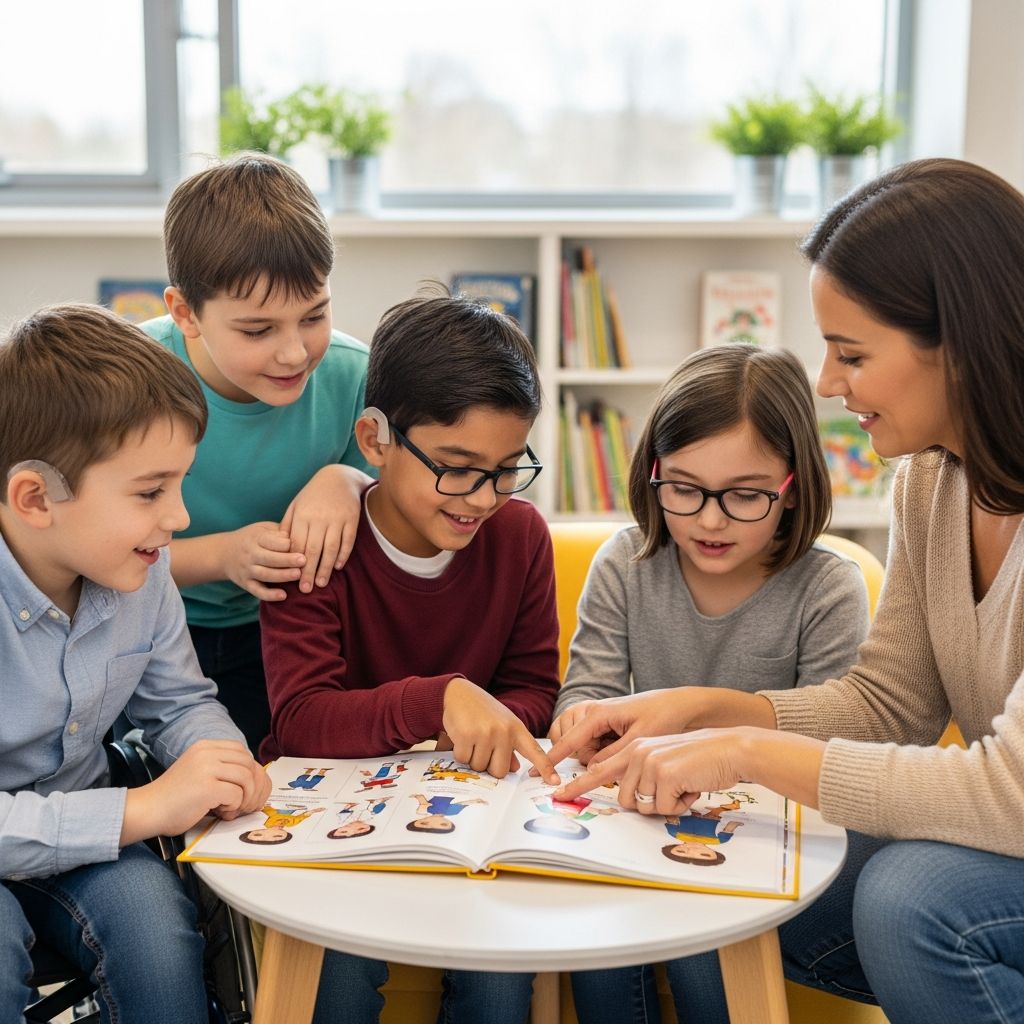
As children enter elementary school, their ability to understand more complex concepts increases, and their awareness of less-visible disabilities such as learning differences and behavioral conditions grows. At this developmental stage, parents should help children recognize that peers with disabilities may share many interests and abilities with them. Encouraging children to see a classmate who uses mobility aids or hearing devices as a potential friend, rather than focusing exclusively on differences, helps build inclusive relationships.
When children ask about less-visible disabilities, honesty combined with factual information remains essential. If a parent doesn’t have complete information about a particular disability, it is perfectly acceptable to acknowledge this and offer to learn more together. This models lifelong learning and demonstrates that seeking accurate information is better than making assumptions.
Conversations with Older Children
As children mature into middle and upper elementary years, they can engage with more nuanced discussions about disability. They begin to understand that disabilities exist on a spectrum and that people have varying experiences and needs. Older children benefit from opportunities to learn about specific disabilities and conditions through research projects, documentaries, or conversations with people in their lives who have disabilities. This deeper learning helps combat stereotypes and builds genuine understanding.
Cultivating Honest and Direct Responses
One of the most effective approaches to children’s questions about disabilities is providing straightforward, honest answers. When a child asks why someone cannot walk or communicate in typical ways, vague responses like “We don’t talk about that” or deflections actually communicate that disability is a taboo subject. This avoidance can increase a child’s confusion and may reinforce the idea that disabilities are shameful or not appropriate to discuss.
Instead, direct answers address the child’s natural curiosity. For example, if a child notices a feeding tube, a parent might explain, “This is how Jack gets nutrition. Some people eat through their mouth like you do, and Jack eats through his stomach.” This simple, factual explanation satisfies curiosity without judgment or excessive detail. The key is matching the complexity of the answer to the child’s age and cognitive level while remaining truthful.
The Power of Positive Language and Framing
The language families use when discussing disabilities significantly shapes children’s attitudes. Children absorb language patterns and attitudes like sponges, adopting the terminology and perspectives they hear from trusted adults. Using positive, capability-focused language creates a foundation for respectful attitudes.
For instance, describing that a hearing aid “helps someone hear” rather than saying “he can’t hear” focuses on function and assistance rather than deficit. Similarly, explaining that a wheelchair “helps someone move around” rather than “she can’t walk” emphasizes mobility and independence rather than limitation. This linguistic choice doesn’t deny the disability itself but frames it in terms of adaptation and capability.
Additionally, avoiding language that implies something is “wrong” with a person who has a disability is crucial. A child might have difficulty with verbal communication or struggle in group situations, but these challenges don’t mean something is fundamentally wrong with the child as a person. Helping children distinguish between a disability or difference and a character flaw prevents harmful stigmatization.
Addressing Uncomfortable Questions and Comments
When Children Make Thoughtless Remarks
Young children sometimes make comments that sound rude or insensitive without intending to be disrespectful. They are attempting to make sense of what they observe rather than deliberately trying to hurt anyone’s feelings. When a child says something like “Why does she look weird?” or “That’s gross,” parents should respond with education rather than shame.
Parents can gently correct the child while explaining that there is nothing wrong with people who have disabilities. They can help the child understand that people’s bodies and abilities vary widely, and differences are simply part of human diversity. This correction should maintain the child’s dignity while establishing clear expectations for respectful language and behavior.
Difficult Questions from Peers and Strangers
Parents of children with disabilities sometimes face challenging or insensitive questions from other adults or children. Questions like “He looks so normal, I wouldn’t have known he was disabled” or “Will she grow out of it?” may come from curiosity or genuine concern but can feel intrusive or dismissive. Parents can choose to share information about their child’s disability while politely setting boundaries about what they prefer to discuss.
A parent might respond, “My child’s disability is part of who they are, and it won’t go away. But it doesn’t stop them from learning, going to school, or making friends. I’m happy to share more if you’d like to understand better.” This response educates while maintaining appropriate boundaries and emphasizing the child’s capabilities and potential.
Building Inclusive Perspectives Through Experience
Using Media and Literature as Teaching Tools
One practical way to normalize conversations about disabilities is to weave them into daily life through books, television, and movies that feature characters with disabilities. Exposing children to media that includes characters with visible and invisible disabilities helps prevent surprise or discomfort when they encounter disabilities in real life. Children learn that disabilities are simply part of human experience and that people with disabilities can be protagonists in their own stories, not background figures.
Learning from Real-World Connections
If a child knows someone personally who has a disability—whether a classmate, family member, or family friend—this relationship provides authentic learning opportunities. Parents can point out the range of disabilities and abilities among the people they know and help their child understand that some disabilities are immediately visible while others become apparent only through knowing someone well. This real-world exposure builds genuine understanding that transcends abstract information.
Teaching Through Environmental Observation
Parents can use everyday moments to discuss disability and accessibility. When walking through a community and noticing a wheelchair ramp, elevator, or accessible parking space, a parent might pause and explain why these features exist and who they help. Discussing curb cuts, closed captioning, or adjustable desks helps children understand that accommodations benefit many people and represent thoughtful design.
Preparing Yourself as a Parent
Before engaging children in conversations about disabilities, parents benefit from examining their own attitudes, beliefs, and assumptions. Many adults have absorbed negative or fearful perspectives about disability from their own upbringing or cultural messages. These unconscious biases can surface in conversations with children, undermining efforts to teach respect and inclusion.
Parents might reflect on their own reactions when they see someone with a disability. Do they feel pity, fear, or inspiration? Do they make assumptions about what that person can or cannot do? Becoming aware of these initial reactions allows parents to consciously counter unhelpful patterns and approach people with disabilities with genuine curiosity, kindness, and openness. When children witness their parents modeling respectful, curious attitudes, they internalize these behaviors.
Strategies for Different Disability Types
Visible Physical Disabilities
Children more readily understand disabilities they can see, such as those requiring mobility devices or involving visible physical differences. Explaining these disabilities is straightforward because the adaptation or difference is obvious. However, parents should ensure that children understand the person’s capabilities beyond what the disability affects and avoid making assumptions about what someone can or cannot do.
Invisible and Developmental Disabilities
Disabilities related to learning, behavior, sensory processing, or mental health are harder for children to grasp because they are not immediately apparent. A child who behaves unexpectedly or has difficulty with attention might seem fine to a casual observer. Parents can explain that some differences become clear once you spend time with a person and get to know them better. This helps children understand that disabilities exist on a spectrum and manifest differently for different people.
Communication and Speech Differences
When a child has difficulty speaking or uses alternative communication methods, children may wonder if the person can understand or learn. Parents can explain that communication happens in many ways and that having difficulty speaking doesn’t affect intelligence or the ability to understand. If appropriate, they might explain that the person uses a different method to share their thoughts, whether through devices, sign language, or other approaches.
Creating Inclusive Environments Beyond Conversation
Practical Inclusion Strategies
Beyond conversations, children learn inclusion through experience. Ensuring that children interact with peers and adults with disabilities in ordinary settings—school, community activities, neighborhoods—normalizes disability as part of human experience. When children have opportunities to collaborate with, play with, and befriend people with disabilities, they develop natural understanding and compassion.
Encouraging Curiosity and Questions
Parents should actively encourage children to ask questions rather than stare silently or make assumptions. Framing curiosity as positive helps children feel comfortable exploring topics they don’t fully understand. A parent might say, “That’s a great question. Let’s ask them directly” or “I’m not sure, but let’s learn about that together.” This approach teaches children that seeking knowledge is more respectful than remaining ignorant or making assumptions.
Key Takeaways for Parents
- Respond to children’s questions about disabilities with honest, age-appropriate answers rather than avoiding the topic
- Use positive, capability-focused language that emphasizes function and adaptation rather than deficit
- Examine your own attitudes about disability to model respectful and open-minded perspectives
- Provide experiences with people who have disabilities through books, media, and real-world interactions
- Correct insensitive comments without shaming children, using them as teaching opportunities
- Distinguish between visible and invisible disabilities, helping children understand that differences manifest differently
- Create environments where children regularly encounter disability as a normal part of human diversity
- Remain patient with your own learning process, modeling lifelong curiosity about topics you don’t fully understand
Frequently Asked Questions
Q: What should I do if my child stares at someone with a visible disability?
A: Acknowledge what your child notices and redirect their curiosity into respectful behavior. You might say, “Yes, I see that person uses a wheelchair. That helps them get around. Let’s not stare, but if you have questions, we can ask them.” This validates their observation while teaching respectful interaction.
Q: How do I explain invisible disabilities to children?
A: Explain that some disabilities you can’t see right away, and you learn about them once you know a person better. For example, “Some people’s brains work differently in ways you can’t see. They might need extra support with certain things, but that doesn’t mean there’s anything wrong with them.”
Q: What if my child asks why someone “looks weird” or “talks funny”?
A: Use this as a teaching moment. Explain that people look and sound different in many ways, and that’s normal. You might say, “People have all kinds of different voices, bodies, and ways of moving. That person’s way is just different from yours, and that’s okay.”
Q: Should I tell my child that someone with a disability is “special” or “inspiring”?
A: Avoid these characterizations, as they can create unhelpful stereotypes. Instead, help your child see the person as an individual with their own interests, abilities, and challenges—not defined solely by their disability.
Q: How can I help my child develop genuine friendships with peers who have disabilities?
A: Focus on shared interests rather than differences. Help your child see a peer with a disability as someone to play with and learn from based on common interests. Facilitate natural interactions rather than forcing awareness of the disability.
Q: What should I say if someone else makes an insensitive comment about disability in front of my child?
A: Gently correct the comment and model respectful language. You might say, “Actually, we focus on what people can do. This person uses a wheelchair to help them get around.” This teaches your child to respectfully challenge misinformation and bias.
References
- Respecting Differences: How to Talk With Your Child About Disabilities — Seattle Children’s Hospital. Accessed 2026-01-16. https://www.seattlechildrens.org/health-safety/parenting/respecting-differences-disabilities/
- 10 Strategies for Talking to Kids About Disability — Seattle Play Garden. Accessed 2026-01-16. https://seattleplaygarden.org/10-strategies-for-talking-to-kids-about-disability/
- How to Talk to Kids About Disabilities — Melinda Moyer. Accessed 2026-01-16. https://melindawmoyer.substack.com/p/how-to-talk-to-kids-about-disabilities-74e
- Your Top Disability Inclusion Questions Answered — KIT (Kids Included Together). Accessed 2026-01-16. https://www.kit.org/your-top-disability-inclusion-questions-answered/
- Answering Questions About Your Child’s Disabilities — Illinois Early Intervention Clearinghouse. Accessed 2026-01-16. https://eiclearinghouse.org/articles/answer-questions-disability/