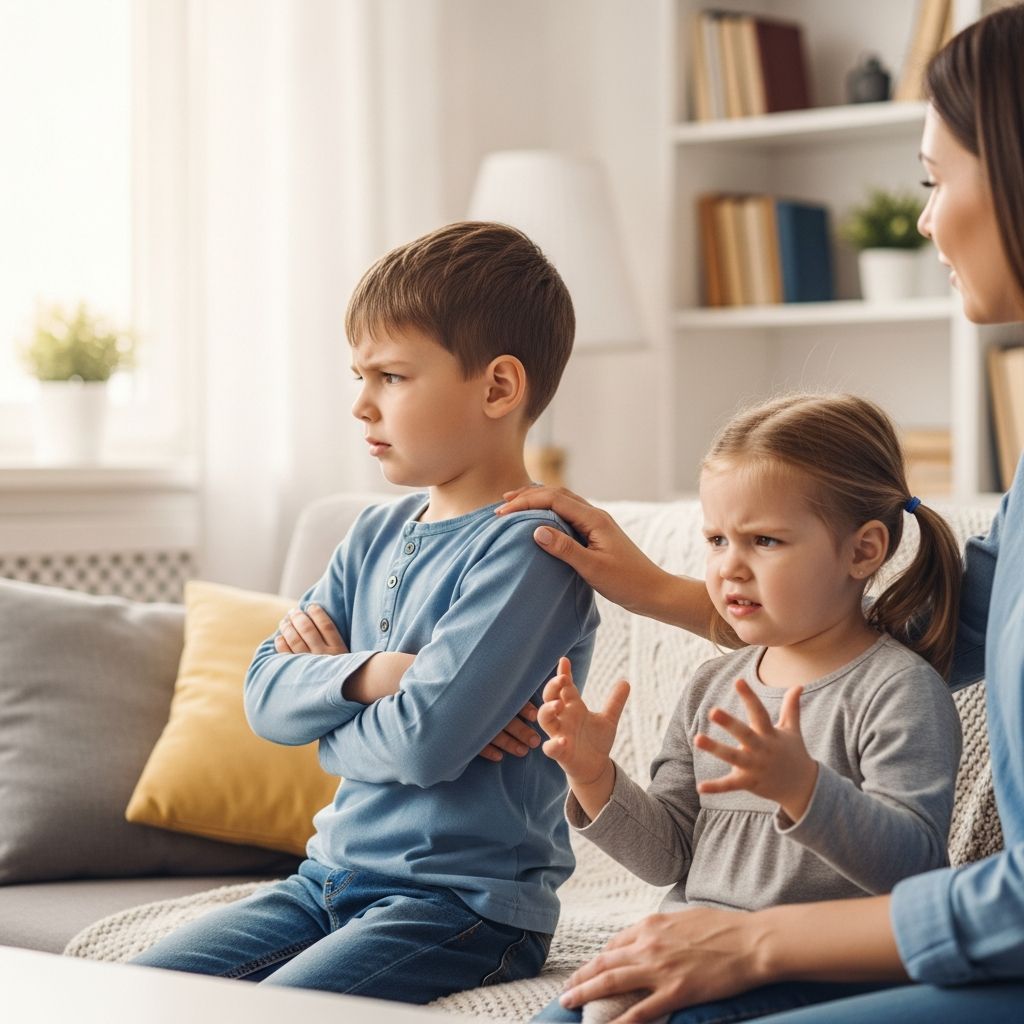
Siblings who adore each other can still have moments when things get physical. A shove over a toy, a slap after name-calling, a punch when patience runs out—these moments are alarming and exhausting for parents. This guide is designed to help you respond safely and calmly in the moment, then take concrete steps to reduce hitting over time.
The goal is not to raise children who never argue, but to raise children who learn healthier ways to express anger, solve problems, and repair relationships after they’ve made mistakes.
Why Siblings Hit Each Other
Physical aggression between siblings rarely comes out of nowhere. It usually sits on top of big feelings and unmet needs. Understanding what might be driving the behavior makes it easier to respond in a way that actually changes something, instead of just punishing the surface problem.
- Competition for attention: Children may hit when they feel overlooked or believe a sibling is “the favorite.”
- Developmental limits: Younger kids have less impulse control and may lash out before their thinking brain catches up.
- Copying what they see: Kids exposed to shouting, rough play, or physical discipline may repeat it with siblings.
- Big emotions with tiny tools: Anger, jealousy, frustration, and boredom are powerful feelings, and hitting can feel like a fast way to get relief or control.
Recognizing these roots does not excuse hitting, but it does guide you toward teaching better tools instead of just saying, “Stop it!” and hoping for the best.
Your First Priority: Safety, Not Blame
When you hear the scream from the next room, your heart jumps and your brain races: Who started it? Who’s at fault? Those instincts are understandable, but your very first job is simpler and more important—everyone needs to be safe.
In the first 30–60 seconds, think like an emergency responder, not a judge. Once everyone is calm and separated, there will be time to sort out what happened and teach better choices.
Step-by-step safety response
- Move quickly but stay as calm as you can; your tone sets the temperature for the room.
- Physically separate the children if needed—gently but firmly.
- Use a brief, clear rule such as: “No hitting. Bodies must be safe in this house.”
- Check for injuries and offer comfort to any child who is hurt.
- Delay problem-solving and detailed questions until everyone is calmer.
Think of this phase as “emotional first aid.” You are not taking sides; you are taking charge of safety.
What to Say in the Heat of the Moment
In the chaos of a fight, it is easy to yell or say things you later regret. Planning a few simple, neutral phrases ahead of time helps you stay steady and consistent.
Aim for language that is:
- Short and clear.
- Focused on behavior, not character.
- Respectful to both children.
Example phrases you might use
- “Stop. I will not allow hitting.”
- “I see two very upset kids. We’re going to pause and calm our bodies.”
- “Hands are for helping and playing, not for hurting.”
- “We’re taking a break so everyone can feel safe again.”
You do not need a long lecture in that moment. A few consistent phrases, paired with firm but gentle action, communicate that violence is off-limits and that you are in charge of making sure everyone is safe.
A Calm-Down Plan for Each Child
Once you have separated the siblings, each child needs a chance to settle. A calm child can think, listen, and learn; an overwhelmed child cannot. “Calm-down” is not a punishment; it is a reset, a way of saying, “Your feelings matter, and we’re going to help your body come down from fight mode.”
What works will depend on age and temperament, but you can experiment and create a simple plan with each child ahead of time.
Ideas for calming strategies
- Deep breaths together (“Smell the flower, blow out the candle”).
- Holding a favorite stuffed animal or pillow.
- Listening to quiet music in a separate space.
- Drawing or scribbling feelings on paper.
- Using a “calm corner” with soft items and visual tools, like emotion charts.
Let each child help design their own calm-down options when they’re not upset. They are more likely to cooperate with a plan they helped create.
Talking It Through Without Taking Sides
When everyone is calmer, it is tempting to launch an interrogation and figure out who “deserves” the bigger consequence. But constantly playing detective can actually fuel rivalry, because each child feels pressure to prove they are the victim and their sibling is the villain.
Instead, aim to be a guide and coach. You are helping both children notice what happened, take responsibility for their choices, and brainstorm better options for next time.
Guiding questions that teach skills
- “What was happening right before things got physical?”
- “What were you feeling in your body?”
- “What did you want in that moment?”
- “How did your choice affect your brother/sister?”
- “Next time you feel this way, what could you do instead of hitting?”
Your goal is not to force matching stories, but to help each child tell their own story and identify different choices for the future. When possible, give both kids a chance to talk to you one-on-one, especially if one tends to dominate the conversation.
Natural and Logical Consequences That Teach
Consequences are often more helpful when they are related to the behavior and respectful to the child, instead of random punishments chosen in anger. Think of consequences as feedback that helps children connect their actions to outcomes, rather than as payback.
| Situation | Unhelpful reaction | More constructive option |
|---|---|---|
| Child hits sibling over a toy | Taking away all toys for the day | Both children lose access to that toy for a set time and later practice asking for turns |
| Child pushes in a board game | Yelling and ending all screen time “because you can’t behave” | Game ends for now; child helps reset pieces and later practices playing without pushing |
| Older sibling repeatedly hits when frustrated | Labeling: “You’re the mean one” | Short loss of a privilege plus a calm practice session of using words and asking for help |
After a consequence, always circle back to connection: a hug, a short conversation, a reminder that everyone makes mistakes and can learn new skills.
Helping the “Aggressor” Learn Better Tools
The child who hits needs clear limits, but also guidance and belief that they are capable of change. Seeing themselves as “the bad kid” can lock them into the very behavior you are trying to change. Your tone and words matter.
When you speak with the child who did the hitting, you are working on three goals: responsibility, empathy, and replacement skills.
Ways to support the child who hit
- Describe what happened without character labels (“You were angry and you hit”) instead of global judgments (“You’re a bully”).
- Ask how they think their sibling felt, and listen even if the answer is short or clumsy.
- Practice specific replacement behaviors such as walking away, using a phrase like “I need a break,” or calling for an adult.
- Help them plan an appropriate repair (a drawing, kind words, helping fix what was damaged, or a simple, sincere apology).
Practice these skills outside of conflict too—during playtime, in pretend games, or while reading stories about characters who handle anger well or poorly.
Supporting the Child Who Was Hurt
The child on the receiving end of hitting needs comfort, validation, and practical tools for future situations. Comfort first: “You didn’t deserve to be hit. Your body deserves to be safe.” Validation reminds them that their feelings make sense.
Then, when they are calmer, you can help them build their own skills for staying safe and speaking up.
Skills to teach the hurt child
- How to say firmly, “Stop. I don’t like that.”
- How to move away and come find an adult without feeling like they are “tattling.”
- How to name their feelings: “I was scared,” “I felt disrespected,” “I was embarrassed.”
- How to participate in repair—listening to an apology, accepting a gesture, or explaining what they need to feel safe again.
Make sure the hurt child does not feel pressured to forgive instantly or pretend they are fine. Repair is a process, not a single magic sentence.
Reducing Hitting Over Time: Daily Habits That Help
While no household can eliminate sibling conflict entirely, consistent daily practices can reduce the frequency and intensity of physical fights. Think of these as the long game—small actions that add up.
Connection habits
- Offer regular one-on-one time with each child, even 10–15 minutes of undivided attention.
- Notice and comment on positive sibling interactions, like sharing or helping (“I saw you give your brother a turn—that was thoughtful.”).
- Build fun traditions that don’t involve competition, such as family walks, collaborative games, or group storytelling.
Environment and routine adjustments
- Reduce obvious flashpoints, like having only one of a high-demand toy if it constantly leads to fights.
- Protect sleep and nutrition routines; tired, hungry kids have less capacity to handle frustration.
- Give clear expectations before shared activities (“If this game turns into pushing, we’ll pause and try something else”).
These small changes do not erase conflict, but they lower the temperature so disagreements are less likely to explode into hitting.
The Power of Modeling Calm Conflict
Children learn more from what they observe than from what they are told. When adults around them handle disagreements with yelling, threats, or slamming doors, kids often absorb those patterns and repeat them with siblings.
Perfect behavior from adults is impossible, but even small shifts in how you handle your own frustration can make a real difference.
Ways to model healthy conflict
- Use respectful words and a steady tone when you disagree with a partner or another adult in front of your kids.
- Say out loud when you are using a coping strategy (“I’m feeling really annoyed, so I’m going to take three deep breaths before I answer”).
- Apologize when you lose your temper—this shows that everyone is still learning, including grown-ups.
When children see you repair after conflict, they learn that relationships can survive mistakes and that saying “I was wrong” is a strength, not a weakness.
When to Worry and Seek Extra Help
Not all sibling hitting is the same. Occasional scuffles that end quickly and respond to guidance are different from ongoing patterns of severe or one-sided aggression. As a parent, trust your instincts—if something feels beyond “normal sibling stuff,” it is worth getting more support.
- Take action quickly if there are serious injuries, use of objects as weapons, or threats that truly frighten you or your child.
- Consider discussing concerns with your pediatrician, school counselor, or a child therapist if hitting is frequent, intense, or tied to other worrying signs like sleep problems, drastic mood changes, or regression.
- Seek help for yourself too if you find it hard to stay calm, feel constantly overwhelmed, or worry about repeating patterns from your own childhood.
Reaching out for help is not a sign that you have failed as a parent; it is a sign that you are taking your family’s emotional safety seriously.
Simple Scripts for Tough Moments
Having a few ready-made sentences can reduce the pressure in the moment. You can adapt these to match your family’s language and values, but use them as starting points when you feel stuck.
- To stop the action: “Pause. I can’t let anyone get hurt. We’re taking a break.”
- To name the rule: “In our family, we solve problems with words, not with our hands.”
- To acknowledge feelings: “You’re really angry, and it makes sense. Hitting is still not okay.”
- To invite problem-solving: “What are two other things you could do next time instead of hitting?”
- To support repair: “How can you help your sister feel safer after what happened?”
You do not need perfect words. Consistent, calm, and values-based language will serve you far better than a long speech said through gritted teeth.
Frequently Asked Questions
Is some sibling fighting normal?
Yes. Disagreements, bickering, and even occasional physical scuffles are common among siblings, especially when they are close in age or share many spaces and toys. What matters most is whether children are responsive to guidance, able to repair after conflicts, and gradually learning better skills.
Should I always step in when they fight?
Intervene immediately if there is any risk of physical harm or if you sense that the situation is escalating beyond what they can handle. For milder conflicts, you can sometimes hang back and see whether they can negotiate on their own. Over time, coaching them on problem-solving skills allows you to step in less often.
Is it okay to send them both to their rooms?
Separating children so they can calm down is often helpful, but it works best when it is framed as a chance to reset, not as banishment. You might say, “We’re taking a pause so everyone can calm their body,” and then reconnect with each child individually before bringing them back together.
How do I avoid always blaming the older child?
It is easy to fall into the pattern of assuming the older child should “know better,” but this can breed resentment and intensify rivalry. Focus on the specific actions each child took rather than their age, and help both kids see what they can do differently next time.
What if hitting never seems to improve?
If you are consistent with boundaries, modeling, and teaching skills and still see frequent or escalating aggression, it may be time to consult a professional. A pediatrician, psychologist, or family therapist can help rule out underlying issues and offer tailored strategies for your unique family dynamics.
Siblings may not always be gentle or gracious with each other, but with patient guidance and steady limits, they can learn to move from hitting and hurting to repairing and respecting. You cannot control every argument, but you can shape the culture of your home: a place where all feelings are allowed, all bodies are protected, and everyone is still learning how to love each other well.