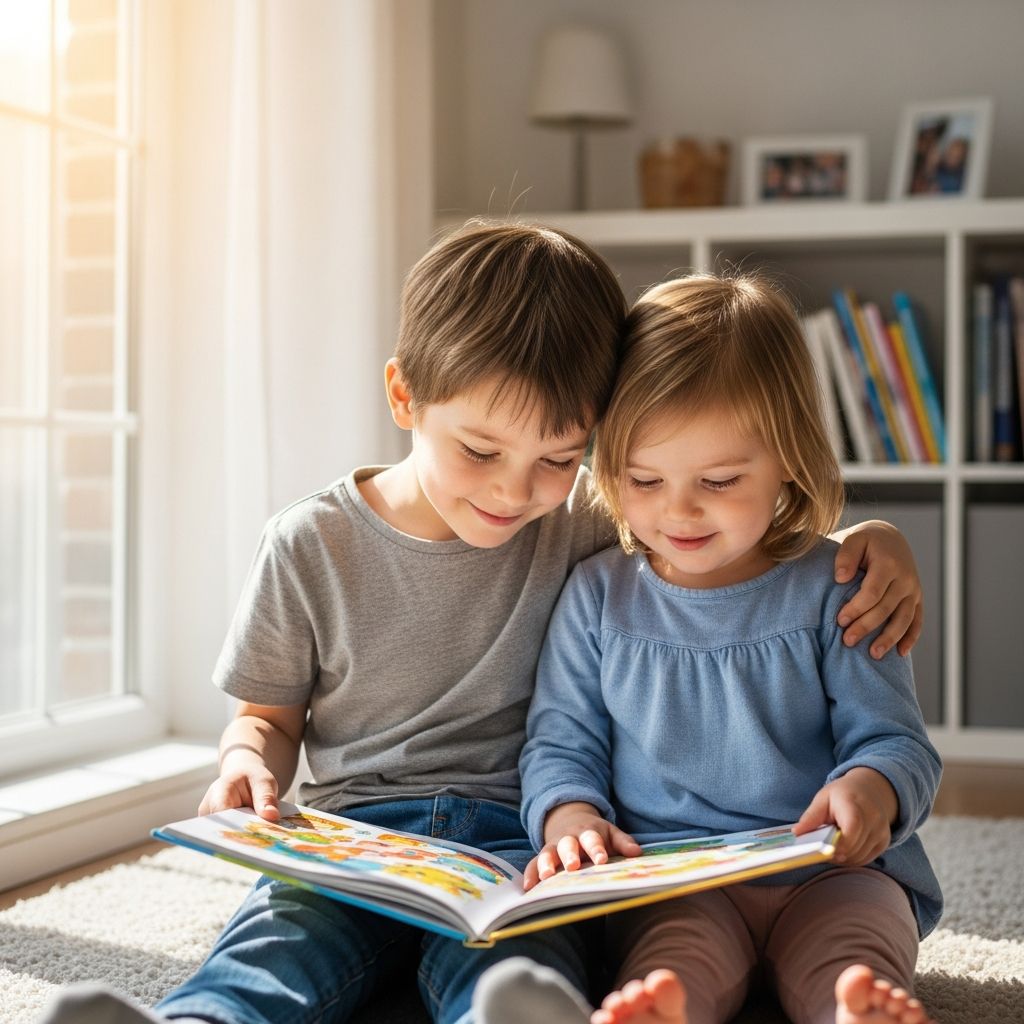
Siblings can be each other’s greatest allies, but in many homes they spend more time arguing than connecting. Those daily squabbles are exhausting for adults, yet they are also powerful opportunities to teach skills that children will use in every close relationship for the rest of their lives.
This guide offers a calm, practical roadmap to reduce rivalry, handle fights without yelling, and strengthen the bond between your children, using empathy, boundaries, and consistent routines.
Why Siblings Fight (Even in Loving Homes)
Understanding what fuels conflict makes it easier to respond wisely instead of reacting in the moment. Children rarely fight because they are “bad”; they fight because they are human, immature, and learning.
Hidden Drivers of Sibling Conflict
Several common dynamics make conflict between siblings almost inevitable. When parents recognize these patterns, they can address root causes rather than only managing outbursts.
- Competition for attention: Children are wired to seek connection and can quickly interpret a sibling’s special time as a threat to their own place in the family.
- Different temperaments: A sensitive child paired with a high-energy child can lead to frequent clashes, even when both are trying their best.
- Developmental gaps: Older siblings may expect younger ones to act older than they are, while younger siblings push into spaces the older one sees as “mine.”
- Unmet basic needs: Tired, hungry, overstimulated children simply have less capacity for patience and sharing.
Why Sibling Conflict Is Not All Bad
Conflict itself is not a sign that something is wrong with your family; it is a sign that your children are practicing how to live with other people. Within safe limits, sibling disagreements can teach emotional regulation, boundaries, and negotiation.
- Children learn to say “no,” ask for what they need, and tolerate frustration without giving up on the relationship.
- Handled with support rather than punishment, conflicts become real-life lessons in empathy, compromise, and repairing hurt.
From Referee to Coach: Changing the Adult Role
Many parents feel stuck in the role of constant referee: deciding who is right, who is wrong, and who “had it first.” Shifting from referee to coach helps children build their own skills instead of relying on adults to solve every disagreement.
Why Taking Sides Makes Things Worse
When adults consistently decide who is right, children quickly start competing for the role of “good child” and blaming each other to win adult approval. Over time, that pattern can harden into resentment and fixed labels.
- Repeatedly labeling one child as “the victim” and the other as “the troublemaker” teaches them to see each other through that narrow lens.
- Children may even escalate conflicts to gain attention or to prove that a sibling is misbehaving.
Coaching Skills Instead of Issuing Verdicts
A coaching approach focuses on teaching children what to do next rather than scolding them for what just happened. The adult holds the boundary—no hurting, no name-calling—while guiding children to express needs and listen to each other.
- Stay neutral about who is “right,” but be firm about respectful behavior.
- Invite each child to tell the story, help them name feelings, and support them in brainstorming solutions.
A Simple Step-by-Step Framework for Handling Fights
When voices rise and tempers flare, a clear framework helps adults respond calmly and consistently. The following steps can be adapted to different ages and situations, from toy disputes to hurtful words.
Step 1: Ensure Safety and Pause the Conflict
Your first task is always safety. Physical aggression and intense dysregulation make problem-solving impossible until everyone has calmed down at least a little.
- Calmly move between children, separate bodies if needed, and remove any object they are actively fighting over.
- Use a grounded, low voice to signal that you are in control and that everyone will get a chance to speak.
Step 2: Acknowledge Feelings on All Sides
Children calm down faster when they feel understood. Naming feelings does not mean agreeing with behavior; it means showing that emotions are noticed and acceptable, while actions still have limits.
- Reflect each child’s perspective in simple language, such as “You wanted the toy” or “You felt left out.”
- Validate the underlying emotion—frustration, jealousy, disappointment—so children do not have to escalate to be heard.
Step 3: Help Each Child Speak for Themselves
One goal of conflict coaching is to move from grabbing, yelling, and tattling toward clear, respectful communication. Younger children may need prompts or phrases to copy; older children can express themselves more fully.
- Encourage “I” statements, such as “I feel upset when…” instead of “You always…”
- Ask one child to speak while the other listens, and then switch, so both feel that their voice matters.
Step 4: Invite Listening and Perspective-Taking
Listening to a sibling’s point of view is a powerful way to soften rigid positions. Children do not have to agree, but they can begin to understand that the other person also has feelings and reasons.
- Ask each child to repeat back what they heard the other say, focusing on the main point and the feeling.
- Gently correct only if needed, emphasizing effort: “You really tried to understand your brother just now.”
Step 5: Brainstorm Solutions Together
Instead of the adult imposing a solution, guide the children to suggest options that consider everyone’s needs. This teaches compromise and creativity while increasing buy-in.
- Invite multiple solutions—taking turns, trading toys, playing together, or scheduling time—before choosing one.
- Reality-check the options: they must be safe, respectful, and reasonably practical for the family.
Preventing Rivalry Before It Starts
How adults structure daily routines and respond to children’s emotional needs has a large impact on how often conflicts explode. Prevention is not about eliminating all disagreement but about reducing triggers that predictably lead to fighting.
One-on-One Time as Emotional “Insurance”
Children who feel regularly seen and valued are less likely to compete with siblings for attention. Short, consistent individual time has more impact than occasional grand outings.
- Set aside 10–15 minutes of predictable one-on-one time with each child, even if it is just reading, drawing, or chatting.
- During that time, put away devices and avoid correcting or teaching; the goal is pure connection.
Clear Family Rules About Respect
Children need simple, concrete expectations for how family members treat each other. Rules work best when they are few, clearly explained, and modeled by adults in the home.
- Examples of core rules include: “We do not hit,” “We use kind words,” and “Everyone gets a turn to talk.”
- Revisit these rules during calm moments and celebrate examples of siblings living them out.
Teaching Emotional Skills That Make Peace Possible
Siblings get along better when they have tools to manage their own big feelings. Emotional skills are not inborn; they are taught and practiced, often in the heat of everyday frustrations.
Emotional Vocabulary and Self-Regulation
Children who can identify what they feel are better able to ask for help and to pause before acting. Labeling emotions also makes it easier for siblings to recognize and respond to each other’s moods.
- Use everyday moments to name emotions: “You look disappointed” or “You seem excited.”
- Teach simple calming tools such as deep breathing, squeezing a pillow, or taking a short break in a cozy spot.
Building Empathy Between Siblings
Empathy grows when children see that their actions affect others and when adults consistently point out those connections. Over time, siblings can learn to care about each other’s inner world, not just their own.
- After conflicts, briefly reflect on impact: “When you grabbed the toy, your sister felt scared and sad.”
- Also highlight positive moments: “You waited for your brother; that helped him feel included.”
Balancing Fairness and Individuality
Parents often aim to be perfectly “fair,” but children need more than identical treatment; they need to feel uniquely valued. Fairness is about meeting needs, not matching every privilege or item exactly.
Avoiding Comparisons and Labels
Comparing siblings, even casually, can plant seeds of rivalry that last for years. Labels like “the athletic one” or “the difficult one” shape how children see themselves and each other.
- Focus on describing effort and specific behaviors rather than fixed traits.
- Choose private moments for feedback so one child does not feel praised at the other’s expense.
Individual Strengths and Customized Support
Each child’s age, temperament, and challenges require slightly different parenting responses. Explaining this openly helps children understand why “the same” does not always mean “fair.”
- Offer simple explanations, such as “Your brother goes to bed earlier because his body needs more sleep right now.”
- Create individual rituals—special songs, games, or responsibilities—that reflect who each child is.
Practical Household Strategies That Support Harmony
Small structural changes in the home can significantly reduce friction. Think of these as “guardrails” that keep children from constantly colliding.
Space, Possessions, and Boundaries
Clear physical and psychological boundaries help siblings feel safe and respected. Children are more open to sharing when they also know some things are truly theirs.
- Identify a few personal items that are not required to be shared and store them in defined places.
- Designate shared spaces and times, and discuss how to ask for privacy in a respectful way.
Routines That Reduce Flashpoints
Many sibling fights break out at predictable times: before school, during transitions, or in the car. Strong routines reduce uncertainty and help children anticipate what comes next.
- Use simple visual schedules or checklists for high-conflict times, such as mornings and evenings.
- Build in short micro-breaks—quiet reading time, outdoor play, or alone time—to lower overall stress.
When Conflicts Get More Serious
Most sibling conflict is normal and manageable with patience and practice. Still, some patterns signal that extra attention or professional support may be important.
Red Flags to Watch For
Safety and emotional wellbeing are always the priority. When children repeatedly cross certain lines, it is important to respond promptly and, if needed, seek guidance.
- Frequent or severe physical aggression, especially when one child is consistently fearful.
- Persistent, targeted verbal cruelty or humiliation that continues even after intervention.
Getting Extra Help
Support from outside the family can provide fresh perspective and tailored strategies. Seeking help is a sign of responsibility, not failure.
- Consider consulting a child therapist, family counselor, or parenting coach for chronic or escalating conflict.
- Share concrete examples and patterns so a professional can assess whether deeper issues are present.
Sample Approaches by Age: A Quick Reference Table
The core principles remain the same across childhood, but the way adults apply them will vary according to age and developmental stage. The table below offers general guidance.
| Age Range | Main Challenges | Adult Focus |
|---|---|---|
| Toddlers & Preschoolers | Impulsive grabbing, hitting, difficulty sharing, limited language | Safety first, simple feeling words, very short turns, lots of modeling |
| Early School Age | Fairness complaints, tattling, exclusion from play | Teaching problem-solving steps, emphasizing empathy, clarifying family rules |
| Preteens & Teens | Privacy, autonomy, sarcasm, lingering grudges | Respect for boundaries, open communication, collaborative rule-making, restorative talks |
Frequently Asked Questions About Sibling Harmony
Is constant bickering normal, or should I be worried?
Frequent low-level bickering is extremely common, especially in busy households and during times of transition or stress. What matters most is whether children can move on, repair, and also share positive moments together, not whether they never argue.
Should I always let them “work it out themselves”?
Children do benefit from solving minor disagreements independently, but they first need to see what healthy conflict resolution looks like. Adults can gradually step back as children learn the skills to stay safe, speak respectfully, and consider each other’s feelings.
What if one child always seems to be the aggressor?
It is important to protect the child who is being hurt while also remembering that the child who acts aggressively is signaling unmet needs or lagging skills, not fixed character flaws. Focus on teaching alternative behaviors, reducing triggers, and offering extra connection, rather than shaming or labeling.
How can I stop feeling guilty when both kids want me at the same time?
It is impossible to meet every child’s wishes simultaneously, and trying to do so only increases guilt and burnout. Instead, acknowledge each child’s desire, explain clearly what will happen, and then follow through on small, reliable moments of individual attention.
Will they ever actually like each other?
Many siblings who fight frequently in childhood grow into supportive adults, especially when their early conflicts were handled with respect rather than shame. By modeling calm, teaching repair, and nurturing individual bonds, parents greatly increase the odds that siblings will appreciate each other in the long run.
Helping siblings get along is a long-term project, not a quick fix. Every conflict handled with empathy and boundaries is a brick in the foundation of the relationship they are building with one another—and with themselves.