Few moments rattle parents more than seeing an older child hit, push, or pinch the baby. You may feel shocked, angry, guilty, and afraid it will keep happening. Yet sibling aggression in early childhood is common and, with thoughtful guidance, can become an opportunity to teach empathy, boundaries, and emotional regulation.
This guide explains why older children sometimes hurt the baby, what to do in the heat of the moment, and how to prevent repeat incidents while keeping a warm, respectful relationship with both kids.
Why Older Siblings Sometimes Hurt the Baby
Hitting or pushing is rarely about the baby alone. It is usually a sign that your older child’s emotional and developmental needs are overwhelmed.
Common underlying reasons
- Immature impulse control – Young children’s brains are still developing the ability to stop and think before acting. Self-regulation skills grow gradually through early and middle childhood.
- Jealousy and fear of replacement – A new baby can feel like a threat. The older child may fear losing your love, time, or special status as the only child.
- Overload of big feelings – Frustration, disappointment, or fatigue can spill over as aggression when a child lacks words or coping tools.
- Curiosity and experimentation – Children sometimes hit to see what will happen: What does the baby do? What do the adults do?
- Seeking attention or power – If hitting reliably produces a big reaction or one-on-one time with a parent, it can become a habitual way to get connection, even though it is negative attention.
- Copying what they’ve seen – Children imitate peers, shows, or rough play they observe, and may not yet distinguish safe from unsafe touch.
Typical age patterns
Sibling aggression tends to be most intense when the older child is still very young and the baby is newly mobile.
| Age of older child | Common triggers | Typical challenges |
|---|---|---|
| 18–30 months | Loss of parent attention, toy conflicts | Very low impulse control, limited language for feelings |
| 2.5–4 years | Baby touching their things, crowding their space | Intense emotions, budding sense of fairness and ownership |
| 5+ years | Feeling overburdened as “the big kid,” teasing, boredom | Better language, but may use aggression to control or retaliate |
First Priority: Safety for Both Children
Your first responsibility is to keep everyone physically safe while staying as calm as possible. How you respond shapes whether your older child learns new skills or simply feels more ashamed and resentful.
Steps to take in the moment
- Move quickly but stay composed – Take a breath, then step in. Shouting or shaming tends to escalate fear and aggression rather than teach self-control.
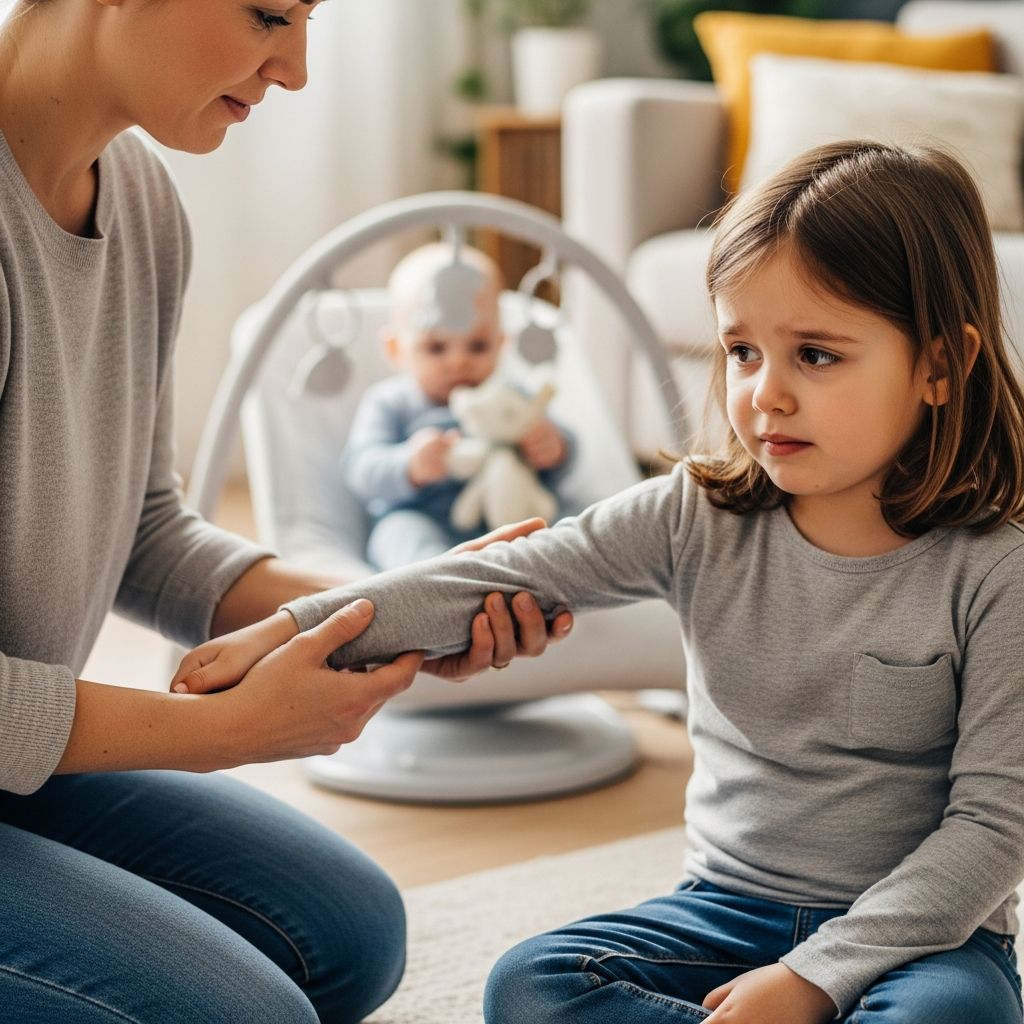
- Physically block or separate – Gently but firmly place your body between the children or move one child away. You might hold the older child’s hands and say in a steady voice, “I won’t let you hit the baby.”
- Attend to the baby first – Quickly check the baby for injuries, pick them up, and soothe. This communicates that hurting others is serious and that you are a reliable protector.
- Use few, clear words – In the heat of the moment, long lectures are ineffective. A simple boundary such as, “Hitting hurts. I can’t let you hit,” is enough.
- Prevent a replay – If the older child is dysregulated, keep some physical distance until they are calm. That might mean bringing the baby with you to another room for a few minutes.
What to avoid in the moment
- Hitting or grabbing harshly – Physical punishment and rough handling are linked with higher levels of later aggression and behavior problems.
- Global labels – Phrases like “You are mean” or “You’re a bad big brother” attack identity instead of behavior.
- Forcing immediate apologies – An insincere apology teaches children to say the words without feeling empathy. Focus first on calming and understanding.
After the Crisis: Connection, Not Shame
Once everyone is safe and emotions have cooled, you can help your older child understand what happened and practice better choices. This is where learning really happens.
Validate the feeling, limit the behavior
Children learn best when they feel seen and safe. You can fully disallow hitting while still honoring the feelings underneath.
- Start with empathy: “You were really upset when the baby knocked down your blocks.”
- Reinforce the boundary: “It’s okay to be upset. It’s not okay to hit.”
- Offer an alternative: “You can say, ‘Stop’ or ask me for help when you feel that mad.”
Teach simple emotional language
Young children often hit because they lack words to express what they feel. Over time, build a shared vocabulary:
- Use emotion words in context: “You look frustrated,” “You’re disappointed,” “You’re jealous.”
- Model sentences they can copy: “I need space,” “I don’t like that,” “I want a turn.”
- Practice when calm, through books, stories, and play-acting.
Repair and restore connection
After an incident, both siblings benefit from gentle repair:
- Support your older child to check on the baby: “Let’s see how your sister is. She cried when she was hit.”
- Invite, but do not force, a repair action: a gentle pat, bringing a toy, or saying, “I’m sorry I hurt you.”
- End with reassurance: “You are still learning. I am here to help you keep everyone safe.”
Practical Prevention Strategies at Home
Prevention is about making aggression less likely by adjusting routines, environments, and your own responses. No plan can stop every incident, but small changes compound over time.
1. Reduce common triggers
Many outbursts happen when basic needs are stretched.
- Sleep – Overtired children are more irritable and aggressive. Consistent naps and bedtimes lower the likelihood of hitting.
- Hunger – Offer frequent, predictable snacks and meals to avoid “hangry” moments.
- Overstimulation – Crowded events, loud noise, or too many new experiences can overload your child’s nervous system. Plan for breaks and quiet time.
2. Protect personal space and treasured items
Older siblings often lash out when the baby touches their belongings.
- Designate a “no-baby zone” (a shelf, drawer, or part of a room) for special toys.
- Provide baby-safe alternatives—baskets of toys the baby may freely explore.
- Use baby gates or play yards strategically so the baby cannot reach everything at once.
3. Offer ways to discharge energy safely
Physical outlets help children who are naturally active or intense use their bodies without hurting others.
- Daily movement: playground time, dancing, obstacle courses, jumping games.
- “Safe hitting” options: pillows, a mattress, a punching ball, or drum they can pound.
- Teach replacement actions: stomping feet, squeezing a pillow, or clapping instead of hitting.
4. Build in one-on-one time
When an older child feels securely connected, they are less likely to attack the baby out of jealousy. Regular focused attention from caregivers fosters emotional security and prosocial behavior.
- Offer even 10–15 minutes a day of “special time” where you follow the older child’s lead.
- Remind them before you turn to the baby: “I’ll feed the baby, then we’ll read our book.”
- Notice and name their strengths as a sibling (“You handed the baby a toy. That was thoughtful.”).
Setting Clear, Consistent Boundaries
Aggression decreases when children clearly understand the rules and can trust that adults will enforce them calmly and consistently.
House rules that protect everyone
Keep rules few, positive, and easy to remember. For example:
- “Hands and feet are for helping and playing, not for hurting.”
- “If you feel like hitting, tell an adult or hit a pillow.”
- “We move away when we need space.”
Review these rules during calm times, not just after problems.
Natural consequences, not harsh punishments
Consequences work best when they are directly linked to the behavior and delivered without anger.
- If a child is rough with the baby, they momentarily lose the privilege of being close until they are calm.
- If a certain toy triggers constant fights, it is put away for a while.
- If a game becomes too rough, it is paused and resumed only with gentler play.
Research indicates that warm, firm, and consistent discipline is more effective for preventing ongoing aggressive behavior than harsh punishment or neglect.
Supporting the Baby’s Safety and Emotional Well-Being
While the older child needs understanding and guidance, the baby also deserves consistent protection and comfort.
Practical protection measures
- Maintain constant visual supervision when both children are together, especially if hitting is a recent pattern.
- Use safe setups: baby in a play yard, high chair, or carrier during high-risk times (transitions, before meals, when the older child is tired).
- Respond promptly to any aggression so the baby learns that adults will step in.
Helping the baby feel secure
- Comfort after incidents with calm voice and gentle touch.
- Offer reassuring routines: familiar songs, cuddles, and consistent caregivers.
- Over time, narrate simple messages: “You didn’t like being pushed. I stopped it. You are safe with me.”
Taking Care of Yourself as a Parent
Repeated conflicts between siblings can drain your patience and confidence. Caring for yourself is not optional; it is part of keeping the family stable.
Normalize your feelings
Many parents feel deep shame or fear when one child hurts another, but sibling aggression in early childhood is common and usually reflects developmental limits and stressors, not failed parenting.
Practical self-support ideas
- Use brief breathing or grounding exercises after intense moments.
- Debrief with a supportive friend, partner, or parent group.
- Lower perfectionistic expectations; aim for “good enough” responses most of the time.
When to seek professional help
Consider consulting a pediatrician or child mental health professional if:
- The older child frequently injures the baby, despite close supervision.
- Aggression is severe (choking, using objects as weapons, cruelty to animals).
- The child seems indifferent to others’ pain, or you notice significant delays in language or social skills.
- Your own stress, anxiety, or anger feels unmanageable.
Early guidance from professionals can reduce long-term difficulties and provide tailored strategies for your family.
Frequently Asked Questions (FAQs)
Q: Should I punish my child every time they hit the baby?
A: It is important to respond every time, but harsh punishment often increases fear and aggression rather than teaching self-control. Focus on immediate safety, clear boundaries (“I won’t let you hit”), brief removal from the situation if needed, and later coaching about what to do instead.
Q: How can I help my older child stop being jealous of the baby?
A: Jealousy is normal. Offer regular one-on-one time, give them age-appropriate ways to help with the baby, and name their feelings without judgment (“You wish it was just you and me again”). Over time, connection and validation reduce jealousy more effectively than scolding.
Q: What do I say right after my child hits?
A: Keep it short and firm: “Hitting hurts. I won’t let you hit the baby.” Then attend to the baby, and once everyone is calmer, return to talk with the older child about what happened and what they can do differently next time.
Q: My child laughs after hitting. Does that mean they don’t care?
A: Laughing can be a sign of nervousness, embarrassment, or emotional overload, not necessarily lack of empathy. Young children often appear detached when they are uncomfortable. Continue to set boundaries and model empathy (“She cried; that hurt her”) rather than assuming cruelty.
Q: Will my children always have a bad relationship because of these early fights?
A: Early conflicts do not doom the sibling relationship. Many siblings who fought intensely as young children later become close. What matters most is that adults respond with safety, fairness, and opportunities to repair and reconnect, helping both kids build skills and trust over time.
References
- Toddler Hitting: Why It Happens and How To Make It Stop — Healthline. 2019-10-28. https://www.healthline.com/health/parenting/toddler-hitting
- What To Do When A Child Hits Another Child — Happily Family. 2018-05-10. https://www.happilyfamily.com/what-to-do-when-a-child-hits-another-child/
- Aggressive Behavior in Young Children — American Academy of Pediatrics / HealthyChildren.org. 2020-01-01. https://www.healthychildren.org/English/ages-stages/toddler/Pages/Aggressive-Behavior.aspx
- How to Handle Toddler Hitting | Tips for Parents from a Pediatrician — YouTube (short educational video). 2023-05-15. https://www.youtube.com/shorts/eZqDfSH5KMs