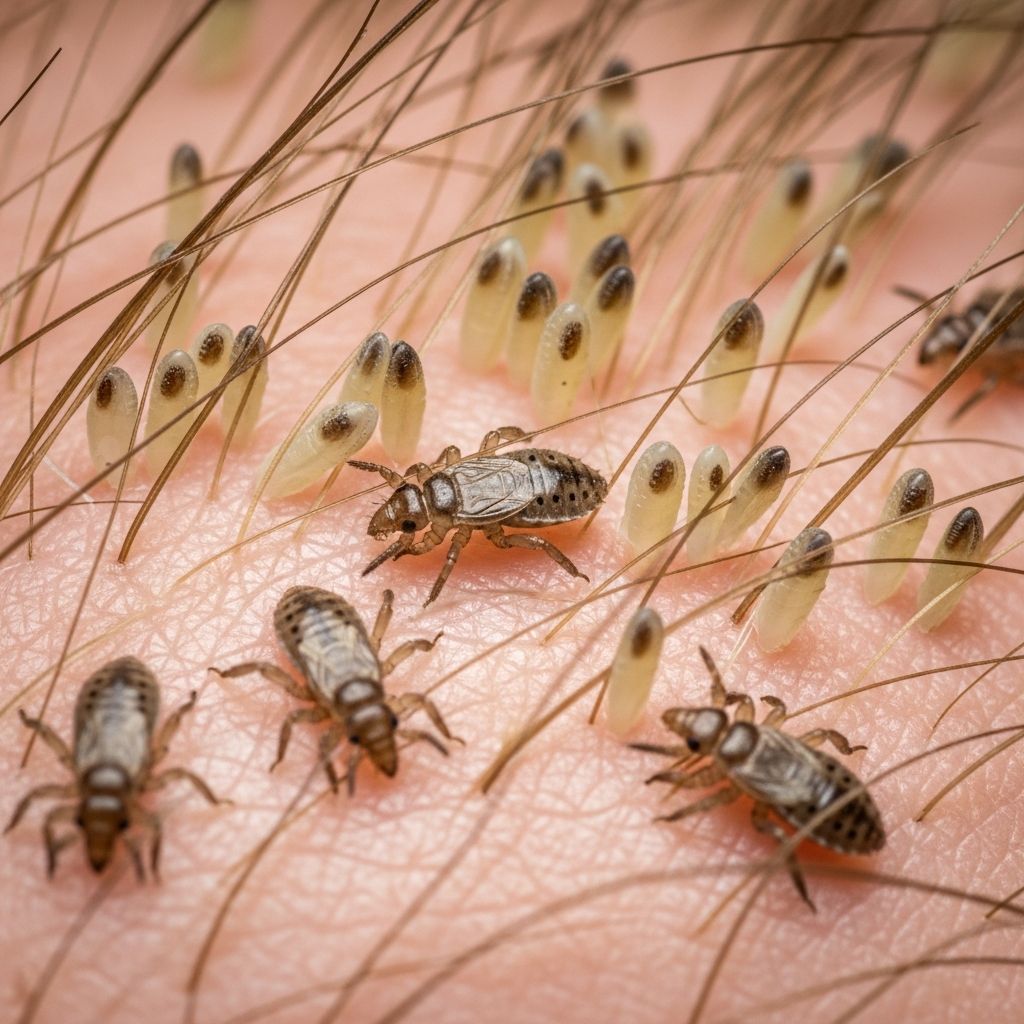
Head lice infestations affect millions of children and families annually, often spreading through close contact. Recognizing lice and their eggs, known as nits, is the first step in effective management. This guide provides detailed descriptions, common locations, and practical tips drawn from reliable health resources.
Understanding the Head Lice Life Cycle
Head lice progress through three stages: egg (nit), nymph, and adult. Adult females lay eggs near the scalp, where warmth aids hatching. Nits hatch in about 7-10 days, releasing nymphs that mature into adults within another week. Adults live up to 30 days on the scalp, feeding on blood multiple times daily. This cycle explains why early detection prevents rapid spread.
- Egg stage: Oval-shaped, glued to hair shafts.
- Nymph stage: Miniature adults emerging from eggs.
- Adult stage: Fully grown, mobile insects.
Key Characteristics of Head Lice Eggs (Nits)
Nits are tiny, oval structures, roughly the size of a knot in thread or a poppy seed (0.03-0.08 mm). They appear white, yellow, amber, golden, or brown, depending on hair color and viability. Viable nits, close to hatching, are often translucent or brownish; hatched ones turn dull white. Unlike dandruff, nits are firmly cemented to one side of the hair shaft with a glue that forms a subtle ‘tail’ shape.
To differentiate:
- Nits resist flicking and require sliding down the entire strand to remove.
- They maintain uniform teardrop shape and size, unlike irregular debris.
- Color intensifies (amber/brown) when placed on white paper.
Where to Find Nits and Lice on the Scalp
Lice prefer warm areas. Focus checks on:
- Behind the ears.
- Nape of the neck.
- Crown of the head.
- ¼ inch from the scalp (viable nits).
Female lice lay 7-10 eggs daily, so clusters (not singles) signal infestation.
| Infestation Stage | Common Locations | Typical Number |
|---|---|---|
| Early (new nits) | Near scalp, hot spots | 3-5+ per day |
| Established | Along shafts, further out | Clusters of 10+ |
| Adults/Nymphs | Scalp base, behind ears | Variable, mobile |
Appearance of Adult Head Lice and Nymphs
Adults measure 2-3 mm, sesame seed-sized, tan, brown, gray, or yellow. They have six claw-tipped legs for gripping hair. Nymphs resemble smaller versions, maturing in 7 days. Fast-moving, they evade detection but leave itchy trails from saliva and feces.
Visibility tip: Lice are eye-visible but tiny; use magnification. Wet combing reveals them as they cling to teeth.
How to Differentiate Nits from Common Impostors
Misidentification delays treatment. Key distinctions:
- Dandruff: Flakes off easily, varies in size/shape, no glue.
- Hairspray residue: Brushes away, not oval/stuck.
- Scabs/Dry skin: Irregular, loose, not side-attached.
- Nits: Fixed, uniform, colored ‘tail’.
Test: Attempt removal. Nits won’t budge without full-strand slide.
Step-by-Step Guide to Checking for Lice
Perform checks in bright light with a fine-toothed detection comb.
- Section dry or wet hair (1-2 inches wide), starting at scalp.
- Comb slowly to ends; wipe on white tissue.
- Inspect comb/tissue for nits (yellow-white specks) or lice (moving specks).
- Pin section; repeat across head, prioritizing hot spots.
- Daily rechecks for 2 weeks post-exposure.
Tools needed: Magnifier, white towel, comb. Dip comb in soapy water between passes.
Signs of Infestation Beyond Sight
Itching signals saliva-induced reaction, though some remain asymptomatic. Look for scratch marks, red bumps, or irritability. Confirm with live lice or viable nits—empty shells alone don’t mean active lice.
Prevention Strategies for Families
Lice spread via head contact, not dirt or animals.
- Avoid shared hats/combs.
- Tie back long hair.
- Weekly family checks.
- Machine-wash bedding in hot water post-exposure.
Treatment Overview After Detection
Once confirmed, use over-the-counter pediculicides or manual removal. Comb daily for 10+ days; viable nits need re-treatment. Avoid harsh chemicals on children; consult professionals for resistance cases. Screen household members.
Frequently Asked Questions
Are nits contagious without live lice?
No, nits can’t reproduce; live lice lay them.
How soon do nits hatch?
Typically 7-10 days; check proximity to scalp.
Can lice jump or fly?
No, they crawl; direct contact required.
Do lice prefer dirty hair?
Myth; hygiene irrelevant.
How often should I check my child’s hair?
Weekly, or daily post-exposure.
Expert Tips for Thorough Inspections
For stubborn cases, professional services offer live video checks. Combine visual hunts with wet combing for 100% efficacy. Persistence clears 95% of infestations manually.
References
- What Are Lice and Nits? – Identifying Lice with Nix® — Nix Lice. Accessed 2026. https://www.nixlice.com/what-are-lice
- 7 Tips to Spot Lice Eggs — Lice Treatment Virginia Beach. Accessed 2026. https://virginiabeachlicetreatment.com/7-tips-to-spot-lice-eggs/
- Checking for Lice: How to Identify Lice in the Hair and Home — Rid Lice. Accessed 2026. https://ridlice.com/blog/checking-for-lice/
- A School’s Guide to the ‘Nitty-Gritty’ About Head Lice — University of Georgia Cooperative Extension (.edu). Accessed 2026. https://fieldreport.caes.uga.edu/publications/C850/a-schools-guide-to-the-nitty-gritty-about-head-lice/
- What Do Head Lice Look Like? — Lice Clinics of America. Accessed 2026. https://www.liceclinicsofamerica.com/main-site/how-to-treat-lice/what-do-head-lice-look-like/
- Head lice and nits — NHS (.gov.uk). Accessed 2026. https://www.nhs.uk/conditions/head-lice-and-nits/