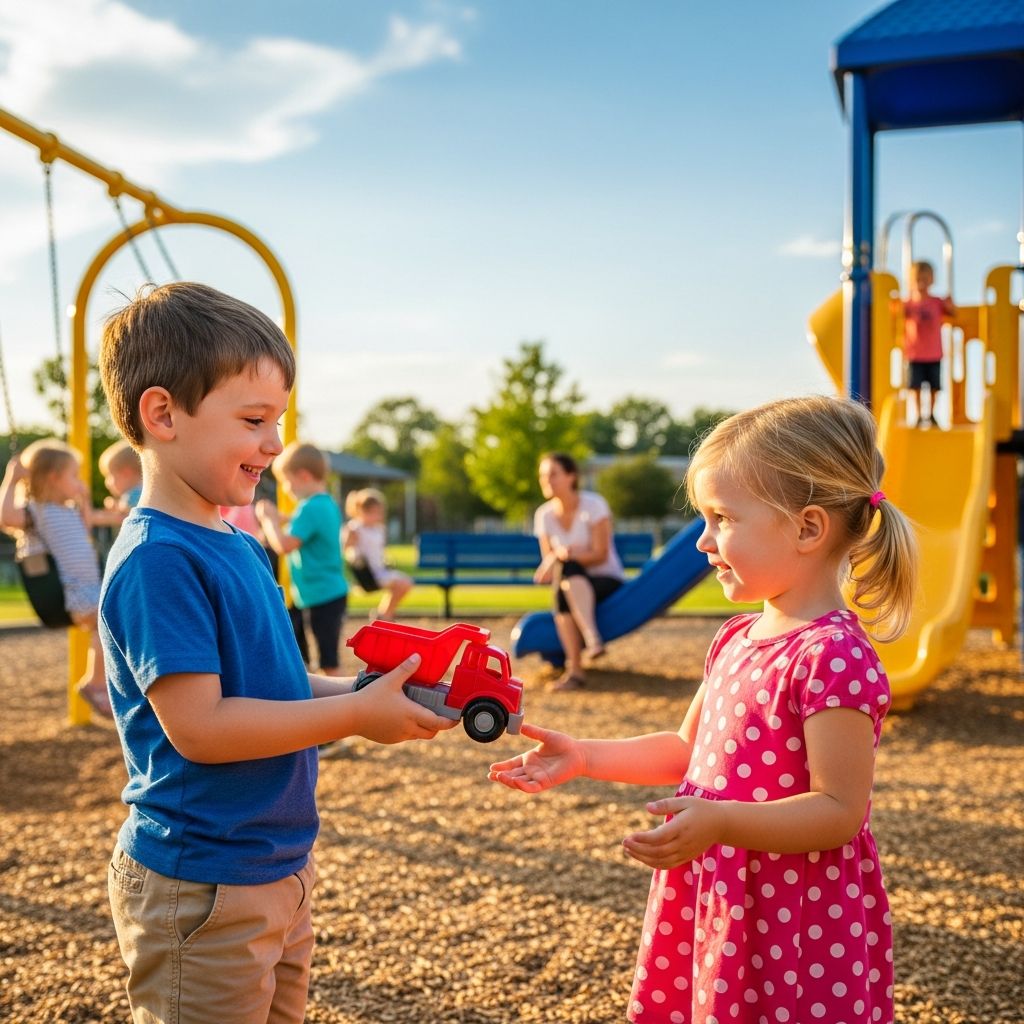
Many four-year-olds are excited to play at the park yet feel unsure about how to approach other children. As a parent or caregiver, you can gently guide your child toward confident, kind interactions without pushing too hard or taking over. This article offers practical, research-informed strategies to help your preschooler build friendship skills that will serve them well now and in the years ahead.
Why Playground Friendships Matter at Four
Preschool friendships are more than just cute moments on the swings. They support key areas of development:
- Social skills: taking turns, sharing, cooperating, and problem-solving with peers.
- Emotional growth: learning to manage big feelings like frustration, jealousy, or disappointment during play.
- Language and communication: practicing conversation, negotiation, and storytelling while they play together.
- Sense of belonging: feeling included and valued, which supports self-esteem and resilience.
Playgrounds are a natural laboratory for all of these skills. The open-ended setting, varied equipment, and flow of children starting and ending games constantly create new social opportunities.
What Is Typical Social Behavior for a Four-Year-Old?
Knowing what is typical at this age makes it easier to set realistic expectations. Around four, many children:
- Show interest in playing with other children instead of only playing side-by-side.
- Can share and take turns with support and reminders.
- Are beginning to understand that others have thoughts and feelings different from their own.
- Sometimes declare “best friends” and may feel hurt when play doesn’t go their way.
- Still struggle to manage conflicts without adult guidance.
Because these skills are emerging, your child may have wonderful days of easy play and other days of clinging, conflict, or tears. That variability is part of the learning process.
Preparing at Home: Building Core Friendship Skills
Most of the work of making playground friends happens before you step onto the wood chips. At home, you can create low-pressure chances to practice essential skills.
Practice Simple Social Scripts
Children this age benefit from concrete phrases they can recall when they feel shy. You can rehearse short, friendly scripts together:
- “Hi, my name is ___. What’s your name?”
- “Do you want to play tag with me?”
- “Can I have a turn when you’re done?”
- “Can I play that game too?”
Make it playful: take turns pretending to be the new child at the park, swap roles, and exaggerate your friendliness to model open body language and a warm tone of voice.
Role-Play Common Playground Moments
Short role-plays give your child a chance to practice without the pressure of real peers watching.
- Pretend someone says “No, you can’t play.” Brainstorm polite responses together such as “Okay, I’ll find something else to do” or “Maybe later.”
- Practice offering a toy: “Do you want to use this bucket?”
- Act out taking turns on the slide and saying, “It’s your turn now.”
Keep these sessions brief and fun. The goal is not perfect performance but familiarity with respectful options.
Strengthen Sharing and Turn-Taking
Friendship skills like sharing and taking turns can be practiced at home during everyday activities.
- Use board games, card games, or simple dice games to highlight waiting and turn order.
- Model losing and winning gracefully: “You won this time. Nice game!”
- Praise specific behaviors: “I saw you waited for your turn with the car. That was thoughtful.”
Talk About Feelings and Empathy
Children who can recognize and name feelings are better equipped to respond kindly to peers.
- Use books about friendship or emotions and pause to ask, “How do you think this character feels now?”
- Label your child’s emotions: “You looked disappointed when your friend left.”
- Notice others’ cues at home: “Your brother is covering his ears. I think the noise is too loud for him.”
Setting the Stage at the Playground
Once you arrive at the park, your role shifts from teacher to quiet coach and safety net. A few thoughtful choices can make social success more likely.
Choose the Right Time and Environment
Crowded spaces can be overwhelming for children who are still learning how to join in. When possible:
- Visit at moderately busy times so there are peers available but not overwhelming crowds.
- Look for playgrounds with equipment that naturally encourages cooperative or parallel play, like sand areas or see-saws.
- Stay long enough that your child can warm up; some children need 10–20 minutes of solo play before approaching others.
Agree on a Gentle Plan Together
Before your child runs off, take a moment to connect:
- Ask, “What’s one thing you might say if you want to play with someone?”
- Offer two simple choices: “Do you want to start at the swings or the sandbox?” Keeping the decision small reduces pressure.
- Reassure them: “If you’re not ready to talk to anyone yet, it’s okay to just play and watch for a while.”
Your Role: Supportive but Not Controlling
Parents walk a fine line between helpful and intrusive. A useful principle is: stay close enough to help, far enough to let them lead.
| Helpful Support | Over-Involvement |
|---|---|
| Staying nearby and observing quietly. | Directing every move: “Go say this… Go play that…” |
| Whispering suggestions when your child looks stuck. | Speaking for your child without offering them a chance to try. |
| Stepping in to ensure safety or stop hurtful behavior. | Solving minor disagreements before children attempt to work it out. |
Coaching in the Moment: Joining Play and Talking to Peers
Joining an ongoing game is one of the trickiest social tasks for a four-year-old. You can quietly coach specific strategies while still letting your child take the lead.
Help Your Child Notice What Others Are Doing
Observation is an important part of social learning. You might say softly:
- “Look, those kids are making a train on the slide. How are they playing?”
- “What game do you think they’re playing near the climbing wall?”
Guiding your child to pay attention to the existing play helps them think of ways to join in respectfully instead of trying to change the game.
Suggest Respectful Ways to Join In
Once your child seems interested in a group, offer one quiet idea and then give them space:
- “You could ask, ‘Can I be the next train car?’”
- “Maybe you can stand in line and say, ‘I want a turn after you.’”
- “You could just start digging near them and see if they invite you to help.”
Many preschoolers prefer parallel entry—playing near others in a similar way until someone notices and invites them in—over direct verbal requests. Both are valid paths to connection.
Model Friendly Body Language
Social skills are not only about words. From a small distance, you can demonstrate:
- Facing the group with an open posture.
- Smiling and making brief eye contact.
- Approaching slowly instead of rushing in.
Children absorb a great deal from watching how you greet other adults and children at the park.
Handling Conflict, Rejection, and Big Feelings
Even when children are kind, they will sometimes be refused, left out, or upset by peers. These moments can be painful to watch, but they are also powerful chances to build resilience and problem-solving.
When Another Child Says “No”
Rejection is hard, especially at four. If your child is turned away:
- Validate first: “It hurt your feelings when they said you couldn’t play.”
- Stay neutral about the other child; avoid labels like “mean.”
- Offer options: “Do you want to play near them, find someone else, or just swing with me for a bit?”
Over time, this teaches that “no” from one peer is not a judgment of their worth, only a signal to pivot.
Supporting Problem-Solving Between Children
Conflict over toys or turns is nearly guaranteed. Rather than solving everything for them, aim to be a calm coach.
- Describe what you see: “You both want the same shovel.”
- Prompt ideas: “What are two ways we can share it?”
- Offer language if needed: “You can say, ‘Can I have it when you’re done?’”
If safety is at risk, intervene immediately. Otherwise, give children a moment to try your suggestions before stepping in further.
When Your Child Feels Overwhelmed
Some days, the playground will simply be too much. Signs include clinging, tears that don’t resolve, or rough behavior. In those moments:
- Offer a quiet break on a bench or in your lap.
- Normalize their feelings: “It’s okay to feel shy or tired. That happens to everyone.”
- Let go of the social agenda for the day; focus on helping them feel safe again.
Encouraging Ongoing Friendships Beyond the Playground
Repeated positive contact helps preschool friendships deepen. If your child connects with someone at the park or in preschool, you can support that budding relationship in simple ways.
Arrange Low-Key Playdates
Short, predictable playdates with one other child are usually easier than large groups for four-year-olds.
- Keep the first few playdates to 60–90 minutes.
- Put away special or fragile toys that may be hard to share.
- Offer a couple of activity choices (blocks, playdough, dress-up) and then step back while staying nearby.
Use Books and Stories to Reinforce Skills
Stories offer a safe way to revisit themes like sharing, kindness, and apologizing.
- Choose picture books that show realistic preschool social situations.
- Pause to ask, “What could the friend do differently next time?”
- Relate the story gently to your child’s experience: “That’s a bit like when you were sad about the swing yesterday.”
Notice and Praise Effort, Not Popularity
Instead of focusing on how many friends your child has, highlight the process of being a good friend:
- “I saw you wait patiently for your turn on the ladder.”
- “You shared your ball today. That was generous.”
- “You tried saying hello even though you felt nervous. That was brave.”
This kind of feedback builds internal motivation to act kindly, rather than pressure to impress others.
When to Consider Extra Support
Children develop social skills at different paces. Still, it may be worth seeking additional guidance if, over several months, your four-year-old:
- Almost never plays with other children, even when opportunities are regular.
- Frequently hurts others or is hurt by others during play.
- Seems extremely distressed by social situations, not just occasionally shy.
- Shows very limited interest in communication with peers.
In these cases, talking with your child’s preschool teacher, pediatrician, or an early childhood specialist can help clarify what is typical and what may benefit from further evaluation or support.
Frequently Asked Questions (FAQs)
Should I push my four-year-old to talk to other kids if they are shy?
Respect your child’s temperament. Gently invite, model, and offer simple scripts, but avoid forcing interactions. Provide chances to warm up, let them observe first, and celebrate small steps like smiling or playing nearby. Over time, repeated, low-pressure experiences often build confidence.
How long should I stay at the playground for social practice to be helpful?
Many preschoolers need at least 20–30 minutes to transition from warming up to active play. Short visits can still be useful, but if you want your child to practice making friends, aim for enough time that they can first explore alone, then gradually approach others when ready.
What do I do if other children are consistently unkind to my child?
Step in calmly to protect your child’s safety and dignity. Use clear, firm language with other children (e.g., “We use kind words here”). Then comfort your child, name their feelings, and help them choose where and with whom they want to play next. If this happens in a recurring setting like preschool, speak with staff so they can monitor and support peer dynamics.
Is it a problem if my child prefers one close friend to a big group?
Not necessarily. Many children are more comfortable with one or two close friends than with large groups. Focus on whether your child can share, cooperate, and enjoy play with at least one peer rather than on how many children they know.
How can I tell if my child’s social difficulties are more than just a phase?
Look at patterns over time rather than single difficult days. If your child regularly avoids all peers, has intense, ongoing distress around other children, or shows very limited communication with others, it can be helpful to consult a pediatrician or early childhood professional. They can suggest observations, screenings, or supports tailored to your child’s needs.
References
- Preschoolers making friends — Raising Children Network. 2021-06-21. https://raisingchildren.net.au/preschoolers/behaviour/friends-siblings/preschoolers-making-friends
- Preschool friendship: Social skills start in early childhood — Sanford Health. 2022-03-15. https://news.sanfordhealth.org/parenting/preschool-friendship-social-skills/
- Preschooler Social Skills: Building Friendships — Prescolaire Early Learning Academy. 2023-04-10. https://www.prescolaireus.com/index.php/news/building-social-skills-in-preschoolers
- Friendship activities to teach friendship skills — Brightwheel. 2022-08-05. https://mybrightwheel.com/blog/friendship-activities
- 14 Great Friendship Supports for Early Childhood Classrooms — Brookes Publishing. 2020-02-19. https://blog.brookespublishing.com/14-great-friendship-supports-for-early-childhood-classrooms/
- Making Preschool Friendships — Little Sunshine’s Playhouse & Preschool. 2021-09-01. https://littlesunshine.com/blog/making-preschool-friendships/
- Promoting Friendship Skills Across the Day — Virtual Lab School. 2017-01-01. https://www.virtuallabschool.org/preschool/social-and-emotional-development/lesson-4/act/19571