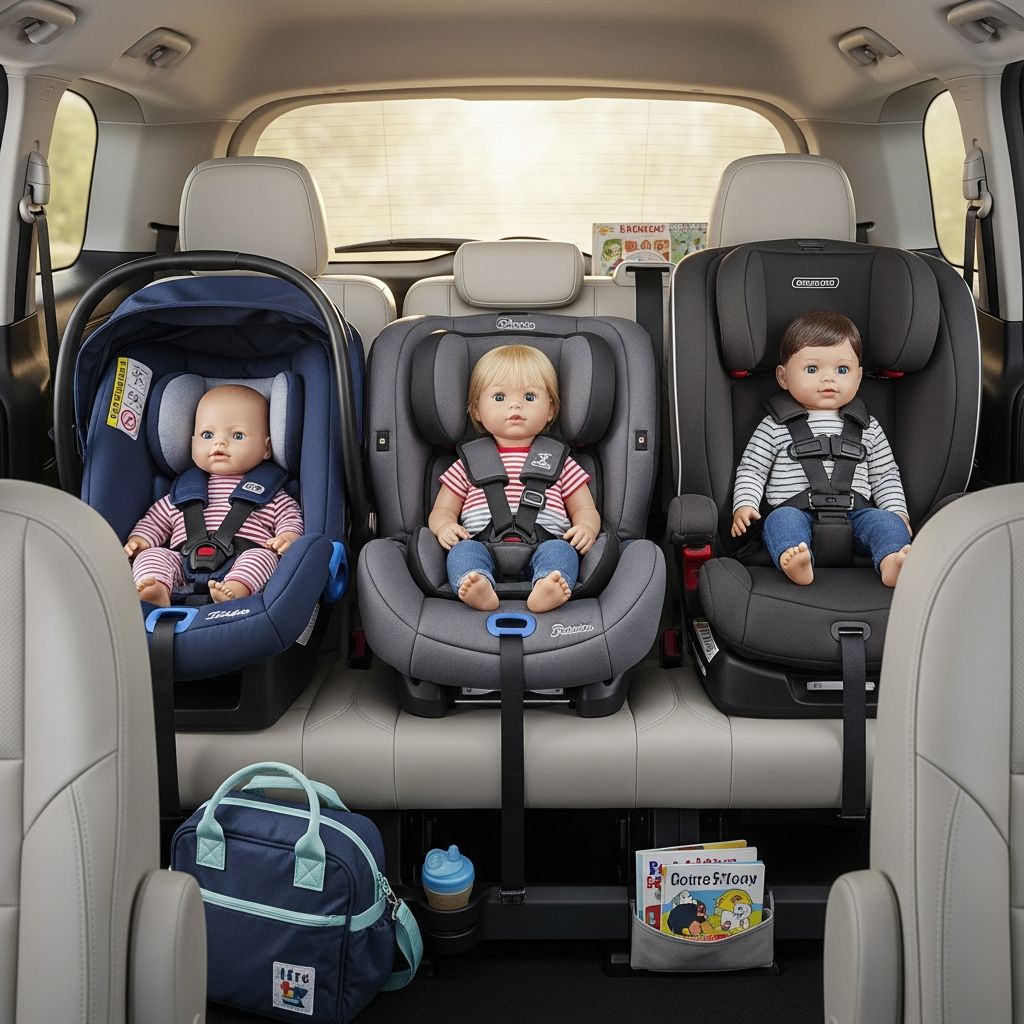
Adding a new baby to the family is exciting, but it quickly becomes a logistical puzzle when you realize you may need to fit three car seats across one back seat. Many parents discover this only after the baby arrives or when it is time to upgrade a toddler to a new seat, and suddenly the back row feels impossibly small. This guide walks you through how to make three-across setups safer, more comfortable, and less stressful.
Why Three-Across Feels So Hard
Modern car seats are safer than ever, but that often means deeper shells, higher sides, and extra padding that take up more space. Vehicle seats, on the other hand, have not grown wider at the same pace. When you put these trends together, simply clipping three seats in a row can feel like trying to solve a sliding-tile puzzle that never quite lines up.
The good news is that with careful planning, realistic expectations, and some trial-and-error, many families can make three-across arrangements work—even in smaller vehicles. The key is to think of the entire system: kids, seats, and car.
Step One: Understand Your Car Seat Types
Before diving into layouts and measurements, it helps to know what you are working with. There are several main categories of child restraints, each with different shapes and space needs.
- Rear-facing only infant seats: Typically used from birth until around 1 year and/or the seat’s height and weight limits. They click in and out of a base and often have tall handles and deep shells.
- Convertible seats: Can be used rear-facing for infants and toddlers, then turned forward-facing later. Some are very bulky front-to-back, but there are also narrow, three-across-friendly models.
- Forward-facing harness seats: These have a five-point harness and usually stay installed in the car. They can be narrower than infant seats but often sit high on a base.
- Booster seats: Use the vehicle’s seat belt rather than a built-in harness. Backless boosters can be very compact but may be harder for kids to buckle independently if they are squeezed between two larger seats.
- All-in-one or 3-in-1 seats: Designed to last from infancy through booster stage. Very convenient, but many are large and may not be ideal for tight three-across setups.
Step Two: Measure Your Real Space
Many parents look up seat widths online, only to discover that the numbers do not tell the whole story. What matters is the usable width of your back seat and how the contours of the vehicle affect that width at different heights.
- Measure the width of the back seat cushion from door to door at the points where car seat bases will rest.
- Check the width a few inches above the cushion; door handles and trim may intrude on shoulder space.
- Look for seat belt anchors, buckle stalks, and LATCH anchors and note their positions relative to each seating position.
- Confirm whether any seating position is too narrow or oddly shaped for a base to sit flat.
Use a simple tape measure and write your numbers down. Those figures will guide which seats and arrangements have any chance of working before you begin wrestling with plastic shells and tangled straps.
Common Three-Kid Configurations
Families rarely have three children at the exact same stage. Instead, the puzzle usually involves a mix of newborns, toddlers, preschoolers, and early elementary kids. Here are some typical scenarios that drive the three-across challenge.
- Two older kids in forward-facing harnesses and a new baby in a rear-facing infant seat.
- One child in a high-back booster, one in a forward-facing harness, and one rear-facing toddler.
- Twins or close-in-age toddlers both rear-facing, plus an older sibling in a booster or harnessed seat.
- Triplets or three children less than three years apart, all needing full harnessed protection.
In each scenario, age and stage recommendations still come first. Do not move a child to a booster or forward-facing position too early simply to make more room; instead, use configuration strategies and seat choices to protect each child appropriately.
Strategic Seat Placement
Once you understand the children’s needs and the space you have, you can decide where each child will sit. It helps to think in terms of both safety and logistics.
Safety Considerations
- Back seat over front seat: Children are safest in the back seat; three-across should always be in a rear row when possible.
- Middle seat priority: The middle position is often considered slightly safer in many vehicles because it is further from side impacts. If one child is still very young or medically fragile, many parents prefer to place that seat in the center.
- Installation quality: The safest seat is the one installed correctly every time. Prioritize solid installation over squeezing a seat into the theoretical “safest” position if it compromises security.
Daily Practicality
- Place the most frequently buckled child (often a rear-facing baby) on the side where you usually park.
- Give a more independent, older child the tightest access spot; they are more likely to climb in and buckle themselves with a bit of guidance.
- Think about school drop-offs and carpool: Which child needs to exit quickly on the curb side?
Harness vs. Booster in Tight Spaces
Parents often wonder whether switching an older child from a harnessed seat to a booster will free up space. The answer depends on the specific seats and vehicle, but there are some general patterns.
| Aspect | Harnessed Seat | Booster Seat |
|---|---|---|
| Width | May be similar or slightly wider, depending on model | High-back boosters can be narrow; backless boosters often narrowest |
| Buckling | Adult buckles harness once; no need to access vehicle buckle each ride | Child must reach the vehicle buckle every ride, which can be hard when squeezed between seats |
| Age/Stage Suitability | Best for preschoolers and younger school-age children who still need extra support | Suitable only when the child can sit correctly 100% of the time and meets height and weight guidelines |
| Stability in Three-Across | Usually more stable; less likely to tilt when nearby seats are installed tightly | Can shift or lean if wedged, especially backless boosters |
In many three-across situations, keeping an older child in a narrow harnessed seat a little longer actually makes daily life easier, because you are not fighting to reach buried buckles between seats.
Narrow Seats and Staggered Installations
Seat shape matters more than the number on a spec sheet. Some seats flare widely at the top while remaining narrow at the base, which can allow them to overlap gently with a neighbor. Others are blocky and do not “puzzle” well next to anything.
Two useful concepts for maximizing space are:
- Narrow-profile seats: These are specifically designed with slim shells and low-profile armrests or cup holders. They can be game-changers for three-across setups.
- Staggered or “puzzled” configurations: One seat may sit slightly higher or lower than its neighbor, allowing them to overlap like pieces of a jigsaw rather than competing for identical horizontal space.
Using LATCH vs. Seat Belt in Three-Across
In many vehicles, the lower anchors for LATCH are available only for the outer positions or for specific paired spots. When trying to fit three across, you might gain more flexibility by using the vehicle’s seat belt instead of LATCH for one or more seats, as long as you follow all instructions.
- Seat belt installation often allows more side-to-side adjustability than fixed LATCH anchor spacing.
- LATCH has weight limits; larger kids in forward-facing seats or boosters typically need seat belt installation anyway.
- Never “double up” on a single set of anchors or buckle two children into one belt; each child must have their own dedicated restraint and belt path.
Always check both the vehicle manual and the car seat manual before deciding which installation method to use in each position.
Testing a Three-Across Setup Before Committing
Trying to figure out three-across after you have brought everything home is a recipe for frustration. If possible, test-fit seats in your actual vehicle before making final purchase decisions.
- Bring your measurements and a list of candidate seats to the store.
- If allowed, take display seats to your car and test various combinations.
- Check that each seat can be installed independently according to its instructions, not just crammed in by pressure from the others.
- Practice buckling and unbuckling every child; theoretical fits do not always translate into usable daily setups.
Consider visiting a certified child passenger safety technician (CPST) if available in your area; they can often suggest configurations you may not have considered.
Signs Your Setup Is Not Safe Enough
A three-across arrangement is only successful if it stays safe and practical day after day. Watch for these red flags that may mean it is time to rethink your configuration or upgrade your equipment.
- Car seats shift more than an inch side-to-side or front-to-back at the belt path when pulled firmly.
- Booster buckles are so buried that you or your child must twist or partially unbuckle a neighboring seat to reach them.
- Seat belts or harness straps are routed around armrests, handles, or other parts in ways not shown in the manual.
- A door is difficult to close because a seat shell or handle is pressing into it.
- Kids are regularly riding with loose harnesses or misrouted belts because correct buckling is too difficult in the tight spacing.
When to Consider a Different Vehicle
Many families successfully manage three across in compact cars, but there are situations where a different vehicle—or at least a different seating row—may be the most realistic solution.
- You have three children who will all need rear-facing or forward-facing harnessed seats for several years.
- Your current vehicle has a very narrow or heavily contoured back seat with limited headroom.
- You frequently transport additional children or carpool and need flexible seating more days than not.
A second row of captain’s chairs in a minivan or three true full-size seats in an SUV can dramatically ease three-kid logistics. If a vehicle change is not possible, focusing on the narrowest compatible seats and expert installation support becomes even more important.
Practical Tips to Make Daily Life Easier
Even after solving the puzzle on paper, everyday life with three kids in the back seat can feel chaotic. Small tweaks can improve comfort and routine.
- Use simple seat protectors approved by the car seat manufacturer to help catch crumbs and spills, but avoid thick pads that interfere with installation.
- Establish a clear loading and unloading order (for example: older child climbs in first, buckles; parent then buckles middle child; baby goes in last).
- Teach older kids consistent rules about staying seated, not leaning over siblings, and waiting for an adult to confirm that belts are correct.
- Keep frequently used items—like wipes, water, or pacifiers—in a door pocket or seat-back organizer to reduce contortions while everyone is strapped in.
SEO-Friendly FAQs About Three Car Seats in One Row
Can three car seats fit in a small car?
In many cases, yes. Success depends on the exact width of your back seat, the shapes of the car seats, and how they puzzle next to each other. Using narrow-profile seats, installing at least one seat with the vehicle seat belt, and experimenting with which child sits where can make three-across workable even in a compact car.
Is it safe to put the baby in the middle seat?
The center position can be an excellent place for a rear-facing seat as long as it can be installed according to the car seat and vehicle instructions. The seat must not tip, rock, or rely on the pressure of neighboring seats to feel secure. If you cannot achieve a solid installation in the center, it is safer to use an outboard position with a correct install than to fight with a marginal center setup.
Should my older child move to a booster to make more room?
Only move a child to a booster when they are developmentally ready and meet all age, height, and weight requirements for that type of restraint. A narrow harnessed seat can sometimes be easier in a tight row because the adult controls the harness, and the child does not need to reach a buried seat belt buckle every ride.
Can I let a child share a seat belt with a sibling in the middle?
No. Each child must have their own seating position and their own properly used seat belt or harness. Sharing belts, doubling up in one seat, or improvising with aftermarket gadgets that are not crash tested as part of the seat’s system can significantly increase the risk of injury.
How do I know if my three-across setup is correct?
Each seat should move less than an inch at the belt path when tugged firmly, every harness should be snug at the shoulders, and every seat belt or LATCH strap should be routed exactly as shown in the manuals. Nothing should be twisted, woven through armrests, or forced into strange angles. When in doubt, schedule a check with a certified child passenger safety technician who can review your installation in person.
Balancing Safety, Budget, and Sanity
Fitting three children safely in one row is not just a question of buying the narrowest seat on the shelf. It involves understanding each child’s needs, respecting safety guidelines, knowing the limitations of your vehicle, and accepting that some level of compromise and experimentation is part of the process. With patience, a tape measure, and a willingness to rearrange a few times, most families can build a three-across solution that protects their kids and keeps daily life manageable.