Deciding when to allow children to stay home without adult supervision marks a significant milestone in parenting. This transition fosters independence while requiring careful preparation to prioritize safety. Factors like emotional maturity, practical skills, and home environment play crucial roles in determining readiness. Parents must evaluate these elements systematically to minimize risks associated with being unsupervised.
Assessing Your Child’s Readiness for Independence
Every child develops at a unique pace, making age alone an insufficient indicator for leaving them home alone. Maturity levels vary widely, so parents should observe specific behaviors and abilities. Key indicators include the ability to follow instructions reliably, manage emotions during stressful situations, and demonstrate basic self-care skills.
- Emotional Resilience: Does the child remain calm when faced with unexpected events, such as a power outage or strange noises?
- Responsibility in Routines: Can they complete homework, prepare simple meals, and maintain a tidy living space without reminders?
- Decision-Making: Have they shown good judgment in past situations, like handling peer pressure or minor conflicts?
Guidelines from child safety experts suggest that children under 8 years old generally should not be left alone for extended periods due to limited cognitive and physical capabilities. For ages 8-10, brief periods not exceeding three hours may be appropriate if other criteria are met. By age 12, many children can manage a few hours independently with proper training, though overnight stays remain inadvisable without further evaluation.
| Age Group | Recommended Max Unsupervised Time | Key Readiness Checks |
|---|---|---|
| Under 8 | None extended | Basic self-care only |
| 8-10 | Up to 3 hours | Follows rules, knows emergencies |
| 11-12 | Few hours | Handles routines independently |
| 13+ | Extended with rules | Mature judgment, first aid knowledge |
This table summarizes general benchmarks; individual assessment trumps generalizations. Start with short trials, such as running errands for 15-30 minutes, gradually increasing duration while monitoring compliance.
Securing the Home Environment
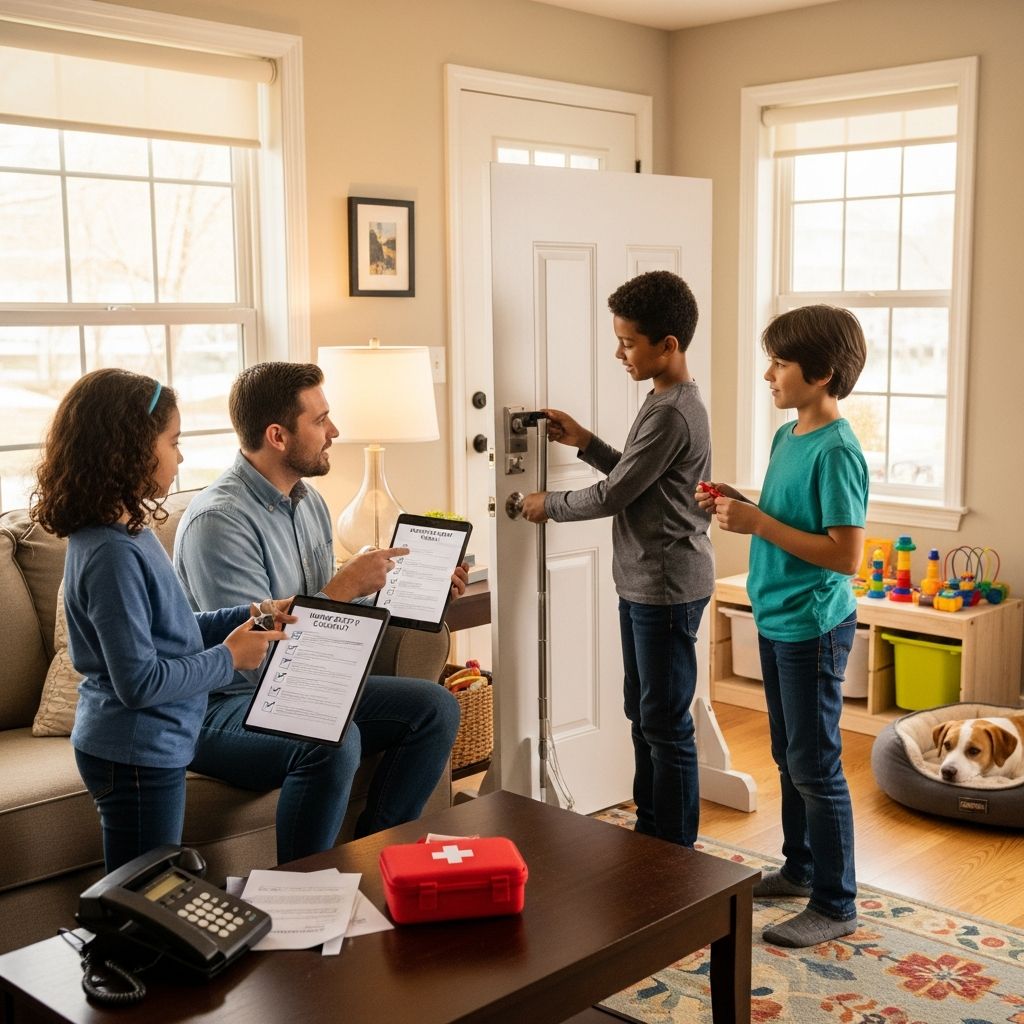
A safe physical space forms the foundation for successful home-alone experiences. Conduct a thorough home audit to identify and mitigate hazards. Lock away items that pose immediate dangers, ensuring children cannot access them impulsively.
- Store firearms, ammunition, sharp tools, and blades in secured cabinets or safes.
- Relocate household chemicals, medications, and cleaning supplies to high shelves or locked storage.
- Install covers on unused electrical outlets and verify smoke alarms function on every level, especially near bedrooms and kitchen areas.
Locate flashlights with fresh batteries and ensure children know their locations for power failures. For kitchen use, limit activities to no-cook options like sandwiches or pre-made items for younger children, reserving stovetop use for those demonstrating proficiency. Smartphones or tablets equipped with first aid apps provide quick guidance for minor injuries.
Developing a Robust Emergency Response Plan
An effective emergency plan empowers children to act decisively. Practice scenarios repeatedly through role-playing to build muscle memory. Post a visible list including 911, parental contacts, neighbors, and trusted adults.
Outline clear steps:
- Immediately exit for fires or smoke, using two escape routes per room.
- Call emergency services from a safe location, providing precise address and details.
- For medical issues, assess severity using first aid knowledge before contacting help.
Draw home maps highlighting exits, fire extinguishers, and safe meeting points outside. Role-play door knocks, phone calls from strangers, and injury simulations to reinforce protocols.
Establishing Clear Rules and Communication Protocols
Explicit rules prevent misunderstandings and promote accountability. Discuss and agree on boundaries collaboratively, posting them prominently.
- No Visitors: Friends over only with prior permission; never admit strangers or intoxicated individuals.
- Check-Ins Mandatory: Call or text upon arriving home, before leaving (if allowed), and at set intervals.
- Phone Etiette: Ignore unknown callers; never reveal being alone. Say parents are unavailable.
- Travel Restrictions: Stick to approved routes from school; no unscheduled outings.
Implement a daily schedule incorporating homework, chores, and limited screen time to structure the afternoon productively. Use alarms or apps for reminders if needed.
Building Practical Life Skills
Beyond safety, equip children with skills for self-sufficiency. Teach phone operation, basic first aid, door peephole use, and alarm system activation. Practice giving home directions for emergencies and recognizing suspicious circumstances, like open doors or broken windows—do not enter and call adults immediately.
Encourage carrying a house key securely (not under mats) and knowing how to operate locks. For older kids, introduce budgeting snacks or simple budgeting if errands are permitted.
Addressing Common Fears and Emotional Aspects
Fear of isolation or noises can undermine confidence. Validate concerns and desensitize through preparation. Teach investigating sounds from safe vantage points without exiting; call parents or police if uneasy.
Monitor for anxiety signs post-trials, adjusting pace accordingly. Praise successes to reinforce positive independence growth.
Frequently Asked Questions
What is the minimum age for leaving a child home alone?
No universal law exists, but experts advise against it for children under 8 for extended times, starting short periods around 11-12 based on maturity.
Can children cook when home alone?
Limit to microwave or no-heat for younger ones; supervised practice for stoves. Ensure working smoke detectors.
What if someone knocks on the door?
Never open it. Check peephole/window, ignore if unknown, or call parents/police if persistent.
Should kids answer the phone?
No for unknowns; let voicemail handle. On cells, ignore unrecognized numbers.
How do I start preparing my child?
Begin with brief absences, role-play emergencies, set rules, and secure home gradually.
Long-Term Benefits of Supervised Independence
Gradual home-alone exposure cultivates responsibility, problem-solving, and self-reliance—skills vital for adulthood. Parents report increased trust and family communication. Monitor progress, revisiting rules as children age. Consult local laws, as some regions set minimum ages (e.g., Illinois 14).
(Word count: 1678)
References
- Safety Steps to Follow if Kids are Home Alone — American Red Cross. 2023-06-15. https://www.redcross.org/about-us/news-and-events/news/Red-Cross-Offers-Safety-Tips-For-When-the-Kids-Are-Home-Alone.html
- 7 Safety Rules for Kids at Home Alone — Scholastic. 2024-01-10. https://www.scholastic.com/parents/family-life/social-emotional-learning/social-skills-for-kids/7-safety-rules-kids-home-alone.html
- Staying Home Alone — Nationwide Children’s Hospital. 2025-03-20. https://www.nationwidechildrens.org/research/areas-of-research/center-for-injury-research-and-policy/injury-topics/home-safety/staying-home-alone
- Home Alone Handbook: Is Your Child Ready? MP571 — University of Arkansas Extension. 2022-11-05. https://www.uaex.uada.edu/life-skills-wellness/personal-family-well-being/MP571.pdf
- Home alone: a parent’s guide — King County, Washington. 2024-09-12. https://kingcounty.gov/en/dept/sheriff/courts-jails-legal-system/crime-prevention-safety/kids-teens/home-alone
- School’s Out Safety Tips for Parents — City of St. Paul. 2023-05-18. https://www.stpaul.gov/sites/default/files/Media%20Root/Police/kids%20safety%20summer.pdf
- “Home Alone” Child Tips — Prevent Child Abuse America. 2021-08-01. https://preventchildabuse.org/images/docs/homealonechildtips.pdf