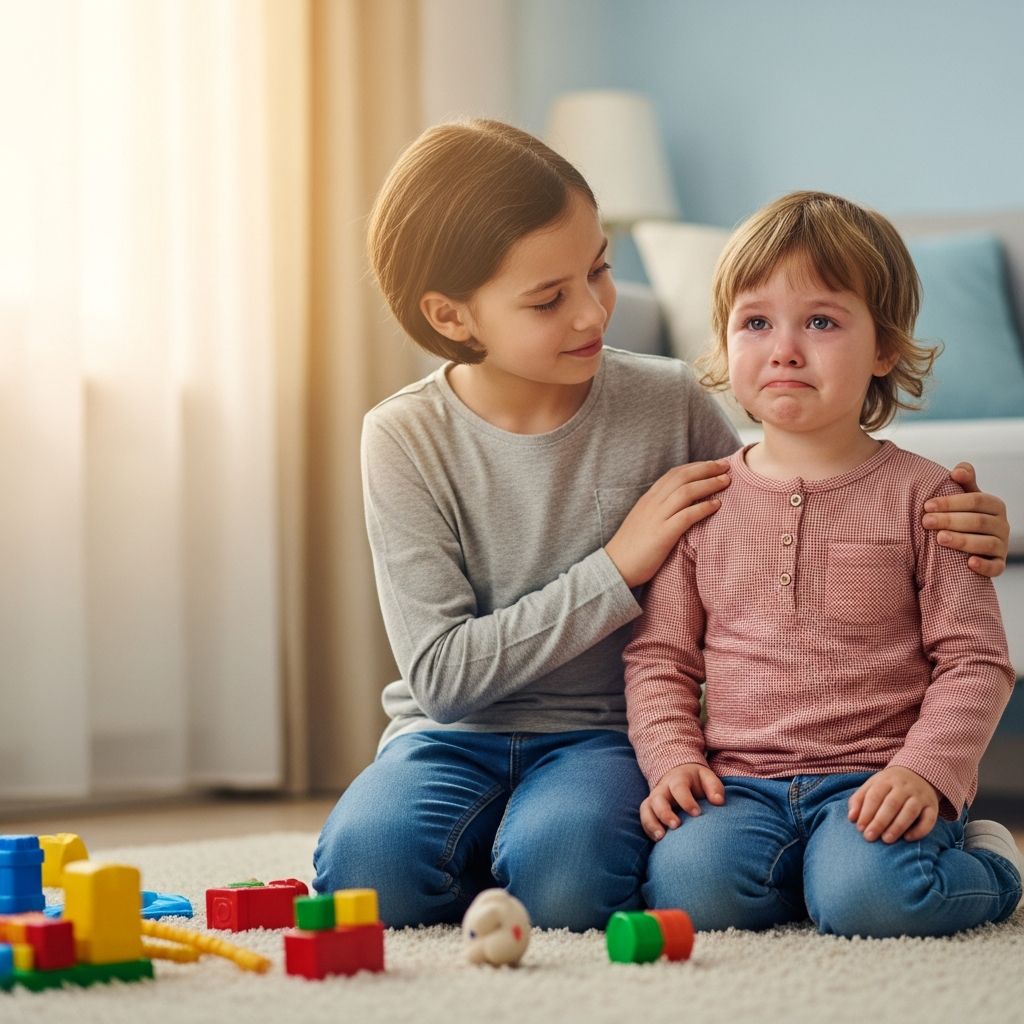
When a younger child hits, bites, or screams at an older sibling, parents often feel torn. You want to protect your older child, but you also know the younger one is still learning how to handle overwhelming feelings. It is possible to keep everyone safe, honor both children’s emotions, and teach real-life conflict skills that last.
This article offers a practical roadmap to help you coach your older child through these tough moments, reduce resentment, and create a home where siblings learn cooperation instead of constant rivalry. All strategies are designed to protect the bond between siblings while preserving everyone’s dignity.
Why Younger Siblings Often Act Aggressively
Before you can coach an older sibling, it helps to understand what is happening inside the younger child. Most young children do not yet have the impulse control, language, or perspective-taking abilities needed to express frustration calmly. Aggression is often a clumsy attempt to communicate big feelings.
- Developmental immaturity: The younger child’s brain is still under construction, especially in areas responsible for self-control, problem-solving, and empathy.
- Intense emotions with few words: Overwhelm, jealousy, fatigue, or hunger can quickly turn into hitting, pushing, or screaming when a child cannot yet express their needs clearly.
- Fear of losing connection: A new baby or a more capable older sibling can stir up fears of being left out, replaced, or less loved, which sometimes show up as aggression.
- Copying what they see: If a child sees yelling, grabbing, or harsh reactions from adults or media, they may imitate those behaviors with their siblings.
Seeing younger children’s aggression as a communication attempt does not mean excusing it. Instead, it guides you to respond in a way that is firm about safety and gentle about emotions.
The Hidden Impact on Older Siblings
Older siblings may appear patient or mature, but repeated aggression from a younger child can slowly erode their sense of safety and fairness. When their feelings are minimized, they may begin to withdraw, copy aggressive behavior, or lash out in return.
- Resentment and hurt: If the older child hears “You’re bigger; just let it go” too often, they may feel unprotected and less valued.
- Role confusion: Some older siblings take on a mini-parent role, trying to manage every conflict, which creates pressure and burnout.
- Acting out later: When an older child is expected to endlessly “understand” while the younger one hits, they may eventually explode in anger or seek control in other ways.
Your goal is not to make the older child endlessly tolerant; instead, you want to help them set healthy boundaries while still nurturing compassion and connection.
Parent Mindset: Guardrails, Not Guilt
How you think about these conflicts shapes how you respond. Rather than viewing yourself as a referee who must assign blame, imagine yourself as a coach putting guardrails around your children so they can learn safely.
- Protect both children equally: The younger one needs support to regulate, and the older one needs protection and validation.
- Focus on skills, not villains: Instead of “Who started it?” think “What skill is missing here—self-control, words, problem-solving, empathy?”
- Expect repetition: Skill-building takes time. Repeated conflicts do not mean failure; they are practice opportunities.
This mindset keeps you calm and clear, even when emotions in the room are loud.
Immediate Safety: What To Do In The Moment
When a younger child is aggressive, your first priority is to stop harm. Do this swiftly but gently, showing both siblings that you are in charge of safety, not punishment.
Step-by-step emergency response
- Move your body between them. If possible, physically block another hit or push by stepping in and using your arm as a soft barrier.
- Use a calm, low voice. Name what you see: “I see hitting. I’m going to stop your hands.” Keep words simple and neutral.
- Secure safety. Gently hold the younger child’s hands if needed, or move one child a few steps away to prevent more harm.
- Check on the older child. A quick “Are you hurt?” or “Let me see your arm” shows protection and care.
Once the immediate risk has passed, shift your focus toward coaching instead of lecturing.
Coaching the Older Sibling: Foundation Skills
Your older child is not responsible for the younger one’s behavior, but they can learn powerful skills that protect their own boundaries and model healthier conflict navigation. Think of these tools as a small starter kit you repeatedly practice together.
Core skills to teach
- Clear boundary statements: Short, confident phrases that say what is and is not okay.
- Stepping away: Knowing when to leave a situation before it escalates.
- Calling in an adult: Understanding that getting help is wise, not tattling, when safety is at risk.
- Emotional naming: Putting words to their own feelings: “I feel scared when you hit,” “I feel mad when my game is grabbed.”
These skills help your older child feel less helpless and more empowered without resorting to revenge or cruelty.
Sample Boundary Phrases For Older Siblings
Many children need concrete language to use in the heat of the moment. Practicing these phrases during calm times—through role play or even silly dramatizations—makes it more likely they will remember and use them later.
| Situation | Example phrase |
|---|---|
| Younger child is hitting or kicking | “No hitting. My body is not for hurting.” |
| Younger child grabs a toy or game | “I’m using this. You can have a turn when I’m done.” |
| Younger child screams very close to their face | “That’s too loud for me. I’m stepping away now.” |
| Older child feels unsafe | “I’m not safe. I’m going to tell Mom/Dad now.” |
| Older child wants to exit the game | “I don’t want to play this anymore. I’m taking a break.” |
Over time, encourage your child to tweak these phrases so they sound natural in their own voice.
How To Support Without Blaming
It is easy to fall into speaking as if the older child must always yield, because they are bigger or more capable. A more balanced approach reassures your older child that you are on their side and that the younger sibling is still learning.
- Validate first: Start by acknowledging the older child’s experience: “You didn’t like being hit. That was scary and not okay.”
- Reinforce their rights: Clearly state that no one is allowed to hurt them, not even a younger sibling.
- Separate behavior from worth: Talk about the younger child’s actions (“hitting”) rather than labeling them as a “bully” or “bad kid.”
When both children feel seen and valued, they are more open to learning better ways to interact.
Teaching The Younger Child Peaceful Alternatives
While this article focuses on coaching the older sibling, you also need to actively teach the younger child safer, kinder ways to get what they need. This often involves repeating simple steps again and again.
- Label the feeling: “You were mad that your brother had the toy.”
- State the limit: “Hitting hurts. I will not let you hit.”
- Offer the words: “You can say, ‘My turn, please?’ or ‘Can I have it when you’re done?’”
- Practice right away: Gently rehearse the phrase with the younger child, even if the conflict is over.
This pattern slowly wires a new pathway: from feeling overwhelmed to using words and waiting, instead of using hands or teeth.
Guided Problem-Solving Conversations
Once everyone is calm, a short, structured problem-solving conversation allows both siblings to share their perspectives and brainstorm solutions. Keep it simple and brief, especially for younger children.
Four-part problem-solving template
- Each child shares their view. Give each sibling a turn, without interruption, to describe what happened in their own words.
- Reflect and translate. Repeat each child’s main point back to them, using calmer language if needed.
- Ask for ideas. Invite the children to suggest solutions: “What could we do next time so no one gets hurt?”
- Choose and restate. Help them pick a solution and say it out loud so both know the new plan.
This approach teaches siblings that their voices matter and that problems are solvable without attacking one another.
Common Parent Pitfalls (And What To Try Instead)
Even the most loving parents can accidentally make sibling conflicts worse. Recognizing these patterns helps you shift toward responses that build long-term trust and cooperation.
| Unhelpful habit | More helpful alternative |
|---|---|
| Automatically siding with the younger child because they’re “little” | Listen briefly to each child; validate both, then focus on solutions instead of blame. |
| Ordering the older child to “be the bigger person” every time | Allow the older child to hold boundaries and keep favorite items safe, while still encouraging kindness. |
| Yelling or punishing harshly in the heat of the moment | Pause, ensure safety, then address behavior with calm limits and teaching once everyone is regulated. |
| Labeling: “You’re the troublemaker,” “You’re the good one” | Describe actions instead: “You hit when you were mad,” “You asked for help when you felt unsafe.” |
| Forcing apologies immediately | Encourage genuine repair later, after feelings are heard and the child is calm enough to understand. |
Daily Habits That Reduce Future Aggression
Conflicts will never disappear entirely—nor should they. Children learn negotiation, empathy, and self-advocacy by working through disagreements. However, certain everyday habits can significantly reduce the intensity and frequency of aggressive episodes.
- Individual connection time: Spend short, dedicated periods regularly with each child doing something they genuinely enjoy. Even ten minutes of distraction-free attention can lower competition.
- Predictable routines: Children who know what to expect—mealtimes, playtimes, rest times—have fewer meltdowns triggered by surprise transitions.
- Clear family rules: Establish a few simple rules like “No hurting bodies,” “Use words,” and “Ask before taking,” and review them often in playful ways.
- Modeling calm conflict: Let your children overhear you and another adult disagree respectfully so they see how problems can be solved without yelling or hitting.
These small, steady practices create a home climate where cooperation is more likely and aggression has less space to grow.
FAQs About Coaching Older Siblings
Is it fair to expect my older child to be more patient?
Older children usually do have more skills, so they can handle slightly more responsibility, like using words instead of pushing back. But fairness does not mean the older child must always sacrifice their needs. Balance is key: protect your older child’s right to safety and space while gently encouraging them to practice patience in age-appropriate ways.
What if my older child starts hitting back?
This is a signal that they feel unprotected or overwhelmed. Address both behaviors without singling one child out as the sole problem. Later, talk privately with your older child about other options—stepping away, using boundary phrases, or calling you—and make clear that you are committed to keeping them safe so they do not feel forced to defend themselves with aggression.
Should I separate them whenever they fight?
Immediate separation is helpful if safety is at risk or emotions are so intense that no one can think clearly. However, always aim to circle back for a brief repair conversation, even if it’s just a few sentences. Repeatedly separating without guidance can stop the behavior in the moment but does not teach better ways to handle conflict.
How do I stop my younger child from always being the “aggressor”?
Remember that labels easily become self-fulfilling. Instead of thinking of your younger child as “the aggressive one,” see them as a learner who needs extra coaching in emotional regulation. Support them with predictable routines, chances to move their body, language for feelings, and repeated practice of asking for turns and tolerating “no.”
What if I lose my temper when they fight?
Every parent eventually has a moment they wish they could redo. Repair is powerful. After you calm down, briefly acknowledge your reaction, restate the family rules about safety, and share what you will try next time. You are modeling that even adults make mistakes and can choose better responses in the future.
Building A Sibling Team, Not Opposing Sides
When a younger child is aggressive, it is easy to fall into a cycle of constant policing and punishment. Shifting toward coaching your older child, teaching your younger one emotional tools, and protecting both children with clear, consistent limits creates a different story—one in which siblings are teammates learning life-long skills together.
Over time, your calm presence, fair boundaries, and steady guidance weave a powerful lesson: in this family, everyone’s feelings matter, everyone’s body is safe, and conflicts are chances to grow closer, not further apart.