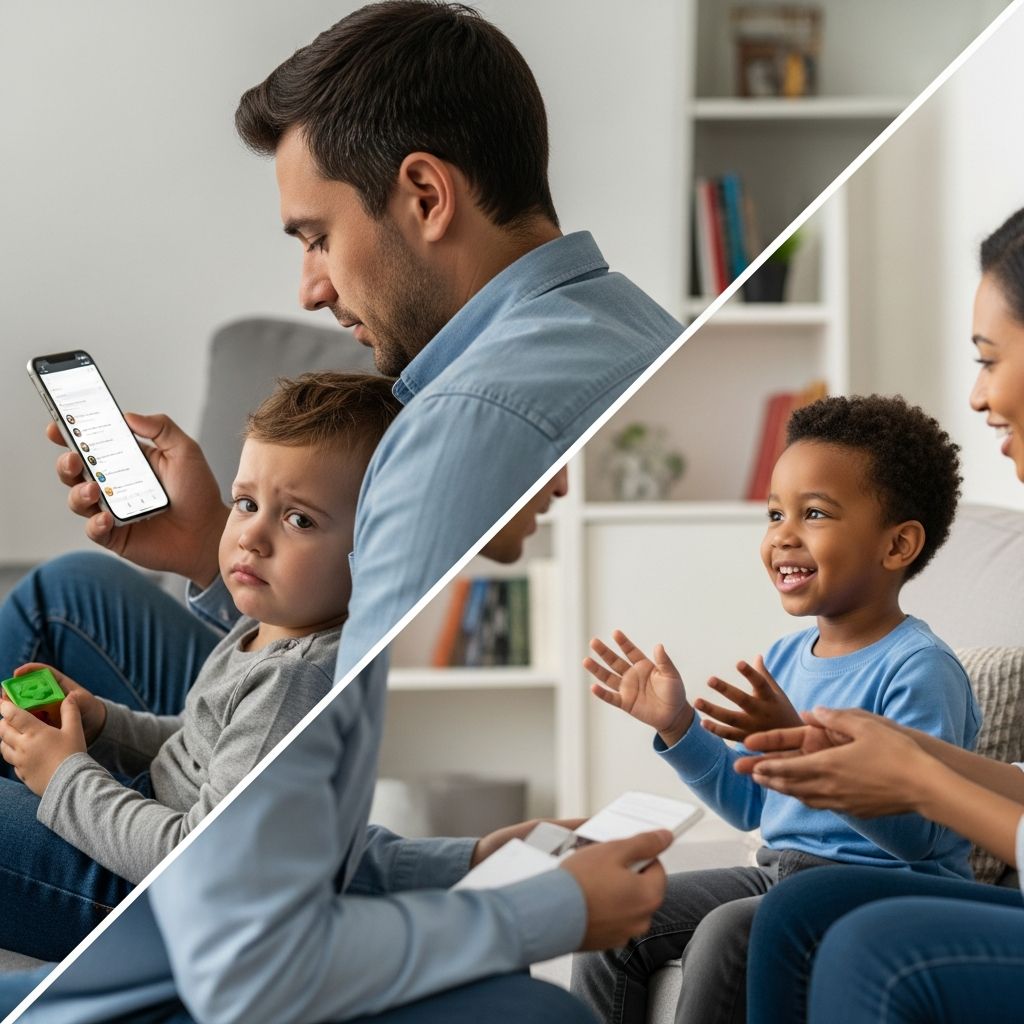
Young children’s language abilities form the foundation for future learning, social bonds, and academic success. Yet, in our screen-saturated world, parents’ frequent smartphone engagement during interactions with toddlers can disrupt this critical process. Studies reveal that even brief diversions to devices cut down meaningful conversations, directly correlating with poorer vocabulary growth and comprehension in kids under age three.
The Hidden Cost of ‘Phubbing’ in Family Moments
When caregivers check notifications or scroll feeds while with their little ones, they engage in ‘phubbing’—a blend of ‘phone’ and ‘snubbing.’ This behavior slashes the quantity and quality of words directed at children. A key study tracked real-world home interactions and found maternal cell phone use tied to a 16% drop in infants’ speech exposure overall. Such reductions compound over time, as toddlers thrive on repetitive, responsive dialogue to master sounds, words, and grammar.
Brain development hinges on these back-and-forth exchanges. Infants as young as six months parse parental speech patterns to build neural pathways for language. Distractions fragment this input, leaving gaps that hinder expressive skills like naming objects or forming sentences. Researchers observing parent-child play sessions noted that device-diverted adults spoke 20-30% fewer child-appropriate phrases, mimicking effects of reduced reading or singing routines.
Screen Exposure: Direct Hit to Toddler Talk
Beyond parental use, handing devices to children for passive viewing amplifies risks. Data from large cohorts of two- and three-year-olds show that one hour or more of daily mobile screen time links to significantly lower language scores. Kids exceeding two hours scored 0.48 points worse on comprehension scales (0-14 range), even after accounting for family income, education, and home literacy practices.
This association holds for both understanding spoken words and producing them. Children with high device time faced higher odds of delays: odds ratios climbed for comprehension difficulties (adjusted models) and expressive shortfalls. Unlike brief exposure under 60 minutes, which showed no harm, prolonged sessions displaced vital activities like joint play or storytelling.
| Daily Mobile Screen Time | Language Comprehension Impact (B-coefficient) | Expressive Skills Impact (B-coefficient) |
|---|---|---|
| 0 hours (reference) | 0 | 0 |
| 1-2 hours | 0.28 (95% CI: 0.05, 0.51) | 0.42 (95% CI: 0.20, 0.64) |
| >2 hours | 0.48 (95% CI: 0.23, 0.73) | 0.35 (95% CI: 0.10, 0.60) |
Table notes: Adjusted for sociodemographics and home factors. Positive values indicate poorer outcomes.
Why Devices Disrupt Language Wiring
Young brains prioritize live, contingent interactions over digital ones. Screens present ‘video deficit’—kids under 24 months struggle to extract lessons from 2D displays, generalizing poorly to real life. Time on apps or videos supplants face-to-face talk, where caregivers mirror emotions, expand utterances, and provide context.
- Displacement effect: Each minute on a tablet means one less for responsive dialogue.
- Attention split: Parents on phones deliver fragmented speech, lacking the prosody toddlers crave.
- Passive vs. active: Watching shows yields fewer words than cooing games or book-sharing.
Neuroimaging supports this: face-to-face exchanges activate broader language networks than screen viewing. By age two, average screen time nears two hours daily—double book exposure—yet correlates inversely with vocabulary size.
Parental Tech Habits Under the Microscope
It’s not just child screens; moms’ and dads’ device dips matter too. Emerging research spotlights ‘technoference’—tech intrusions into quality time. In observed families, high parental smartphone use during meals or play cut infant-directed speech by notable margins, echoing findings across cultures from Saudi Arabia to Scandinavia.
One analysis of preschoolers linked caregiver phone proximity to heightened language delay rates: 59.6% among heavy smartphone-exposed kids vs. 51.7% in low-exposure groups. Factors like parental education didn’t fully offset these trends, underscoring universal vulnerability in early years.
Signs Your Child’s Language May Be Lagging
Spot early red flags to intervene promptly. By 12 months, most babble with intonation and say 1-3 words. At 18 months: 10-20 words, simple gestures. Two-year-olds combine two words (‘more milk’), follow two-step directions. Three-year-olds use sentences, tell stories.
- No single words by 16 months.
- Fewer than 50 words by 24 months.
- No two-word phrases by 30 months.
- Difficulty following simple instructions.
- Limited eye contact or pointing during talk.
If delays appear, consult pediatricians. Tools like the MacArthur-Bates Communicative Development Inventories gauge progress accurately.
Proven Fixes: Reclaim Conversation Time
Fortunate news: Small shifts yield big gains. Frequent reading buffers screen harms, slashing comprehension delay risks. Aim for 15-20 minutes daily of interactive books—point, question, repeat.
- Set phone-free zones: Meals, baths, bedtimes demand undivided attention.
- Model mindful tech: Narrate actions (‘I’m putting phone away to play blocks!’).
- Boost live input: Sing nursery rhymes, describe daily routines richly.
- Curate screens wisely: Limit to educational, joint viewing like video chats with kin.
- Track and tweak: Use apps to monitor family device time; cap under AAP’s one-hour toddler guideline.
Quality trumps quantity: Video calls with grandparents can enrich vocabularies if interactive. Educational e-books with discussion outperform solo swiping. One study affirmed social media use offsets passive viewing downsides when paired with real talk.
Age-Specific Strategies for Lasting Gains
Infants (0-12 Months)
Prioritize skin-to-skin, eye-level coos. Silence notifications; respond instantly to gurgles. Black-and-white contrasts aid visual speech cues pre-six months.
Toddlers (1-3 Years)
Expand one-word bursts into phrases (‘Yes, big red ball rolls fast!’). Play turn-taking games mimicking conversation flow. Avoid background TV, which dilutes focus.
Preschoolers (3-5 Years)
Encourage storytelling; ask ‘What happens next?’ Limit fast-paced shows favoring narrative ones. Co-view apps, pausing to discuss plots.
Family Policies That Stick
Co-create ‘device diets’: Family baskets at dinner, ‘tech timeouts’ pre-bed. Reward talk-filled evenings with stickers. Track progress via journals: Note daily words added, interactions savored.
Schools and clinics reinforce: Programs teaching ‘media mentoring’ empower parents. Policymakers eye guidelines, as ubiquitous devices demand proactive education.
Frequently Asked Questions
Does all screen time harm language?
No—passive viewing over one hour daily risks delays, but interactive video chats or co-read e-books support growth when under limits.
Can reading counteract phone effects?
Yes, regular storytime buffers comprehension issues from screens, though it aids understanding more than expression.
What if both parents work remotely?
Schedule sacred no-phone play; use downtime for enriched talk. Quality bursts outweigh constant presence.
Are tablets worse than TVs?
Mobile devices enable anytime access, often displacing more interactions than fixed TVs, per cohort data.
When to seek professional help?
By 18 months if under 20 words; consult speech therapists for tailored interventions.
Building a Talk-Rich Tomorrow
Language blooms from presence, not pixels. By curbing device distractions, parents invest in children’s eloquence, empathy, and intellect. Commit today: One conversation at a time transforms trajectories.
References
- Mobile device screen time is associated with poorer language development among toddlers — S. Berglund et al. 2024-04-08. https://pmc.ncbi.nlm.nih.gov/articles/PMC11020890/
- The impact of parents’ smartphone use on language development in infancy and early childhood — Society for Research in Child Development. 2023. https://srcd.onlinelibrary.wiley.com/doi/10.1111/cdep.12449
- Research Shows Maternal Cell Phone Use May Negatively Impact Infant Language Development — Society for Research in Child Development. 2024-06-26. https://www.srcd.org/news/research-shows-maternal-cell-phone-use-may-negatively-impact-infant-language-development
- Language learning in a digital world: How screen time impacts children’s language development — SMU KID Lab. 2024. https://infantstudies.org/language-learning-in-a-digital-world-how-screen-time-impacts-childrens-language-development/
- Social interactions offset the detrimental effects of digital media use on children’s vocabulary — Kucker, S. C., & Schneider, J. M. 2024. https://doi.org/10.3389/fdpys.2024.1401736