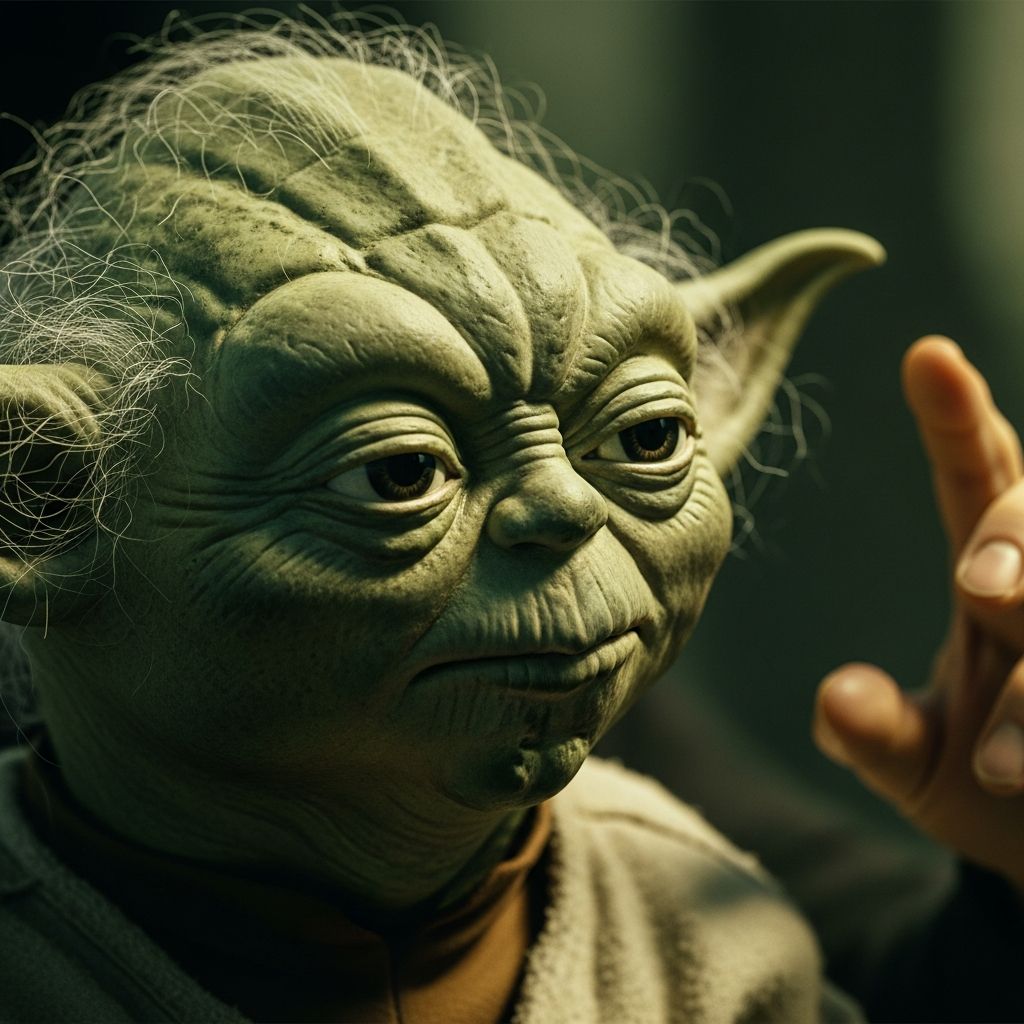
Yoda’s voice is one of the most recognizable sounds in modern cinema, yet the way he speaks was not a fixed plan from the beginning of The Empire Strikes Back but the result of a bold creative decision by Frank Oz and the trust of George Lucas.
The Unlikely Birth of a Galactic Sage
When Yoda first appeared in The Empire Strikes Back, audiences saw a small, wrinkled creature who looked more like an eccentric hermit than a legendary warrior, but it was his voice that instantly signaled wisdom, age, and mystery. The character’s physical design came from makeup artist Stuart Freeborn, while the personality and vocal identity were shaped almost entirely by Frank Oz, a veteran puppeteer and performer known for his work on the Muppets.
Initially, Yoda’s dialogue on the page was more conventional, with only hints of the now-iconic inverted sentences that fans would later imitate endlessly. Oz saw potential in those fragments of unusual syntax and asked Lucas for permission to push the pattern much further, turning a small quirk into the character’s defining speech style.
Frank Oz Before the Jedi Master
Frank Oz did not come to Star Wars as a typical film actor but as a seasoned puppeteer and voice performer who had already shaped some of television’s most beloved characters. His work with Jim Henson on projects like The Muppet Show and Sesame Street gave him deep experience in giving personality and emotional depth to non-human figures, from Miss Piggy to Grover and other famous characters.
This background taught Oz that a character’s voice is more than sound; it is posture, rhythm, breath, and intention wrapped into a single performance. That understanding allowed him to look at the early Yoda material not just as a set of lines but as an opportunity to invent an entire culture and history through the way the character spoke.
- Extensive experience with puppet characters shaped Oz’s sensitivity to timing and rhythm in dialogue.
- Collaboration with Jim Henson encouraged bold, character-first choices rather than safe, generic voices.
- Years of performing for children’s television refined his skill at conveying warmth, humor, and wisdom simultaneously.
From Straightforward Dialogue to Twisted Syntax
In early versions of the script for The Empire Strikes Back, Yoda’s lines were written largely in ordinary word order, with only traces of the unfamiliar phrasing that audiences later associated with him. When Oz revisited that draft years later, he noted that the mix of casual, contemporary speech and a bit of “odd” syntax left the character in an uncertain space that did not fully express his age or status.
Instead of treating the unusual phrasing as a side detail, Oz proposed treating it as the rule: Yoda would structure almost every sentence in this distinctive pattern. Lucas agreed, and what might have remained a minor quirk became a central device for signaling that this Jedi Master came from another time, with a way of speaking that predated the younger heroes around him.
| Aspect | Conventional Dialogue | Yoda’s Final Style |
|---|---|---|
| Word order | Subject–verb–object is the usual pattern in English dialogue. | Verb or object often appears first, creating a sense of formality and distance. |
| Tone | Casual and colloquial, closer to how the other characters talk. | Measured and ceremonial, echoing a tradition older than the current generation. |
| Function in story | Primarily to convey information quickly. | Communicates both plot information and a sense of history, philosophy, and strangeness. |
A Voice Rooted in Ancient Jedi Tradition
Oz has described Yoda’s speech as more than a gimmick; in his view, the syntax reflects a very old, formal mode of Jedi communication, preserved by a character who has lived for centuries. This idea positions Yoda as a guardian of heritage, holding on to an elegant, ritualized language while younger characters speak in looser, more modern ways.
That concept helps explain why the strange word order never feels random within the story, even if fans initially encountered it as a fun pattern to mimic. Each line, delivered in that reversed structure, reminds the audience that Yoda is not just another military leader but a sage whose mindset was shaped in a very different era.
- Yoda’s syntax implies a linguistic tradition separate from the everyday talk of pilots and smugglers.
- The voice makes him feel older than any timeline chart could, simply by virtue of how he arranges sentences.
- Fans’ fascination with his style shows how a formal, archaic tone can still feel intimate and playful.
Why a Simple Voice Change Was a Massive Risk
From a production standpoint, allowing a key mentor figure to speak in heavily stylized language was not an obvious safe choice. If the approach had failed, Yoda might have come across as silly or confusing instead of wise, undermining crucial scenes that carry the emotional weight of Luke Skywalker’s training.
The risk extended beyond clarity; a puppet already asks the audience for suspension of disbelief, and layering a highly unusual voice on top could easily have broken the illusion. However, Oz’s confidence in the character’s inner life, combined with Lucas’s willingness to support that creative leap, turned a potential liability into a strength.
Voice, Puppet, and Performance Working as One
What makes Yoda convincing is not just the sound of his voice but the way that voice synchronizes with every movement of the puppet. Oz’s background allowed him to control facial motions, eye direction, and body posture while also delivering lines, creating the illusion of a single living being rather than separate elements.
Small choices—like a pause before a key word or a slight head tilt as a sentence inverts—make the rhythm of the dialogue feel thoughtful rather than mechanical. The synergy between physical performance and vocal delivery is a major reason fans accept that this small creature can train Jedi and speak for an entire philosophy.
Imitation Everywhere, But Soul Matters Most
Decades after Yoda’s first appearance, people around the world still attempt to copy his voice, often by rearranging words and tightening the pitch to sound older and more gravelly. Oz has acknowledged these impressions and does not seem bothered by them, pointing out that anyone can approximate the surface sound.
He has emphasized that what truly defines a character is not a catchphrase or a vocal trick but the “soul” behind the performance, meaning the internal logic and emotional truth that guide every choice. Yoda’s enduring appeal comes from the combination of unusual speech with a clear moral center and visible compassion for the students he guides.
- Fans commonly mimic Yoda’s reversed word order in conversation and online jokes.
- Oz stresses that the deeper work of acting lies in motivation, not just tone or rhythm.
- The distinction between voice and soul explains why few imitations feel as complete as the original performance.
How Yoda’s Voice Reshaped a Galaxy
Without Yoda’s distinctive speech pattern, the middle chapter of the original Star Wars trilogy might have felt far more conventional. The character is central to Luke’s arc, providing not only instruction on the Force but also a counterpoint to the fast-talking, informal style of the other heroes.
The success of Yoda’s voice gave the franchise permission to embrace stranger, more stylized characters in later films and animated series. It also showed that audiences would respond strongly to a figure who communicates profound ideas through a voice that initially seems playful or even odd.
| Story Element | Impact of Yoda’s Voice |
|---|---|
| Luke’s training scenes | The inverted speech adds a sense of ritual and depth, making simple lessons feel like ancient teachings. |
| Franchise tone | Demonstrates that Star Wars can balance mythic seriousness with quirky character details. |
| Audience memory | Lines become instantly quotable because of their unusual rhythm, cementing Yoda in pop culture. |
From Yoda to Grogu: A Legacy of Small Green Icons
The arrival of Grogu—popularly nicknamed “Baby Yoda”—on The Mandalorian highlighted how deeply the original character’s presence is embedded in the franchise. Even though Grogu has a different role and limited speech, audiences immediately associated him with the wise master who trained generations of Jedi.
That association speaks to the strength of the foundation Oz helped build: a way of moving, sounding, and existing on screen that makes any similar creature feel connected to a larger spiritual lineage. Yoda’s voice, in retrospect, became the template that defined what it means to belong to that mysterious, long-lived species within the Star Wars universe.
Lessons for Creators and Performers
For writers, actors, and directors, the story behind Yoda’s voice offers a set of practical lessons about building memorable characters. It illustrates how a single, well-considered choice in speech pattern can reveal backstory, culture, and worldview without a single line of exposition spelling it out.
It also shows the importance of collaboration: Oz’s idea could only reshape the film because Lucas was open to experimentation and trusted the performer’s instincts. Together they turned a role that might have stayed small and eccentric into the moral compass of an entire saga.
Key Takeaways for Storytellers
- Let character history shape language. A long-lived figure may speak with rhythms that feel older than those of younger heroes.
- Use voice to hint at unseen cultures. Syntax, tone, and pacing can suggest a wider tradition beyond the frame.
- Embrace risk when it serves character truth. Unconventional choices can become iconic when grounded in clear motivation.
- Remember that performance is holistic. Voice, movement, and expression must align to convince the audience a non-human figure is alive.
FAQs About Yoda’s Voice and Frank Oz
Did Yoda always speak with unusual word order in the script?
Early script drafts contained only partial use of the inverted syntax that Yoda is now known for, mixing those lines with more colloquial speech. Frank Oz suggested leaning fully into the unusual phrasing, a suggestion that George Lucas approved, turning it into the character’s standard way of speaking.
Why did Frank Oz think the speech pattern fit Yoda?
Oz saw the unconventional syntax as a reflection of a formal, ancient Jedi language, appropriate for a character who had lived for many centuries. The structure made Yoda feel like a relic of an older, more ceremonial era, rather than just another soldier in the current conflict.
Is the voice just a funny gimmick?
While the phrasing is easy to parody, Oz has emphasized that the essence of the character lies in the emotional and spiritual core behind the performance, not just a quirky vocal trick. The voice works because it is guided by Yoda’s deep sense of responsibility, compassion, and hard-earned wisdom.
Did Frank Oz continue voicing Yoda after the original trilogy?
Yes, Oz returned to voice Yoda in the prequel trilogy and in various later appearances, including animated projects and later films, reinforcing continuity for longtime fans. His involvement helped keep the character’s personality consistent across different eras of Star Wars storytelling.
How has Yoda’s voice influenced later Star Wars creations?
Yoda’s distinctive speech and manner of delivery set a benchmark for how non-human or ancient characters could sound in the franchise. The success of that choice gave creators confidence to introduce other unusual voices and species, from animated series to newer live-action stories.