Understanding Pregnancy Timelines and Due Date Calculation
One of the first questions expectant parents ask after confirming pregnancy is: when will my baby be born? While the answer depends on several factors, healthcare providers use established calculation methods to estimate a due date. The estimated due date (EDD) represents the anticipated day when labor will spontaneously begin, typically around 40 weeks after conception. However, this date is not set in stone—most babies arrive within a two-week window before or after the predicted date. Understanding how due dates are calculated empowers pregnant individuals to track pregnancy progress, prepare for birth, and anticipate the arrival of their newborn.
The Last Menstrual Period Method: The Standard Approach
The Last Menstrual Period (LMP) method remains the most widely used technique for estimating due dates in clinical practice. This approach calculates pregnancy duration by counting 280 days (40 weeks) forward from the first day of the last menstrual period. The underlying assumption is that ovulation occurred approximately 14 days into a regular 28-day menstrual cycle, making conception occur around day 14.
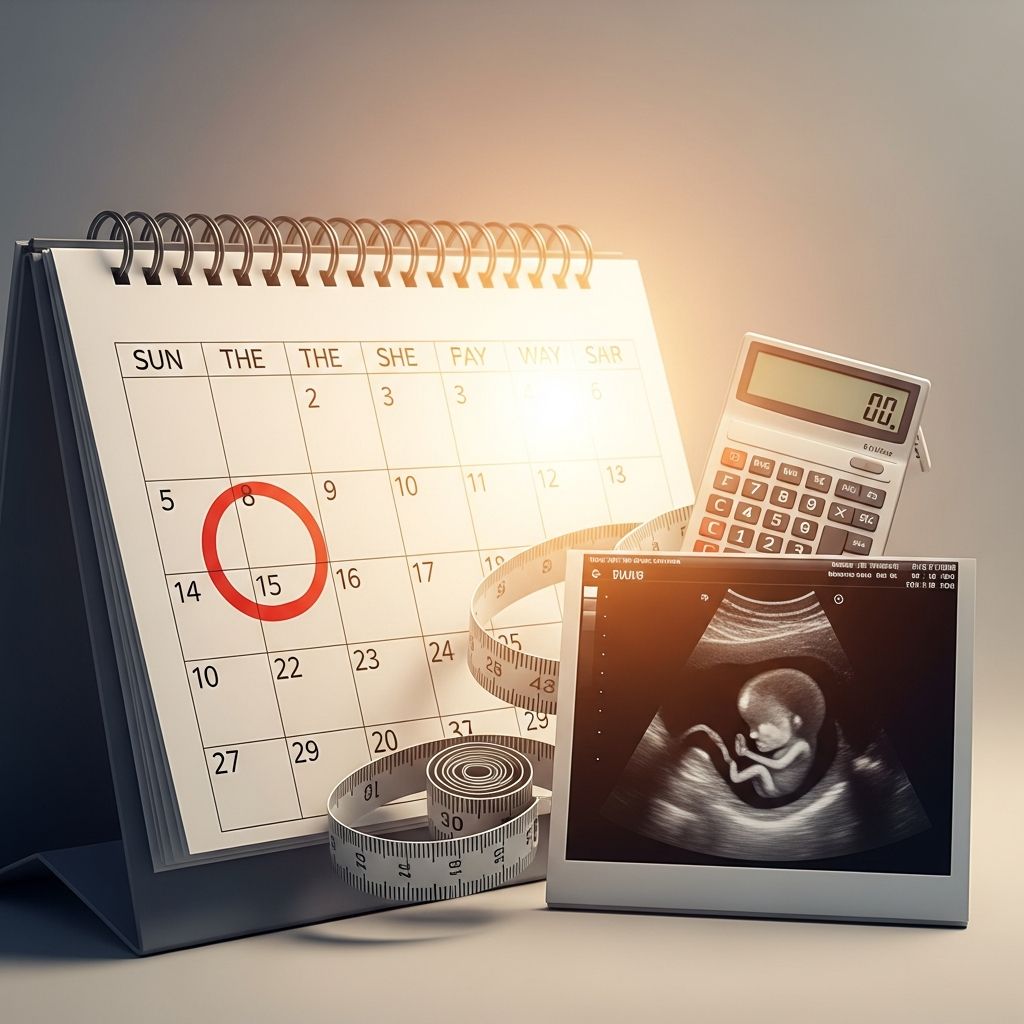
To apply the LMP method, a healthcare provider begins with the first day of the last period and adds nine months and seven days to determine the estimated due date. Alternatively, healthcare providers may add 280 days directly to the LMP date using a pregnancy wheel or calculator. For example, if a woman’s last menstrual period began on January 1st, the estimated due date would fall around October 8th of the same year.
Despite its widespread adoption, the LMP method has significant limitations. It assumes regular, predictable menstrual cycles and standard ovulation timing—assumptions that do not apply to all women. Women with cycle lengths shorter or longer than 28 days will have inaccurate due dates if not adjusted. Additionally, if someone cannot recall their LMP date or has irregular cycles, healthcare providers must rely on alternative calculation methods.
Adjusting for Individual Cycle Variations
Recognizing that not all women have identical menstrual cycles, midwifery and obstetric professionals have developed modified calculation methods. The Woods Method, named after midwifery professor Carol Wood, refines Naegele’s Rule—the traditional LMP-based calculation—by accounting for individual cycle length variations.
Using the Woods Method, the initial calculation follows standard LMP protocol: add one year, subtract three months, and add seven days to the first day of the last menstrual period. However, an additional step accounts for cycle variations. If a woman’s actual cycle differs from 28 days, the difference is added or subtracted from the preliminary due date. For instance, a woman with a 32-day cycle would have four additional days added to her calculated due date, moving it from October 8th to October 12th.
Another refined approach, Dr. Parikh’s Formula, takes a different mathematical path while achieving similar results. This method adds nine months to the LMP date, subtracts 21 days, then adds the actual cycle length. Although the calculation sequence differs, it yields comparable adjustments for women with non-standard cycle lengths. These alternative methods prove particularly valuable for women whose cycles consistently deviate from the 28-day standard.
Conception and Ovulation-Based Calculations
For women who have tracked their ovulation closely or know their exact conception date, alternative calculation methods offer greater accuracy than LMP-based estimates. When the precise date of conception is known—particularly common among women using fertility tracking methods or undergoing assisted reproductive technologies—healthcare providers add 266 days (approximately 38 weeks) to determine the due date.
The conception date method requires detailed ovulation tracking through methods such as basal body temperature charting, cervical mucus observation, or ovulation predictor kits. Modern technology has enhanced these approaches through digital applications and wearable devices that provide refined ovulation predictions. Women who have used these monitoring techniques to identify their fertile window possess concrete evidence of when conception likely occurred, allowing for more precise due date estimation compared to the LMP method.
This method proves especially beneficial for women with irregular menstrual cycles, as it bypasses the assumptions required by LMP calculations. Rather than estimating backward from cycle length, healthcare providers calculate forward from a known starting point, eliminating many sources of error inherent in traditional approaches.
Ultrasound Imaging for Gestational Age Assessment
Ultrasound technology provides an independent method for estimating gestational age and confirming due dates. During early pregnancy ultrasound examinations, typically performed before 13 weeks and 6 days of gestation, healthcare providers measure the embryo or fetus to determine developmental stage. The first-trimester ultrasound stands out as the most accurate method for establishing or revising due dates, with measurement precision decreasing as pregnancy advances.
During these early scans, technicians measure the crown-rump length (CRL)—the distance from the baby’s head to the base of the spine. This measurement is compared against established population data to estimate how many weeks of development have occurred. When the crown-rump length measurement is at least 7 weeks (approximately 10 mm), this represents the earliest reliable point for ultrasound-based gestational age determination.
Ultrasound proves particularly valuable when LMP dates are uncertain or when significant discrepancies exist between LMP-based calculations and fetal size observed on imaging. As pregnancy progresses beyond the first trimester, ultrasound accuracy diminishes, making early pregnancy scans the gold standard for confirming or adjusting previously calculated due dates. Healthcare providers may revise due date estimates based on ultrasound findings, especially if substantial differences exist between LMP calculations and observed fetal measurements.
In Vitro Fertilization and Assisted Reproductive Technology
Women who conceive through In Vitro Fertilization (IVF) have the advantage of knowing precise dates related to their conception and embryonic development. Due date calculation for IVF pregnancies depends on the stage at which the embryo was transferred.
For day-three embryo transfers, when embryos are typically three days old at transfer, healthcare providers add 263 days from the transfer date to estimate the due date. For day-five embryo transfers, which involve more developed blastocyst-stage embryos, 261 days are added to the transfer date. These specific calculations account for the known developmental stage of the transferred embryo, providing highly precise due date estimates.
IVF-based due date calculations offer significant advantages over LMP methods because they rely on documented, medically confirmed dates rather than patient recall or cycle assumptions. This precision helps healthcare providers and patients establish accurate baselines for monitoring fetal development throughout pregnancy.
Comparing Calculation Methods: Accuracy and Reliability
| Calculation Method | Formula | Best Used For | Accuracy Range |
|---|---|---|---|
| LMP Method | Add 280 days to first day of last period | Women with regular 28-day cycles | ±2 weeks |
| Woods Method | LMP + 280 days, adjusted for cycle length | Women with non-standard cycle lengths | More accurate than standard LMP |
| Conception Date | Add 266 days to conception date | Women with tracked ovulation or fertility treatments | Highly accurate when date is confirmed |
| IVF Transfer Date | Add 263 days (day 3) or 261 days (day 5) to transfer date | Women who conceived through IVF | Most accurate method available |
| First-Trimester Ultrasound | Measure crown-rump length and compare to population data | Any pregnancy, especially with uncertain LMP | Most accurate imaging method |
Planning Ahead: From Due Date to Birth Month
Understanding when your due date falls helps expectant parents prepare for their baby’s arrival across multiple dimensions. Once a healthcare provider establishes an estimated due date, parents can plan for work leave, arrange childcare for other children, prepare the nursery, and mentally prepare for the transition to parenthood.
However, it is important to recognize that due dates represent educated estimates rather than guarantees. Approximately 85% of pregnancies progress beyond the estimated due date, and fewer than 10% of babies arrive exactly on their due date. Most births occur within a two-week window on either side of the calculated due date. Healthcare providers monitor pregnancies extending beyond the due date and may recommend induction of labor if pregnancy progresses significantly past 42 weeks, when risks to both parent and baby increase.
Parents should use due date information to establish reasonable expectations about timing rather than assuming their baby will arrive on that specific calendar day. Factors influencing exact birth timing include whether the pregnancy is the parent’s first (first pregnancies tend to progress longer), maternal age, fetal position, and overall maternal health.
Consulting Healthcare Providers for Personalized Assessment
While various calculation methods provide useful estimates, healthcare providers consider the complete clinical picture when establishing due dates. The most accurate approach involves comparing results from multiple methods and assessing whether results align or diverge significantly.
If LMP-based calculations differ substantially from ultrasound measurements or conception-based calculations, healthcare providers will investigate the discrepancy and potentially revise the due date. Similarly, if a woman reports irregular cycles or uncertainty about her LMP date, healthcare providers will prioritize ultrasound-based assessment or conception dates over LMP calculations.
Professional medical guidance ensures that due date calculations account for individual variations and clinical circumstances that generic calculators may not address. Healthcare providers can also discuss whether factors such as maternal age, pregnancy complications, or fetal concerns might influence recommendations about when labor should be induced if spontaneous labor does not begin by a certain timeframe.
Frequently Asked Questions
Q: What is the difference between my due date and my expected due date?
A: The terms are essentially synonymous. The due date, estimated due date (EDD), and expected due date all refer to the date when your healthcare provider anticipates spontaneous labor will begin, typically around 40 weeks of gestation.
Q: Can my due date change during pregnancy?
A: Yes, due dates can be revised if ultrasound measurements in early pregnancy show significant discrepancies from LMP-based calculations. First-trimester ultrasounds are considered highly accurate and may lead healthcare providers to adjust previously calculated due dates.
Q: Is the LMP method accurate for women with 35-day menstrual cycles?
A: Standard LMP calculations assume 28-day cycles and may be inaccurate for women with longer cycles. The Woods Method or other adjusted formulas that account for actual cycle length provide more accurate estimates for women with non-standard cycles.
Q: What if I do not know my last menstrual period date?
A: Healthcare providers typically rely on first-trimester ultrasound imaging to establish gestational age and estimate due dates when LMP dates are unavailable. Crown-rump length measurements provide accurate developmental assessment.
Q: How accurate is ultrasound for determining due dates?
A: First-trimester ultrasound (up to 13 weeks and 6 days) is the most accurate imaging method for establishing gestational age, superior to LMP-based calculations for many women.
Q: Will my baby definitely arrive on my due date?
A: No. Most babies arrive within a two-week window before or after the due date. Only about 10% of births occur exactly on the estimated due date.
References
- Estimated Due Dates Explained: Understanding Pregnancy Timelines — My Little Light Midwifery. 2024. https://www.mylittlelightmidwifery.com/blog/understanding-estimated-due-dates-in-pregnancy
- Pregnancy Due Date Calculator — American Pregnancy Association. 2024. https://americanpregnancy.org/resources/pregnancy-calculator/
- Working out your due date — Pregnancy Birth and Baby. Australian Government Department of Health. 2024. https://www.pregnancybirthbaby.org.au/working-out-your-due-date
- Pregnancy Due Date & Gestational Age Calculator — Perinatology.com. 2024. http://perinatology.com/calculators/Due-Date.htm
- Methods for Estimating the Due Date — American College of Obstetricians and Gynecologists (ACOG). Committee Opinion No. 700. May 2017. https://www.acog.org/clinical/clinical-guidance/committee-opinion/articles/2017/05/methods-for-estimating-the-due-date