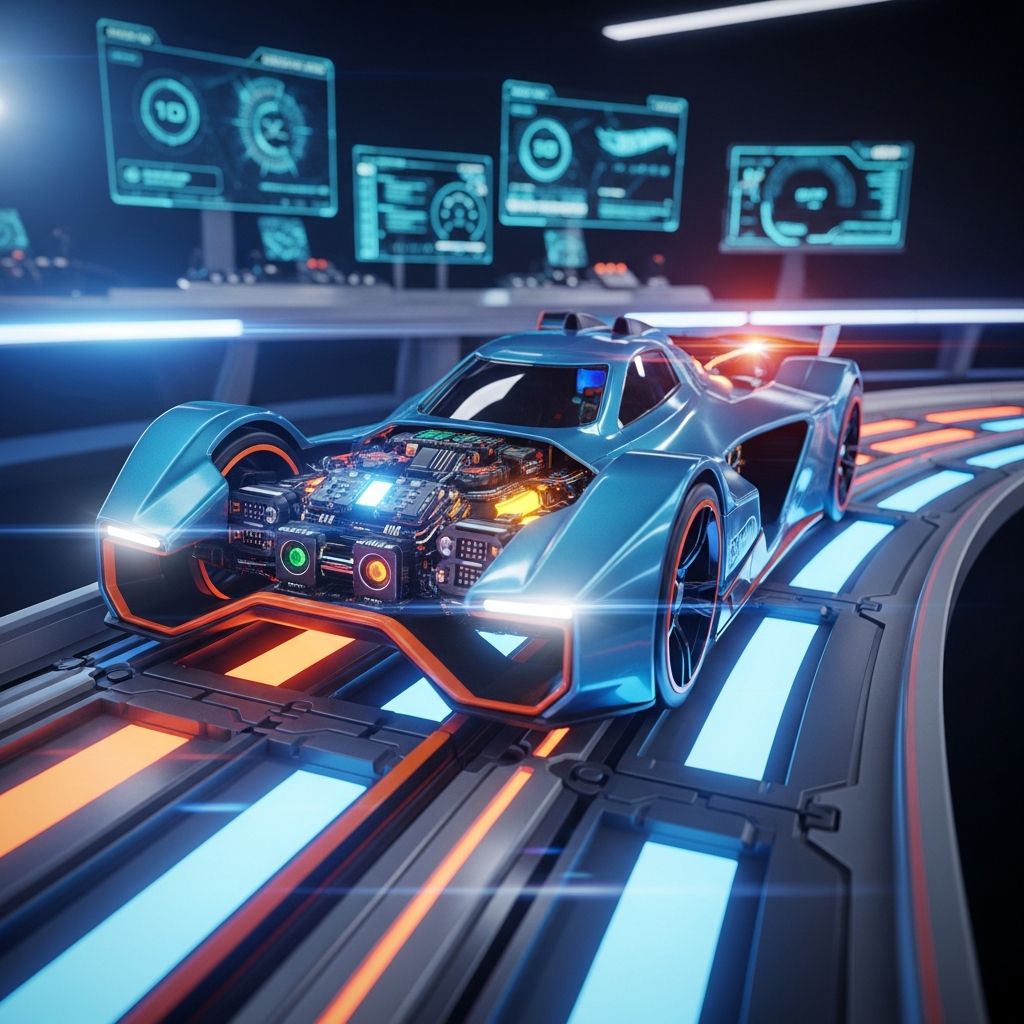
The Hot Wheels A.i. Intelligent Race System took the familiar idea of a toy racetrack and boosted it with sensors, software, and clever design to keep cars on the track, introduce digital hazards, and create a genuine sense of competition. [web:2][web:3] It became a standout example of how smart toys can bridge the gap between screen-based gaming and hands-on, physical play. [web:2][web:4]
What Made This Racetrack Different?
At its core, the A.i. system was a complete racing ecosystem: smart cars, handheld controllers, and a printed track that cars could “read” in real time. [web:2][web:5] Unlike traditional slot cars that rely on grooves or fixed rails, these vehicles used onboard sensors and processing to follow the track, adjust speed, and react to virtual obstacles. [web:2][web:4]
- Wireless smart cars with scale speeds of up to about 180 mph, allowing dramatic, high-energy laps when set to higher difficulty levels. [web:2][web:3]
- Game-style controllers that added modes, hazards, and skill levels more reminiscent of a console racer than a simple toy set. [web:2][web:4]
- Reconfigurable track pieces designed to snap together into more than 40 layouts, keeping the experience fresh over time. [web:2][web:3]
Key Components of the System
The Starter Set packaged together everything needed to race out of the box, while still leaving room to expand with additional track packs and themed cars sold separately. [web:2][web:3] The way these pieces worked together showed how intentionally the system had been designed for both accessibility and replay value. [web:2][web:8]
| Component | Main Role | Notable Details |
|---|---|---|
| Smart Cars | Drive on and off track with onboard guidance. | Use sensors to follow the printed track and can reach high scale speeds at advanced settings. [web:2][web:5] |
| Controllers | Player input and game logic interface. | Offer steering, throttle, hazard launch, and mode selection, plus multiple difficulty levels. [web:2][web:4] |
| Smart Track | Physical racing surface with printed guidance. | Includes around 20 pieces that can form more than 40 configurations and include directional markings. [web:2][web:3] |
| Game Modes | Structure races, practice, and free play. | Include championship-style racing, practice modes, and free-drive options with or without the track. [web:2][web:4] |
How the Artificial Intelligence Worked
The “A.i.” in the name did not mean deep learning, but a practical use of onboard sensors and programmed behavior to enhance racing. [web:2][web:4] Each vehicle scanned the surface beneath it to identify the printed pattern on the track, then used that data to correct its line and avoid veering off during normal play. [web:5][web:6]
- Guidance assistance helped drivers, especially beginners, by nudging cars back toward the center of the track when steering was slightly off. [web:2][web:4]
- Computer-controlled rival cars could be added, turning solo play into a competitive race even when only one human player was available. [web:2][web:6]
- Virtual hazards and engine effects were triggered through the controllers and software rather than physical props on the track, creating a layered, game-like environment. [web:2][web:4]
Game Modes and Skill Levels
The system’s depth came from its variety of racing modes and difficulty settings that scaled from cautious beginner speeds to twitchy, near-out-of-control expert races. [web:2][web:3] These options allowed younger kids and adults to enjoy the same hardware in very different ways without changing physical parts. [web:3][web:4]
Racing Modes Explained
- Championship-style racing: Structured races with lap counts, positions, and AI opponents, capturing the feel of an organized motorsport event for family play sessions. [web:2][web:4]
- Practice modes: Simplified setups that emphasize learning control and track lines without pressure from hazards or aggressive rivals. [web:2][web:4]
- Freeplay / off-track driving: A mode that allowed cars to run without the printed track, turning any flat surface into an open driving area. [web:2][web:5]
Difficulty Settings for All Ages
Difficulty levels primarily adjusted speed, steering sensitivity, and the extent to which the system corrected driving mistakes. [web:3][web:4] At lower levels, cars moved more slowly and were strongly assisted, while higher settings raised speed dramatically and allowed cars to fly off the track when pushed too hard, rewarding precise control. [web:3][web:5]
- Beginner settings made the cars feel stable and almost locked to the track, which suited inexperienced drivers or very young racers. [web:3][web:4]
- Advanced and expert settings unlocked the full potential of the system, with quick accelerations, sharper responses, and the real risk of spinning out or leaving the circuit. [web:3][web:5]
Digital Hazards and Power-Up Style Features
One of the system’s most distinctive touches was the inclusion of digital hazards and combat-like elements, clearly inspired by video game racing titles. [web:2][web:4] Rather than placing physical obstacles on the track, players triggered effects through their controllers, letting the software simulate issues like oil slicks or tire blowouts. [web:2][web:3]
- Virtual oil spills made cars harder to control for a brief period, mimicking a traction loss effect that could change race outcomes. [web:2][web:3]
- Simulated tire damage or engine trouble would slow a car or require the player to respond strategically, such as easing off the throttle or adjusting driving style. [web:2][web:4]
- Offensive abilities, such as firing virtual projectiles at opponents, added a light combat layer that felt familiar to fans of kart-style video games. [web:4][web:5]
Track Design and Layout Creativity
The printed track pieces were double-sided sections that snapped together on the floor, allowing families to build custom circuits rather than being stuck with a single layout. [web:2][web:3] With roughly 20 sections included in the starter kit, Hot Wheels promoted the possibility of more than 40 distinct track configurations. [web:2][web:8]
- Curves, straights, and special segments could be rearranged to emphasize speed, technical corners, or tight chicanes. [web:2][web:8]
- Directional arrows printed on the surface guided both smart cars and builders, ensuring the sensors read the intended path clearly. [web:5][web:8]
- Additional expansion packs introduced raised sections and alternative shapes, adding vertical interest and variety for long-term owners. [web:3][web:8]
Why Families Found It Engaging
Many parents described the A.i. system as one of the rare high-tech toys that truly pulled them down onto the floor with their children, rather than leaving adults on the sidelines. [web:3][web:4] It combined simple setup and intuitive controls with enough nuance that older players could still enjoy skill-based competition. [web:3][web:5]
- Shared excitement came from live races where adults and kids could compete fairly by adjusting difficulty modes and car assistance. [web:3][web:4]
- The tactile act of building and rebuilding tracks offered a screen-free, constructive activity that naturally led into active play. [web:2][web:3]
- Collectible themed body shells, including pop-culture tie-ins like superhero or game-inspired designs, let children personalize their cars over time. [web:3][web:8]
Strengths and Limitations at a Glance
Like most ambitious toys, the Hot Wheels A.i. Intelligent Race System had clear strengths but also practical drawbacks, especially around setup and stability at high speeds. [web:3][web:5] Families who understood these trade-offs often had a better long-term experience with the product. [web:5][web:8]
| Aspect | Advantages | Challenges |
|---|---|---|
| Gameplay | Rich modes, hazards, and AI opponents create depth beyond basic slot-car racing. [web:2][web:4] | Can feel busy or overwhelming for very young kids if too many features are enabled at once. [web:4][web:5] |
| Difficulty Scaling | Beginner to expert options support a wide age range in one system. [web:3][web:4] | High-speed expert play can send cars off the track frequently, leading to more time spent repositioning. [web:3][web:5] |
| Track System | Modular, reconfigurable pieces encourage creativity and variety. [web:2][web:8] | Sections can shift or separate during intense races, especially on uneven floors, which interrupts flow. [web:5][web:8] |
| Tech Design | Onboard sensors and AI guidance lower frustration for beginners and keep cars roughly on course. [web:2][web:6] | Requires careful alignment of track arrows and good lighting conditions for optimal sensor performance. [web:5][web:8] |
Best Practices for Setup and Play
Families who took a few minutes to set up the track carefully and calibrate their expectations usually had smoother racing sessions. [web:5][web:8] Attention to details such as floor surface, track alignment, and mode selection could significantly reduce mid-race disruptions. [web:5][web:8]
- Build on a smooth, hard surface instead of carpet whenever possible, as this helps track sections stay flat and connected. [web:5][web:8]
- Double-check the direction of printed arrows on every piece so sensors read the path consistently throughout the lap. [web:5][web:8]
- Start with beginner or intermediate difficulty until everyone is familiar with controls, then step up to higher speeds in later sessions. [web:3][web:4]
How It Compared to App-Driven Racers
When it released, the A.i. system arrived in a market that already included app-driven racing platforms that depended heavily on smartphones or tablets. [web:5][web:8] Hot Wheels took a different route by bundling dedicated controllers, ensuring that families did not need extra devices to play. [web:2][web:5]
- Standalone controllers simplified the experience for households that prefer to keep phones away from kids during playtime. [web:2][web:5]
- The absence of mandatory apps reduced friction and possible compatibility issues while still delivering digitized racing features. [web:2][web:6]
- Compared with some premium app-based sets, this approach helped maintain a more traditional toy feel alongside its advanced functions. [web:5][web:8]
What the System Reveals About the Future of Play
Beyond its specific feature set, the Hot Wheels A.i. Intelligent Race System illustrated how traditional brands are weaving digital intelligence into toys without eliminating physical interaction. [web:2][web:3] Its mixture of tangible cars and track with invisible logic and hazards previewed a broader trend in hybrid play experiences. [web:3][web:8]
- Smart sensors and lightweight AI are being used to smooth out frustration, assist beginners, and keep play sessions interesting over time. [web:2][web:6]
- Physical-digital hybrids encourage families to move, build, and experiment rather than just sit in front of a screen. [web:3][web:4]
- Expandable ecosystems, with new cars and track packs, help toys feel more like long-term platforms than one-season novelties. [web:2][web:8]
Frequently Asked Questions
Do you need a smartphone or tablet to use the Hot Wheels A.i. Intelligent Race System?
No, the system was designed to work entirely with its included controllers, so families did not need extra devices or apps to get started. [web:2][web:5]
How many players could race at once?
The system could support up to four cars on the track simultaneously, allowing small group races, though the starter set typically included two vehicles and controllers. [web:2][web:4]
Could the cars be used without the track?
Yes, a free-drive style mode allowed the smart cars to run on flat surfaces off the printed track, turning them into more open-ended RC vehicles. [web:2][web:5]
Was it suitable for very young children?
With beginner modes and strong guidance assistance, younger kids could enjoy gentler, slower races, although adult help with setup and supervision was recommended. [web:3][web:4]
Were expansion packs necessary?
The starter set provided enough track and features for complete races, but expansion packs with extra track or themed cars extended variety and replay value for families who loved the system. [web:2][web:3]