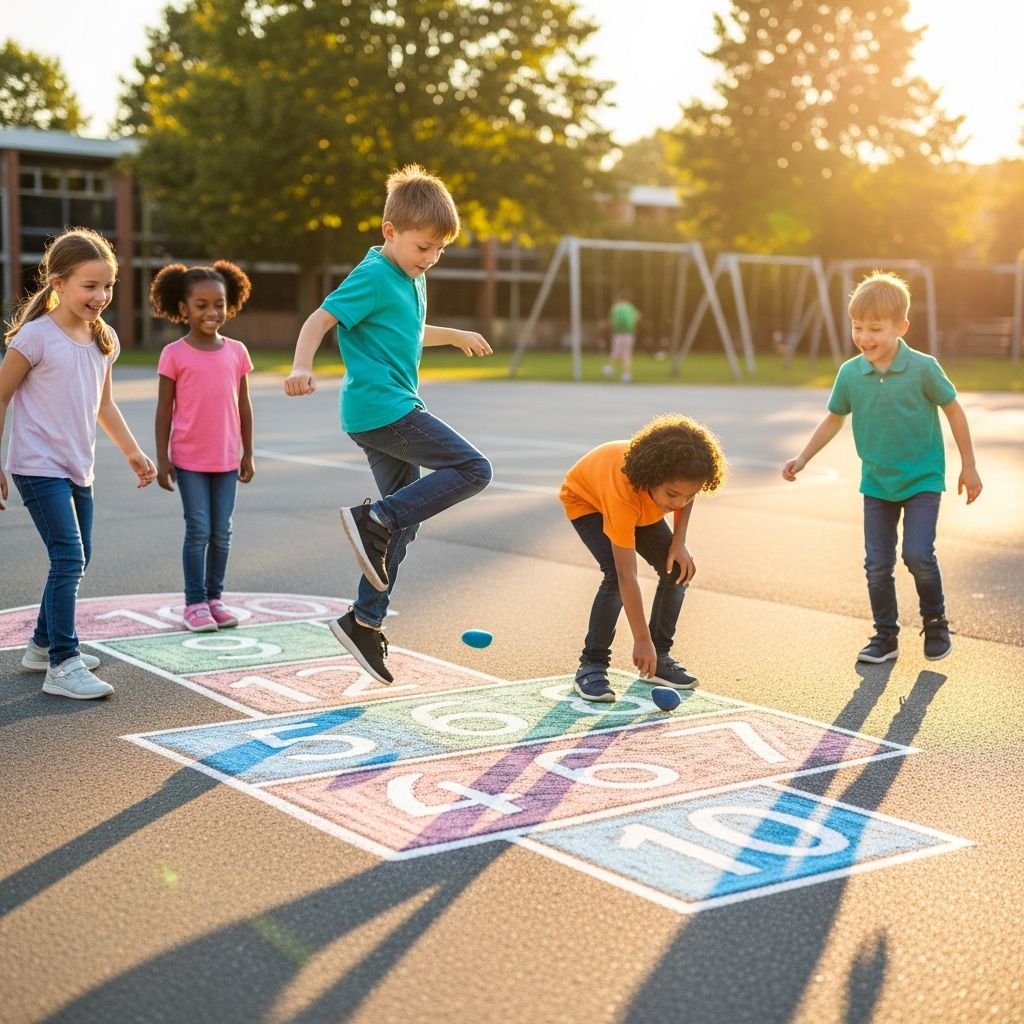
Hopscotch stands as one of the most enduring playground games, captivating generations with its blend of physical challenge and simple joy. Requiring only chalk, a flat surface, and a small object like a stone or beanbag, it encourages children to hop, balance, and strategize while enjoying fresh air.
Unraveling the Historical Roots of Hopscotch
The game’s origins spark debate among historians, with claims spanning continents and centuries. While popular lore ties it to ancient Roman soldiers training in full armor on massive courts over 100 feet long to sharpen footwork, this narrative lacks solid evidence and stems from a 19th-century misunderstanding in archaeological discussions. More reliable accounts point to an early modern emergence in Europe.
Francis Willughby’s Book of Games, compiled between 1635 and 1672, first documents “Scotch Hopper,” describing children etching lines on floors and hopping with a piece of lead. By the late 17th century, references in English texts like Poor Robin’s Almanack (1707) mention “Scotch-hoppers,” indicating its spread among youth. In the U.S., the 1828 Webster’s American Dictionary defines it as boys hopping over “scotches and lines in the ground.”
Regional names abound: “Hop-Score” in Yorkshire, “Scotch Hobbies” in Suffolk, and “Peevers” in Scotland. Some sources suggest even earlier ties, like painted markings from India’s Painted Grey Ware era (c. 1200–600 BCE), though unproven, or ancient China where the marker symbolized the soul’s journey to heaven. Ulrich Schädler deems it enigmatic but early modern. These tales highlight hopscotch’s global appeal, evolving from etched floors to chalked sidewalks.
Essential Materials and Setup Guide
Setting up hopscotch demands minimal resources, making it accessible anywhere. Key items include:
- Chalk or markers: For drawing the court on pavement, blacktop, or indoors with tape.
- Flat surface: Sidewalk, driveway, or gym floor; ensure it’s smooth and safe.
- Marker: Small stone, beanbag, coin, or rubber “lagger”—anything tossable that stays put.
- Optional: Colored chalk for themed designs, numbers, or patterns.
Draw a standard court: a rectangle divided into 10 squares (two side-by-side at top, singles below), numbered 1 to 10. Each square about 1-2 feet wide, total length 6-10 feet. Add a “safe zone” or “heaven” at the end. Indoors, use masking tape for portability.
| Court Variation | Description | Best For |
|---|---|---|
| Classic Linear | 10 numbered squares in a line or cross shape | Beginners |
| Double Dutch | Side-by-side squares for hopping challenges | Advanced players |
| Shape Fun | Star, heart, or alphabet instead of numbers | Creative play |
Mastering the Core Rules and Gameplay
Play solo or in turns. Objective: Toss marker into sequential squares, hop through without landing on lines or marker, retrieve it on return, and progress upward.
- Toss: Throw marker into square 1. Must land fully inside without touching lines.
- Hop: Single-foot in singles, two-footed in doubles. Skip marker’s square.
- Turn: Reach end, turn, pick up marker hopping back.
- Progress: Succeed to next number. Miss or fault? Pass turn.
- Win: Complete full course, often three rounds.
Faults: Marker out/bounces/touches line, stepping on lines/marker, losing balance. Younger kids start with fewer squares. Promotes turn-taking and patience.
Exciting Variations to Keep It Fresh
Standard rules evolve with creativity. Try these to engage different ages:
- One-Foot Challenge: Entire course on one foot for balance pros.
- Backward Hop: Face away, heightening difficulty.
- Team Relay: Pairs hop together, tagging next player.
- Themed Hops: Squares as colors, animals, or letters—call them out.
- Potato Chip: Add hopping on two feet in select squares.
- International Twists: Scotland’s “Peevers” uses pots; France’s marelles features intricate designs.
For groups, create multiple courts or elimination rounds. Adapt for abilities: Sit-hop for mobility-limited kids.
Boosting Child Development Through Hopscotch
Beyond fun, hopscotch delivers multifaceted benefits, backed by play experts. It enhances gross motor skills—balance, coordination, agility—crucial for ages 3-12.
- Physical Gains: Leg strength from hopping, core stability for turns, spatial awareness avoiding lines.
- Cognitive Perks: Counting squares builds math; sequencing tosses aids memory and strategy.
- Social Skills: Waiting turns fosters patience; cheering builds camaraderie.
- Sensory Input: Tactile chalk drawing, proprioceptive feedback from jumps.
Studies link such unstructured play to reduced obesity risk and better focus. In mid-20th century Singapore, it was a staple for dexterity. Today, it counters screen time, promoting 60 daily activity minutes per WHO guidelines.
Practical Tips for Parents and Educators
Maximize enjoyment safely:
- Location Scout: Sunny, even pavement; avoid traffic.
- Safety First: Check for cracks/debris; supervise young ones; proper shoes prevent slips.
- Age Adapt: 3-5: Short courts; 6+: Variations.
- Indoor Hack: Painter’s tape on carpet; hop on cushions.
- Group Play: Tournaments with prizes like stickers.
Incorporate learning: Number squares backward for math; shapes for geometry. Track progress with photos.
Seasonal and Themed Hopscotch Ideas
Refresh with holidays:
- Halloween: Pumpkin squares, ghost hops.
- Summer: Water chalk for cool fun.
- Learning: Sight words or ABCs in squares.
Scale for classrooms: Giant courts for P.E.; portable mats for rainy days.
Frequently Asked Questions About Hopscotch
What age is hopscotch suitable for?
Ideal for 3+, with simplified rules for toddlers focusing on balance over tossing.
Can hopscotch be played indoors?
Yes, use tape or string on floors; soft markers prevent damage.
How does hopscotch help with learning?
It reinforces counting, patterns, and fine motor control through sequential hopping and tossing.
What’s the best marker for hopscotch?
Beanbags stay put; stones for outdoors. Avoid glass or sharp items.
Is there a world record for hopscotch?
Largest court spans thousands of feet, but personal bests focus on speed/completions.
Why Hopscotch Endures in Modern Play
In an era of gadgets, hopscotch persists for its low barrier and high engagement. It embodies free play, vital for creativity and health. Parents worldwide revive it for family bonding, echoing its journey from 17th-century etchings to global chalk art. Encourage kids to invent rules—it’s the essence of play.
References
- Hopscotch — Wikipedia. Accessed 2026. https://en.wikipedia.org/wiki/Hopscotch
- Hopscotch — National Library Board Singapore. Accessed 2026. https://www.nlb.gov.sg/main/article-detail?cmsuuid=8a47c535-503b-47f8-ad84-fd8e56e16a19
- Hopscotch | Origins, Variations & Benefits — Encyclopædia Britannica. Accessed 2026. https://www.britannica.com/topic/hopscotch-game
- The Games > Hopscotch — Streetplay.com. Accessed 2026. http://www.streetplay.com/thegames/hopscotch.htm
- Hopscotch–ancient Roman maneuver, drunken carousing, or just a game — Susanna Calkins Blog. Accessed 2026. http://www.susannacalkins.com/blog/hopscotch-ancient-roman-maneuver-drunken-carousing-or-just-a-game
- Hop along hopscotch — Early Years Educator (MAG Online Library). 2016-05-01. https://www.magonlinelibrary.com/doi/10.12968/eyed.2016.18.5.xiv