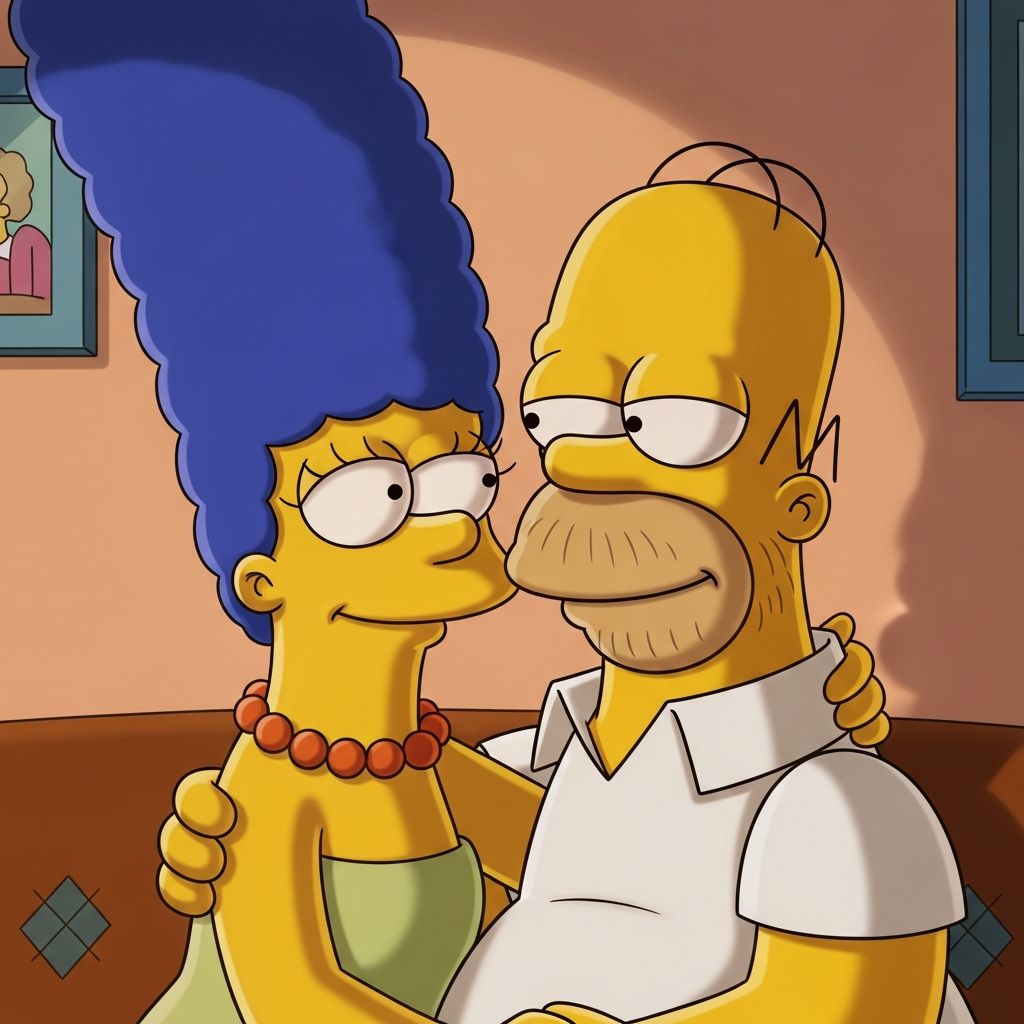
For more than three decades, Homer and Marge Simpson have argued, made up, raised three kids, and somehow stayed married while living inside one of television’s strangest small towns. Their relationship is messy and exaggerated, but that is exactly what makes it so useful as a lens on real-world love and family life.
Why This Cartoon Couple Still Matters
There are countless TV romances that glow with idealized affection, but very few are as flawed, contradictory, and oddly relatable as Homer and Marge. Instead of endless candlelit dinners, viewers see unpaid bills, parenting meltdowns, broken promises, and small gestures that keep the relationship from collapsing entirely.
This long-running animated marriage has become a cultural reference point for how couples fight, forgive, and keep going even when one partner seems to sabotage things on a weekly basis. The most memorable stories about the pair often begin with Homer messing up and end with Marge deciding whether this particular disaster is survivable.
Different People, Same Couch: Who Homer and Marge Really Are
Part of the power of this fictional marriage lies in how sharply the two partners contrast with each other. Marge is patient, conscientious, and attentive, often functioning as the family’s moral compass. Homer is impulsive, distractible, and prone to shortcuts that blow up in his face, but he is also capable of surprising loyalty and tenderness.
At their best, these personality differences create balance: Marge pushes Homer toward responsibility, and Homer drags Marge into joy, spontaneity, and occasional chaos. At their worst, those differences leave Marge carrying an unfair emotional burden and Homer leaning too heavily on apologies instead of growth.
- Marge tends to think long-term, worrying about the kids, the mortgage, and the family’s reputation.
- Homer tends to think about the next snack, the next scheme, or the next moment of comfort, only later realizing the damage left behind.
- Each partner believes they are doing what is best for the family, but they define “best” in radically different ways.
Love Lessons From Springfield: Themes Behind Their Biggest Stories
Across hundreds of episodes, the relationship between Homer and Marge circles several recurring themes that will look familiar to anyone who has tried to keep a long-term partnership afloat. These themes provide a framework for understanding why viewers still care whether these two animated people stay together.
1. Imperfection Is Baked In
Homer is not secretly a perfect husband trapped in a goofy body; he really does forget anniversaries, hide important news, and act selfishly. Marge is not flawless either, sometimes burying resentment, ignoring her own needs, or assuming that forgiveness is the only option. Their stories emphasize that no amount of love erases human limitations.
Instead of offering a polished fantasy, the show leans into the chaos of a household where one partner constantly tests the other’s patience. The emotional core often comes from the question: how much imperfection can a relationship realistically hold before something breaks?
2. Forgiveness Has Limits — and Costs
Marge forgives Homer repeatedly, and viewers often cheer when the couple hugs it out in the final minutes of an episode. But those reconciliations carry an implied cost: the more often Marge resets the emotional ledger, the more pressure is placed on her sense of self, her boundaries, and her expectations for the future.
These stories quietly ask whether loyalty can become a trap. When does grace become enabling? When does a vow to stay together begin to erase the person who made the promise? The marriage works best when forgiveness is paired with at least a small step forward from Homer, not just another grand gesture followed by the same old habits.
3. Money, Stress, and the Background Noise of Real Life
Many of the biggest arguments between Homer and Marge arise from practical pressures that feel very familiar: job insecurity, reckless purchases, surprise bills, or risky side hustles. Financial trouble often magnifies personality conflicts they already have.
By treating money problems as more than a throwaway joke, the show grounds its wildest plots in a reality where love does not automatically pay the rent. Emotional strain usually increases when the family’s economic situation gets shakier, highlighting how external stress can inflame old wounds.
4. Temptation and Loyalty in a World of Alternatives
Both Homer and Marge encounter outside romantic interest over the years, from country singers and coworkers to professors and old flames. These episodes underline that commitment is not merely the absence of opportunity; it is the choice to stay when a different life appears attractive.
Often, the real drama comes from how long the tempted partner allows the fantasy to linger before firmly choosing the marriage. Emotional affairs, lingering crushes, and workplace flirtation are treated not as harmless jokes but as real threats that demand clarity and courage.
Key Dimensions of Their Relationship
To understand why Homer and Marge keep returning to each other, it helps to break their dynamic into several overlapping layers. The table below summarizes how these layers function across different stories.
| Dimension | How It Shows Up | Typical Outcome |
|---|---|---|
| Emotional connection | Private conversations, late-night confessions, and nostalgic moments remind them why they fell in love. | Reconnection after conflict, often through a shared memory or simple, heartfelt line. |
| Trust and honesty | Homer hides schemes or mistakes; Marge sometimes withholds how hurt she really feels. | Temporary loss of trust, followed by a partial rebuild when secrets come to light. |
| Power and responsibility | Marge takes on more domestic and emotional labor, while Homer drifts or rebels against responsibility. | Resentment builds until Marge enforces a boundary or Homer briefly steps up. |
| Intimacy and affection | Romantic getaways, small physical gestures, and spur-of-the-moment affection keep their bond alive. | The couple remembers that attraction and comfort still exist beneath the arguments. |
| Parenting style | Marge emphasizes stability and safety; Homer gravitates toward fun, shortcuts, or escapism. | The children receive mixed messages, but also see that love can look different from each parent. |
Parenting From Opposite Sides of the Couch
The marriage between Homer and Marge cannot be separated from their roles as parents. Their relationship is constantly reshaped by the demands of raising three children with wildly different temperaments, needs, and dreams.
When the couple works well together, they complement each other: Marge provides structure and emotional security, while Homer offers absurd adventures, comic relief, and a willingness to be the fool for his kids’ amusement. When they are out of sync, however, the children become witnesses to unresolved frustration and miscommunication.
- Many episodes explore the tension between being a partner and being a parent, forcing Marge and Homer to decide whose needs come first in critical moments.
- Conflict often spikes when one parent tries to be the “fun” one at the expense of the other’s rules, turning small disagreements into full-blown arguments.
- Over time, the kids develop a nuanced understanding of both parents’ flaws, seeing devotion and dysfunction side by side.
The Comedy of the “Comic Fool” Husband
Homer fits a long-standing comedic archetype: the bumbling husband whose incompetence drives the plot. Unlike older sitcoms where this pattern often ends in easy harmony, the animated format allows the show to push his mistakes into absurd territory, highlighting how exhausting this kind of partner can be.
Yet the same exaggeration that makes Homer unbearable at times also makes his moments of sincerity land more strongly. When someone who normally thinks of snacks, naps, and shortcuts suddenly offers a selfless act or vulnerable confession, the emotional contrast becomes part of the joke and part of the heart.
Marge’s Dilemma: Love, Duty, and Self-Respect
Viewed from Marge’s perspective, the marriage often looks like an ongoing negotiation between loyalty and self-respect. She adores her husband but cannot ignore the ways in which his patterns hurt her, and the show frequently frames her internal struggle as a central moral question.
When Marge considers leaving or taking a firmer stand, the narrative usually piles on complexity: children who would be affected, a community that assumes she will hold the family together, and her own habit of minimizing her pain. The result is a portrait of a woman who feels responsible not just for her own happiness, but for everyone else’s stability.
- Marge’s sense of obligation often delays or dilutes her pushback, even when she is clearly in the right.
- Moments where she explores new hobbies, friendships, or careers reveal how much she has sacrificed for the household.
- The tension between staying and demanding change becomes one of the most persistent emotional threads in the series.
Why They Stay Together: Underneath the Chaos
For all the arguments, missteps, and near-breakups, Homer and Marge keep choosing each other. The show suggests several overlapping reasons: shared history, mutual dependence, genuine affection, and a belief that the good days still outweigh the bad.
Small gestures often say more than grand apologies. A simple act of support, a reaffirmed promise, or a quiet moment of laughter on the couch can feel more meaningful than an over-the-top stunt performed to win forgiveness. The show repeatedly implies that durable love is built out of these small, repeated acts rather than one-time heroics.
What Viewers Can Take Away (Without Copying the Chaos)
No healthy couple should aim to recreate the exact conditions of Homer and Marge’s marriage, but their fictional struggles highlight several insights that can be applied more gently to real relationships. These insights are less about the specific plots and more about recurring patterns that keep the couple both fragile and enduring.
- Accountability beats grand gestures: Flowers and speeches matter less than consistent follow-through.
- Boundaries protect love: Marge’s most powerful moments come when she refuses to tolerate the same hurtful behavior yet again.
- Shared history is powerful, not sacred: Nostalgia can motivate repair, but it should not be an excuse to accept unchanging dysfunction.
- Humor can heal, but not replace effort: Jokes ease tension, but they cannot rebuild trust on their own.
- Partnership is a moving target: Parents, workers, and spouses change over time, and so must the terms of their partnership.
Frequently Asked Questions About Homer and Marge’s Relationship
Are Homer and Marge actually a good couple?
Whether they are a “good” couple depends on which episodes and which criteria are used. They clearly love each other and repeatedly choose to stay together, but their dynamic normalizes a level of imbalance and emotional labor that would be unhealthy in real life. The show uses their extremes to explore how far love can stretch before it snaps.
Why does Marge stay with Homer despite everything?
Marge stays for a combination of reasons: emotional attachment, shared history, concern for the children, and a strong personal belief in keeping commitments. Her choice is not depicted as simple devotion; it is a complicated, sometimes painful decision revisited in different forms across many stories.
Does Homer ever truly change?
Because the series largely resets the family’s status quo, Homer’s growth tends to be temporary and situational rather than permanent. Individual episodes show him learning, sacrificing, or maturing in specific ways, but the larger narrative often pulls him back toward his familiar flaws to keep the comedy engine running.
What makes their marriage feel realistic, despite the cartoon setting?
Viewers recognize themselves in the smaller details: forgotten promises, mismatched expectations, money worries, and the tension between nostalgia and frustration. The emotional beats—hurt, apology, doubt, and reconciliation—mirror patterns found in real relationships, even when the surrounding plot is completely implausible.
Is their relationship meant to be romantic or critical?
The show walks a careful line between celebrating loyalty and questioning why some couples stay together at all. On one level, Homer and Marge are a testament to enduring love; on another, they serve as a critique of how easily one partner’s needs can eclipse the other’s in the name of family unity.
Springfield’s Most Famous Marriage, Reconsidered
Homer and Marge Simpson were never designed as role models in the conventional sense, yet their chaotic, enduring marriage has become one of television’s most revealing long-term case studies in commitment. Their story shows how love can thrive in unlikely conditions, but also how easily affection can coexist with resentment, habit, and fear of change.
By watching this animated couple stumble, forgive, and try again, audiences are invited to reflect on their own boundaries, expectations, and definitions of loyalty. Somewhere between the pratfalls and punchlines, a more serious question emerges: what kind of partnership is worth holding onto, and what would it take to make it truly better, not just survivable?