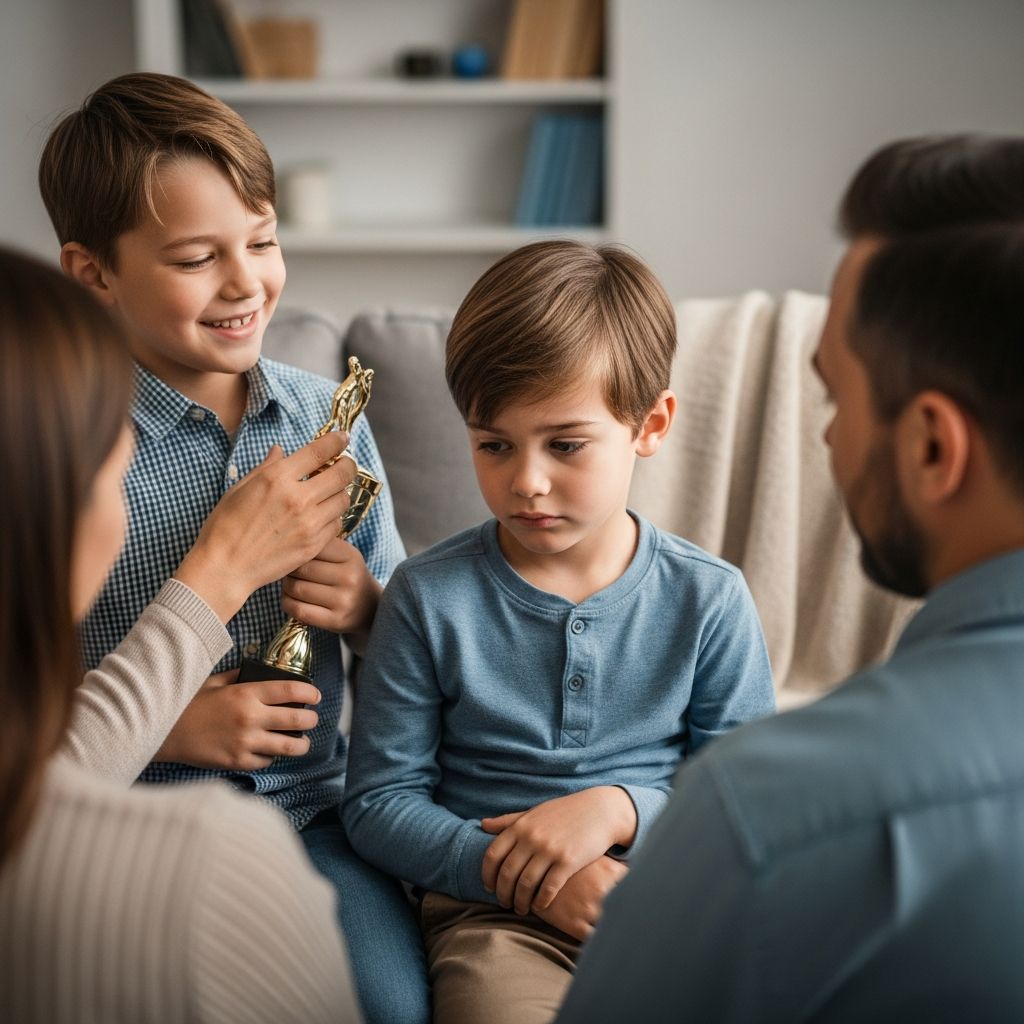
In many families, the second-born son quietly wonders if there is any space left for him after a strong, intense, or high-achieving firstborn has taken the spotlight. He may adore his older brother and still feel constantly compared, constantly behind, and constantly “less than.” This article offers a practical roadmap to understand what he is going through and how to respond in ways that strengthen both boys rather than pitting them against each other.
Why the Second Son’s Experience Is So Intense
The second-born son arrives in a world already shaped by his older brother’s personality, routines, and reputation. Parents are more experienced, often more confident, and sometimes more tired. Without meaning to, adults can slip into patterns that unintentionally send the message, “Your brother did it first, did it earlier, or did it better.”
- The older child is often treated as the trailblazer and benchmark.
- The younger child feels like his every milestone is being graded against someone else’s timeline.
- Family stories, photos, and habits may focus heavily on “the first time we…” which usually centers on the oldest.
Over time, this can cause the second son to see himself primarily in relation to his brother, instead of as a person with his own path and pace.
Common Feelings of an Overshadowed Second Son
Every child is different, but second sons in the shadow of a powerful older brother often share similar emotional themes. Recognizing these early is the first step to shifting the family dynamic.
- Invisible: He may feel that his successes are “no big deal” because they are not new to the family.
- Behind or “less than”: He may assume he is not smart, strong, or capable because his brother can already do more.
- Pressured: He can sense unspoken expectations to keep up, even when no one is saying it directly.
- Conflicted love: He might genuinely admire his big brother yet secretly resent how often he is compared to him.
Left unaddressed, these feelings can harden into a lasting identity: “I’m the difficult one,” “I’m the lazy one,” or “I’m the one who never measures up.”
How These Feelings Show Up in Behavior
Because children express emotional pain through behavior, a second son who feels overshadowed is unlikely to calmly say, “I feel unseen.” Instead, parents often see confusing or frustrating patterns.
- Acting out: Tantrums, defiance, or rude language may be attempts to get noticed when positive behavior seems ignored.
- Clowning and silliness: He may use humor, goofiness, or constant noise to claim some emotional space.
- Giving up quickly: If he believes he can never match his brother, he may stop trying at school, sports, or chores.
- Overly competitive or aggressive: He may fight, brag, or cheat to feel equal or superior, even briefly.
- People-pleasing: Some children become overly helpful and compliant, hoping perfect behavior will earn them attention.
When parents respond only to the surface behavior, they may accidentally reinforce the very roles they want to avoid: the older one as “responsible” and the second one as “trouble.” The key is to look underneath behavior for the unmet need to feel valued.
Subtle Parenting Habits That Feed the Problem
Most parents want to be fair, but everyday habits can quietly widen the gap between siblings. Paying attention to these patterns can radically shift the tone at home.
| Unhelpful Habit | Impact on Second Son | Healthier Alternative |
|---|---|---|
| Comparing skills or behavior (“Your brother never did this.”) | Feels judged by brother’s standard; shame and resentment build. | Describe expectations without naming siblings (“In this family, we speak respectfully.”) |
| Praising the oldest in front of the younger | Hears praise as proof that he is “less.” | Rotate praise; highlight different strengths at different times. |
| Letting the older child “speak for” the younger | Loses opportunities to voice his own thoughts and preferences. | Ask each child directly, even if the older rushes to answer. |
| Assigning permanent labels (“the sporty one,” “the smart one”) | Feels locked out of whole parts of identity. | Use flexible language (“Right now, you really love reading,” etc.). |
Seeing Each Child as an Individual, Not a Role
The first major shift is internal: moving from seeing brothers as a matched set to seeing each of them as a whole, separate human being. That sounds obvious, but in daily life, it can mean big changes.
- Notice when you think in comparisons: “He’s more sensitive,” “He’s less motivated.” Try to drop the “more/less” lens.
- Identify at least three strengths for each child that do not involve outperforming anyone else.
- Speak these strengths aloud regularly, especially in calm, connected moments.
When a second son hears accurate, non-comparative appreciation, he starts to build a sense of self that is not a reaction to his brother, but a reflection of who he truly is.
One-on-One Time: The Second Son’s Lifeline
Nothing tells a child “You matter” more clearly than time alone with a calm, emotionally present parent. For a second-born who feels overshadowed, this matters even more.
Practical ideas for one-on-one time include:
- Predictable “just us” windows: Ten to fifteen minutes daily or several times a week, scheduled like any other important appointment.
- Child-led activities: Let him choose simple activities—drawing, building, talking, kicking a ball—without correcting, teaching, or multitasking.
- Special rituals: A regular walk, a bedtime chat, or a Saturday breakfast can become a safe space for him to share worries.
During this time, aim less to fix problems and more to listen deeply. When he feels truly heard in these moments, his need to shout through misbehavior often decreases.
Language Shifts That Transform the Atmosphere
Words deeply shape how children see themselves. Small changes in language can make the second son feel more seen and less measured against his brother.
Drop Comparisons, Name Experiences
- Replace “Your brother had no trouble with this” with “This is feeling hard for you today; let’s slow it down together.”
- Change “Why can’t you be more like…” to “Help me understand what’s getting in the way for you right now.”
- When both children are involved in conflict, avoid “Who started it?” and focus on “What do each of you need to feel better and make things right?”
These small shifts teach your second son that he is allowed to struggle, that difficulty is not a character flaw, and that you are on his team, even when his brother appears more competent or composed.
Describe Effort and Character, Not Rankings
Instead of praising one child for being “the best” or “the most,” comment on qualities that both children can access.
- “You kept trying, even when that puzzle was frustrating.”
- “You noticed your brother was sad and brought him a toy. That was thoughtful.”
- “You took a deep breath and tried a calmer way to talk.”
When the focus is on inner qualities, your second son is less likely to believe his worth is something that can be lost when his brother excels.
Creating Fair, Not Equal, Routines
Children often protest about fairness, especially when they perceive that a sibling receives more privileges. Fairness, however, does not mean treating both boys exactly the same; it means meeting each child’s needs as they are right now.
- Explain that older children sometimes have extra responsibilities and freedoms that fit their age, and younger children will grow into them.
- Give the second son age-appropriate opportunities to contribute meaningfully, not just “help” his older brother.
- Let each child have some personal belongings and spaces that are not automatically shared or compared.
When the second son sees that his needs are actively considered, he is more likely to trust that he is not, in fact, second in your heart.
Handling Sibling Rivalry Without Taking Sides
Rivalry between brothers is normal, but when one child already feels overshadowed, routine conflicts can feel like proof of his lower status. It is crucial to respond in ways that reduce, rather than reinforce, that narrative.
Stay Neutral and Name Feelings
- Resist the urge to instantly defend the older child because he seems more logical or verbal.
- Equally, resist automatically siding with the younger because you feel guilty about past patterns.
- Say what you observe: “I see two frustrated brothers who both want the same thing.” Then move into problem-solving.
This stance teaches both children that your love is not a prize for winning an argument.
Teach Repair, Not Blame
Instead of fixating on who was wrong, emphasize how they can make things right.
- Encourage each child to say, “I felt… when you…” and to listen to the other’s sentence.
- Guide them in finding concrete repair steps: returning a toy, giving space, offering a do-over.
- Model apologies yourself when you lose your temper or misjudge a situation.
When conflict becomes a place to practice empathy and repair, the second son doesn’t have to fight as hard to prove he matters.
Protecting the Second Son’s Sense of Competence
A second son who regularly sees his older brother reading faster, running faster, or understanding rules sooner may conclude, “I’m just not capable.” Protecting his sense of competence means deliberately stacking his days with realistic wins and genuine mastery.
- Offer tasks and challenges that match his current abilities, not his brother’s previous or current level.
- Give him chances to be the “expert” in small ways—teaching a younger cousin a game, choosing the recipe, or showing you how a new toy works.
- Limit how often you ask the older child to “help” or “show” the younger; balance this with moments where the younger leads.
Over time, these experiences quietly rewrite his internal story from “I can’t” to “I’m still learning, and I’m good at some things already.”
Caring for the Oldest While Supporting the Second
Supporting the second son does not mean neglecting the oldest. In fact, when the firstborn feels secure and seen, he is less likely to dominate or compete relentlessly for attention.
- Provide the oldest with his own individual time and appreciation for who he is, aside from achievements.
- Acknowledge that being the “big one” is hard too; he may feel pressure to always perform or care for his younger sibling.
- Gently challenge any bossy or dismissive behavior toward the younger one, while also validating how hard it can be to share parents and space.
When both children feel fully valued, competition for your love softens, and the second son feels less need to define himself only in contrast to his brother.
Simple Daily Practices That Change the Story
Grand gestures are not necessary to help an overshadowed second son. Consistency in small, concrete practices is far more powerful.
- Daily check-in: Ask each child, separately if possible, “What was one good thing and one hard thing about today?” and really listen.
- Spotlight rotation: At dinner or bedtime, invite each child to share something they are proud of that day. Rotate who goes first.
- Non-performance affection: Offer hugs, kind words, and warm attention not only after good behavior or success, but simply because your child exists.
- Family language reset: Notice and gently steer relatives or friends away from comparison talk when they visit.
These routines send a steady, predictable message: “You are loved here for who you are today, not for how you stack up against anyone else.”
Frequently Asked Questions
Is it normal for my second son to say he hates his older brother?
Strong statements like “I hate him” usually mask deep hurt, jealousy, or fear of being less important. Rather than scolding the words alone, try to explore what is underneath by acknowledging his feelings (“You’re really upset with him right now”) and offering space to talk about specific situations. Over time, guiding both boys through conflict and repair helps those extreme statements soften.
What if my older child truly is easier and more compliant?
Children have different temperaments, so it is common for one to feel easier to parent. The goal is not to pretend they are the same, but to avoid turning those differences into fixed value judgments. You can privately acknowledge that one child is more laid-back while still making sure your more intense child hears plenty of messages about his strengths, creativity, passion, and persistence.
How do I avoid comparisons when teachers or relatives constantly make them?
You cannot control every outside comment, but you can control the climate at home. When someone compares your children, respond with neutral, redirecting phrases like, “They’re really different people, and we love seeing who each one is becoming.” Later, if your second son heard the comment, you can gently reaffirm his unique qualities in private.
Should I separate my sons in activities to reduce rivalry?
Sometimes having separate spaces—different teams, clubs, or classes—gives each child room to shine. The decision depends on your children’s personalities and stress levels. If every shared activity becomes a comparison contest, offering at least one or two separate arenas can be very helpful, as long as you continue to nurture their bond in other parts of life.
How long does it take for a second son to feel less overshadowed?
There is no fixed timeline, but most children respond noticeably when parents consistently shift language, increase one-on-one time, and reduce comparisons. Expect some back-and-forth: old patterns may reappear during stressful times. Staying patient, staying curious, and repairing quickly when you slip will gradually build a more secure, confident sense of self in your second son.
Closing Thoughts
When a second son feels overshadowed by his older brother, the pain is real—but so is the opportunity. With intentional attention, thoughtful language, and small daily changes, parents can help both children grow up feeling valued, respected, and deeply known. Your second son does not need to become a copy of his brother or a permanent “opposite” to him; he needs room to become fully himself, under the steady light of your unconditional love.