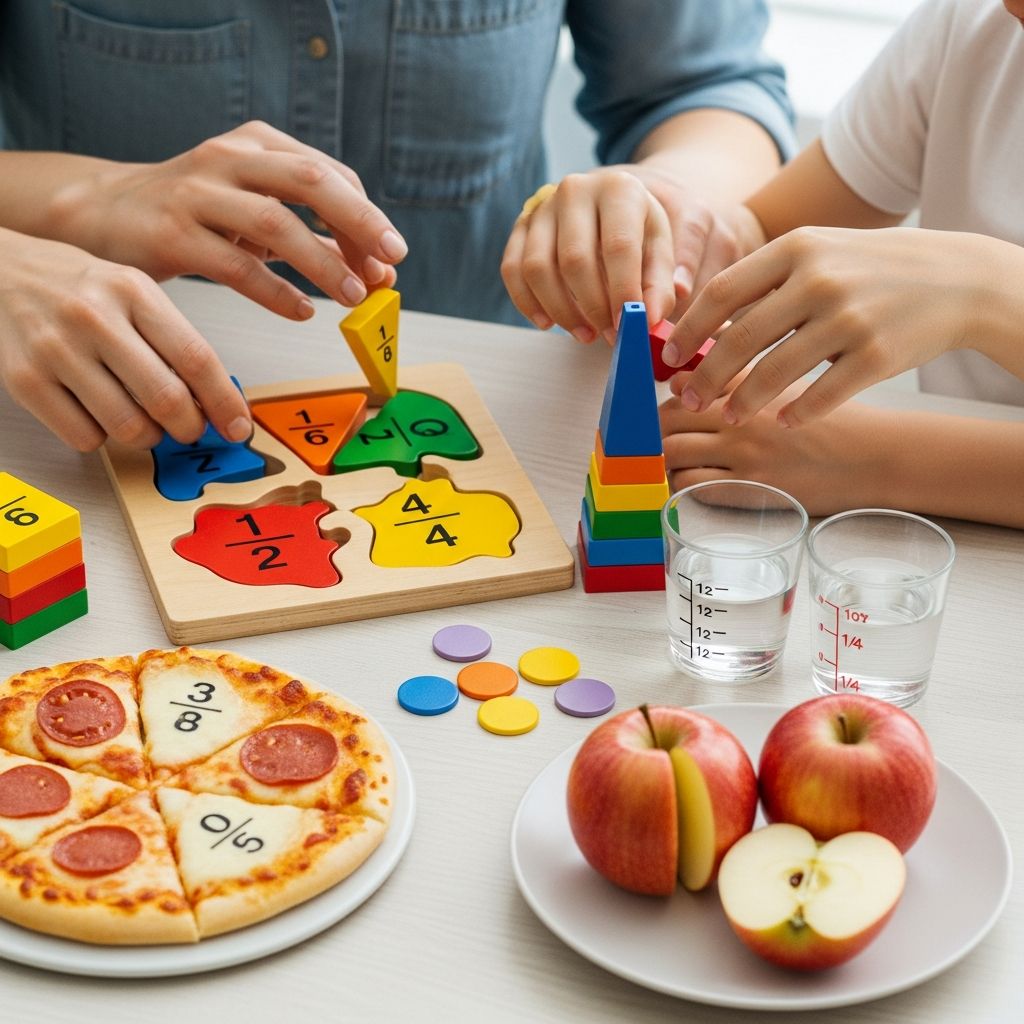
Fractions can feel abstract and intimidating for many children, but when kids can see, touch, and move fraction pieces, understanding suddenly becomes much easier. This guide walks through hands-on fraction activities, manipulatives, and visual strategies you can use at home or in the classroom to build strong, lasting fraction sense.
Why Hands-On Fractions Matter
Fractions are more than numbers on a page; they describe parts of a whole, relationships, and ratios. When children only see fractions as written symbols like 1/2 or 3/4, many struggle to connect those symbols to real quantities. Tactile, visual activities bridge that gap by letting kids build and compare fractions physically.
Hands-on activities also slow thinking down in a productive way. Instead of memorizing a rule, students can explore questions like, “How many fourths make a half?” or “Which is bigger, one-third or one-fourth?” with real objects. This exploration leads to deeper conceptual understanding and better long-term retention.
Key Concepts to Emphasize When Teaching Fractions
Before planning specific activities, it helps to be clear about the main fraction ideas you want children to grasp. You can revisit these ideas across many different games and manipulatives.
- Fraction as part of a whole: A fraction shows how many equal parts are taken out of a whole that has been divided into equal parts.
- Equal-sized parts: The pieces must be the same size for the fraction to be valid; kids should be able to explain why unequal pieces are not fair shares.
- Numerator and denominator roles: The denominator tells how many equal parts the whole is cut into, and the numerator tells how many of those parts are being used.
- Equivalent fractions: Different-looking fractions can represent the same amount, such as 1/2 and 2/4, and these relationships can be shown with physical models.
- Comparing fractions: Children need to reason about which fractions are larger or smaller, using benchmarks such as 0, 1/2, and 1.
Everyday Materials as Fraction Manipulatives
You do not need specialized math kits to teach fractions effectively. Many common items around the classroom or home can become powerful tools for exploring fractional parts.
- Paper strips or sentence strips: Fold and cut into halves, thirds, fourths, and more. Label the pieces with their fraction names.
- Paper plates or construction paper circles: Turn them into fraction pizzas by drawing and cutting equal slices.
- Plastic building bricks: Use stacks of identical bricks to show how shorter stacks are fractional parts of a taller stack.
- Playdough or clay: Roll into equal logs or flatten into circles and divide into equal pieces to represent different fractions.
- Rulers or strips of tape: Mark off equal segments on a length model to represent fractions on a number line.
Using familiar objects lowers anxiety and invites curiosity. Children can manipulate, reshape, and reassemble these materials to test ideas and see how fractions behave.
Classic Hands-On Fraction Activities
The following activities can be adapted to many age levels by adjusting the complexity of the fractions used and the questions you ask. They work well in small groups, centers, or one-on-one tutoring sessions.
Activity 1: Fraction Pizza Party
This simple visual activity introduces the idea of equal parts and fraction names using a circle as the whole.
- Give each child a paper plate or circle cut from cardstock.
- Ask students to fold and cut the circle into equal slices: halves, then fourths, then eighths.
- Have them label each slice with its fraction (for example, 1/4) and color different sets of slices to show equivalent fractions, such as 2/4 being the same amount of pizza as 1/2.
- Pose questions like, “If you eat 3/8 of the pizza, how much is left?” to reinforce subtraction with fractions using the slices.
Activity 2: Fraction Strip Lab
Fraction strips make it easy to compare different fractions side by side and discover equivalence and ordering.
- Provide long strips of paper in multiple colors, all the same length.
- Have children fold one strip into 2 equal parts, another into 3 equal parts, and so on, labeling each piece.
- Ask students to line up strips with the same endpoints to see which fractions are larger and which are equivalent.
- Guide them to statements such as, “Two 1/4 strips are the same length as one 1/2 strip” to build understanding of equivalent fractions.
Activity 3: Fraction Towers With Building Blocks
Stacking identical blocks allows learners to model fractions as parts of a whole length or height.
- Ask students to build a tower using a fixed number of identical blocks, for example 8 blocks.
- Have them break the tower into smaller towers, such as 2-block towers or 4-block towers, and describe each smaller tower as a fraction of the full tower.
- Discuss how many of the smaller towers are needed to rebuild the whole and what that says about denominators and numerators.
- Extend the activity by comparing towers representing different fractions of the same whole tower.
Visual Models: Area, Set, and Number Line
Hands-on fraction instruction works best when children encounter several models of fractions. Area models, set models, and number line models each highlight different ideas and help avoid common misconceptions.
Area Models
Area models show fractions as parts of a shape, such as rectangles, circles, or irregular regions. Children see how equal areas represent equal parts of the whole even if the shapes look different.
- Use rectangles divided into equal squares to demonstrate fractions like 3/5 or 4/10.
- Color different portions and have students identify the fraction of the shape that is shaded and unshaded.
Set Models
Set models show fractions as parts of a collection of objects instead of parts of a single shape. This helps children connect fractions to counting and grouping.
- Give students small counters or buttons and ask them to show, for example, 1/4 of a set of 12 counters.
- Discuss how many counters represent the whole set, how many represent the fraction, and what happens if the size of the set changes.
Number Line Models
Number lines place fractions in order along a continuous line from 0 to 1 and beyond. This visual emphasizes that fractions are numbers with a specific location, not just pieces to be eaten or shared.
- Draw a line from 0 to 1, mark equal intervals, and label them with fractions such as 1/4, 1/2, and 3/4.
- Use sticky notes or clothespins labeled with fractions that students can physically move along a string number line.
Using Real-Life Contexts to Teach Fractions
Fractions show up in daily life all the time. By connecting fraction lessons to cooking, shopping, sports, and sharing, children see that fractions matter outside the worksheet.
- Cooking and baking: Measuring cups and spoons are perfect examples of halves, thirds, and fourths. Kids can double or halve recipes to practice fraction multiplication and division in a meaningful context.
- Money: Coins help students see that 25 cents is 1/4 of a dollar and 50 cents is 1/2, reinforcing equivalent fractions and benchmark fractions.
- Sharing snacks: Sharing apples, granola bars, or sandwiches equally among friends invites natural questions about fair shares and dividing into equal parts.
- Sports and games: Scoreboards and statistics (for example, a player making 3 out of 4 shots) introduce fractions as part-whole relationships in data.
Simple Table of Common Fraction Benchmarks
The following table summarizes a few benchmark fractions, their common visual interpretations, and an everyday example. This can be used as a quick reference in your lesson or study area.
| Fraction | Visual Idea | Everyday Example |
|---|---|---|
| 1/2 | Half of a circle, rectangle, or collection | Half a pizza, half an hour |
| 1/3 | One of three equal pieces | Sharing a chocolate bar equally among three people |
| 1/4 | One of four equal parts | One quarter of a dollar, one slice when a sandwich is cut into four equal pieces |
| 3/4 | Three of four equal parts | Three quarters of a full cup of flour, three quarters of a lap around a track |
Games and Puzzles for Fraction Practice
Games keep fraction practice lively and low-pressure. Children get repeated exposure to key ideas without feeling like they are doing endless drills. Consider mixing these games into math centers or homework alternatives.
Fraction Matching Memory
Create a set of cards showing fractions in different forms: numerical (1/2), pictorial (half-shaded circle), and word form (“one half”). Place them face down for a memory game. Players turn over two cards per turn, trying to match equivalent fractions in any form. This reinforces the understanding that different representations can show the same quantity.
Fraction Number Line Race
Draw a large number line on a strip of paper or tape it on the floor. Give each student a fraction card and have them place a marker where they think that fraction belongs on the line. After everyone has placed their markers, discuss which placements are accurate and why, using benchmark fractions as reference points. This activity deepens sense of fraction order and magnitude.
Build the Whole Challenge
Provide children with a pile of fraction pieces, such as paper strips labeled 1/4, 1/3, and 1/6. Their goal is to build as many wholes as possible using combinations of these pieces. Encourage them to record equations that match their creations, such as 1/2 + 1/2 = 1 or 1/4 + 1/4 + 1/2 = 1, linking the manipulative work to written fraction addition.
Common Fraction Misconceptions and How Hands-On Activities Help
Many children develop misconceptions about fractions, especially if they move too quickly to procedures. Hands-on work with manipulatives can correct these misunderstandings before they become ingrained.
- Thinking a larger denominator means a larger piece: With fraction strips, children can see that 1/4 is larger than 1/8 even though 8 is greater than 4.
- Confusing the whole: Using differently sized wholes (such as pizza slices and mini pizzas) helps students understand that 1/2 of a large whole is more than 1/2 of a small whole.
- Ignoring the need for equal parts: Sharing pretend snacks unequally shows why only equal partitions can be described with standard fractions.
- Treating fractions as separate from numbers: Placing fractions on number lines and comparing them to whole numbers reinforces that fractions are numbers with real positions on a continuum.
Tips for Parents and Teachers
Hands-on fraction teaching works best when it is consistent, flexible, and responsive to student thinking. Rather than racing through every possible activity, choose a few strong ideas and return to them often with increasing depth.
- Encourage students to explain their thinking using both words and fraction symbols.
- Invite children to create their own fraction problems or games using household objects or classroom supplies.
- Use quick check-in questions such as, “Which is closer to 1: 2/3 or 3/4?” to keep fraction reasoning alive throughout the year.
- Normalize mistakes and revisions; hands-on work is about experimenting and adjusting ideas, not getting everything right on the first try.
Frequently Asked Questions About Teaching Fractions
At what age should children start learning about fractions?
Informal fraction ideas can begin as soon as children share snacks or notice halves and quarters in everyday life. More formal instruction with symbols like 1/2 and 1/3 typically begins in early elementary grades, but young learners benefit from hands-on experiences with equal sharing and partitioning long before they write fraction notation.
Do I need to buy special fraction manipulatives?
Commercial fraction tiles and circles are helpful but not required. Many powerful activities can be done using paper, crayons, scissors, building blocks, and kitchen measuring tools. The key is that the materials can be divided into equal parts and compared accurately.
How can I support a child who is afraid of fractions?
Start with concrete, low-pressure activities rather than worksheets. Focus on play, exploration, and visual models before introducing rules and procedures. Celebrate small insights, such as recognizing that 2/4 and 1/2 cover the same amount, to build confidence gradually.
How do hands-on activities connect to fraction algorithms?
Physical and visual models give meaning to procedures like adding fractions or finding a common denominator. After students combine fraction strips or pieces to make a whole, for example, you can show how the same process is recorded with symbols, slowly shifting from concrete to abstract.
How often should I use fraction games and manipulatives?
Short, regular exposure works better than one intense unit. Integrate fraction games, number lines, and hands-on tasks across the year so that students see fractions as a normal, recurring part of mathematics rather than a one-time hurdle.