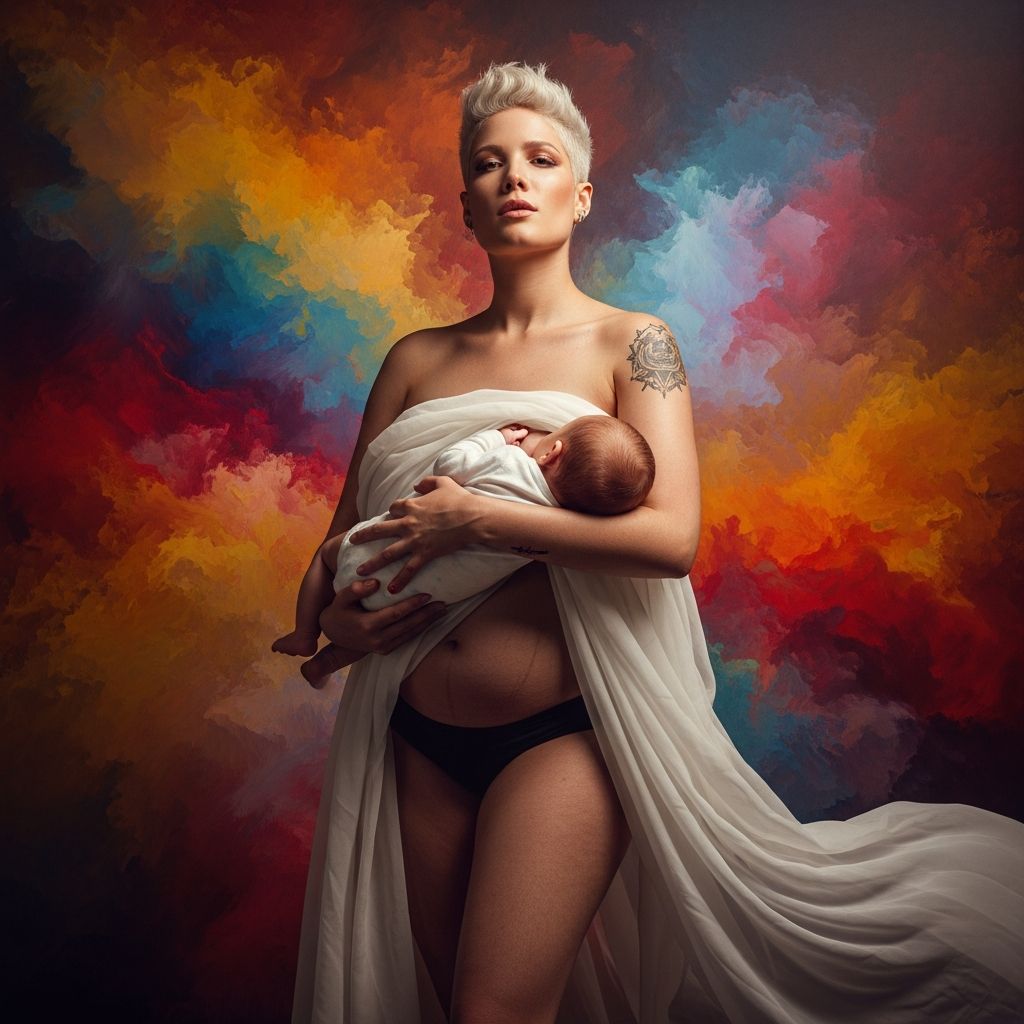
Halsey’s decision to feature a breastfeeding image on her album cover marks a powerful statement in both music and motherhood discussions. This artistic choice not only promotes her upcoming project but also confronts longstanding societal taboos surrounding women’s bodies during and after pregnancy.
The Artistic Vision Behind the Cover
The cover for Halsey’s album If I Can’t Have Love, I Want Power depicts the artist in a regal pose, topless and cradling her child, evoking imagery of ancient queens and modern matriarchs. Revealed dramatically at New York City’s Metropolitan Museum of Art, the artwork blends vulnerability with strength, positioning Halsey as both a nurturing mother and a commanding figure.
This visual narrative stems from Halsey’s personal journey into motherhood. Expecting her first child with partner Alev Aydin, she channeled the dualities of pregnancy—the profound joys intertwined with intense challenges—into a concept album. The cover serves as its visual manifesto, symbolizing the coexistence of sensuality and maternal instinct.
Challenging the Madonna-Whore Dichotomy
At the heart of Halsey’s message lies a critique of the Madonna-whore complex, a cultural trope that pits purity against sexuality. Halsey explicitly addresses this in her announcement, asserting that a woman’s body can embody both erotic appeal and life-giving capacity without conflict. This reclamation of autonomy counters years of public scrutiny over her physical form.
By presenting her postpartum body as throne-worthy, Halsey elevates it beyond objectification. She describes the image as a declaration of pride in her role as a ‘life force,’ transforming personal narrative into universal empowerment for other mothers navigating similar judgments.
Addressing Breastfeeding Stigma in Public Spaces
Breastfeeding remains a flashpoint in societal norms, often shrouded in discomfort or outright shame. Halsey’s cover thrusts this reality into the spotlight, advocating for normalization. She highlights the need to admire pregnant and postpartum forms openly, pushing back against veils of secrecy.
- Public breastfeeding faces legal protections in many areas, yet social backlash persists, leading to isolation for many women.
- Celebrity endorsements like Halsey’s amplify visibility, encouraging broader acceptance.
- Studies from health organizations underscore breastfeeding’s benefits, yet cultural hurdles impede its practice.
This bold move aligns with growing movements where influencers and artists use platforms to destigmatize natural bodily functions.
Cultural and Historical Parallels in Art
Halsey’s imagery echoes centuries of artistic tradition. From Renaissance paintings of Madonna lactans—depicting the Virgin Mary nursing—to contemporary photography, breastfeeding has symbolized divinity and humanity. By unveiling her portrait at The Met, Halsey bridges pop culture with classical reverence.
Modern parallels include photographers like Jessica Lange and campaigns by brands promoting inclusive motherhood visuals. These precedents frame Halsey’s work not as controversy, but as continuation of a dialogue on female corporeality.
Impact on Fans and the Music Industry
Revealed via social media, the cover ignited waves of support from fans praising its authenticity. Comments flooded in, sharing personal stories of postpartum body struggles, underscoring Halsey’s role in fostering community.
In the music world, produced by Nine Inch Nails’ Trent Reznor and Atticus Ross, the album promises sonic exploration of maternal themes. Set for August release, it positions Halsey as a vanguard, where personal milestones fuel artistic innovation rather than halt careers.
| Aspect | Traditional View | Halsey’s Challenge |
|---|---|---|
| Motherhood Imagery | Desexualized, hidden | Sexual and powerful |
| Breastfeeding | Private, stigmatized | Public, celebrated |
| Postpartum Body | Flawed, concealed | Beautiful, admired |
Broader Implications for Maternal Health Advocacy
Halsey’s platform extends beyond entertainment, influencing maternal health discourse. Postpartum depression affects up to 15% of mothers, exacerbated by body image pressures. Visual representations like this can alleviate shame, promoting mental well-being.
Health bodies emphasize skin-to-skin contact and breastfeeding for bonding and immunity, yet societal norms deter public practice. Halsey’s art contributes to shifting these dynamics, potentially increasing confidence among new parents.
Public Reactions: Support, Critique, and Debate
While many hailed the cover as revolutionary, others debated its provocative nature. Supporters view it as progress; critics question its accessibility for conservative audiences. This polarization mirrors ongoing tensions in body positivity movements.
- Positive: Empowerment for marginalized mothers.
- Critical: Potential over-sexualization of infancy.
- Neutral: Artistic freedom in personal expression.
Ultimately, the discourse amplifies visibility, regardless of stance.
The Role of Celebrities in Normalizing Motherhood
Halsey joins figures like Beyoncé and Adele in redefining celebrity postpartum narratives. Unlike airbrushed returns, these artists embrace raw transitions, humanizing fame. This trend pressures media toward authentic portrayals, benefiting everyday families.
Social media accelerates this, with #NormalizeBreastfeeding garnering millions of posts. Halsey’s contribution adds star power to grassroots efforts.
Future of Art and Activism Intersection
As Halsey’s album approaches, its cover foreshadows deeper explorations of power, love, and creation. Produced by award-winning collaborators, it blends industrial sounds with intimate lyrics, mirroring the cover’s intensity.
This fusion signals a future where artists leverage visuals for activism, challenging industries to evolve inclusively.
Frequently Asked Questions (FAQs)
What inspired Halsey’s album cover art?
Her pregnancy experiences, aiming to blend sexuality and motherhood while combating body stigmas.
Where was the cover revealed?
At The Metropolitan Museum of Art in New York City, via a cinematic video.
What is the album’s theme?
The joys and horrors of pregnancy and childbirth, conceptualized as a narrative journey.
Who produced the album?
Trent Reznor and Atticus Ross of Nine Inch Nails.
How does this address breastfeeding stigma?
By portraying it regally, promoting admiration over shame.
When is the album releasing?
August 27, as announced with the cover.
This article draws inspiration from Halsey’s cultural moment to explore motherhood’s evolving portrayal. (Word count: 1678)
References
- Halsey celebrates ‘pregnant and postpartum bodies’ with new album cover art — MyTalk 107.1. 2021-07-08. https://www.mytalk1071.com/halsey-celebrates-pregnant-and-postpartum-bodies-with-new-album-cover-art/
- Halsey Uses New Album Cover To Normalize ‘Bodies And Breastfeeding’ — Scary Mommy. 2021-07-08. https://www.scarymommy.com/halsey-new-album-cover-breastfeeding
- Breastfeeding and Feminism Introduction — National Library of Medicine, PMC. 2012-01-01. https://pmc.ncbi.nlm.nih.gov/articles/PMC3376809/
- Postpartum Depression: Action Towards Causes and Treatment — World Health Organization via NCBI. 2020-08-15. https://www.ncbi.nlm.nih.gov/pmc/articles/PMC7466458/
- Global Strategy for Infant and Young Child Feeding — World Health Organization. 2003-04-01. https://www.who.int/publications/i/item/9241562218