Every child is unique, but behind every smile, eye color, and health trait lies a shared biological language: genetics. Understanding the basics of DNA, genes, and inheritance can help parents make sense of family resemblances, medical risks, and even some surprising differences between siblings.
1. What Do We Mean by Genetics?
Genetics is the study of how traits and health conditions pass from one generation to the next through DNA and genes. In humans, this includes everything from blood type to how our bodies process certain nutrients or respond to medications.
Key points for parents:
- Genetics explains why children often resemble their parents or relatives.
- It also helps explain why some health conditions run in families.
- Genetic information is carried in every cell of your child’s body.
2. From Cells to Chromosomes: The Big Picture
To understand heredity, it helps to zoom in step by step from the whole body to its smallest information units.
2.1 Cells: The Body’s Building Blocks
The human body is made of trillions of cells, tiny structures that work together to keep your child alive and growing. Most cells contain the complete genetic blueprint for that person.
- Skin cells protect and sense the outside world.
- Blood cells carry oxygen and fight infection.
- Nerve cells transmit signals so we can move, think, and feel.
Inside many of these cells is a central compartment called the nucleus, which stores genetic material.
2.2 Chromosomes: Bundles of DNA
Within the nucleus, DNA is tightly packaged into structures called chromosomes. You can think of chromosomes as organized volumes in a library of instructions.
- Most human cells contain 46 chromosomes, arranged in 23 pairs.
- One chromosome of each pair comes from the biological mother and the other from the biological father.
- Chromosomes are numbered 1 through 22, plus a pair of sex chromosomes (XX or XY).
| Structure | What It Is | Role in Inheritance |
|---|---|---|
| Cell | Basic living unit of the body | Contains the full set of genetic instructions (in most cells) |
| Nucleus | Center of the cell where DNA is stored | Holds chromosomes that carry genes |
| Chromosome | Package of DNA and proteins | Organizes genes and is passed from parent to child |
3. DNA and Genes: The Instruction Manual
3.1 DNA: The Chemical Code
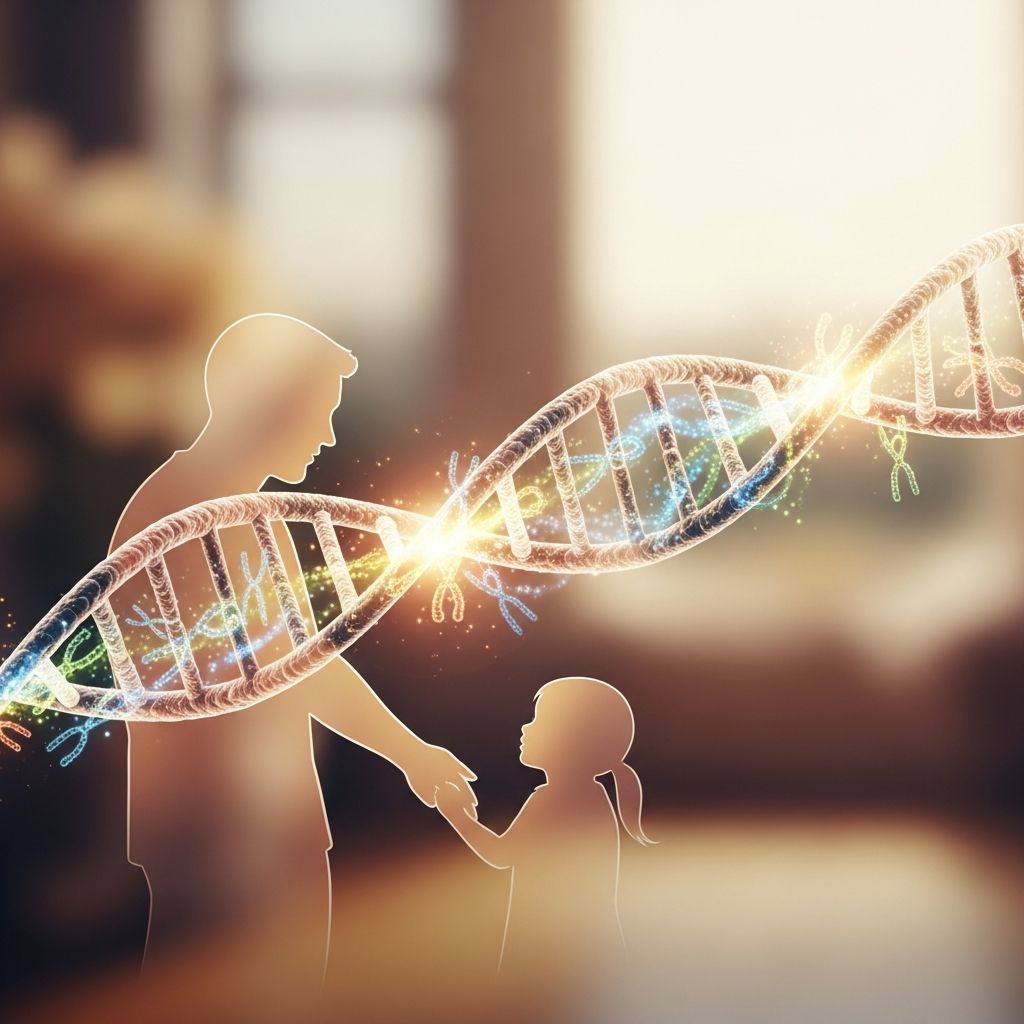
DNA (deoxyribonucleic acid) is the long molecule that carries genetic instructions. Its structure looks like a twisted ladder, often called a double helix.
- The “rungs” of the ladder are made from four chemical bases: A (adenine), T (thymine), C (cytosine), and G (guanine).
- Specific pairing rules apply: A pairs with T, and C pairs with G.
- The order of these letters—like a long sentence—stores the information needed to build and run the body.
3.2 Genes: Individual Sets of Instructions
A gene is a segment of DNA that provides instructions for making a specific protein or for regulating when certain proteins are made. Proteins perform most of the work in cells, such as building tissues and carrying chemical signals.
- Humans are estimated to have about 20,000–25,000 genes.
- Genes are arranged along chromosomes, like pages in a book.
- Each person has two copies of most genes—one inherited from each parent.
Although all people share the vast majority of their genes, small differences in DNA sequences can lead to variations in appearance, metabolism, and disease risk.
4. How Children Inherit Traits
When a baby is conceived, they receive a mix of genetic material from each biological parent. This process shapes everything from their blood type to their natural hair color.
4.1 Egg and Sperm: Half-Sets of Chromosomes
Most body cells have 46 chromosomes, but egg and sperm cells each carry just 23. When an egg and sperm join during fertilization, their chromosomes combine, restoring the total to 46.
- Each egg contains one copy of each chromosome (23 total).
- Each sperm contains one copy of each chromosome (23 total).
- The fertilized egg (zygote) receives a half-set from each parent and then divides and grows into a baby.
4.2 Sex Chromosomes and Biological Sex
Among the 23 pairs of chromosomes, one pair determines biological sex at birth.
- Egg cells almost always carry an X chromosome.
- Sperm cells carry either an X or a Y chromosome.
- XX typically leads to a female biological sex, while XY typically leads to a male biological sex, due largely to genes on the Y chromosome that direct the development of male reproductive organs.
While this XY system explains the basic biology, it is important to note that variations in sex chromosomes and development can result in intersex traits. Those more complex topics are often explored with a specialist.
4.3 Why Siblings Can Be So Different
Even though siblings share the same parents, they are usually not genetically identical (except for identical twins). During the formation of egg and sperm cells, chromosomes are shuffled and recombined, creating new combinations of genes in each reproductive cell.
This genetic mix means:
- One child might inherit more of one parent’s features, while another resembles the other parent.
- Different combinations of genes can influence personality, abilities, and health risks.
- Some traits may skip a generation and show up in grandchildren.
5. Variants, Dominant and Recessive Patterns
5.1 Gene Variants and Alleles
Most genes come in slightly different versions called variants or alleles. These variants are normal differences that contribute to human diversity.
- About 99.9% of DNA is the same from person to person; the remaining fraction accounts for most genetic differences.
- Some variants affect visible traits (like eye color), while others affect how the body works internally (like how medicines are processed).
- Some variants are neutral, some are helpful, and some can increase disease risk.
5.2 Dominant and Recessive Inheritance (Simple Overview)
For many conditions, the interaction between two copies of a gene follows patterns often described as dominant or recessive.
- Dominant: One changed (altered) gene copy can be enough to cause a trait or condition.
- Recessive: Usually, both copies of a gene must be changed for the condition to appear.
In reality, many traits (like height or body weight) are influenced by many genes and environmental factors, not just a single dominant or recessive gene.
6. Genetics and Your Child’s Health
Understanding genetics can help parents be proactive about health. Some conditions are purely genetic, while others arise from a mix of genes and lifestyle or environmental factors.
6.1 Types of Genetic Conditions
Health issues related to genes can appear in different ways:
- Single-gene conditions: Caused mainly by changes in a specific gene; often follow dominant or recessive patterns.
- Chromosomal conditions: Caused by extra, missing, or rearranged chromosomes (for example, having an extra copy of a chromosome).
- Multifactorial conditions: Involve many genes combined with lifestyle or environmental factors (for example, some heart diseases or diabetes).
6.2 When Family History Matters
It can be useful to share family medical history with your child’s healthcare provider. Patterns that may warrant extra attention include:
- Several relatives with the same or related serious conditions (such as certain cancers or heart disease).
- Conditions that appear at an unusually young age.
- Known inherited disorders within the family.
- Multiple pregnancy losses or infants with severe health problems.
Not every pattern means there is a genetic problem, but it can help guide screening and prevention strategies.
6.3 Environment Still Matters
Genetics is not destiny. A child’s health is shaped by both genes and environment, including:
- Nutrition and physical activity
- Exposure to toxins or infections
- Access to healthcare and vaccinations
- Stress, sleep, and overall lifestyle
Healthy habits can sometimes reduce or delay the impact of genetic risks, especially for conditions like heart disease or type 2 diabetes.
7. Genetic Testing and Counseling
Many parents hear about genetic testing during pregnancy, newborn screening, or when a child has unexplained health issues. Understanding what these tests can and cannot do is important.
7.1 What Genetic Tests Can Show
Genetic tests analyze DNA, chromosomes, or specific genes. Depending on the test, they may:
- Confirm or rule out a suspected genetic condition in a child.
- Identify carrier status for certain recessive disorders.
- Estimate the chance of developing some conditions later in life.
- Help doctors choose medications or doses based on how a child’s body processes drugs (pharmacogenetics).
No test can predict a child’s entire future, personality, or life outcomes. Results often need careful interpretation.
7.2 The Role of Genetic Counselors
Genetic counselors are trained professionals who help families understand genetic information and make informed choices.
- They explain what a test can reveal and its limitations.
- They review family history and discuss chances of passing on certain conditions.
- They support families in making decisions that fit their values and circumstances.
8. Talking About Genetics With Children
As children grow, they may ask why they look like their parents or why someone in the family has a particular illness. Simple, age-appropriate explanations can help them feel informed rather than afraid.
Tips for parents:
- Use everyday comparisons, like recipes or building instructions, to explain DNA and genes.
- Emphasize that differences between people are normal and valuable.
- If a child has a genetic condition, reassure them that it is not their fault and that many people live full lives with medical conditions.
- Ask healthcare professionals or genetic counselors for kid-friendly educational materials when needed.
9. Frequently Asked Questions (FAQs)
Q1: Do genes decide everything about my child?
Genes influence many traits, but they do not act alone. Environment, upbringing, nutrition, physical activity, and chance events all interact with genetic information. For many common conditions, genes create a tendency or risk, not a fixed outcome.
Q2: Can my child change their genes by eating better or exercising?
Healthy habits do not change the DNA sequence itself, but they can strongly affect how genes are expressed and how likely certain health problems are to develop. Good nutrition, sleep, and physical activity can help children make the most of their genetic potential.
Q3: If a condition runs in my family, will my child definitely have it?
Not necessarily. Inheritance patterns vary widely. Some conditions have a high chance of being passed on if a parent is affected, while others are influenced by many genes plus lifestyle factors. A healthcare provider or genetic counselor can help estimate your child’s specific risk.
Q4: Should every child have genetic testing?
Most children already receive certain newborn screening tests required by public health programs, which check for serious but treatable conditions. Beyond that, genetic testing is usually recommended only when there is a specific medical reason, such as symptoms suggesting a genetic disorder or a strong family history.
Q5: What if genetic test results are uncertain?
Sometimes tests find a variant whose impact on health is not yet known. These are called variants of uncertain significance. In these situations, doctors may suggest monitoring health over time and waiting for more scientific information. Genetic counselors can help families understand and cope with uncertainty.
References
- Understanding Genetics — National Academies of Sciences, Engineering, and Medicine / NCBI Bookshelf. 2007-01-01. https://www.ncbi.nlm.nih.gov/books/NBK115568/
- Basics of Human Genetics — AMBOSS Medical Knowledge. 2023-05-01. https://www.amboss.com/us/knowledge/basics-of-human-genetics/
- Genes and Genetics Explained — Better Health Channel, State Government of Victoria. 2022-08-01. https://www.betterhealth.vic.gov.au/health/conditionsandtreatments/genes-and-genetics
- Understanding the Basics of Genetics — GeneHome, Invitae. 2023-04-01. https://www.thegenehome.com/basics-of-genetics
- Human Genetics — Encyclopaedia Britannica. 2021-06-01. https://www.britannica.com/science/human-genetics
- Basic Genetics — University of Utah, Learn.Genetics. 2020-01-01. https://learn.genetics.utah.edu/content/basics/
- Help Me Understand Genetics — MedlinePlus, U.S. National Library of Medicine. 2024-03-01. https://medlineplus.gov/genetics/understanding/